March 2025 Core Update in Hindsight
The March 2025 core update ran 13 to 27 March, 14 days. What Google said about surfacing creator content, and what the update looks like in hindsight.

The March 2025 core update rolled out from 13 March 2025 to 27 March 2025, taking 14 days. It was the first core update of 2025 and the first of only four algorithm updates Google confirmed that year. Google used its standard description — “a regular update designed to better surface relevant, satisfying content for searchers from all types of sites” — but attached one additional sentence it has not repeated since: that Google would “continue our work to surface more content from creators through a series of improvements throughout this year”, some already shipped and others still to come.
Eighteen months later, that creator sentence is the most interesting thing about the update, and also the least conclusive. Google never named the improvements, never published documentation for them, and never referred back to the commitment in a subsequent update announcement. What the industry has is one sentence and no follow-up.
What did Google say when it launched the March 2025 core update?
Google announced the update on its Search Status Dashboard on 13 March 2025 and published a short statement. The core of it was the familiar formula about surfacing relevant, satisfying content from all types of sites — the same wording Google used for the June 2025, December 2025, March 2026 and May 2026 core updates.
The addition was the creator line. Read carefully, it says three things: that Google had been working on surfacing more content from creators, that some of that work had already shipped before March 2025, and that more would arrive later in the year. It does not say the March 2025 core update was that work, and it does not define what counts as a creator.
That is a meaningful distinction, because a great deal of commentary at the time treated the sentence as a description of the update itself. It was published alongside the update, not as an explanation of it. The honest position is that Google flagged a direction of travel and never quantified it.
How long did the March 2025 core update take?
Fourteen days, comfortably inside Google’s usual “up to two weeks” estimate. Placed in the longer record, it sits at the short end of the 2025 rollouts and the long end of the 2026 ones.
| Core update | Started | Completed | Days |
|---|---|---|---|
| March 2024 | 5 Mar 2024 | 19 Apr 2024 | ~45 |
| December 2024 | 12 Dec 2024 | 18 Dec 2024 | ~6 |
| March 2025 | 13 Mar 2025 | 27 Mar 2025 | 14 |
| June 2025 | 30 Jun 2025 | 17 Jul 2025 | ~17 |
| December 2025 | 11 Dec 2025 | 29 Dec 2025 | 18 |
| March 2026 | 27 Mar 2026 | 8 Apr 2026 | 12 |
The spread is the point. A rollout can finish in under a week or run for six, and both windows carry the same official description and the same absence of explanation. Planning around an expected duration is therefore unwise: the only date you can rely on is the completion notice on Google’s dashboard. Core update rollouts have run from about six days to about 45. Google has never explained why, and no external party can tell you what a 14-day rollout signifies relative to a 45-day one. The full rollout duration series lays out every confirmed core update since 2024.
How much did rankings actually move?
Data providers reported that volatility during the March 2025 core update was broadly similar to the core update that preceded it. It was not characterised as an outlier in either direction.
That is worth stating plainly because “similar to previous updates” is a genuinely useful finding that rarely gets reported as one. A core update that produces typical volatility is the normal case. Sites that lost heavily during a typical core update lost for site-specific reasons, not because the update was unusually severe.
It also means the March 2025 core update is a poor candidate for the kind of retrospective narrative that gets attached to updates — “the update that killed affiliate sites”, “the AI content update”. Google named no target, published no new policy, and the measured movement was ordinary. Anyone offering a thematic explanation is describing their own client sample, not the update.
What did the March 2025 core update teach that still applies?
Three things, all of which held through the four core updates that followed it.
- Google’s core update language is a template, not a description. The same sentence has now been used for five consecutive core updates. Parsing it for signal is wasted effort — the useful information is in the dates and in your own data.
- An announced direction is not a ranking system. The creator content line was a statement of intent with no documentation behind it. Treating an unquantified commitment as a named signal to optimise against is how SEO myths start. The same care applies to the difference between confirmed and unconfirmed updates.
- Recovery does not arrive between core updates. Sites hit in March 2025 that made substantive improvements would, on Google’s own model, expect movement at the June 2025 or December 2025 core update rather than in April. When recovery actually arrives covers the timing question properly.
Where does March 2025 sit in the wider record?
It opened a year in which Google confirmed unusually little. Four updates in total: the March core update, the June 2025 core update from 30 June to 17 July, the August 2025 spam update from 26 August to 22 September, and the December 2025 core update from 11 to 29 December. That is down from seven confirmed updates in 2024.
Google has since said it releases smaller core updates that it does not announce and only confirms the larger, broader ones. So the low 2025 count is a statement about Google’s communications, not about how much changed. The full 2025 timeline includes the unconfirmed changes that moved more data than some of the confirmed ones — most notably the September withdrawal of the &num=100 parameter, which stripped rank-tracker impressions out of Search Console for nearly every site.
How does March 2025 compare with March 2026?
The two March core updates are worth putting side by side, because they show how little Google’s public behaviour has changed and how much its rollout mechanics have.
| March 2025 core update | March 2026 core update | |
|---|---|---|
| Window | 13-27 March 2025 | 27 March – 8 April 2026 |
| Duration | 14 days | 12 days, 4 hours |
| Google’s wording | Standard “regular update” formula | Identical formula |
| New guidance | One creator content sentence | None at launch or completion |
| Context | First confirmed update of 2025 | Third confirmed update in about five weeks |
The March 2026 core update arrived after a February Discover core update and a March spam update, three confirmed changes inside roughly five weeks — a very different cadence from 2025, which had a single confirmed update between January and June. It also completed faster than any 2025 core update.
What did not change is the informational content of Google’s announcements. Five consecutive core updates, one sentence, no named systems. If you were waiting for Google to explain a core update in enough detail to act on, the March 2025 to March 2026 stretch is the evidence that the wait is not worth extending.
What should you do if you dropped in March 2025 and never recovered?
A drop that started in mid-March 2025 and never came back has now survived four subsequent core updates. That is information in itself: whatever the gap is, incremental changes have not closed it.
- Verify the dates before anything else. A decline beginning before 13 March 2025 is not this update. Compare equal-length windows that both sit fully outside 13-27 March.
- Check Search Console for a manual action. Security and Manual Actions. If it is empty you do not have one, and no reconsideration request applies.
- Find the pattern, not the total. Segment by URL, template, query cluster, device and country. Core update losses are almost always patterned, and the pattern is the diagnosis. The traffic-drop checklist sets out the sequence.
- Audit for anonymity. If the losing pages carry no byline, no stated methodology and no verifiable expertise, that is a concrete gap against Google’s own who-how-why self-assessment questions. Why anonymous content struggles and what E-E-A-T actually asks for cover the fix.
- Compare against what gained, honestly. Pull the pages that now outrank yours and ask what they contain that yours does not. If the answer is “nothing, they are just bigger”, look again — usually there is first-hand experience, original data, or specificity you have not matched.
- Plan around the next core update. Google states there are no specific actions guaranteeing recovery and that the largest changes tend to arrive with a subsequent core update. The 30-day recovery plan is built around that constraint rather than against it.
The most durable lesson from the March 2025 core update is a negative one. Google named nothing, promised something vague about creators, and never returned to it. Five core updates later, the sites that recovered are the ones that improved on grounds Google has documented for years — evidence, expertise, specificity, and a reason for the page to exist — rather than the ones that tried to reverse-engineer a single sentence. What a core update actually is explains why that is the only reliable route.
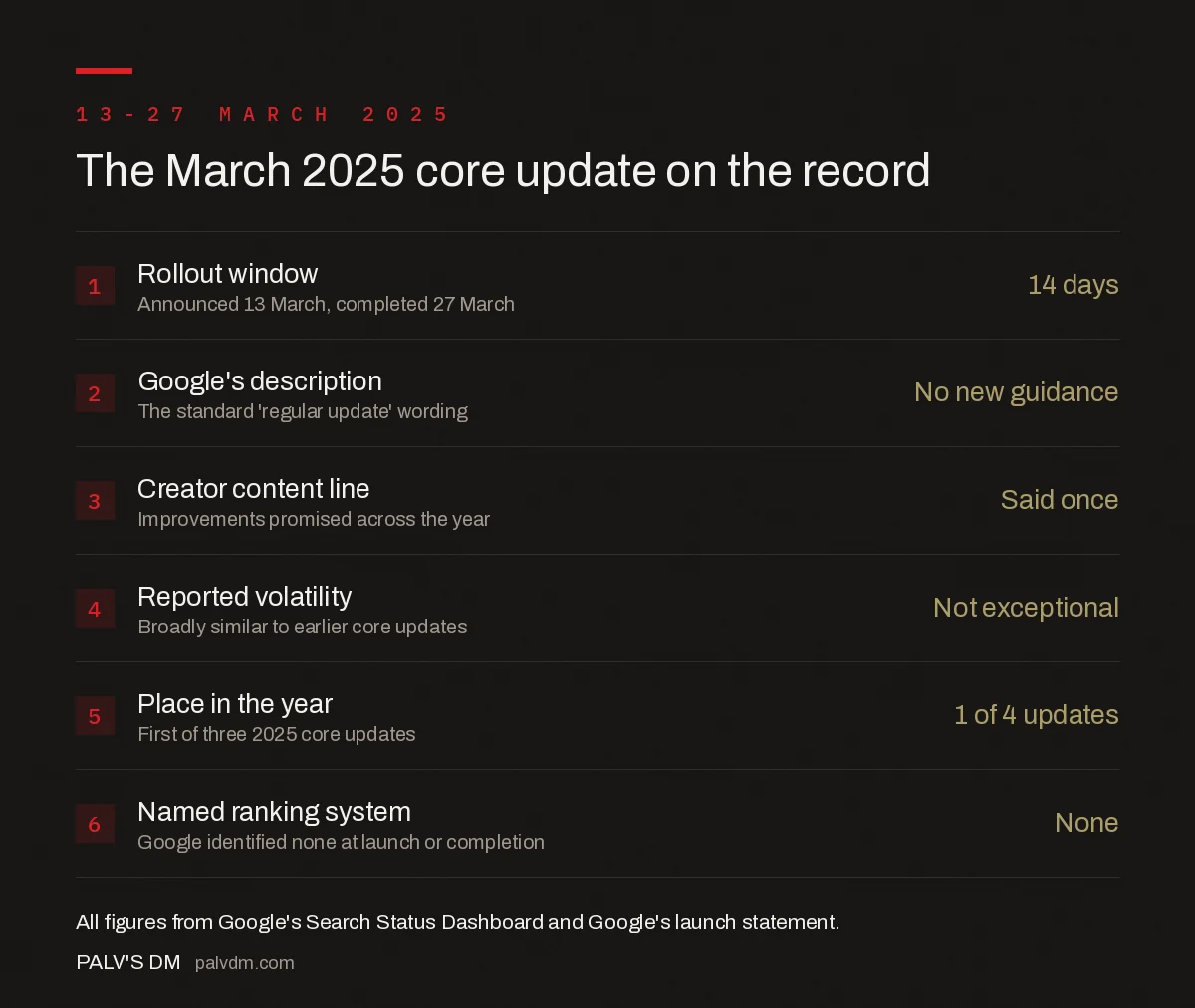
The March 2025 core update on the record
- Rollout window — 14 days. Announced 13 March, completed 27 March.
- Google’s description — No new guidance. The standard ‘regular update’ wording.
- Creator content line — Said once. Improvements promised across the year.
- Reported volatility — Not exceptional. Broadly similar to earlier core updates.
- Place in the year — 1 of 4 updates. First of three 2025 core updates.
- Named ranking system — None. Google identified none at launch or completion.
Frequently asked questions
When was the March 2025 Google core update?
The March 2025 core update started rolling out on 13 March 2025 and Google marked it complete on 27 March 2025, a rollout of 14 days. It was announced on Google’s Search Status Dashboard and was the first of three core updates Google confirmed during 2025, alongside a single spam update in August.
What did Google say about the March 2025 core update?
Google used its standard description of a regular update designed to better surface relevant, satisfying content for searchers from all types of sites. It added one sentence it has not repeated: that it would continue work to surface more content from creators through a series of improvements across the year, some already shipped and others still to come.
Did the March 2025 core update target AI content or affiliate sites?
Google named no target. It published no new policy, identified no ranking system, and data providers reported volatility broadly similar to the previous core update rather than anything exceptional. Any thematic account of who won or lost is drawn from a particular agency’s client sample, not from a Google statement or a measured industry study.
How long did the March 2025 core update take to roll out?
Fourteen days, from 13 March to 27 March 2025, which sits inside Google’s usual estimate of up to two weeks. For comparison, the June 2025 core update took roughly 17 days, December 2025 took 18, and both 2026 core updates completed in 12. Google has never explained why rollout durations vary.
What was Google's creator content statement in March 2025?
Alongside the March 2025 core update Google said it would continue its work to surface more content from creators through a series of improvements throughout that year, noting some had already happened and more would come later. Google never named those improvements, published no documentation for them, and did not refer back to the commitment in later update announcements.
I lost rankings in March 2025 and never recovered. What now?
A loss that has survived four subsequent core updates suggests the gap is substantive rather than incidental. Verify the decline began on or after 13 March 2025, check Search Console for a manual action, then segment the loss by URL, template and query cluster to find the pattern. Google’s guidance is that the largest changes arrive with a later core update.
Sources
- Google March 2025 core update rolling out now — Search Engine Land
- Google March 2025 core update rollout is now complete — Search Engine Land
- Google core updates and your website — Search Central
- Creating helpful, reliable, people-first content — Search Central
Want this done on your site?
Every PalV’s DM engagement starts with a free audit of your actual website — a 12-point
crawl covering what is blocking indexation, on-page gaps against your primary keywords, speed
findings, and the three to five fixes worth making first. Delivered in two working days. No
payment details, and the findings are yours whether you hire us or not.