What to Do When SEO Isn’t Working After Six Months
Six months of SEO with nothing to show usually has one of six causes. How to work out which one you have before spending another six.
Six months of SEO with nothing to show almost always has one of six causes: the work never actually shipped, the targets were unwinnable at the budget, the content is a paraphrase of what already ranks, the traffic arriving is the wrong intent, something technical is blocking indexation, or you are measuring the wrong thing and it is working. The first is by far the most common, and it is also the one nobody checks, because it is uncomfortable for everyone involved. Before renewing, cancelling or switching agencies, work down that list — the answer changes what you should do next completely.
Worth saying plainly: six months is a reasonable point to expect something. Meaningful movement typically shows in three to six months, so “be patient” is no longer an adequate answer at this stage. What should have happened month by month sets the benchmark.
1. Did the work actually ship?
Start here, always. Pull the original audit and check, item by item, what was implemented.
The typical failure is not incompetence. It is a queue. Recommendations go to a developer who has other priorities, sit for six weeks, get partially done, and nobody tracks it to completion. The agency reports “recommended,” the client hears “done,” and neither realises the gap until the review meeting.
Concrete checks: are the technical fixes from month one live on the site right now? Was the content actually published, and how much? Were internal links added? If the audit flagged indexation problems in month one, are those pages indexed today?
If a substantial share is still open, you do not have an SEO problem. You have a delivery problem, and changing agency will not fix it.
2. Were the targets ever winnable?
The second most common cause, and the one clients are least often told about honestly.
A new site on a ₹5,000 per month budget targeting a national head term with established competitors was never going to rank inside six months. That is not a failure of execution; it is a failure of target selection, and it should have been said at the audit stage.
Check the keyword difficulty of your targets against your site’s actual authority. Look at who ranks on page one — if they are national brands with hundreds of referring domains and you have twelve, the gap is structural. A good consultant says a term is unwinnable at your budget before taking twelve months of fees chasing it.
The fix is to re-target: longer-tail, more specific, more commercial, more local. Winning “seo consultant ahmedabad” is worth more than losing “seo services”.
3. Did impressions move, even if clicks did not?
This is the diagnostic that separates “nothing is working” from “it is working slowly.”
Impressions move before positions, and positions move before clicks. If impressions have risen materially over six months while clicks have not, the machinery is working — you are becoming visible for more queries — and the problem is further down the funnel.
If impressions are genuinely flat across six months, that is a real signal that either nothing shipped or the targets are hopeless. Go back to steps one and two.
Check this in Search Console with two equal six-month windows, and look at impressions, positions and clicks separately. Averaging them hides exactly the signal you need.
4. Is the content actually differentiated?
A great deal of SEO content is a competent restatement of the current top ten. It reads fine, covers the subtopics, and has no reason to outrank anything.
The test takes ten minutes. Open the top ten for one of your target queries, list every substantive claim in your page, and mark each one that already appears in a ranking result. What remains unmarked is your entire competitive case. If nothing remains, the page cannot win, and no amount of on-page tweaking changes that.
This has become sharper over 2026, where the updates consistently favoured content offering something the existing results did not. Information gain in practice covers the six workable forms, and the 2026 pattern covers why it matters more now.
5. Is the traffic the wrong intent?
A specific and frustrating version of “not working”: clicks are up, sometimes substantially, and enquiries have not moved.
This almost always means the content programme targeted informational queries when the business needs commercial ones. Someone reading “what is technical SEO” is not close to hiring anyone. Someone searching “seo agency pricing india” is.
Segment your Search Console queries by intent and check the mix. If eighty per cent of your growth is top-of-funnel, the programme is working as built and was built wrong. The fix is a rebalance toward commercial-investigation and transactional terms, which are also less exposed to being absorbed by AI Overviews.
6. Is something technical blocking it?
Less common after six months of active work, but worth eliminating.
Check Search Console’s Pages report: are your target pages actually indexed? Look for stray noindex tags, canonicals pointing elsewhere, robots.txt disallows, or pages sitting in “Crawled — currently not indexed.” A page that is not indexed cannot rank, and this occasionally survives six months because nobody checked the one report that would reveal it.
Also confirm nothing broke midway. The twelve diagnoses covers the sequence if traffic went backwards rather than merely flat.
The uncomfortable seventh possibility
Sometimes the answer is that a core update landed mid-engagement and reset the baseline. Two ran in 2026 — March and May — and a site that was climbing in April could have given it all back in late May through no fault of the work.
Check whether your flat six months contains a confirmed rollout. If so, the correct read is not “SEO does not work” but “we were reassessed downward, and recovery arrives with a subsequent core update.” See what a core update actually is and the 30-day recovery plan. This is a genuine explanation, but it is also the most abusable one — insist on the dashboard dates rather than accepting it as a general excuse.
What to ask before renewing
- Show me the audit and what is still open. Item by item, with dates.
- Show me impressions over six months, not rankings. Rankings can be cherry-picked; impressions across the whole site cannot.
- Which of our targets do you consider unwinnable at this budget? A consultant who names some is being straight with you. One who says all of them are achievable is not.
- What does our content say that the current top ten does not? If there is no answer, that is the problem.
- What is the commercial-to-informational ratio of the traffic we gained?
- Can I see this in my own Search Console and GA4? If the numbers only exist in an agency dashboard, you cannot verify anything.
One reframe worth holding onto. If impressions rose, indexation improved, and the content genuinely got better, the engagement may be working while the reporting is measuring the wrong thing — and abandoning it at month six means someone else inherits the compounding. If none of those improved, six more months of the same will not change the outcome, and the honest move is to change the plan rather than the calendar.
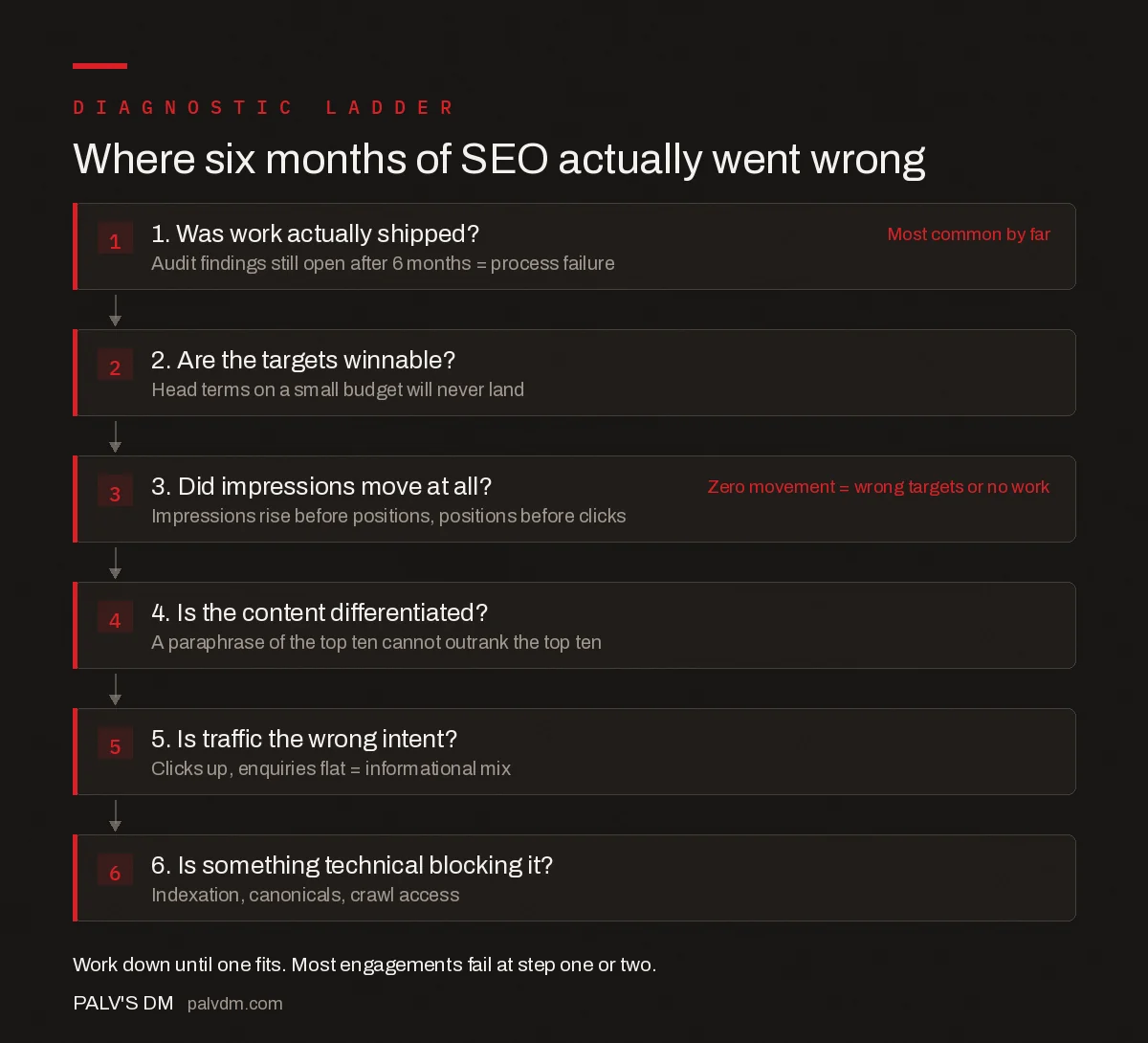
Where six months of SEO actually went wrong
- 1. Was work actually shipped?. Audit findings still open after 6 months = process failure. Most common by far
- 2. Are the targets winnable?. Head terms on a small budget will never land.
- 3. Did impressions move at all?. Impressions rise before positions, positions before clicks. Zero movement = wrong targets or no work
- 4. Is the content differentiated?. A paraphrase of the top ten cannot outrank the top ten.
- 5. Is traffic the wrong intent?. Clicks up, enquiries flat = informational mix.
- 6. Is something technical blocking it?. Indexation, canonicals, crawl access.
Frequently asked questions
Why is my SEO not working after 6 months?
Usually one of six causes: the recommended work never actually shipped, the target keywords were unwinnable at your budget, the content is a paraphrase of what already ranks, the traffic arriving is informational rather than commercial, something technical is blocking indexation, or the reporting is measuring the wrong thing. The first is by far the most common and the least often checked.
How do I know if my SEO agency is actually doing the work?
Ask for the original audit and check item by item what is live on the site right now. Technical fixes from month one should be implemented, flagged indexation problems should be resolved, and published content should be countable. Also insist on reporting from your own Search Console and GA4 rather than an agency dashboard, so you can verify the numbers independently.
Should I fire my SEO agency after 6 months of no results?
Diagnose before deciding. If impressions rose and indexation improved while clicks lagged, the machinery is working and switching restarts the clock for someone else’s benefit. If the audit items are still open after six months, that is a delivery problem a new agency may or may not fix. If the targets were never winnable at your budget, the plan needs changing more than the supplier does.
My SEO traffic went up but I got no enquiries. Why?
Almost always an intent mismatch. The content programme targeted informational queries when the business needs commercial ones — someone reading “what is technical SEO” is not close to hiring anyone. Segment your Search Console queries by intent, and if most of your growth is top-of-funnel, rebalance toward commercial-investigation and transactional terms.
Could a Google update be why my SEO stalled?
Possibly, and it is worth checking properly rather than accepting it as a general excuse. Two core updates ran in 2026, in March and May, and a site climbing in April could have been reassessed downward in late May. Verify the exact dates on Google’s Search Status Dashboard and check whether your decline aligns with a rollout window rather than merely occurring in the same quarter.
Sources
- Search Console Performance report — Google Search Central
- Creating helpful, reliable, people-first content — Google Search Central
- Google Search Status Dashboard
Want this done on your site?
Every PalV’s DM engagement starts with a free audit of your actual website — a 12-point
crawl covering what is blocking indexation, on-page gaps against your primary keywords, speed
findings, and the three to five fixes worth making first. Delivered in two working days. No
payment details, and the findings are yours whether you hire us or not.