
How Long Does SEO Take to Show Results? A Month-by-Month Breakdown
SEO typically shows meaningful movement in three to six months. Here is what actually happens each month, and what should worry you if it does not.
For most sites, SEO shows meaningful movement in three to six months, with competitive commercial terms taking nine to twelve. Technical fixes land fastest — indexation changes can register within days. Long-tail and low-competition keywords typically move between weeks six and ten. Head terms in a competitive market are a nine-to-twelve-month project, and sometimes longer if your site has no existing authority. Anyone promising page one in thirty days is either targeting keywords nobody searches or guessing with your money.
The honest complication: “how long does SEO take” has no single answer because the timeline depends on four things that vary wildly between sites — your starting technical health, your existing authority, how competitive your targets are, and how fast you can actually publish and ship fixes. A three-year-old site with clean architecture and a stalled content programme moves far faster than a brand-new domain in a crowded category.
What actually happens month by month?
This is the shape of a well-run engagement on a site that starts with typical problems, run as weekly sprints. Treat it as a reference curve, not a promise.
| Period | What is happening | What you should see |
|---|---|---|
| Month 1 | Crawl, audit, technical fixes, competitor research, roadmap agreed | Indexation improvements, crawl errors clearing, Search Console coverage tidying up. Usually no ranking change yet. |
| Month 2 | On-page work on existing pages, internal linking, first new content shipping | Pages that were ranking 15–40 start moving. Impressions rise before clicks do. |
| Month 3 | Content programme running, first links earned, thin pages pruned or merged | First genuine click growth. Long-tail terms entering the top ten. |
| Months 4–6 | Compounding: more pages, more internal links, topical coverage filling in | Meaningful traffic growth. Mid-competition commercial terms reaching page one. Enquiries start moving. |
| Months 7–12 | Authority building, head terms, refreshing what has plateaued | Competitive terms landing. The curve steepens rather than flattens, because earlier work keeps paying. |
The counter-intuitive part is that month one often looks like nothing happened. Fixing what blocks indexation and correcting a botched canonical setup are the highest-value things you will do all year, and neither produces a chart that goes up this month.
Why does SEO take months rather than weeks?
Four separate delays stack up, and only one of them is under your control.
Crawling and indexing lag. Google has to recrawl a changed page before the change counts. On a small or low-authority site that can take days to weeks per page. You can request indexing for individual URLs, but you cannot force a site-wide recrawl.
Evaluation lag. Even once indexed, a page’s position tends to settle rather than snap into place. Google appears to test pages at various positions and adjust based on how they perform, which means early rankings are frequently unstable.
Link acquisition is slow by nature. Genuinely earned citations arrive on other people’s schedules. Anything that arrives faster than that was usually bought, and carries risk.
Site-level assessment moves slowly. Google has confirmed that its helpful content assessment operates partly at site level. If your site is carrying a large volume of weak pages, improving twenty of them does not immediately reset how the whole domain is assessed. This is also why recovery from a core update often waits for the next core update rather than arriving between them.
What can you legitimately expect in the first thirty days?
Plenty, as long as you measure the right things. Month one is where the largest permanent wins usually happen, they just do not show up as traffic.
- Indexation fixes. If pages were blocked by robots.txt, carrying a stray noindex, or canonicalised to the wrong URL, correcting that is the highest-leverage change available and it can register within days.
- Quick-win rankings. Pages already sitting at positions 8–20 often move with on-page work alone. These are the fastest legitimate wins and any competent audit will identify them first.
- Technical debt cleared. Redirect chains, soft 404s, duplicate title tags, orphaned pages. Unglamorous, permanent.
- A prioritised plan you can check. If month one ends without a written list of what is being done and in what order, that is a process problem, not a timeline problem. A 12-month SEO roadmap should exist by then.
What should worry you at each stage?
Slow is normal. These are the specific signals that something is genuinely wrong rather than merely early.
| By when | Warning sign | What it usually means |
|---|---|---|
| End of month 1 | No audit, no written roadmap, no access to your own Search Console | Process problem. You cannot verify anything that follows. |
| End of month 2 | Indexation issues identified in month one are still open | Work is not shipping. Ask what is blocking it. |
| End of month 3 | Zero movement in impressions on any target keyword | Either the targets are far too competitive for the budget, or the work is not landing. |
| End of month 6 | Impressions up, clicks flat | You are ranking on the wrong queries, or titles and descriptions are not earning the click. |
| End of month 6 | Clicks up, enquiries flat | Traffic is the wrong intent. Usually too much informational content, not enough commercial. |
| Any month | Reporting that never comes from your own Search Console and GA4 | You are being shown a story rather than the numbers. |
What makes SEO faster or slower on your specific site?
Four variables account for most of the spread between a four-month result and a fourteen-month one.
Domain age and existing authority. An established site with earned links has a large head start. A brand-new domain has to build that from zero, which is the single biggest reason new sites take longer.
Technical starting condition. A site where half the pages are not indexed has enormous available upside and can move quickly once unblocked. A technically clean site has less low-hanging fruit and depends more on content and links, which are slower.
Competition in your category. Ranking for a niche B2B term in a specialised market is a different sport from ranking for “insurance” or “web hosting”. Keyword difficulty is not a vanity metric; it is a direct input to the timeline.
Publishing and deployment speed. This is the one you control, and it is routinely the bottleneck. If recommended fixes sit in a developer queue for six weeks, the timeline extends by six weeks. Agencies get blamed for delays that were caused by approval cycles.
Do AI citations arrive faster than classic rankings?
Often, yes — for specific niche queries. This is the core argument for treating AI search as a separate surface. The AI-answer surface is considerably less crowded than page one of Google, and generative engines select passages rather than whole domains, which reduces the authority barrier that makes classic rankings slow for new sites.
Peer-reviewed work on generative engine optimisation (Aggarwal et al., KDD 2024) found that adding statistics, named quotations and citations to authoritative sources lifted a source’s visibility in generative answers by up to around 40%. Those are page-level content changes, not domain-level authority changes, which is why they can pay before your domain has earned the links a competitive head term requires.
This does not shortcut classic SEO. It does mean a new brand has a route to visibility in months rather than years, and it is a genuine early-mover advantage while most competitors are still optimising only for blue links.
How to hold an SEO engagement to a timeline honestly
Agree the checkpoints before the work starts, not after a disappointing month three.
- Get the audit findings in writing in month one, with issues ranked by impact, before any content is commissioned.
- Agree which keywords are realistic at your budget and which are not. A good consultant will tell you a term is unwinnable at ₹5,000 a month rather than take twelve months of fees chasing it.
- Track impressions, not just rankings, from week one. Impressions move before positions do, and positions move before clicks. It is your earliest honest signal.
- Report from your own Search Console and GA4. If the numbers only exist inside an agency dashboard, you cannot verify them.
- Review the plan quarterly, not monthly. Monthly reviews of a compounding channel produce panic decisions. Quarterly reviews catch real problems while there is still time to change course.
The realistic summary: expect indexation and technical wins inside month one, first ranking movement around weeks six to ten, genuine traffic growth by month three to four, and commercial results between months four and six. Competitive head terms take the better part of a year. Any faster than that, on a term with real volume and real buyers behind it, is worth asking hard questions about.
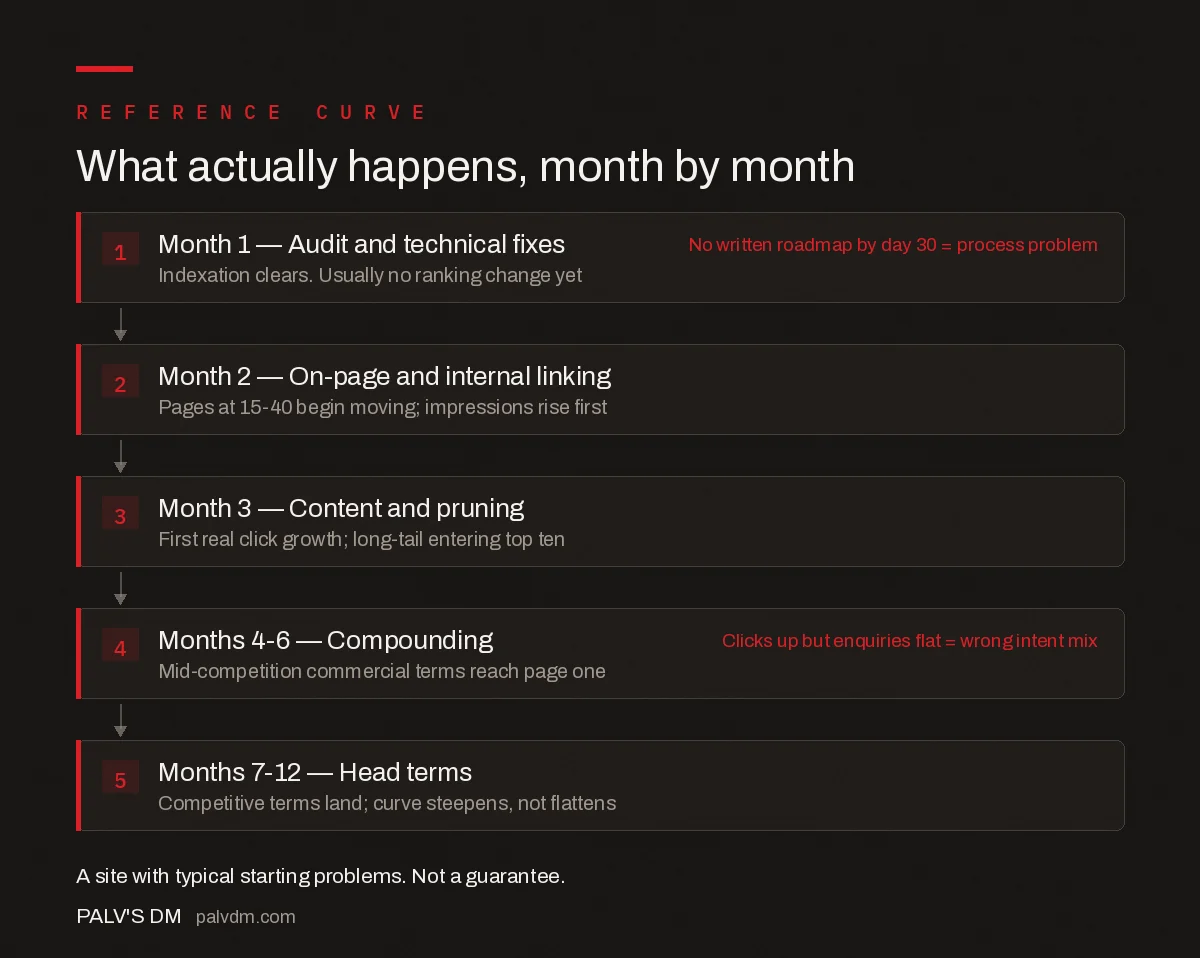
What actually happens, month by month
- Month 1 — Audit and technical fixes. Indexation clears. Usually no ranking change yet. No written roadmap by day 30 = process problem
- Month 2 — On-page and internal linking. Pages at 15-40 begin moving; impressions rise first.
- Month 3 — Content and pruning. First real click growth; long-tail entering top ten.
- Months 4-6 — Compounding. Mid-competition commercial terms reach page one. Clicks up but enquiries flat = wrong intent mix
- Months 7-12 — Head terms. Competitive terms land; curve steepens, not flattens.
Frequently asked questions
How long does SEO take to show results?
Most sites see meaningful movement within three to six months. Technical and indexation fixes can register within days, long-tail keywords typically move between weeks six and ten, and competitive commercial terms usually take nine to twelve months. The exact timeline depends on your domain’s existing authority, technical starting condition, competition level, and how quickly fixes actually ship.
Can SEO work in 30 days?
Partly. Within thirty days you can fix indexation problems, clear technical debt, and move pages already ranking between positions 8 and 20 through on-page work alone. What you cannot do in thirty days is rank a new page for a competitive commercial term. Anyone guaranteeing page one in a month is either targeting keywords with no search volume or is not being straight with you.
Why is my SEO not working after 6 months?
The most common causes, in order: targets far too competitive for the budget, recommended fixes never shipped because they sat in a development queue, the content is a paraphrase of what already ranks and adds nothing new, or traffic is growing on informational queries that were never going to convert. Check whether impressions moved even if clicks did not, as that distinguishes a ranking problem from a click-through problem.
Does SEO take longer for a new website?
Yes. A brand-new domain has no earned links and no track record, so it must build the authority that established competitors already have. Expect a new site to take roughly twice as long to reach competitive terms. The offsetting advantage is that new sites carry no legacy content problems, and can often win AI-answer citations faster than classic rankings because that surface is less crowded.
How long does it take to recover from a Google core update?
Recovery frequently waits for the next core update rather than arriving between them, which in practice means two to six months given recent rollout cadence. Google’s own guidance states there are no specific actions that guarantee recovery, and that a ranking drop does not necessarily mean something is wrong with your pages. Substantial improvement to the site as a whole, assessed at the next core update, is the realistic path.
Sources
- Google core updates and your website
- Creating helpful, reliable, people-first content — Google Search Central
- GEO: Generative Engine Optimization (Aggarwal et al., KDD 2024)
Want this done on your site?
Every PalV’s DM engagement starts with a free audit of your actual website — a 12-point
crawl covering what is blocking indexation, on-page gaps against your primary keywords, speed
findings, and the three to five fixes worth making first. Delivered in two working days. No
payment details, and the findings are yours whether you hire us or not.


