
SEO Sprint Planning: A Weekly Operating Rhythm That Ships
SEO fails from work that never ships, not work wrongly chosen. How to run weekly SEO sprints with owners, a definition of done, and an honest review.

SEO sprint planning means committing to a small, fixed list of SEO deliverables every week, each with a named owner and a written definition of done, instead of working from an open-ended monthly plan. The rhythm is deliberately short: one planning session at the start of the week, work shipped through the week, one review at the end. It works because SEO engagements fail far more often from work that never shipped than from work that was wrongly chosen. A weekly cadence makes the not-shipping visible in seven days rather than at the end of a quarter.
There is a genuine tension to manage. SEO results compound over months while a sprint measures in days, so sprint reviews have to judge output — what actually shipped — rather than outcome — what actually ranked. Confusing the two produces the most common failure in SEO delivery: abandoning correct work after a fortnight because the traffic graph has not moved yet.
What is an SEO sprint?
An SEO sprint is a fixed time block, usually one week, containing a closed list of SEO tasks that will be finished inside it. Closed is the operative word. Nothing is added mid-sprint except a genuine emergency, and anything not finished rolls forward visibly rather than quietly.
Three things distinguish a sprint from an ordinary task list. Every item has a single named owner, not a team. Every item has a definition of done that someone else could verify — “meta titles rewritten and deployed on the 14 category pages listed in the sheet”, not “improve category page titles”. And the sprint has a hard end date, so an item 80% complete on Friday is unfinished, not nearly done.
The sprint sits underneath a longer plan. Strategy lives in a twelve-month SEO roadmap that answers what you are trying to win and in what order; the sprint answers only what gets built this week. Running sprints without a roadmap produces busywork. Running a roadmap without sprints produces plans nobody executes.
Why plan SEO weekly rather than monthly?
Monthly planning has one structural flaw: the feedback loop is longer than the failure mode. If a developer ticket stalls in week one of a monthly cycle, nobody finds out until the month-end report and four weeks of runway are gone. Weekly planning shortens the loop to five working days. Three benefits follow.
Blockers surface early. Most SEO delay is not analytical, it is procedural — waiting on developer capacity, waiting on approval of a draft, waiting on access to Search Console. A weekly review names the blocker while there is still time to escalate it.
Scope creep gets a boundary. A closed weekly list gives you a legitimate place to put every new request: next sprint. Without one, ad-hoc requests silently absorb the hours meant for the roadmap.
Estimates get calibrated. After six weeks you know what your team genuinely ships in a week. That number is the only reliable input to forecasting when a piece of the roadmap will land.
What goes into a single week’s sprint?
A workable sprint mixes work types rather than doing one thing for a week. Technical fixes, content and links all move on different timescales, so a sprint that is entirely content produces a month with no technical progress at all.
| Slot | Typical share of the week | What it covers |
|---|---|---|
| Technical | 20-30% | Indexation fixes, redirect chains, schema, speed work from the technical audit backlog |
| Content | 30-40% | New pages, refreshes and merges, each starting from a written content brief |
| On-page | 15-20% | Titles, headings, internal links, entity coverage on pages already ranking in positions 8-20 |
| Off-page | 10-20% | Outreach, digital PR, reclaiming unlinked mentions |
| Measurement | 10% | Search Console review, tracking checks, updating the log of what changed and when |
The percentages are a starting shape, not a rule. A site with half its pages excluded from the index should spend its first four sprints almost entirely on technical work, because content published into a broken index earns nothing.
How do you run the SEO sprint planning session?
Thirty to forty-five minutes, same slot every week, same agenda. Longer than that and the meeting is doing work that belongs in the backlog.
- Close the previous sprint first. Item by item: shipped, or not shipped and why. No discussion of new work until the old list is accounted for.
- Read the change log, not the rankings. Confirm what went live last week and on which date. This log is what lets you attribute a movement four weeks later to a specific change rather than guessing.
- Pull from the ranked backlog. The backlog should already be ordered by impact against effort, which is a separate exercise done at task prioritisation time, not invented live in the meeting.
- Assign one owner per item. Shared ownership is unowned. If an item needs a developer who is not in the room, that dependency is part of the item and gets flagged now.
- Write the definition of done. One sentence per item, phrased so a person outside the team could check it.
- Stop when the week is full. Whatever remains is next sprint’s problem. Overloading a sprint does not produce more output; it produces a list of half-finished items and no reliable velocity number.
How do you size a sprint when nobody works on SEO full time?
Most Indian SMEs and startups run SEO with a fraction of one person’s week, often a founder or a marketing generalist. The sprint still works, but the sizing changes and pretending otherwise is how plans collapse in month two.
Start by measuring capacity in hours rather than tasks. Four hours a week buys roughly one substantial deliverable — one new page shipped, or one technical fix deployed, or one round of outreach. Not all three. A team that commits to three and lands one ends the quarter with twelve deliverables and a demoralised owner; a team that commits to one and lands it ends with the same twelve and a working habit.
Second, protect the slot in the calendar rather than the intention. SEO work has no external deadline pressure, which is precisely why it loses every collision with client work. Third, front-load the items that do not depend on anyone else. Anything requiring developer time should be batched and queued a sprint ahead. If capacity is genuinely under a few hours a week, buying specific deliverables through standalone services from ₹500 is usually more honest than committing to a sprint the team cannot staff, and a retainer such as SEO Foundation at ₹5,000 a month exists for the same reason.
What should the end-of-sprint review check?
Output first, always. The review answers one question: did what we said would ship, ship? Anything else is a second conversation.
Then a short metrics pass, on the right cadence. Positions and clicks are too noisy to read weekly, which is why a weekly metrics review should cover leading indicators — indexation counts, impressions on newly published URLs, crawl errors — while the KPIs that judge the engagement are reviewed monthly or quarterly. Reading a rankings chart every Friday is how teams talk themselves out of correct decisions.
Finally, one process question: what blocked us, and does the same blocker appear next sprint? A blocker that recurs three weeks running is not a blocker, it is the actual project. If developer capacity has stopped every technical item for a month, the honest sprint output is an escalation, not another optimistic ticket.
What breaks SEO sprints most often?
Adding work mid-sprint. The single most common cause. Every mid-week insertion pushes something else out and destroys the velocity figure that makes planning possible.
Vague items. “Improve internal linking” cannot be finished, so it lives on the list forever. “Add contextual links from the eight blog posts listed in the sheet to the pricing page” can be finished on Thursday.
Judging sprints on rankings. Rankings move on Google’s schedule. Expecting a weekly ranking response contradicts everything known about how long SEO takes to show results, and it punishes exactly the technical and structural work that pays the most over a year.
No written record of changes. Without a dated log, a traffic movement six weeks later is unattributable and you cannot tell your own work apart from an algorithm update. Keeping a log of site changes alongside confirmed Google updates costs minutes a week.
Skipping documentation. Sprints repeat the same task types constantly. Writing standard operating procedures for the recurring ones converts a two-hour job into a twenty-minute one, and makes the work transferable when the person who knows it leaves.
The rhythm is not complicated: a ranked backlog, a closed weekly list, named owners, a written definition of done, and a review that checks shipping before it checks rankings. Agree the cadence at the kickoff rather than improvising it later. The teams that get results from SEO are rarely the ones with the cleverest strategy — they are the ones whose plan survives contact with a normal working week.
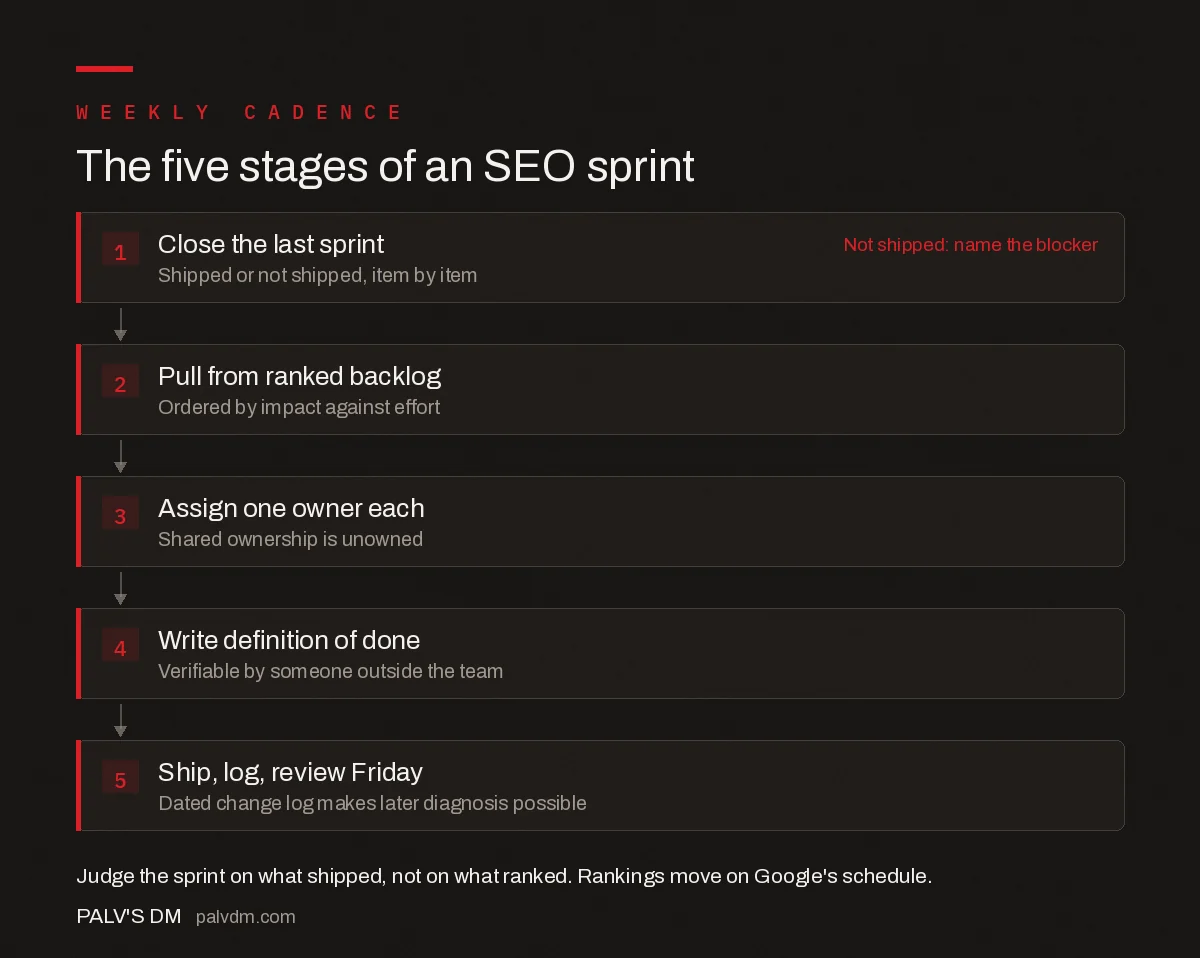
The five stages of an SEO sprint
- Close the last sprint. Shipped or not shipped, item by item. Not shipped: name the blocker
- Pull from ranked backlog. Ordered by impact against effort.
- Assign one owner each. Shared ownership is unowned.
- Write definition of done. Verifiable by someone outside the team.
- Ship, log, review Friday. Dated change log makes later diagnosis possible.
Frequently asked questions
How long should an SEO sprint be?
One week suits most teams. It is short enough that a stalled task is caught within five working days, and long enough to finish a real deliverable such as a published page or a deployed technical fix. Two-week sprints work for larger teams with heavy developer dependencies, but anything longer starts behaving like monthly planning, where blockers hide until the end-of-period report.
What should go into an SEO sprint backlog?
Findings from the technical audit, pages ranking in positions 8 to 20 that need on-page work, content briefs waiting to be written, outreach targets, and tracking fixes. Each item needs an owner, an effort estimate and a definition of done. Order the backlog by impact against effort before the planning session, not during it.
Can you run SEO sprints with only a few hours a week?
Yes, provided you size honestly. Roughly four hours a week buys one substantial deliverable: one page published, or one technical fix deployed, or one round of outreach. Not all three. Committing to one item and landing it every week beats committing to three and landing one, because a reliable weekly velocity is what makes any forecast possible.
Should you review rankings at the end of every sprint?
No. Weekly ranking data is too noisy to act on and encourages abandoning correct work early. Review leading indicators weekly: indexation counts, impressions on newly published URLs, crawl errors, and whether committed work shipped. Save position and click analysis for a monthly or quarterly review, where the signal is large enough to mean something.
What is the difference between an SEO roadmap and an SEO sprint?
A roadmap covers six to twelve months and answers what you are trying to win and in what order. A sprint covers one week and answers only what gets built now. Sprints without a roadmap produce busywork; a roadmap without sprints produces a plan nobody executes.
How do you stop new requests derailing an SEO sprint?
Keep the sprint list closed once planning ends, and give every new request one destination: the backlog, for the next planning session. Only a genuine emergency, such as a site-wide indexation failure, justifies mid-sprint insertion. Each mid-week addition pushes something else out and destroys the velocity figure that makes planning work.
Sources
- Creating helpful, reliable, people-first content — Google Search Central
- Google Search Status Dashboard — Confirms whether a movement coincided with a Google update
- Google core updates and your website
Want this done on your site?
Every PalV’s DM engagement starts with a free audit of your actual website — a 12-point
crawl covering what is blocking indexation, on-page gaps against your primary keywords, speed
findings, and the three to five fixes worth making first. Delivered in two working days. No
payment details, and the findings are yours whether you hire us or not.


