Content Brief Template: What Writers Can Actually Follow
A content brief template with 7 fields writers actually use: keyword, intent, headings, audience, sources, links, and the angle that makes it different.
Published: August 2026
A content brief writers can actually follow needs seven things: the target keyword and search intent, a heading structure derived from what’s already ranking, the audience and their specific problem, word count range, sources to cite, internal links to include, and a one-line answer to “what should this post say that nothing else does.” Skip any of these and the writer either guesses or asks you questions the brief should have already answered.
What should a content brief actually contain?
Most briefs fail for one of two reasons: they’re too vague to remove ambiguity, or they’re so long the writer skims past the parts that matter. The fix is a fixed set of fields, filled in specifically, every time.
| Field | What goes here | Why it matters |
|---|---|---|
| Primary keyword + intent | The exact target phrase and whether the searcher wants a guide, comparison, or definition | Wrong intent means the wrong format, no matter how well it’s written |
| Heading skeleton | H2s and H3s pulled from what’s ranking, plus any gaps you want covered | Removes the writer’s guesswork on structure and coverage |
| Audience + specific problem | Who’s reading this and what decision they’re trying to make | Prevents generic writing that could apply to any reader |
| Word count range | A range, not a fixed number, derived from competitor median | Stops both padding and under-covering the topic |
| Sources and stats required | Specific citations, studies, or data points that must appear | Fact-checking after the fact is slower than briefing it up front |
| Internal links | 2-4 specific URLs with suggested anchor text | Writers rarely know the site’s link map; don’t make them guess |
| The information-gain angle | One sentence: what this post says that competitors don’t | Without this, the post is a paraphrase of the SERP |
Why do writers ignore parts of the brief anyway?
Usually because the brief buries the important decisions in prose instead of surfacing them as scannable fields. A paragraph that says “this piece should cover the main reasons why X happens, touching on Y and Z where relevant, written for an audience that understands the basics but wants more depth” contains real information, but a tired writer skimming five briefs before lunch will miss half of it. The same information as a labelled field – Audience: marketing managers with basic SEO knowledge wanting operational detail – gets read and followed. Format is not a cosmetic choice here; it’s the difference between a brief that gets followed and one that gets skimmed.
How long should a content brief be?
Most effective briefs run 500-1,500 words – long enough to remove ambiguity, short enough that a writer actually reads the whole thing before starting. A 3,000-word brief for an 1,800-word article is a sign the brief-writer is doing the writer’s job for them, which defeats the point of delegating. If you find yourself writing full sentences for every paragraph, you’re drafting the post, not briefing it.
How do you build the heading structure without copying competitors?
Pull the H2s and H3s from the top 5-10 ranking pages for the target keyword and build the union – every subtopic any of them cover. That union becomes your coverage floor, not your final outline. Then do two things: cut anything genuinely redundant across competitors, and add at least one section addressing a gap none of them cover well. Copying one competitor’s outline produces a paraphrase. Building from the union and then adding something new produces a brief that can actually outrank the field.
How do you keep briefs consistent across multiple writers?
A shared template file that every brief starts from is the single biggest lever here – not a style guide reminder, an actual document with the seven fields pre-labelled so no one has to remember the structure from memory. Beyond the template, a short 15-minute review of the first brief a new writer produces catches most inconsistencies before they compound across ten posts. Teams that skip this step usually discover the inconsistency only after publishing, when one writer’s posts read noticeably different from another’s despite using “the same process.”
What’s the biggest mistake briefs make?
- Vague intent statements. “Write about content briefs” tells a writer nothing about format, audience, or angle. “Write a how-to for marketing managers who’ve been burned by vague briefs before” tells them everything.
- No word count range. A single fixed number (“1,800 words exactly”) produces padding on easy topics and thin coverage on hard ones. A range tied to competitor depth fixes both.
- Missing sources. If a claim needs a citation, name the source in the brief. Asking the writer to find sources after drafting means either delays or unverified claims slipping through.
- No stated angle. If the brief doesn’t answer “what’s different about this post,” most writers default to summarising the top 3 search results, which produces exactly the kind of content Google’s helpful content systems are built to demote.
How do you write a brief in under 30 minutes?
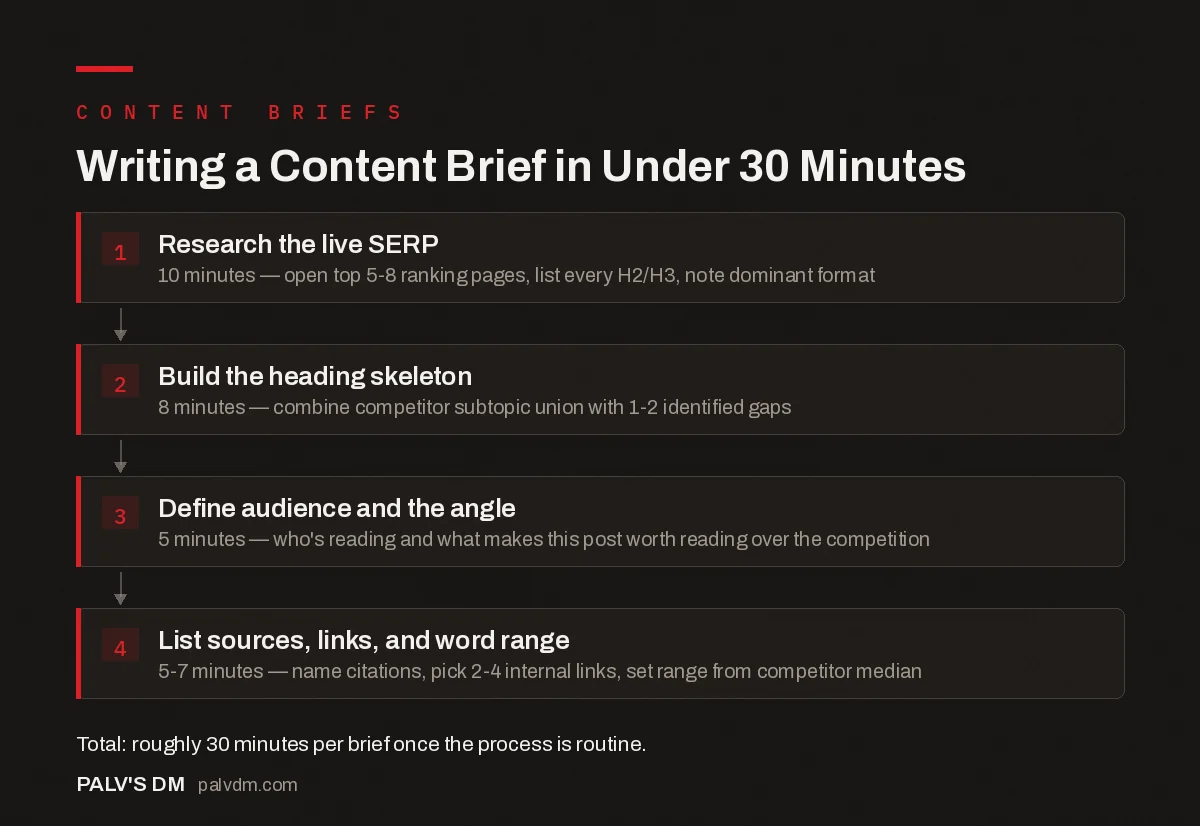
Writing a Content Brief in Under 30 Minutes
- Research the live SERP. 10 minutes — open top 5-8 ranking pages, list every H2/H3, note dominant format.
- Build the heading skeleton. 8 minutes — combine competitor subtopic union with 1-2 identified gaps.
- Define audience and the angle. 5 minutes — who’s reading and what makes this post worth reading over the competition.
- List sources, links, and word range. 5-7 minutes — name citations, pick 2-4 internal links, set range from competitor median.
How do you brief for a comparison or listicle post differently than a guide?
The seven core fields stay the same, but two of them need extra detail depending on archetype. For a comparison post, the brief must specify the exact items being compared and the criteria for the verdict – without that, writers default to a wishy-washy “it depends” conclusion instead of taking a clear position. For a listicle, the brief needs to state how many items, roughly how self-contained each one needs to be (can a reader skip straight to item 7 and understand it), and whether items should be ranked or unranked.
A how-to brief benefits from an explicit prerequisites list and a “common mistakes” section, because those two additions are what separate a genuinely useful how-to from a generic numbered list. Match the brief’s extra detail to what the archetype actually needs, not to a fixed template that treats every post the same.
Should a brief specify tone and voice, or just structure?
Both, briefly. A one-line voice note (“direct, no hedging, second person”) takes ten seconds to write and saves a full editing pass later. What doesn’t belong in a brief is a style guide reproduced in full – that’s a separate, reusable document a writer references once, not something to paste into every brief. Link to the style guide; don’t duplicate it.
Does the brief change for AI-assisted drafting versus a human writer?
The core fields stay the same, but AI-assisted drafts need more explicit constraints, because a model will confidently fill any gap left in the brief with something plausible-sounding but unverified. If a brief is going to be used with AI drafting tools, be stricter about naming exact sources for every stat claim and flagging anything that must not be invented – a human writer might leave a gap and ask; a model usually won’t.
FAQ
What’s the difference between a content brief and an outline?
An outline is just the heading structure. A brief includes the outline plus intent, audience, word count, required sources, internal links, and the differentiation angle. An outline tells a writer what order to cover things in; a brief tells them why this post needs to exist at all.
Who should write the content brief, the strategist or the writer?
Whoever has done the SERP research should write it, because the brief’s value comes from that research being distilled into decisions. If the writer does their own research and briefing, that’s fine too – the point is that briefing happens before drafting starts, not during.
How specific should the word count range be?
Specific enough to guide effort, loose enough to allow the topic to dictate final length. A range like “1,500-2,000 words” is more useful than an exact target, because it signals the writer should stop once the topic is fully covered rather than padding to hit a number.
Should a brief include competitor URLs?
Yes, 3-5 of the top-ranking URLs for the target keyword, so the writer can see what they’re up against and where the gaps are, without needing to redo the SERP research themselves.
Can a content brief template work across very different topics?
The field structure can stay fixed – keyword, intent, headings, audience, sources, links, angle – but the content in each field always changes per topic. A template is a checklist, not a fill-in-the-blank paragraph.
If building and maintaining a brief system for every post feels like its own project, PalV’s DM’s content writing service includes brief creation as part of the process, not a separate line item. This post is part of our content strategy guide. Related reading: building an editorial calendar, how many blog posts per month you need, and content templates that keep quality consistent across writers.