Building an Editorial Calendar That Survives Contact With Reality
Most editorial calendars fail from zero buffer time and vague status fields. See the 5 elements that make a content calendar actually hold up.

Published: August 2026
An editorial calendar that survives contact with reality needs five things a spreadsheet with just “date” and “title” columns doesn’t have: a status field beyond done/not-done, buffer time built into every deadline, a topic cluster map so priorities don’t get decided ad hoc, an owner per post who isn’t the person approving it, and a review cadence separate from the publish cadence. Most calendars fail not because the plan was wrong, but because the plan had zero slack and one missed deadline cascaded into three.
Why do most editorial calendars fall apart within two months?
Because they’re built as a wish list, not a capacity plan. A calendar that schedules 8 posts a month based on ambition rather than actual writing and editing hours available will look fine in week one and be three posts behind by week six. The second common failure is a binary status field – “scheduled” or “published” – that hides the real bottleneck. A post stuck in “needs research” for two weeks looks identical to one on track, right up until the deadline arrives and nothing’s ready.
The fix for both isn’t more discipline. It’s building slack and visibility into the structure itself, so a slipping post shows up as a problem in week one, not week four.
What should the calendar actually track?
| Field | Purpose |
|---|---|
| Working title + target keyword | Locks the topic before research starts, prevents mid-project scope drift |
| Status (6+ stages, not 2) | Briefed → researching → drafting → editing → scheduled → published. Each stage has an expected duration. |
| Owner | One person accountable per post, separate from whoever approves it |
| Target publish date + buffer | The real deadline, plus 3-5 buffer days built in, not bolted on after slippage |
| Cluster / pillar | Which topic cluster this post supports, so priority decisions aren’t made in isolation |
| Dependencies | Any research, quotes, or approvals this post is waiting on from someone else |
How much buffer time should you build in?
Most teams underestimate this badly. A post that “should” take a week from brief to publish routinely takes nine or ten days once research delays, one round of revisions, and scheduling conflicts are accounted for. Building in 30-40% buffer beyond your optimistic estimate, rather than the estimate itself, is what actually holds up under real conditions. A calendar with zero buffer isn’t a plan, it’s a best-case scenario that fails the first time someone gets sick or a stakeholder takes three days to approve a brief instead of one.
How do you decide what goes on the calendar first?
- Map the topic cluster before scheduling individual posts. Decide which pillar and supporting posts matter most as a group, then sequence within that group, rather than picking topics one at a time as ideas arrive.
- Prioritise posts that unblock others. A pillar page that several planned posts will link to should usually go first, even if a supporting post feels more urgent individually.
- Balance evergreen and timely content deliberately. Reserve calendar slots for seasonal or time-sensitive topics in advance rather than letting them displace planned evergreen posts at the last minute.
- Leave 10-20% of slots unassigned. Reactive opportunities – a trending question, a competitor gap you spot mid-month – need somewhere to go without bumping planned work.
What does a calendar that actually survives reality look like?
Building a Calendar That Survives Contact With Reality
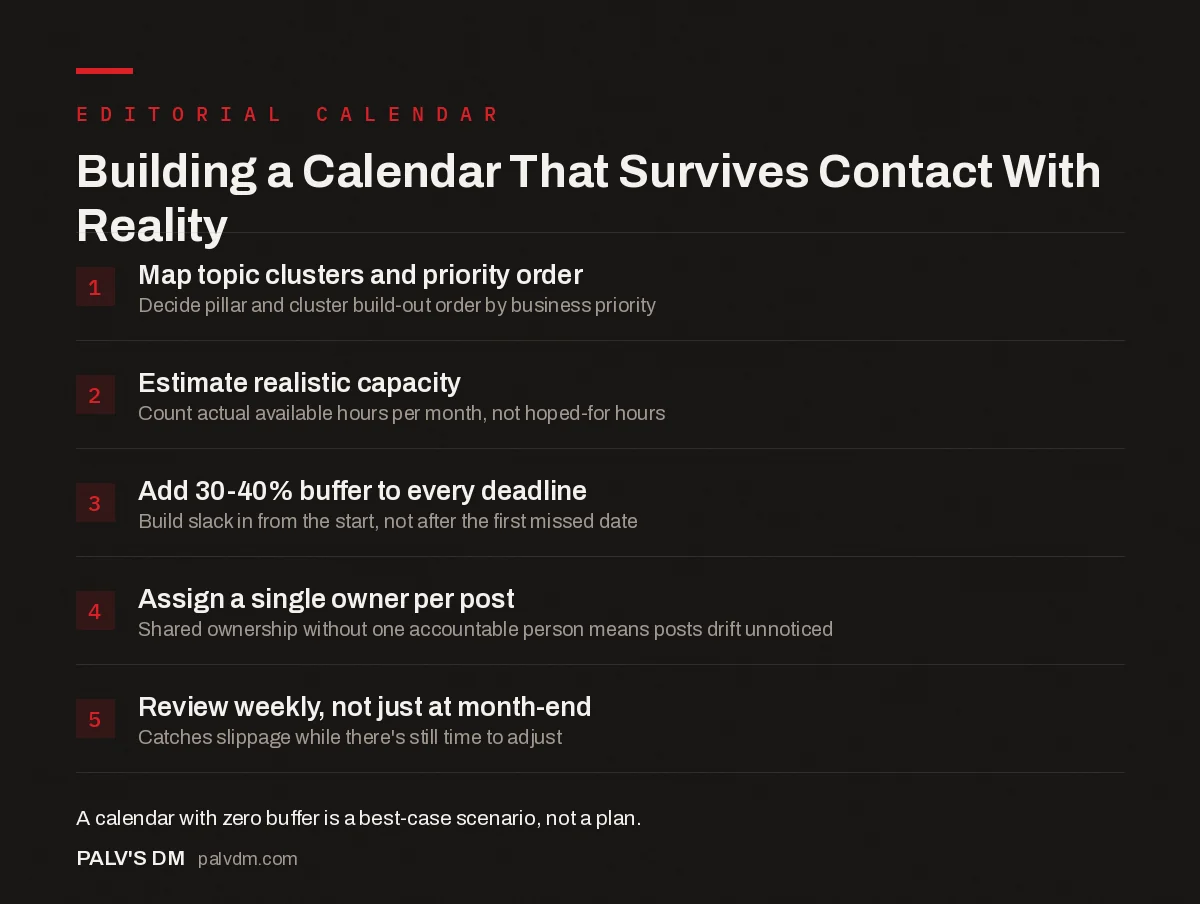
- Map topic clusters and priority order. Decide pillar and cluster build-out order by business priority.
- Estimate realistic capacity. Count actual available hours per month, not hoped-for hours.
- Add 30-40% buffer to every deadline. Build slack in from the start, not after the first missed date.
- Assign a single owner per post. Shared ownership without one accountable person means posts drift unnoticed.
- Review weekly, not just at month-end. Catches slippage while there’s still time to adjust.
How do you handle multiple writers on the same calendar?
Give each writer visibility into the whole calendar, not just their own assignments. A common failure mode on multi-writer teams is two people unknowingly producing overlapping content because neither could see what the other was assigned. A shared calendar with the cluster field visible to everyone reduces this significantly, because overlap becomes obvious at a glance rather than discovered after both drafts are finished.
Capacity planning also changes with multiple writers. Instead of one aggregate monthly number, track individual writer capacity separately, because averaging hides the reality that one writer might be at capacity while another has room for an extra post. A calendar that assigns work evenly by headcount rather than by actual available hours per person routinely overloads someone without anyone noticing until deadlines start slipping.
Should the calendar be a spreadsheet or dedicated software?
Either works, and the tool matters far less than the structure behind it. A spreadsheet with the six fields above, reviewed weekly, outperforms an expensive project management tool used as a glorified to-do list with two status options. Dedicated content calendar software becomes worth the switch once a team grows past roughly 3-4 contributors, mainly because real-time collaboration and notifications reduce the coordination overhead that a shared spreadsheet starts to struggle with at that size.
What’s the connection between the editorial calendar and content ROI?
A calendar built purely around output – hitting a post count each month – tends to drift away from what’s actually driving results. Tying the calendar to a lightweight quarterly review, where underperforming topics get deprioritised and working topics get more slots, keeps the plan connected to outcomes rather than becoming a self-sustaining production schedule disconnected from whether any of it is working. This doesn’t need to be complicated: a 30-minute review of which published posts are gaining traction, folded into the next month’s planning session, is usually enough to keep priorities honest.
How does a calendar handle a missed deadline without derailing the month?
The calendar needs an explicit rule for this, decided in advance rather than improvised under pressure: does a late post bump the next scheduled post back, get dropped from that month’s plan entirely, or get fast-tracked with reduced scope. Teams without this rule tend to let one slip cascade through the entire month, because everyone assumes someone else made the call. Deciding this rule once, as part of building the calendar, removes the need to renegotiate it every time something slips.
What tools actually fit each stage of team growth?
| Team size | Recommended tool | Why |
|---|---|---|
| Solo or 2 people | Shared spreadsheet (Google Sheets) | Zero setup cost, full visibility, no learning curve for a tool that will outgrow simple needs anyway |
| 3-5 people | Spreadsheet or lightweight board tool (Trello, Notion) | Visual status columns help at this size without the overhead of a full project management platform |
| 6-15 people | Dedicated content calendar software (Airtable, CoSchedule) | Real-time collaboration and notifications start to matter once coordination overhead grows non-linearly |
| 15+ people or multiple content streams | Full project management platform with content-specific views | Cross-team dependencies (design, SEO, legal review) need a system beyond a calendar alone |
Switching tools too early adds overhead without solving a real problem; switching too late means a spreadsheet straining under a volume of updates it was never built to handle. The signal to switch isn’t team size alone, it’s whether people are starting to miss updates because the current tool doesn’t surface them.
A worked example: recovering a calendar that’s already broken
A team running an 8-post-a-month calendar with zero buffer notices in month three that they’re consistently three posts behind, morale is dropping, and the backlog keeps growing because each month’s shortfall gets added to the next month’s target instead of adjusted for. The fix isn’t working faster. It’s resetting the plan: pause new assignments for two weeks, clear the existing backlog at a sustainable pace, then rebuild the calendar around a lower number – in this case, 5 posts a month – with 30% buffer built in from the start.
Three months later, the team is hitting 5 out of 5 consistently, with the buffer absorbing the inevitable slow week rather than cascading into a missed post. The counterintuitive part is that 5 reliable posts a month, sustained, builds more topical authority over a year than a chaotic attempt at 8 that only actually delivers 5 anyway, because the reliable version also protects editorial quality and team morale along the way. A calendar’s job is to make output predictable, not maximal.
FAQ
How far in advance should an editorial calendar be planned?
4-8 weeks ahead for most teams gives enough runway to build in proper research time and buffer, without planning so far out that priorities go stale before the post gets written. Seasonal or festive content often needs 8-12 weeks of lead time given production dependencies.
What’s the biggest reason editorial calendars fail?
Zero buffer time built into deadlines. A calendar based on best-case timing for every post has no slack for the inevitable delays – slow approvals, research taking longer than expected, illness – so one slip cascades into the rest of the month.
Should every post on the calendar have the same deadline structure?
No. A definitional post answering a simple question needs less research time than a comparison post requiring competitor analysis. Building uniform deadlines for posts of different complexity is a common cause of the buffer running out on the hardest pieces.
How often should an editorial calendar be reviewed?
Weekly, at minimum, for status and blockers. A monthly-only review catches problems too late to fix within that month’s plan, since most slippage compounds over the first two weeks before it becomes visible.
Who should own the editorial calendar?
One person, even on a small team, needs final accountability for keeping it current and flagging risk early. Shared ownership without a single point of accountability is one of the most common ways calendars quietly stop being trusted and used.
If keeping a calendar realistic and current isn’t the best use of your team’s time, PalV’s DM’s content writing service handles planning and production together, so the calendar reflects actual delivery capacity from day one. This post is part of our content strategy guide. Related reading: how to write a content brief writers can follow, how many blog posts per month you need, and content calendars for festive campaigns in India.