Festive Content Calendars for Indian Brands: A Planning Guide
Diwali planning needs 8-12 weeks lead time. See India's festive content calendar by region, the teaser-to-wind-down arc, and common mistakes to avoid.
Published: August 2026
A festive content calendar for India needs to start 45-60 days before the anchor festival, cover the full run rather than a single sale-day push, and account for regional variation – Diwali dominates nationally, but Onam, Durga Puja, and Ganesh Chaturthi carry equal weight in specific states and shouldn’t be treated as afterthoughts if your audience is concentrated there. The brands that get festive content right build a full-season narrative: teasers, gift guides, the sale window, and a post-festival wind-down, not just a discount announcement on the day itself.
When should festive content planning actually start?
For Diwali specifically, planning needs to begin in September for a November festival, with teaser content live by early October – roughly 45-60 days out. This isn’t excessive lead time; it accounts for creative production, any influencer coordination, and giving ad platforms time to optimise before the highest-intent shopping window. Waiting until two weeks before Diwali to start planning means competing for attention in an already saturated feed with rushed creative.
Regional festivals need similar lead time relative to their own dates, not relative to Diwali. A Bengal-focused D2C brand planning Durga Puja content on a Diwali timeline will miss the actual peak interest window by weeks.
What does India’s festive calendar actually look like across the year?
| Festival | Approximate timing | Planning lead time | Regional weight |
|---|---|---|---|
| Lohri / Makar Sankranti | January | 3-4 weeks | Strong in North India, Punjab, Gujarat |
| Holi | March | 4-6 weeks | Nationwide, especially North India |
| Ganesh Chaturthi | August-September | 6-8 weeks | Very strong in Maharashtra |
| Navratri / Durga Puja | September-October | 6-8 weeks | Strong in Gujarat, Bengal, and nationally |
| Diwali | October-November | 8-12 weeks | Nationwide, highest commercial intent of the year |
| Christmas / New Year | December | 4-6 weeks | Nationwide, strong in metro and Christian-majority regions |
This is a planning guide, not an exhaustive list – Onam, Pongal, Eid, and dozens of other regional and religious festivals matter enormously depending on where your customers actually are. The mistake is defaulting to a generic “pan-India” calendar built around Diwali and Holi alone when your actual audience data shows concentration somewhere else.
What should the content mix look like during a festive run?
- Teaser phase (30+ days out). Build anticipation without discounting yet – gift guides, styling or usage ideas, behind-the-scenes content that builds emotional connection to the season.
- Pre-sale phase (7-14 days out). Early access announcements, countdown content, and answering the practical questions shoppers have before the sale opens.
- Sale window. The actual promotional push, but layered with continued value content, not discount messaging alone.
- Post-festival wind-down (1-2 weeks after). Thank-you content, gift exchange or return policy reminders, and a bridge into the next seasonal moment rather than a hard stop.
Brands that publish festive content only during the sale window, and go quiet the rest of the season, get less organic reach and weaker brand association than those maintaining a lighter presence across the full run.
How do you avoid generic, forgettable festive content?
Each festival carries its own emotional register, gifting culture, and high-intent product categories – treating them all with the same template produces the same forgettable output every year. Diwali content leans into home, light, and gifting. Holi leans into colour, celebration, and often a younger audience. Durga Puja and Ganesh Chaturthi carry deep regional and devotional significance that generic “festive sale” messaging can misread badly if it’s not written with genuine familiarity with the occasion. Content written by someone who understands the specific festival, not a template swapped with a new festival name each time, is what actually differentiates.
How does festive planning differ for e-commerce versus service businesses?
E-commerce and D2C brands typically build entire campaigns around the festive purchase moment – gift guides, limited editions, bundled offers – because the buying behaviour itself spikes sharply around specific dates. Service businesses, including B2B ones, often get more value from festive content that’s less about direct promotion and more about relationship maintenance: greetings, reflections on the year, or planning-ahead content timed to when clients are themselves budgeting for the next cycle. Applying an e-commerce-style hard sale push to a service business’s festive content usually reads as forced, because the underlying purchase behaviour doesn’t spike the same way.
What does a realistic festive planning timeline look like?
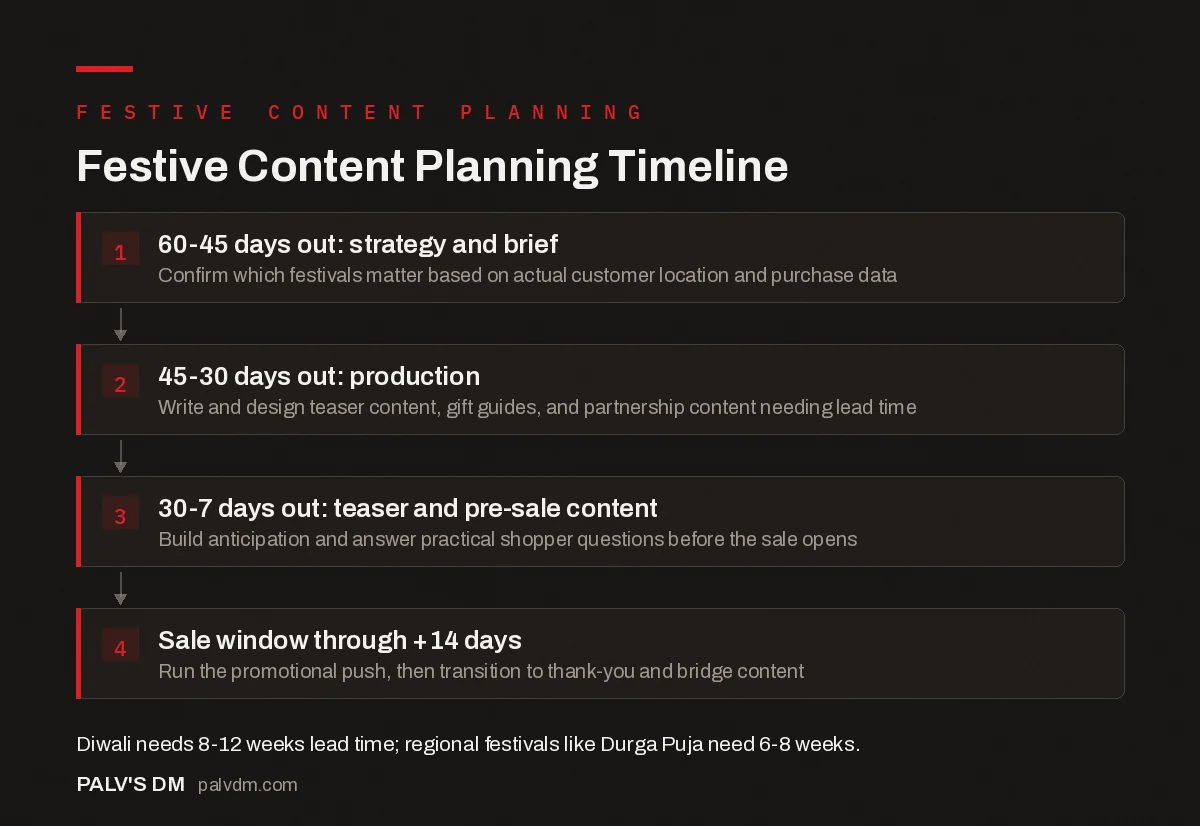
Festive Content Planning Timeline
- 60-45 days out: strategy and brief. Confirm which festivals matter based on actual customer location and purchase data.
- 45-30 days out: production. Write and design teaser content, gift guides, and partnership content needing lead time.
- 30-7 days out: teaser and pre-sale content. Build anticipation and answer practical shopper questions before the sale opens.
- Sale window through +14 days. Run the promotional push, then transition to thank-you and bridge content.
How should regional language and localisation factor in?
For brands with meaningful audience share in specific states, festive content that at least nods to regional language or local custom performs better than content that’s purely in English with a generic pan-India tone. This doesn’t necessarily mean full translation of every piece – even English-language content that references the correct regional name for a festival, its specific customs, and locally relevant gifting categories reads as more credible than a template with the festival name swapped in. Brands operating primarily through English-language content should still verify festival names, dates, and customs with a regional source before publishing, since generic assumptions about how a festival is celebrated nationally often miss real regional differences.
How do you measure whether festive content actually worked?
Track engagement and conversion across the full arc, not just sale-day revenue. A teaser post published 30 days out that drove strong organic traffic and email signups did its job even if it generated zero direct sales, because its role was building the audience that the sale-window content later converted. Judging every piece of festive content purely on same-day revenue undervalues the awareness-building content that made the sale window effective in the first place. Reviewing performance by phase – teaser, pre-sale, sale, wind-down – after the season ends gives a clearer picture than a single blended number.
Should festive content be evergreen or rewritten every year?
A hybrid approach works best. A well-built “Diwali gifting guide” pillar page can be evergreen – updated annually with current products and dates rather than rebuilt from scratch – while the supporting teaser and sale content should be genuinely fresh each year, tied to that year’s specific offers and cultural moment. Treating the entire festive calendar as disposable, one-year content wastes the compounding SEO value a well-maintained evergreen gifting guide can build over several festive seasons. For more on this trade-off, see our guide on evergreen vs timely content.
What mistakes cost brands the most during festive planning?
- Treating Diwali as the only festival that matters. A brand with a strong customer base in Maharashtra or West Bengal that only plans around Diwali and Holi leaves Ganesh Chaturthi and Durga Puja – both high-intent regional moments – completely uncovered, handing that attention to competitors who did plan for them.
- Starting creative production after the teaser phase should have already begun. Waiting until 20 days out to start writing gift guides and producing creative means launching mid-teaser-phase at best, missing the early anticipation-building window entirely.
- Copy-pasting the previous year’s calendar without checking dates. Lunar and regional festivals shift dates year to year; a calendar built by subtracting a fixed number of days from “last year’s Diwali post date” without checking the actual current-year date routinely misses the real window by one to three weeks.
- Using generic stock imagery and templated copy across every festival. Swapping only the festival name into an identical template reads as inauthentic to audiences who notice when a brand doesn’t understand the occasion it’s referencing.
- No plan for the post-festival lull. Going completely quiet after the sale window ends wastes the audience attention built up over the previous six weeks, right when a thank-you or bridge post could carry some of that momentum forward.
A worked example: planning a Diwali campaign against the calendar above
A home decor D2C brand with customers concentrated in North and West India works backward from a late-October Diwali. In early September (roughly 8 weeks out), the team locks the campaign brief and confirms which product categories get featured in the gift guide. By mid-September, creative production is underway: gift guide photography, teaser copy, and any influencer partnerships that need lead time to coordinate. The first teaser content goes live in early October, three to four weeks before the festival, focused on gifting inspiration rather than discounts.
Pre-sale content – early access signup, countdown messaging – runs the two weeks before the sale opens, and the sale window itself runs through the festival period with value content layered alongside the discount messaging, not replacing it. In the two weeks after Diwali, the brand publishes thank-you content and a returns-policy reminder, then transitions into planning for the shorter lead time needed for Christmas and New Year content five to six weeks later. The full arc, planned this way, means no phase is rushed and each piece has the lead time its production actually requires.
FAQ
How far in advance should Diwali content planning start?
Roughly 8-12 weeks before Diwali, meaning early-to-mid September for a festival that typically falls in late October or November. This allows time for creative production, teaser content, and ad platform optimisation before the highest-intent shopping window opens.
Should every Indian brand plan content around every major festival?
No. Match festival priority to where your actual customers are and what they buy, not to a generic nationwide list. A brand concentrated in Maharashtra should weight Ganesh Chaturthi heavily; a Kerala-focused brand should prioritise Onam over festivals with less regional relevance to that audience.
What’s the biggest mistake brands make with festive content?
Publishing only during the sale window and going quiet the rest of the season. Brands that maintain a lighter content presence across the full teaser-to-wind-down arc build stronger brand association and better organic reach than those doing a single discount announcement.
Can festive content be reused year to year?
Evergreen pillar content like a gifting guide can be updated annually rather than rebuilt, which compounds SEO value over multiple seasons. Time-sensitive sale and teaser content should be written fresh each year to stay relevant to that year’s actual offers and dates.
Does festive content need to be different for D2C versus B2B brands?
Yes. D2C festive content typically centres on gifting, discounts, and emotional/seasonal messaging. B2B festive content in India often works better around year-end budget cycles, corporate gifting, and planning-ahead messaging rather than consumer-style discount pushes, since the buying motivations differ substantially.
If building a full festive content calendar feels like more than your team can plan alone, PalV’s DM’s content writing service maps the full teaser-to-wind-down arc against your specific festivals and audience. This post is part of our content strategy guide. Related reading: building an editorial calendar that survives contact with reality, evergreen vs timely content, and planning SEO content six months ahead.