Evergreen vs Timely Content: Getting the Mix Right
Most calendars work best at 70-75% evergreen, 25-30% timely content. See how to compare the two and calculate the right ratio for your business.

Published: August 2026
Most content calendars work best with roughly 70-75% evergreen content and 25-30% timely content, though the exact ratio depends on your industry’s news cycle and how seasonal your customer’s buying behaviour is. Evergreen content builds compounding organic traffic over years; timely content captures short-term spikes in attention around events, trends, or seasons. Neither replaces the other – a calendar built entirely on one or the other either misses real-time opportunities or burns effort on content with a shelf life of two weeks.
What actually makes content evergreen versus timely?
Evergreen content answers a question that stays relevant regardless of the calendar date – “how does keyword research work,” “what is a content brief” – and it can be updated periodically rather than replaced. Timely content is tied to a specific moment: a product launch, a festival, a trending topic, an algorithm update. The test isn’t how the content reads, it’s whether the core question it answers is still being asked in the same way two years from now. If the answer is yes, it’s evergreen; if the content’s relevance depends on a date, it’s timely.
How do the two compare directly?
| Evergreen content | Timely content | |
|---|---|---|
| Traffic pattern | Slow build, compounds over months and years | Sharp spike, then rapid decline |
| Update frequency needed | Periodic refresh (every 6-12 months) | Usually retired or archived after the moment passes |
| SEO value over time | High – accumulates links and authority | Limited beyond the event window, unless repurposed as evergreen |
| Production lead time | Can be planned and researched thoroughly | Often needs fast turnaround to catch the moment |
| Best for | Building long-term organic search authority | Capturing attention tied to a specific trend, launch, or season |
Why do most experts recommend a 70/30 or 75/25 split?
Because evergreen content is what actually compounds. A well-ranked evergreen guide keeps generating traffic for years with occasional updates, while a piece of timely content’s value mostly evaporates once its moment passes. But a calendar with zero timely content misses real opportunities – product launches, industry news, seasonal moments – where being present in the conversation matters, even if the long-term SEO payoff is smaller. The 70/30 split reflects this: evergreen does the heavy lifting for sustained traffic, timely content keeps the brand present and relevant in the moment.
Some teams run closer to 60/40 if they’re in a fast-moving industry where staying current matters more to their audience – adtech, certain fintech niches, anything algorithm-dependent. There’s no single correct ratio; the point is that it should be a deliberate choice, not an accident of whatever felt urgent that week.
Can timely content become evergreen later?
Sometimes, with real editing rather than just a date change. A “2026 festive marketing trends” post can be restructured into an evergreen “how to plan festive marketing” guide that gets updated with fresh examples each year, keeping the accumulated links and rankings from the original while extending its useful life well past the original moment. This works when the underlying framework or process discussed is genuinely durable and only the specific examples or data were time-bound. It doesn’t work for content that was inherently about a single event with no lasting structure to build on.
What’s the risk of over-investing in timely content?
The traffic pattern is the giveaway: a spike around the event, followed by a steep drop that leaves little residual value once the moment passes, unless the piece gets deliberately converted into something more durable. A calendar dominated by timely content means constantly starting from zero – each month’s traffic depends entirely on that month’s fresh output, with little accumulating base to build on. This is a genuinely harder position to sustain than one where evergreen content keeps generating a baseline of traffic even during a quiet production month.
How do you decide the right mix for your specific business?
- Audit what’s currently driving traffic. If evergreen posts from a year ago still generate the bulk of organic visits, that’s evidence to keep investing there.
- Map your industry’s actual news cycle. A fast-moving category (AI tools, algorithm updates) justifies a higher timely share than a stable one (legal services, home renovation).
- Check your customer’s buying calendar. A gifting-heavy D2C business genuinely needs more seasonal and festive content than a B2B SaaS tool with flat demand year-round.
- Track how fast timely content decays. If last year’s seasonal posts show zero residual traffic today, that’s a sign to either reduce timely investment or start converting the strongest ones into evergreen assets.
What does a practical evergreen-to-timely ratio look like month to month?
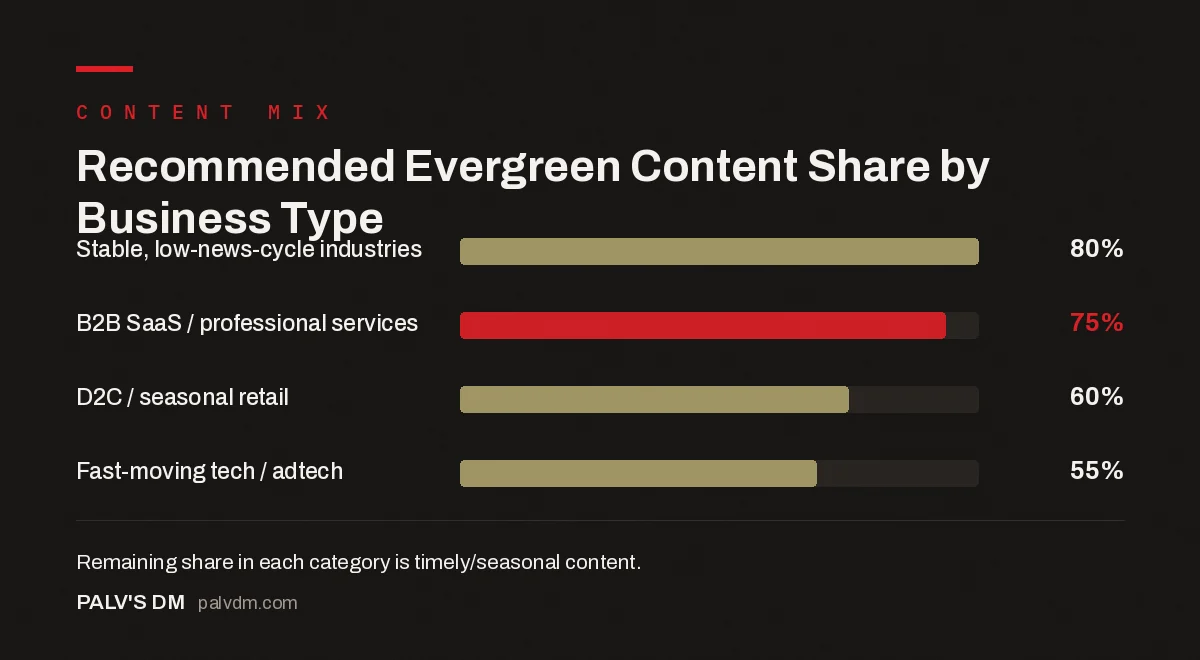
Recommended Evergreen Content Share by Business Type
| Metric | Value |
|---|---|
| Stable, low-news-cycle industries | 80% |
| B2B SaaS / professional services | 75% |
| D2C / seasonal retail | 60% |
| Fast-moving tech / adtech | 55% |
How should evergreen and timely content link to each other?
Deliberately, and in both directions. A strong evergreen pillar page on, say, editorial calendars should link out to the current year’s timely festive planning post, keeping the pillar current and giving readers a natural next step. In the other direction, timely content should link back to the evergreen pillar it supports, both for the reader’s benefit and because it passes some of the timely post’s short-term traffic spike toward a page built to hold that authority long-term. Sites that keep evergreen and timely content in separate silos, with no cross-linking, waste the compounding value that a well-connected content structure would otherwise capture.
Does timely content need less research than evergreen content?
No, and treating it that way is a common mistake. Timely content often needs to be produced faster, which is different from needing less rigour. A festive campaign post published in a rush with an unverified claim or a factual error does more brand damage in that compressed window than a slow evergreen post would, precisely because timely content typically gets more concentrated attention during its short window. Speed and quality bar are separate variables; only speed should flex for timely content.
A worked example: converting a timely post into a lasting evergreen asset
A B2B software company publishes “5 Content Marketing Trends for 2026” in January, timed to industry planning season. It performs well for six to eight weeks, picking up shares and a burst of organic traffic, then follows the expected pattern – a steep decline as the “2026” framing becomes less relevant with each passing month, even though several of the underlying points are still true a year later.
Rather than letting the post decay quietly, the team restructures it in month four: the title becomes “How to Identify Content Marketing Trends Worth Acting On” – a durable, evergreen framing – while the original five trends move into a dated example section clearly marked as illustrative rather than current. The evergreen version keeps the backlinks and search equity the original post had already earned, and the team commits to refreshing the example section annually rather than rebuilding the whole post. A year later, the evergreen version is generating steadier month-over-month traffic than the original ever did at its peak, because it’s no longer racing against its own publish date to stay relevant.
How do you tell if a specific post is a good candidate for this conversion?
Not every timely post can become evergreen, and forcing the conversion on the wrong post wastes the editing effort. Three checks help decide:
- Is there a durable question underneath the timely hook? “2026 trends” has one (how to spot trends worth acting on); “our Diwali sale is live” generally doesn’t.
- Did the original earn meaningful backlinks or rankings worth preserving? A post with zero organic traffic and no backlinks isn’t worth converting – it’s more efficient to archive it and write the evergreen version fresh.
- Can the time-bound specifics be cleanly separated from the durable framework? If removing the dates and specific examples leaves a coherent, still-useful post, it’s a strong candidate. If removing them leaves nothing, the post was inherently timely and should stay that way or be retired.
Posts that pass all three are usually worth the 1-2 hours of restructuring; posts that fail even one are better left as intentionally timely content with a planned retirement date.
FAQ
What’s the ideal ratio of evergreen to timely content?
Most experts recommend 70-75% evergreen and 25-30% timely as a starting point, adjusted for your industry’s news cycle and how seasonal your customers’ buying behaviour actually is. Fast-moving industries can justify a higher timely share; stable ones can lean more evergreen.
Does evergreen content ever need updating?
Yes, roughly every 6-12 months for most competitive topics. Evergreen means the core question stays relevant, not that the content itself should stay static – examples, data, and screenshots age even when the underlying question doesn’t.
Should a small team focus only on evergreen content?
Mostly, yes, if resources are genuinely limited. Evergreen content offers a better return on a small team’s time because it keeps generating traffic long after publication, while timely content requires repeated fresh investment to keep capturing new moments.
How do you know if a piece of content should be evergreen or timely?
Ask whether the core question will still be asked the same way in two years. If yes, write it evergreen with periodic updates planned in. If the content’s relevance depends on a specific date or event, it’s timely, and that’s fine as long as it’s a deliberate share of the calendar, not an accident.
Can timely content hurt SEO if left unupdated?
It can decay rather than actively hurt rankings – a “2024 trends” post left as-is simply becomes less relevant to current searches over time. The fix is either archiving genuinely dated content or converting the durable parts of it into an evergreen asset that gets refreshed annually.
If you’re not sure whether your current content mix leans too far in either direction, PalV’s DM’s content writing service starts with a content audit to show exactly where your evergreen and timely investment is actually going. This post is part of our content strategy guide. Related reading: content calendars for festive campaigns in India, building an editorial calendar, and content freshness: when updating helps.