Seasonality in SEO: Planning Content Six Months Ahead
Seasonal pages need to be live three to six months before the peak. How to find your real curve, why keyword tools hide it, and why the URL must never change.

Seasonal SEO content needs to be live, indexed and accumulating signals three to six months before the peak, because a page published the week demand arrives is competing from a standing start against pages Google has been evaluating for months. That lead time is not a preference. It is the sum of crawl and index lag, the period during which Google appears to test a new page at various positions, and the time it takes for internal links and any earned citations to register. Miss it and you spend the season buying the traffic you could have earned.
The corollary is less obvious and more valuable: the same URL should carry the season every year. A business that publishes a fresh page each cycle throws away the accumulated signals from the last one and restarts the lead time from zero, permanently.
How far ahead should you publish seasonal content?
Work backwards from the peak, not forwards from today. Three lead times matter and they stack.
| Content type | Publish before peak | Why |
|---|---|---|
| New page, competitive term | 5-6 months | Needs indexing, evaluation, internal links and time to earn citations |
| New page, long-tail term | 3-4 months | Less competition, so evaluation settles faster |
| Refresh of an existing seasonal page | 6-8 weeks | The URL already has history; the work is updating substance, not building authority |
| Supporting blog content | 2-3 months | Feeds internal links into the commercial page before it matters |
| Time-sensitive offer detail | 2-3 weeks | Prices and dates change late; the page around them should not |
The table assumes the page is not starting from zero domain authority. On a new site the numbers extend considerably, for the same reasons that govern how long SEO takes to show results generally: a domain with no earned links has to build the trust an established competitor already has.
How do you find your own seasonality rather than guessing it?
Two sources, used together, and neither of them is a keyword tool’s volume estimate.
Google Search Console, year on year. Search Console retains sixteen months, which gives you exactly one full year of comparison before data ages out. Compare impressions by month, by query group and by landing page. Your own history is more reliable than any market-level estimate because it reflects your actual customers. Export it annually rather than discovering the limit when you need month eighteen, and mind the comparison window traps that make a 28-day view look like a trend.
Google Trends, for shape rather than volume. Trends shows relative interest over time and can be filtered to India or to a single state, which is what makes it useful for regional demand. It will not tell you how many searches occurred. It will tell you when the curve starts rising, which is the number your publishing calendar actually needs.
Where the two disagree, trust Search Console for your own demand and Trends for category demand. A gap between them often means competitors are capturing the early part of the season while you arrive late.
Why do keyword tools hide seasonality?
Because most report search volume as a twelve-month average. A term that receives 40,000 searches in one month and almost nothing for the other eleven reports as roughly 3,300 a month — a figure that describes no month that ever existed.
Two errors follow from that averaging. Sharply seasonal terms look unattractive and get cut from the plan, and the peak itself is invisible, so the publishing date is set arbitrarily. Anyone building a calendar from averaged volume is planning against a number that flattens exactly the information they need, which is the practical case for treating seasonal volume as a separate research step and for reading volume estimates as directional rather than measured.
What belongs in an Indian seasonal SEO calendar?
The recurring windows below repeat annually, though the exact dates of the festival-linked ones move with the lunar calendar and must be confirmed each year rather than assumed.
- Festive retail season. Navratri through Diwali, falling between roughly September and November depending on the year. The largest commercial window for most consumer categories, and the reason festive ecommerce SEO work should start in spring.
- Financial year end. India’s financial year closes on 31 March, which drives tax, insurance, investment and B2B procurement queries through January to March.
- Tax filing. Individual return deadlines fall mid-year, producing a sharp, predictable spike in filing and compliance queries.
- Admissions and exams. Education demand clusters around results and admission cycles, largely in the first half of the calendar year.
- Wedding season. Broadly November to February, with a second window around spring, driving jewellery, travel, venue and apparel demand.
- Monsoon. Regionally variable and genuinely commercial for home repair, waterproofing, health and travel categories.
Regional variation matters more here than in most markets. A campaign built on a single national curve will misfire in states where the relevant festival or season sits weeks away from the national average, which is one argument for regional keyword research before the calendar is fixed.
Should you reuse the same URL every year?
Yes, in almost every case. The alternative loses ground annually and the reasons are mechanical rather than stylistic.
- Keep one evergreen URL per season. Use
/diwali-offers/rather than/diwali-offers-2026/. The URL accumulates links, internal signals and history across cycles instead of resetting. - Put the year in the title and content, not the address. A title tag and on-page copy can be updated in minutes; a URL change requires a redirect and a fresh evaluation period.
- Refresh substantively, not cosmetically. Update prices, dates, products and examples. Changing only the date is a trust problem, and freshness signals do not work as a cosmetic edit.
- Never delete the page after the season. Leave it live with off-season content — a guide, last year’s summary, a waiting list. Deleting it destroys every signal it earned and forces a full restart next cycle.
- Redirect any dated URLs you already have. Point
/diwali-offers-2024/and/diwali-offers-2025/at the evergreen URL to consolidate what they accumulated.
How do you run a pipeline that is always six months ahead?
The hard part is not knowing the lead time. It is writing October’s content in April, when nothing about October feels urgent. Four operating habits make that possible.
Fix the calendar once a year, in one sitting. List every recurring window, confirm the movable dates for the coming year, subtract the lead time from each, and put the resulting publishing dates in the calendar as commitments. A season without a publishing date attached is an intention, not a plan.
Keep one seasonal item in every sprint. A single slot per week, permanently reserved for work whose payoff is months away, produces roughly forty seasonal deliverables a year without any heroic effort. Seasonal work loses every collision with urgent work unless it holds a protected slot.
Brief in batches, write in batches. Researching four related seasonal pages together is markedly faster than researching them four months apart, and it keeps the internal linking between them coherent. Write the briefs when the research is fresh, using a standard content brief, and hold them until the publishing date.
Separate the permanent from the perishable on every page. The guide, the comparison, the buying advice — permanent. Prices, dates, stock, offer terms — perishable, and ideally isolated in a block that can be swapped in two minutes. Structuring pages that way is what turns an annual rewrite into an annual edit, and it is the practical difference between evergreen and timely content rather than a philosophical one.
What goes wrong with seasonal SEO planning?
Starting when the season starts. The most common and most expensive error. By the time internal demand signals feel urgent, the publishing window has closed and paid media is the only remaining option.
Judging the season on the season’s own data. A page published six weeks before a peak that underperforms was not a content failure; it was a scheduling failure. Attribution requires knowing which lead time applied, which requires a dated record of what shipped when — the kind maintained through a weekly sprint rhythm.
Building only for the peak. Seasonal demand has a long shoulder. Research queries begin months before transactional ones, and capturing the research phase is what puts you in consideration when the transactional phase arrives.
Treating every category as festive. Plenty of B2B and service businesses have no festive curve at all and a strong financial-year one. Publishing Diwali content for an enterprise software audience is a calendar copied from someone else’s business.
The discipline is straightforward to state and unglamorous to run: measure your own curve from Search Console, confirm the dates each year, publish three to six months ahead onto permanent URLs, refresh rather than republish, and record what shipped and when so next year’s plan is built on evidence instead of memory. That planning belongs in the twelve-month roadmap, where the lead times are visible far enough in advance to act on.
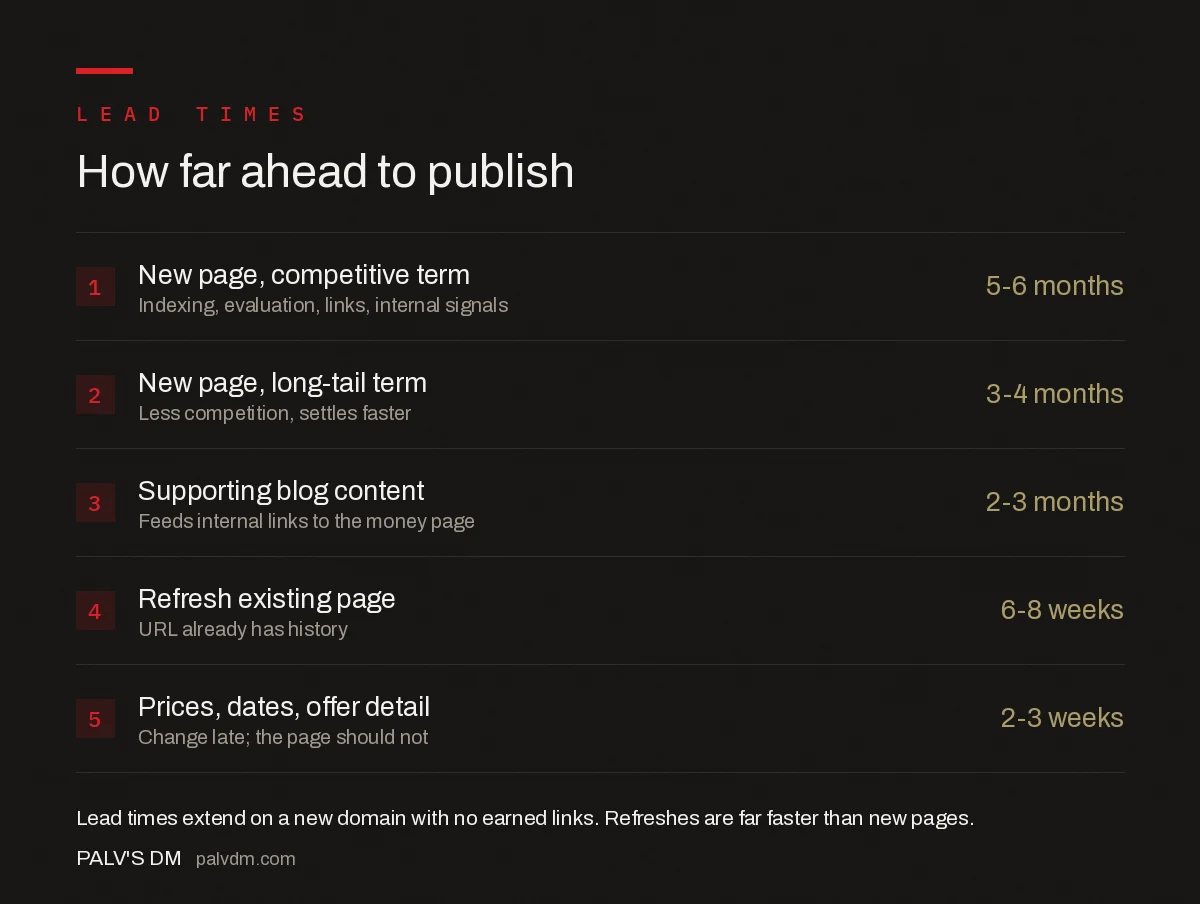
How far ahead to publish
- New page, competitive term — 5-6 months. Indexing, evaluation, links, internal signals.
- New page, long-tail term — 3-4 months. Less competition, settles faster.
- Supporting blog content — 2-3 months. Feeds internal links to the money page.
- Refresh existing page — 6-8 weeks. URL already has history.
- Prices, dates, offer detail — 2-3 weeks. Change late; the page should not.
Frequently asked questions
How far in advance should seasonal SEO content be published?
Three to six months before the demand peak. A competitive new page needs five to six months to be indexed, evaluated, internally linked and given time to earn citations. A long-tail page needs three to four. Refreshing an existing seasonal page is far quicker, at six to eight weeks, because the URL already carries history.
Should I create a new page each year for a seasonal campaign?
No. Use one permanent URL such as /diwali-offers/ and update it each cycle, putting the year in the title and content rather than the address. A dated URL restarts from zero every year and abandons the links and signals the previous page accumulated. Redirect any existing dated URLs into the evergreen one to consolidate what they earned.
How do I find seasonality in my own search data?
Compare impressions month by month in Google Search Console, which retains sixteen months of data — enough for one full year-on-year comparison before older data ages out. Then use Google Trends, filtered to India or a single state, to see the shape of category demand. Search Console describes your customers; Trends describes the market.
Why do keyword tools not show seasonal spikes?
Most report search volume as a twelve-month average. A term receiving 40,000 searches in one month and almost none for the rest of the year reports as roughly 3,300 a month, a figure describing no real month. Sharply seasonal terms therefore look unattractive and get cut, and the peak itself becomes invisible to the planning process.
What should happen to a seasonal page after the season ends?
Leave it live and change what is on it. Replace offers with a guide, a summary of the last cycle, or a waiting list. Deleting the page or returning a 404 destroys the links and signals it earned and forces a complete restart next year, including the full three-to-six-month lead time.
Which seasonal windows matter for Indian businesses?
The festive retail season from Navratri through Diwali, roughly September to November depending on the year; the financial year end on 31 March, which drives tax, insurance and B2B procurement demand from January; mid-year tax filing deadlines; admission and exam cycles; wedding season from around November to February; and regional monsoon demand. Confirm festival dates annually rather than assuming them.
Sources
- Search Console Performance report — Search Console Help
- Google Trends
- Creating helpful, reliable, people-first content — Google Search Central
Want this done on your site?
Every PalV’s DM engagement starts with a free audit of your actual website — a 12-point
crawl covering what is blocking indexation, on-page gaps against your primary keywords, speed
findings, and the three to five fixes worth making first. Delivered in two working days. No
payment details, and the findings are yours whether you hire us or not.