Content Templates That Keep Quality Consistent Across Writers
A working SEO content template locks down seven decisions before writing starts, so quality doesn't depend on which writer picked up the brief.

A content template keeps quality consistent across writers by fixing structure and standards before writing starts — the target query, the answer-first opening, required questions, named internal links, tone rules, and a data requirement — while leaving the actual sentences to the writer. Teams that skip this step end up with a house style that only exists in one editor’s head, rewritten from memory on every new hire.
The template isn’t a stylistic preference. It’s the difference between “make sure it sounds like us” — which is unteachable — and a checklist a new writer can follow on day one and produce something close to on-brand without six rounds of edits.
Why does content quality drift when multiple writers work from the same brief?
Every writer interprets an open-ended instruction differently. “Write 1,500 words on X, SEO-optimised” produces five different structures from five different writers — some front-load a definition, some bury it under three paragraphs of context, some skip internal links entirely because nobody told them which ones to use. None of these writers did anything wrong; they filled a gap with judgment, and judgment varies. A template removes the gap.
What seven sections does a working content template need?
| Section | What it locks down | Why it prevents drift |
|---|---|---|
| Target query and intent | One primary keyword, one stated search intent | Stops writers guessing what the piece is actually for |
| Answer-first opening | First 50-150 words answer the core question directly | Removes throat-clearing intros that vary wildly by writer |
| Required H2 questions | Specific question-style headings pulled from research | Ensures coverage matches what’s actually ranking |
| Internal link slots | Named URLs, not “link where relevant” | Prevents inconsistent or missing internal linking |
| Tone and banned phrases | A short list of voice rules and phrases to avoid | Keeps the brand voice recognisable regardless of author |
| Data/table requirement | At least one real table or structured element | Stops “SEO-optimised” from meaning walls of prose |
| Meta title, description, FAQ | Fixed character limits and format | Removes guesswork on the parts that show up in search results |
Seven sections a working content template locks down
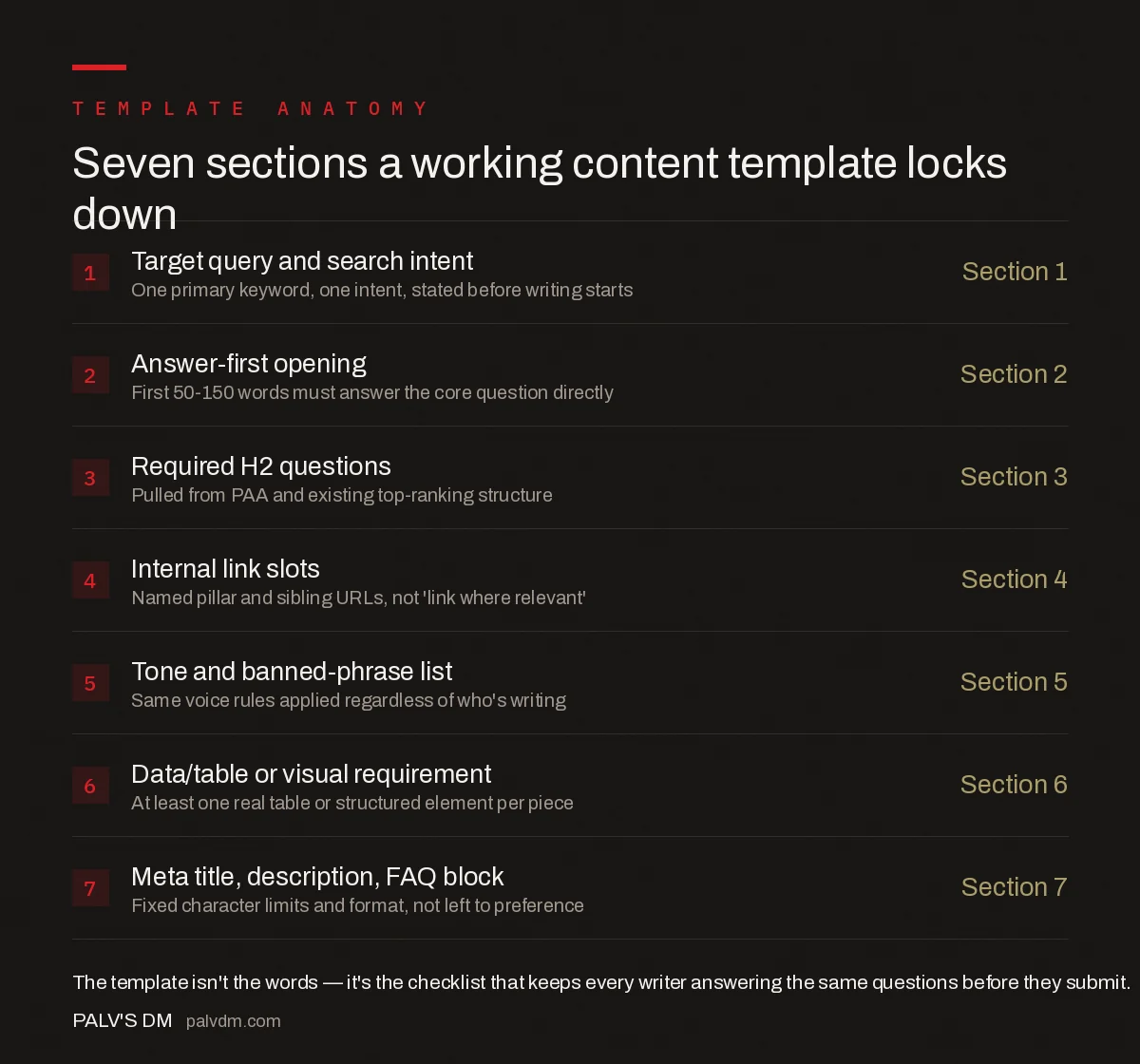
- Section 1 — Target query and intent: One primary keyword, one intent, stated before writing starts.
- Section 2 — Answer-first opening: First 50-150 words must answer the core question directly.
- Section 3 — Required H2 questions: Pulled from People Also Ask and the existing top-ranking structure.
- Section 4 — Internal link slots: Named pillar and sibling URLs, not “link where relevant.”
- Section 5 — Tone and banned-phrase list: Same voice rules applied regardless of who’s writing.
- Section 6 — Data/table or visual requirement: At least one real table or structured element per piece.
- Section 7 — Meta title, description, FAQ block: Fixed character limits and format, not left to preference.
How do you build the template without making writing feel formulaic?
The template should constrain structure, not sentences. Specify that the piece needs a comparison table before the verdict — don’t specify the wording of the verdict itself. Specify that the tone avoids hedging filler and AI-tell phrases — don’t hand writers pre-written paragraphs to fill in. The tightest templates fail here: they turn into fill-in-the-blank forms that produce interchangeable, lifeless content, which is a different failure mode from inconsistency but just as damaging to a site’s credibility.
How do you roll a template out to an existing writing team without a rewrite war?
- Pilot the template on two or three new articles before applying it retroactively to anything published.
- Share the reasoning behind each section, not just the rule — writers follow structure better when they understand what problem it solves.
- Collect friction points after the first week; a section nobody can complete as written is a template bug, not a writer failing to comply.
- Keep the banned-phrase list short and specific — a long list of vague “sound more professional” notes gets ignored, five concrete banned phrases get followed.
What are the most common template failures?
- Too vague to enforce anything. “Use a friendly, professional tone” tells a writer nothing actionable; a banned-phrase list and two example sentences do.
- Too rigid to allow judgment. Forcing every article into an identical H2 count regardless of topic complexity produces padded or truncated pieces that don’t fit their subject.
- No update mechanism. A template written once and never revisited drifts out of sync with what’s actually ranking, especially after a core update changes what “comprehensive” looks like.
- Missing the SEO mechanics, only covering style. A template that nails tone but never specifies internal link slots, table requirements, or meta length still leaves the actual ranking factors to chance.
How do you know the template is actually working?
Compare edit volume before and after rollout — a working template should cut the number of structural edits (missing links, no table, buried lead) even if line-level copyedits stay roughly the same, since those depend on individual writing skill more than the template. If structural edits haven’t dropped after a month, the template’s instructions are either too vague to follow or contradicted by what’s actually rewarded in review, and it’s worth checking which.
What does a filled-out template look like in practice?
| Template field | Example entry for a “how-to” piece |
|---|---|
| Primary keyword / intent | “how to fix a 404 error” / informational, how-to |
| Answer-first requirement | First 50-150 words state the fix directly, no scene-setting |
| Required H2s | “What causes a 404 error?”, numbered fix steps, “How do you prevent future 404s?” |
| Link slots | Pillar: /technical-seo-guide/. Siblings: /soft-404-errors/, /redirect-chains/ |
| Banned phrases | “In today’s digital landscape,” “it’s important to note,” “delve into” |
| Table/visual requirement | One comparison table: 404 vs soft 404 vs 410 |
Filling this out takes an editor or strategist ten minutes per article and removes most of the ambiguity a writer would otherwise have to guess at. The writer still decides how to phrase the fix, which examples to use, and how to sequence the argument — the template only fixes what has to be present, not how it reads.
How does a template change across content archetypes?
A how-to template requires numbered steps and a common-mistakes section a comparison template doesn’t need; a comparison template requires an upfront comparison table and a verdict a how-to piece doesn’t need. Running every archetype through one universal template either forces irrelevant sections into pieces that don’t need them, or strips out structure that a given archetype actually depends on. Maintaining two or three template variants — one for how-to and step-based content, one for comparison and decision content, one for definitional and reference content — costs little extra overhead once built, and each stays genuinely useful rather than becoming a generic checklist nobody follows closely.
Who should own the content template, and how is it enforced?
Ownership matters more than most teams initially assume. A template with no clear owner drifts — one editor quietly tolerates a missing table here, another lets a banned phrase through there, and within a few months the “template” is really just whatever each editor personally remembers to check. Assigning one person (often the SEO lead or content strategist, not necessarily the most senior writer) as the template’s owner, responsible for updating it and fielding disputes about it, keeps it from degrading into a document nobody actually references.
Enforcement works best as a checklist reviewed before a piece goes to the editor, not a set of vague expectations checked only at final review. A five-minute self-check against the template — does the opening answer the question in the first 150 words, are the required link slots filled, is there a table — catches most drift before it reaches an editor’s desk, which is far cheaper than catching it after a full edit pass has already been spent on a structurally incomplete draft.
Frequently asked questions
What’s the difference between a content template and a content brief?
A content brief is filled out once per article with specifics — the keyword, competitor URLs, target word count. A content template is the reusable structure and checklist behind every brief, defining what sections and standards apply to every piece regardless of topic.
Does using a content template hurt originality or make articles sound the same?
Only if the template dictates sentence-level wording. A good template fixes structure — required sections, link slots, tone rules — while leaving the actual argument, examples, and phrasing to the writer, which is where originality actually lives.
How often should a content template be updated?
Review it after any noticeable pattern in editing feedback — if the same fix keeps happening across multiple writers’ drafts, that’s a template gap, not a writer problem. Most teams revisit the template quarterly or after a core update changes what’s ranking.
Should every content type use the same template?
No. A how-to guide, a comparison page, and a definitional glossary entry need different structural rules even if they share the same tone and link-slot conventions. Most teams maintain two or three template variants mapped to content archetype, not one universal template.
Sources
- Creating helpful, reliable, people-first content — Google Search Central
- On-Page SEO Checklist: The Complete Working List
- Publish Dates and Updated Dates: Handling Them Honestly
- Meta Descriptions: Do They Affect Rankings, and What to Write
- Content Readability: Writing for Scanning, Not Scoring
Want this done on your site?
Every PalV’s DM engagement starts with a free audit of your actual website — a 12-point
crawl covering what is blocking indexation, on-page gaps against your primary keywords, speed
findings, and the three to five fixes worth making first. Delivered in two working days. No
payment details, and the findings are yours whether you hire us or not.