Google Ranking Factors That Still Matter (And the Ones That Never Did)
Google has confirmed far fewer ranking factors than the industry claims. Here is what is documented, what is evidenced, and what was never real.
Google has publicly confirmed roughly a dozen ranking factors. The rest of the famous “200 ranking factors” list is inference, inheritance from old blog posts, or invention. The factors with documented evidence behind them are content relevance and quality, links, user-location and language, device, and page experience signals such as HTTPS and mobile usability. Everything else sits on a spectrum from strongly evidenced (click and engagement data, site-level quality) to entirely mythical (a “keyword density” target, a domain-authority score inside Google, a bounce-rate penalty). This guide sorts them into those three buckets, and tells you which ones are worth a line in your next sprint.
The reason this matters is not academic. Agencies bill for work aimed at factors that do not exist. If you have ever been sold a package that promised to raise your “domain authority” to 40, you have paid for a metric that Google does not compute and does not read.
Where does the “200 ranking factors” number actually come from?
The number traces to a 2009 comment by Matt Cutts, then head of Google’s webspam team, who said Google used “over 200 signals.” It was a rough figure offered in passing, not a published list. Over the following decade the SEO industry reverse-engineered a list to fill the gap, and each successive blog post cited the last one. Very little of it was ever verified.
Google’s own position has been consistent since: it will not publish a list, because the systems are not a list. Ranking is produced by many interacting systems, weighted differently by query, and retrained continuously. Asking “is X a ranking factor?” often has no clean yes or no answer.
What changed recently is that we now have two unusually good evidence sources beyond Google’s own documentation. The 2023 United States Department of Justice antitrust trial put Google search engineers on the stand under oath, where systems including Navboost were described in detail. And in May 2024, a large internal Content Warehouse API documentation set became public, exposing thousands of named attributes Google’s systems store about documents. Neither tells you the weights. Both confirm that some long-denied things are at least measured.
Which Google ranking factors are actually confirmed?
These appear in Google’s own public documentation or in direct statements from Google Search staff. They are the safe ground.
| Factor | What Google says | What to do about it |
|---|---|---|
| Content relevance and quality | The dominant input. Google’s helpful content guidance is the closest thing to a published rubric. | Answer the query completely and demonstrably better than the current top ten. |
| Links | Repeatedly confirmed as a signal, though Google says its weight has fallen over time. | Earn citations from real sites. Ignore volume-based link packages. |
| HTTPS | Confirmed lightweight signal since 2014. | Table stakes. Fix mixed-content warnings. |
| Mobile usability | Mobile-first indexing means the mobile rendering of your page is the version that gets indexed. | Check what Googlebot smartphone actually renders, not what your desktop shows. |
| Core Web Vitals | Part of page experience. Google describes it as a tiebreaker, not a primary lever. See the full Core Web Vitals guide. | Fix genuinely bad scores. Do not chase 100/100. |
| Location and language | Results are personalised by country and language. | Get hreflang right if you serve multiple regions. |
| Freshness | Query-dependent. Matters enormously for news, barely at all for definitions. | Update pages where recency is genuinely part of the answer. |
Notice how few of these are levers you can pull in an afternoon. That is the point. The confirmed list is short and mostly reduces to: publish something genuinely useful on a technically sound site, and let people find reasons to cite it.
Which ranking factors are strongly evidenced but never officially confirmed?
These are the interesting ones. Google has often downplayed or declined to confirm them, while sworn testimony and leaked internal documentation indicate they exist.
Click and engagement data
For years Google representatives said clicks were too noisy to use directly in ranking. The DOJ antitrust trial made that position untenable. Testimony described Navboost, a system that stores click data on queries and uses it to adjust results, and Google’s own witnesses discussed the value of the click logs as a competitive moat.
What this does not mean is that you should buy click traffic or run bots. The systems described are aggregate and historical, operating over enormous query volumes, and are the sort of thing that fraud detection is explicitly built to catch. What it does mean is that a title and meta description that earn the click, on a page that satisfies the visit so the user does not return to the SERP, are working with the grain of the system rather than against it.
Site-level quality signals
Google has confirmed that its helpful content assessment operates partly at site level, and that a large volume of unhelpful pages can affect how the whole site is assessed. This is why publishing volume for its own sake is now a liability, and why building genuine topical authority beats publishing to a quota. Fifty thin posts do not merely fail individually; they can weigh on the twenty good ones.
The practical consequence is that pruning is a legitimate SEO tactic. Removing, consolidating or genuinely improving weak pages is often a faster route to recovery than adding more.
Author and entity signals
Google has never confirmed an “author authority score,” and has explicitly denied that a mythical “AuthorRank” exists. But its search rater guidelines lean heavily on who produced content and whether they are demonstrably qualified, and its post-update self-assessment questions ask directly: who wrote this, how was it produced, and why does it exist. Content published under no name at all cannot answer the first of those questions.
Which ranking factors were never real?
Every one of these still appears in agency proposals. None of them survives contact with evidence.
- Keyword density. There is no target percentage. There never was. Google’s systems work on meaning and context, not term frequency ratios. Writing to a density figure produces worse copy and no ranking benefit.
- Domain Authority as a Google input. DA is a third-party metric invented by Moz. Ahrefs’ DR, Semrush’s Authority Score and every equivalent are the same: useful for comparing sites against each other, invisible to Google. Google’s John Mueller has repeatedly said Google has no equivalent single domain score. What does move the needle is earning links from sites that matter.
- Bounce rate as a penalty. Google does not have access to your Analytics bounce rate and has said so. A high bounce rate on a page that answers the question in the first paragraph is a success, not a failure.
- A meta keywords tag. Ignored since 2009.
- Word count as a target. There is no minimum. Length correlates with rankings only because thorough answers tend to be longer, and correlation gets sold as causation. A 900-word page that fully answers the query beats a padded 3,000-word one.
- Submitting your site to hundreds of directories. This was already worthless before Penguin. It is now actively risky.
- LSI keywords. Latent semantic indexing is a real information-retrieval technique from the 1980s that Google does not use, and “LSI keywords” as sold by SEO tools are not a thing. Covering related concepts is genuinely useful; the terminology attached to it is nonsense.
How should you actually prioritise, given all this?
Sort your next quarter by evidence strength and by how much of it is within your control.
- Fix what blocks indexation first. A technical audit finds these. A page Google cannot crawl or index has no ranking factors at all. Check coverage in Search Console before anything else.
- Match the format the SERP is already rewarding. If the results for your target are all comparison tables and you have written a how-to, no amount of on-page work rescues it. Diagnose intent from the live results, not from the keyword.
- Earn the information gain. Ask what your page can say that none of the current top ten can. Original data, a documented first-hand test, a real client example with numbers, a named expert’s view, or simply a much better explanation of something everyone explains badly. This is what information gain means in practice. If you have no answer, you are writing a paraphrase of the SERP, and both Google’s quality systems and AI engines are increasingly good at ignoring those.
- Make the page quotable. Answer-first openings, self-contained sections, specific numbers, and a real FAQ block. This serves featured snippets and generative-engine citation at once.
- Then, and only then, worry about links. Links amplify a page that deserves to rank. They rarely rescue one that does not.
What has changed now that AI answers sit above the results?
Classic ranking factors still decide whether you are eligible to be retrieved. But eligibility is no longer the same as selection. Generative engines pick passages, not pages, and they pick on partly different signals.
Peer-reviewed work on generative engine optimisation (Aggarwal et al., KDD 2024) tested content changes against generative engine responses and found that adding relevant statistics, quotations from named sources, and citations to authoritative sources lifted a source’s visibility in AI answers by up to around 40%. The same study found keyword stuffing performed worse than doing nothing.
That is a meaningful finding, because it means the work that earns AI citations is largely the same work that earns a good ranking: be specific, be sourced, be attributable. The tactics that always felt like cheating now measurably backfire on both surfaces.
Two structural habits carry most of the weight. First, every section should make sense to a reader who lands on it alone — kill orphan pronouns like “this approach” and restate the noun, because an engine extracting that passage has no memory of the previous heading. Second, any figure you show inside a chart or infographic must also appear as text on the page, because generative retrieval cannot read images. Publishing your best data only as a graphic hides it from the engines you are trying to win.
The short version
Google’s confirmed ranking factors would fit on an index card. The evidenced-but-unconfirmed list adds click behaviour, site-level quality and author identity. The mythical list is long, expensive, and still being sold. If you are choosing where to spend a limited budget, spend it on being genuinely the most useful page on your topic, on a site that Google can crawl, written by someone with a name — and skip anything whose justification traces back to a blog post from 2013.
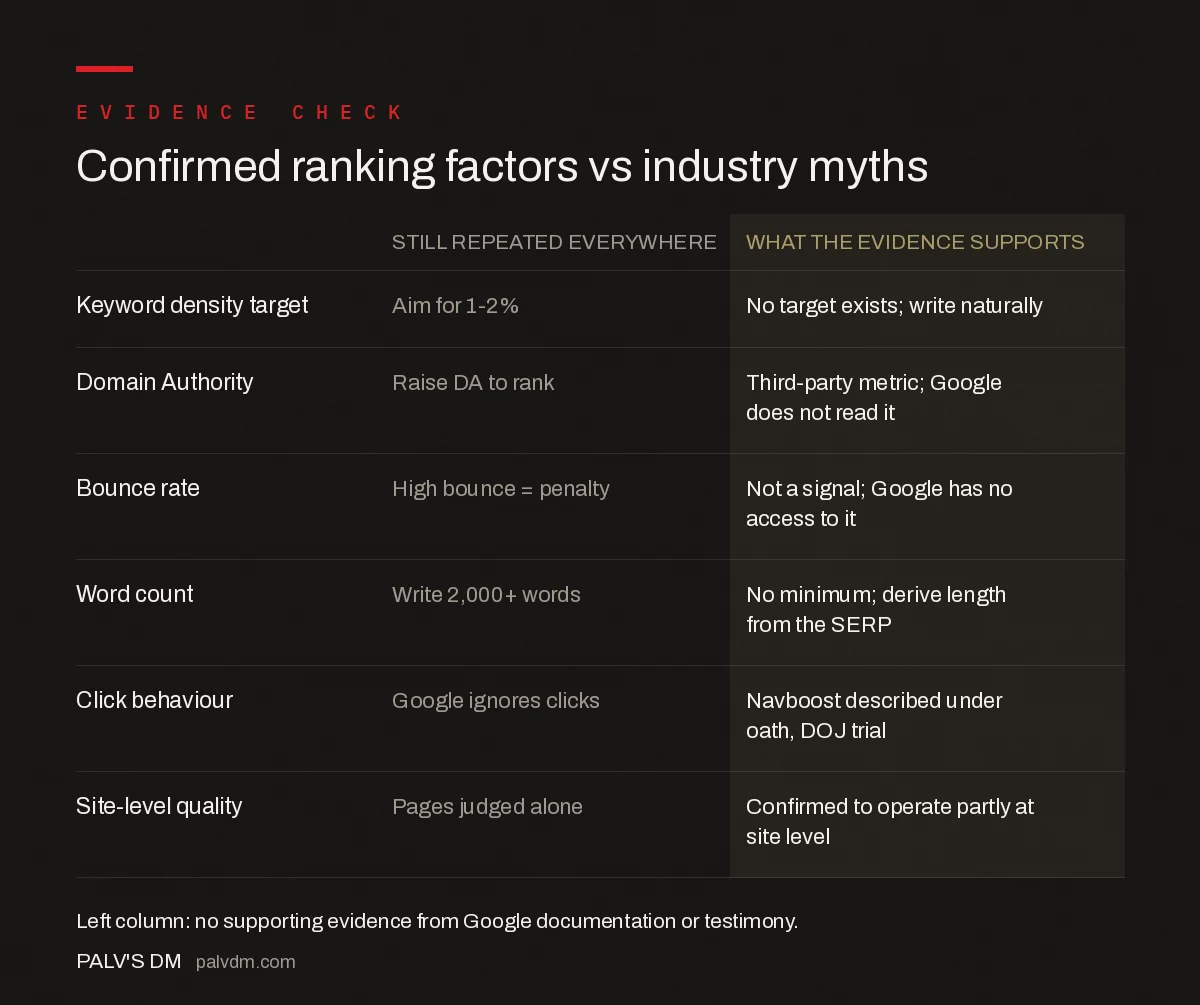
Confirmed ranking factors vs industry myths
| Still repeated everywhere | What the evidence supports | |
|---|---|---|
| Keyword density target | Aim for 1-2% | No target exists; write naturally |
| Domain Authority | Raise DA to rank | Third-party metric; Google does not read it |
| Bounce rate | High bounce = penalty | Not a signal; Google has no access to it |
| Word count | Write 2,000+ words | No minimum; derive length from the SERP |
| Click behaviour | Google ignores clicks | Navboost described under oath, DOJ trial |
| Site-level quality | Pages judged alone | Confirmed to operate partly at site level |
Frequently asked questions
How many ranking factors does Google actually use?
Google has never published a list. The widely quoted “200 ranking factors” figure comes from an offhand 2009 remark by Matt Cutts, not from documentation. Google has publicly confirmed roughly a dozen signals, including content relevance and quality, links, HTTPS, mobile usability, page experience, location, language and query-dependent freshness. Everything beyond that is inference.
Is domain authority a Google ranking factor?
No. Domain Authority is a third-party metric created by Moz, and equivalents like Ahrefs’ Domain Rating and Semrush’s Authority Score are also third-party inventions. Google does not compute or read any of them, and has stated it has no single equivalent site-wide authority score. These metrics are useful for comparing sites to each other, and useless as a ranking target.
Does bounce rate affect Google rankings?
No. Google does not have access to your Google Analytics bounce rate and has said it does not use it as a ranking signal. A high bounce rate can even indicate success, if the page answered the visitor’s question immediately and they had no reason to click further. Click behaviour within Google’s own results is a separate matter, and evidence from antitrust testimony indicates that is used.
What is the ideal keyword density for SEO?
There is no ideal keyword density, and there is no target percentage to hit. Google’s systems interpret meaning and context rather than counting term frequency. Use your primary keyword naturally in the title, the first paragraph, one heading, the URL and the meta description, then write for the reader. Optimising to a density figure produces worse copy with no ranking benefit.
Do Core Web Vitals still matter for rankings in 2026?
Yes, but modestly. Google describes page experience signals including Core Web Vitals as a tiebreaker between pages of comparable relevance and quality, not as a primary ranking lever. Fixing genuinely poor scores is worthwhile, particularly on mobile. Chasing a perfect score on a page that already passes is one of the lowest-return activities in SEO.
Does content length affect rankings?
Not directly. There is no minimum word count and no length that Google rewards. Longer content correlates with better rankings only because thorough answers to complex questions tend to be longer, and that correlation gets misread as causation. Derive your target length from what the current top-ranking pages actually do, then earn every word above that median.
Sources
- Creating helpful, reliable, people-first content — Google Search Central — Google's own quality rubric
- Google core updates and your website — includes the Who/How/Why self-assessment questions
- GEO: Generative Engine Optimization (Aggarwal et al., KDD 2024) — peer-reviewed source of the ~40% visibility finding
Want this done on your site?
Every PalV’s DM engagement starts with a free audit of your actual website — a 12-point
crawl covering what is blocking indexation, on-page gaps against your primary keywords, speed
findings, and the three to five fixes worth making first. Delivered in two working days. No
payment details, and the findings are yours whether you hire us or not.