How Long Should a Blog Post Be? Deriving It From the SERP
Google has confirmed there's no preferred word count. The five myths about blog post length that persist anyway, and the actual method for deriving the right length from the search results.
There is no ideal blog post length — Google’s own guidance explicitly rules out writing to a target word count, and the sites that get this wrong either pad short answers to hit an arbitrary number or truncate genuinely comprehensive topics to stay “concise.” The right length for a specific post is whatever it takes to fully answer the query a reader typed in, derived by reading what’s already ranking for that keyword and matching its topic coverage, not its word count. That can be 300 words for a glossary-style definition or 3,000 for a comparison guide, on the same site, in the same week.
The myths below persist because they contain a grain of truth wrapped around a wrong conclusion. Each one gets a fair hearing, then the correction.
Myth: Longer content always ranks higher
Claim: Content-length studies consistently show that top-ranking pages average more words than pages ranking lower, so writing longer should improve rankings.
Reality: That’s a correlation, not a lever you can pull. Pages that rank well tend to be longer because they cover a topic thoroughly, earn more links as a result, and keep readers engaged — the length is a side effect of comprehensiveness, not the cause of the ranking. Padding a page to match that average word count, without adding coverage a reader actually needs, doesn’t reproduce the ranking; it just adds words a reader has to scroll past.
Why the confusion exists: Studies measuring word count against ranking position are easy to run and produce a clean-looking chart. They rarely control for topic comprehensiveness, backlinks, or domain authority, so the chart implies causation the underlying data doesn’t support.
Myth: Google has a preferred or minimum word count
Claim: Somewhere around 1,500–2,000 words is “what Google wants,” and falling short of that hurts rankings.
Reality: Google addresses this directly in its own documentation on creating helpful content, listing “writing to a particular word count because you’ve heard or read that Google has a preferred word count” as a warning sign of search-engine-first content — and answers it in the same line: “No, we don’t.” John Mueller has said the same thing in Google’s Search Central office hours: “the number of words on a page is not a quality factor, not a ranking factor.”
Why the confusion exists: Early SEO tools and agencies needed a number to hand clients, and “1,500 words minimum” became a repeated rule of thumb that outlived the reasoning behind it, if there ever was reasoning behind it at all.
Myth: Short content is automatically thin content
Claim: Google penalises thin content, and thin means short, so short pages are at risk by default.
Reality: Thin content means content that lacks usefulness, not content that lacks length. A 250-word page that fully and clearly answers “what does rel=canonical do” is not thin. A 2,500-word page that restates the same three points in different words, with no new information past paragraph four, is thin regardless of its word count. Confusing the two leads to padding short, useful pages instead of fixing genuinely unhelpful long ones.
Why the confusion exists: Historically, a lot of genuinely thin content also happened to be short — scraped snippets, auto-generated summaries, doorway pages. The correlation stuck even after Google clarified the actual definition centres on usefulness.
Myth: Match the top-ranking competitor’s word count
Claim: If the #1 result for your target keyword is 2,200 words, hitting 2,200 words gives your page a comparable shot at ranking.
Reality: Mueller has compared this directly to cargo-cult thinking: having the same word count as a top-ranking article doesn’t make a page rank first, in the same way that owning a lot of USB chargers doesn’t get you to the moon. What matters is whether the page covers the same ground with the same or better clarity, structure, and evidence — the word count is a downstream artefact of that coverage, not a target to hit independently.
Why the confusion exists: Word count is the easiest thing to measure about a competing page. Depth, originality, and structure take actual reading to assess, so teams under time pressure default to the number that’s fastest to check.
Myth: Every page on a site should hit a consistent word count target
Claim: Setting a house style of “every blog post is 1,800+ words” keeps content quality consistent across writers.
Reality: Consistency in depth doesn’t require consistency in length, because different query types need different amounts of content to answer completely. A definitional page answering “what is a canonical tag” needs far less than a decision guide comparing five hosting providers on twelve criteria. Forcing both to the same word count either bloats the short one or truncates the long one.
What length ranges actually show up by content type?
These are practical starting ranges based on what typically satisfies each query type, not a target to hit exactly — the SERP for your specific keyword is still the better source of truth.
| Content type | Typical range | Why |
|---|---|---|
| Glossary / definitional term | 300–700 words | The query wants a direct, complete answer, not a tour |
| How-to / step-by-step | 1,000–1,800 words | Enough for prerequisites, steps, and common mistakes without padding |
| Comparison / decision guide | 1,200–2,200 words | Needs to cover multiple options fairly across shared criteria |
| Comprehensive pillar guide | 2,000–4,000+ words | Intentionally covers a topic’s full breadth and links to sub-topics |
| News or update post | 300–800 words | Timeliness matters more than exhaustiveness |
How do you derive the right length from the SERP?
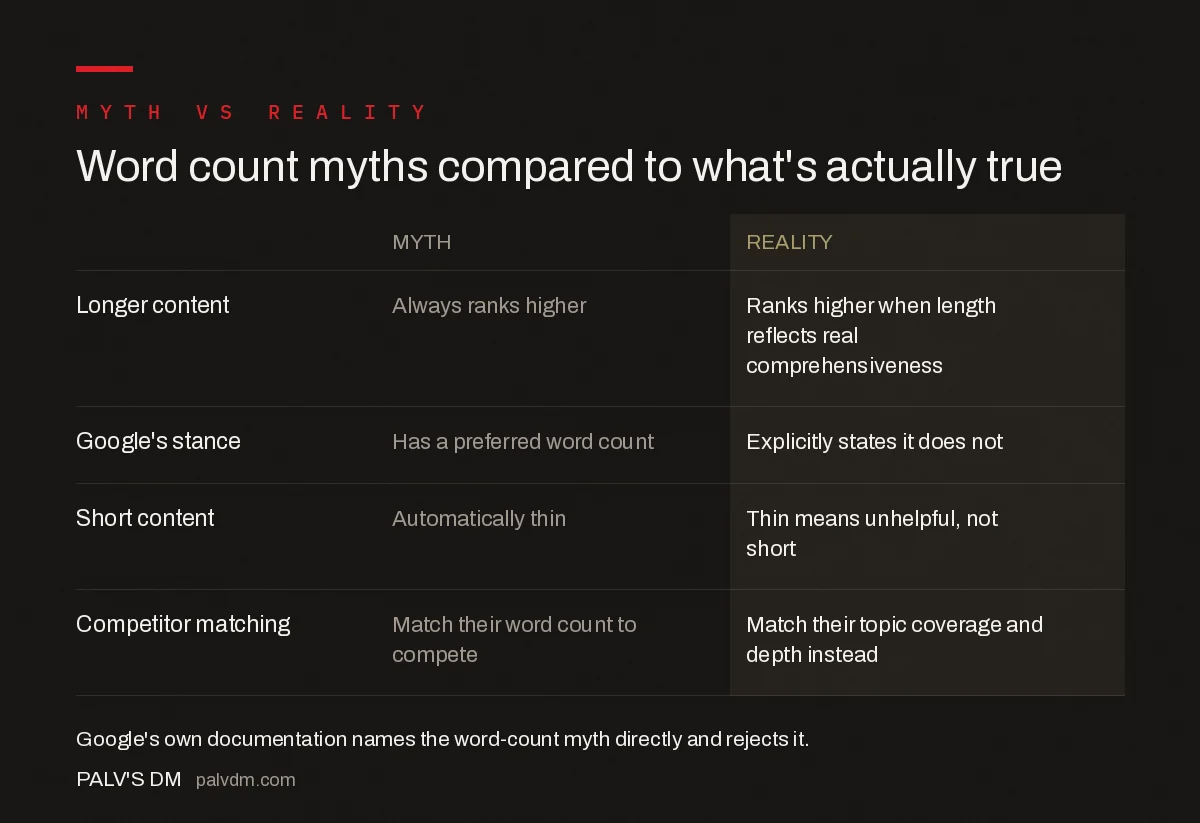
Word count myths vs reality
| Myth | Reality | |
|---|---|---|
| Longer content | Always ranks higher | Ranks higher when length reflects real comprehensiveness |
| Google’s stance | Has a preferred word count | Explicitly states it does not |
| Short content | Automatically thin | Thin means unhelpful, not short |
| Competitor matching | Match their word count to compete | Match their topic coverage and depth instead |
With the myths out of the way, the actual process is short: search the target keyword, open the top 5 to 10 organic results, and read them — not skim, read — noting every subtopic, question, and angle each one covers. Whatever subtopics show up across most of those results form the floor for what a competitive page needs to address. That floor is what determines length, not a number chosen in advance.
From there, add length only where it earns its place: a subtopic none of the current top results cover well, a clearer explanation of a step they gloss over, an example or a table that makes an abstract point concrete. Anything added beyond that is padding, and readers — and increasingly AI systems summarising search results — can tell the difference between coverage and filler.
Does length matter differently for AI Overviews and answer engines?
The unit that gets cited changes, not the underlying rule. AI Overviews, ChatGPT, and Perplexity tend to pull a specific paragraph, list, or sentence that answers the query cleanly, rather than crediting a page for its total length. A 3,000-word guide with a tightly written, self-contained answer near the top has a better shot at being lifted than the same guide with the direct answer buried under four sections of throat-clearing. Length still serves comprehensiveness for the human reader who scrolls past the AI answer to verify it, but the part that gets quoted is judged on clarity and completeness in isolation, not on how long the surrounding page is.
This is one more reason padding backfires twice over: it dilutes the standalone answer an AI system is looking to extract, and it adds nothing for the reader who lands on the page directly. Writing the complete, citable answer first and building supporting depth around it serves both audiences at once.
Frequently asked questions
Does Google have a preferred word count?
No. Google’s own helpful-content documentation lists “writing to a particular word count because you’ve heard Google has a preferred word count” as a warning sign of search-engine-first content, and states directly: “No, we don’t.” There is no minimum or target word count in any official Google ranking guidance.
Is longer content always better for SEO?
No. Longer pages often rank well because comprehensive coverage tends to require more words, not because length itself is rewarded. A page that pads a short answer to hit a word count typically performs worse than a shorter page that answers the query completely and stops.
What counts as thin content if it’s not about word count?
Thin content is content that lacks usefulness to the reader, regardless of length. A 200-word page that fully answers a narrow question isn’t thin. A 2,000-word page padded with repeated points and no new information is thin, even though it’s long.
Should I match the word count of the top-ranking page for my keyword?
Not directly. Matching a competitor’s word count without matching the depth, structure, or usefulness of their content doesn’t reproduce their ranking. Use competitor length as a rough signal for topic scope, not as a target number to hit.
How do I figure out the right length for a specific post?
Search the target keyword, read the top 5 to 10 ranking pages, and note which subtopics all of them cover. That shared coverage is the floor. Add length only where it covers a subtopic the current results miss or explains something more clearly than they do.
Sources
- Creating helpful, reliable, people-first content — Google Search Central
- Google Says Word Count Not a Quality Factor — Search Engine Journal, citing John Mueller
- On-Page SEO: The Complete Checklist
- Content Templates That Keep Quality Consistent Across Writers
- Keyword Density Is a Myth. Here’s What Replaced It
Want this done on your site?
Every PalV’s DM engagement starts with a free audit of your actual website — a 12-point
crawl covering what is blocking indexation, on-page gaps against your primary keywords, speed
findings, and the three to five fixes worth making first. Delivered in two working days. No
payment details, and the findings are yours whether you hire us or not.