Trends & Industry Developments
What Happened to Publisher Traffic: Reading the Decline Data
Publisher traffic decline explained: why zero-click SERPs and AI Overviews hit informational content hardest, and how to diagnose the pattern in your own data.
Publisher traffic is declining because the search results page increasingly answers the question itself, either through a featured snippet, a zero-click answer box, or an AI Overview, before the user ever reaches a website. This isn’t one event or one Google update. It’s a compounding shift in how search results are structured, and it hits informational, explainer-style content hardest while leaving transactional and deeply specific content comparatively more intact. The publisher traffic decline pattern shows up consistently across content sites, news publishers, and B2B blogs we work with, and it follows a recognisable shape once you know what to look for.
Key takeaway
- Publisher traffic decline is concentrated in top-of-funnel, informational content that AI Overviews and answer boxes can summarise directly on the results page.
- The decline is not uniform: transactional, comparison, and highly specific pages retain more of their organic traffic than generic explainers.
- Being cited by an AI system and receiving a click are now two separate outcomes — visibility no longer guarantees a visit, which changes what “success” should mean for a page.
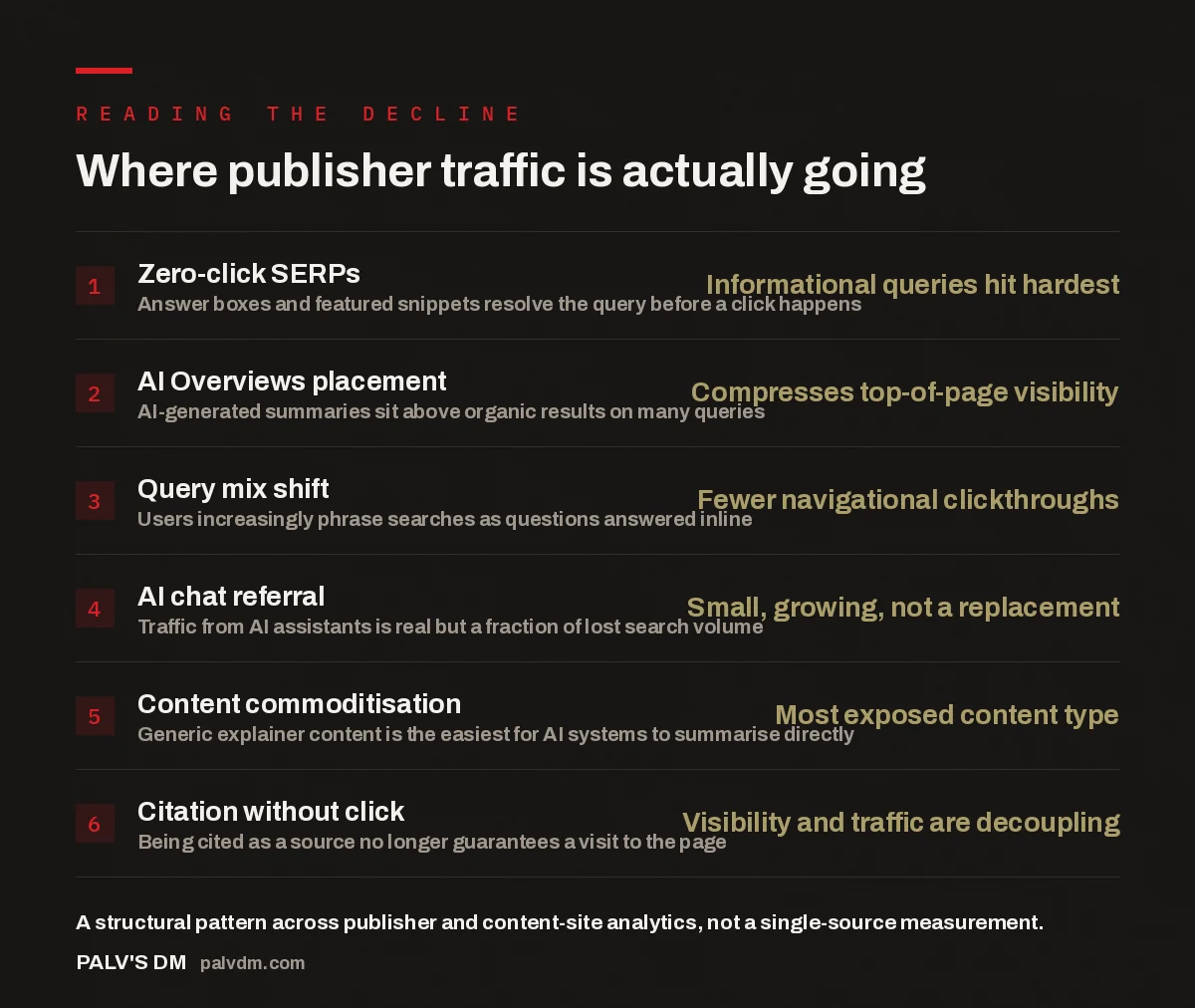
Where publisher traffic is actually going
- Zero-click SERPs — Informational queries hit hardest. Answer boxes and featured snippets resolve the query before a click happens.
- AI Overviews placement — Compresses top-of-page visibility. AI-generated summaries sit above organic results on many queries.
- Query mix shift — Fewer navigational clickthroughs. Users increasingly phrase searches as questions answered inline.
- AI chat referral — Small, growing, not a replacement. Traffic from AI assistants is real but a fraction of lost search volume.
- Content commoditisation — Most exposed content type. Generic explainer content is the easiest for AI systems to summarise directly.
- Citation without click — Visibility and traffic are decoupling. Being cited as a source no longer guarantees a visit to the page.
What does the publisher traffic decline actually look like on a site?
Pull the organic landing page report for almost any content-heavy site over the last couple of years and a pattern repeats: clicks are flat or down even where impressions in Search Console hold steady or grow. That gap between impressions and clicks is the tell — the page is still being surfaced for the query, it’s just visited less often. In the accounts we audit, this shows up most sharply on pages built to answer a single, well-defined question — “what is X,” “how does Y work,” “when should you Z.” Those are exactly the query types a featured snippet or an AI Overview can resolve in two or three sentences without sending anyone further.
What doesn’t decline nearly as fast is anything requiring judgment, comparison, or first-hand experience — product reviews with real testing notes, pricing pages, tools, and pages answering a question too specific for a generic AI summary to safely resolve. If your dashboard shows every category falling at the same rate, that’s usually a technical or indexing issue rather than the AI-driven shift described here — worth ruling out before assuming the cause is search behaviour.
Why is AI Overviews the biggest single factor?
AI Overviews sit above the organic results for a large and growing share of informational queries, and they’re built to synthesise an answer from multiple sources so the user doesn’t have to open any of them. That’s a structural difference from the “ten blue links” era, where even a featured snippet left nine more results competing for attention below it. An AI Overview effectively becomes the first, and sometimes only, thing a user reads. Publishers who built their acquisition strategy around ranking for broad informational keywords are absorbing most of the decline, because that’s precisely the content AI Overviews are designed to replace at the point of search.
This doesn’t mean informational content stops being worth producing — it means the job it does has changed. A well-written explainer can still be the source an AI Overview cites, which keeps a brand present in front of the user even without a click. That’s a different kind of value than a pageview, but it isn’t zero. Treating citation as a legitimate, trackable outcome alongside clicks is one of the more useful adjustments we make when a client’s traffic dashboards start looking grim.
The mistake we see most often is treating a traffic graph going down as proof that content stopped working. Often it means the content is working exactly as well as before — it’s just that “working” no longer automatically produces a click.
Palash, Founder, PalV’s DM
Is all of the decline caused by AI search, or is some of it Google’s own SERP design?
It’s both, and separating them matters because the fixes differ. Some decline predates AI Overviews entirely — featured snippets, “People also ask” boxes, knowledge panels, and local packs have been compressing organic real estate for years, well before generative AI entered the results page. AI Overviews layered on top of an already-shrinking organic footprint rather than starting the shrinkage from zero.
The genuinely new variable is how much of the answer the user sees before deciding whether to click through. A traditional featured snippet pulls one passage from one source and usually still invites the user to “learn more.” An AI Overview synthesises across several sources into a single, self-contained response — a meaningfully higher bar for a page to clear before it’s worth a click. If you’re diagnosing your own site’s decline, checking how much lost traffic tracks with the rollout of AI Overviews in your market versus a longer-running erosion from SERP features generally is a useful first step, and our rundown of what actually changed in search this year walks through that timeline.
How much of the lost traffic is coming back as AI referral traffic?
Not much, proportionally, at least not yet. Referral traffic from AI chat assistants is real and growing in the accounts we track, but it’s a fraction of what’s been lost from organic search — the volumes aren’t remotely comparable. Visitors who do arrive via an AI assistant tend to behave differently once they land: they’ve usually had a question partially answered before clicking through, so they arrive further along in their own research process. That’s worth measuring separately rather than lumping it in with organic traffic and concluding AI referrals are “replacing” what was lost. Our piece on how AI referral traffic converts differently goes into what that visitor behaviour looks like.
The realistic framing is that AI referral traffic is a new, additive channel worth tracking and optimising for in its own right, not a replacement mechanism for organic decline. Treating it as the latter sets expectations that the numbers won’t support.
Which content types are actually protected from the decline?
Across the sites we work with, a consistent pattern holds: content requiring a decision, a comparison, or a transaction retains far more organic traffic than content that only requires an answer. Product and service comparison pages, pricing pages, tools and calculators, and pages built around commercial intent still pull clicks, because the user’s underlying goal isn’t fully satisfied by a summary — they still need to act on the page itself. The query-to-outcome gap is smaller on transactional intent, so AI Overviews and zero-click features are correspondingly less aggressive there.
Content built on genuine first-hand experience, original data, or a point of view that can’t be safely flattened into a generic AI summary also tends to hold up better. This is closely related to why earned media performs so well in AI citations — third-party, independently reported coverage is harder to substitute with a synthesised answer than a brand’s own generic explainer. If your content mix is heavy on broad, easily-summarised top-of-funnel explainers, that’s the segment to expect the steepest decline in and the one most worth re-evaluating.
What should a publisher actually do about the traffic decline?
Start by separating diagnosis from reaction. Pull landing page data segmented by query intent — informational versus transactional versus navigational — over the last 18 to 24 months, and look at impressions alongside clicks rather than clicks alone. If impressions are stable or growing while clicks decline specifically on informational pages, that confirms the zero-click pattern rather than a ranking or technical problem, and the response should be different in each case.
- Audit which pages are losing clicks while holding or gaining impressions — that’s the AI Overview and zero-click signature, and it points to a demand problem, not a ranking problem.
- Shift new content investment toward pages that require a decision or transaction, where a summary can’t fully substitute for the page.
- Start tracking citation in AI answers as its own metric alongside clicks, rather than treating a drop in traffic on a well-cited page as pure failure.
- Check technical fundamentals — crawlability, structured data, and clear, extractable answers early in the page — since being a citable, trustworthy source is now a distinct goal from ranking well.
This is precisely the shift our AI visibility work is built around: measuring and improving how a brand shows up across AI answers and citations, not just where it ranks on a traditional results page.
Get a clear read on your own decline
If you can’t tell whether your traffic drop is a zero-click pattern, a ranking issue, or something technical, that’s exactly what an AI visibility review is for.
FAQ
Is publisher traffic decline the same thing as a Google algorithm penalty?
No. A penalty or algorithm update typically shows up as a drop in both impressions and clicks together, often on a specific date tied to a known update. Publisher traffic decline driven by zero-click search and AI Overviews shows up as clicks falling while impressions stay flat or grow — the page is still ranking, it’s just being clicked less because the answer is visible without a visit.
Which pages lose the most traffic to AI Overviews?
Broad informational pages answering a single, well-defined question — definitions, “how does X work” explainers, and generic how-to content — lose the most, because that content is easiest for an AI system to summarise safely. Comparison pages, pricing pages, tools, and content built on original data or first-hand experience tend to retain more traffic.
Should publishers stop producing informational content altogether?
Not necessarily, but the goal for that content needs to change. Informational content can still earn citations in AI answers, which keeps a brand visible to searchers even without a click. The mistake is expecting the same pageview return from that content that it delivered five years ago, and not tracking citation as a separate, legitimate outcome.
How can I tell if my traffic drop is AI-driven or a technical problem?
Check Search Console impressions against clicks by page and query intent. If impressions are stable or rising while clicks fall specifically on informational queries, that points to zero-click and AI Overview behaviour. If impressions themselves are falling across the board, including transactional pages, that’s more likely a crawling, indexing, or ranking issue and needs a technical audit first.
Is AI referral traffic going to replace the organic traffic that’s been lost?
Not at current volumes. AI referral traffic is real and growing, but it remains a small fraction of what informational content has lost to zero-click search and AI Overviews. It’s worth treating as an additive channel with different visitor behaviour, not as a mechanism that will offset organic decline on its own.
Short version: publisher traffic decline isn’t a mystery or a single algorithm event — it’s the cumulative effect of answers moving onto the results page itself, first through featured snippets and zero-click features, then accelerated by AI Overviews. Informational content is hit hardest because it’s the easiest to summarise; transactional and highly specific content holds up better because a summary can’t finish the job for the user. The right response is to diagnose which pattern you’re actually seeing in your own data, stop measuring every page purely by clicks, and start treating citation in AI answers as a real, trackable outcome alongside traffic.