Trends & Industry Developments
Earned Media Dominates AI Citations: The Strategic Consequence
Earned media ai citations are outpacing owned content in AI Overviews and ChatGPT. Here's why, and how to build earned media into your AI visibility plan.
Earned media — coverage, mentions, and links you did not pay for or publish yourself — is showing up disproportionately often in AI citations, compared to how often brand-owned pages get cited for the same queries. That is the strategic consequence worth planning around: AI Overviews, ChatGPT, and Perplexity are not simply re-ranking your website the way Google search once did. They are assembling answers from a mix of sources, and third-party, independently published content keeps winning a larger share of that mix than the page you control. If your visibility plan is still built entirely around owned content ranking well, earned media ai citations are the gap in that plan.
Key takeaway
- AI engines favour content they judge as independently verified — third-party publications, forums, and press mentions tend to get cited more consistently than a brand’s own product or service pages.
- This is not a ranking algorithm quirk you can outsource to on-page SEO alone; it changes what “visibility work” needs to include — digital PR, contributed content, and community presence, not just website copy.
- The practical response is a citation-worthiness audit of where your brand already gets mentioned, followed by a deliberate push to be quoted, referenced, or covered in places an AI model is likely to pull from.
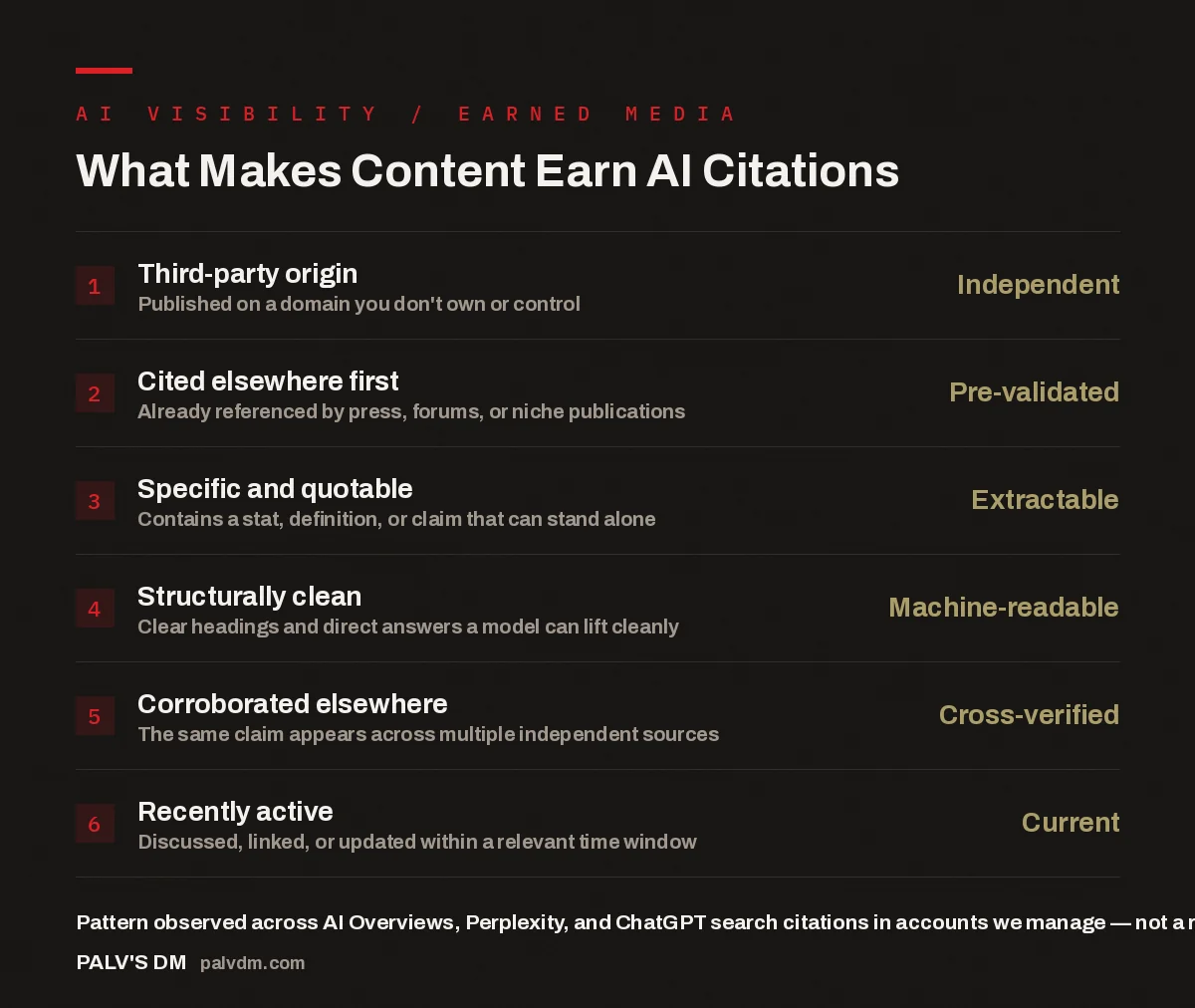
What Makes Content Earn AI Citations
- Third-party origin — Independent. Published on a domain you don’t own or control.
- Cited elsewhere first — Pre-validated. Already referenced by press, forums, or niche publications.
- Specific and quotable — Extractable. Contains a stat, definition, or claim that can stand alone.
- Structurally clean — Machine-readable. Clear headings and direct answers a model can lift cleanly.
- Corroborated elsewhere — Cross-verified. The same claim appears across multiple independent sources.
- Recently active — Current. Discussed, linked, or updated within a relevant time window.
What does “earned media” mean in the context of AI citations?
Earned media is any mention of your brand, product, or claim that appears on a platform you don’t own and didn’t pay to place there directly — a journalist’s article, a review site’s comparison, a Reddit thread, an industry newsletter, a Wikipedia reference, a podcast transcript. It sits opposite owned media (your website, your blog, your product pages) and paid media (ads, sponsored placements). In classic SEO, earned media mattered mostly as a source of backlinks that lifted your own pages up the rankings. In AI search, earned media has a second, more direct job: it is increasingly the thing that gets cited or summarised in the answer itself, sometimes instead of your page rather than in support of it.
That distinction matters because it changes the unit of success. Ranking your homepage for “best project management software” used to mean the click happened on your terms. When an AI engine answers that same query by synthesising a comparison roundup and a handful of forum threads, your product might be named in the answer without your website ever being the cited source — or visited at all.
Why are AI engines citing earned media more than brand-owned pages?
The pattern that shows up repeatedly across the accounts we work on is a trust and verification problem, not a technical one. A brand’s own page describing its own product is, structurally, a single unverified source making claims about itself. A third-party comparison site, a journalist’s writeup, or a long-running community thread carries an implicit layer of independent judgement — someone other than the brand decided this was worth writing about or discussing. AI systems built to reduce the risk of repeating marketing claims as fact lean toward sources that look independently corroborated, because that reduces their own exposure to citing something that turns out to be self-serving or wrong.
There’s also a practical, structural reason: earned media sources frequently already aggregate and compare, which is exactly the shape an AI answer needs. A “best X for Y” article has already done the work of naming several options and describing tradeoffs — that’s a near-complete draft of an AI Overview. Your own product page, by contrast, only ever argues for itself. When a model is assembling a comparative or evaluative answer, a page that only speaks for one option is less useful as raw material than a page that already compares several.
How do AI Overviews, ChatGPT, and Perplexity actually decide what to cite?
None of the major AI search systems publish their citation-selection logic in full, so anything specific here should be read as an observed pattern rather than a documented rule. Across the surfaces we track, three tendencies hold up consistently:
- Multiple corroboration beats single-source strength. A claim repeated across several independent pages tends to surface more reliably than the same claim made once, even if that one source is authoritative.
- Extractable structure gets pulled first. Content with clear headings, direct definitions, and scannable lists is easier for a model to lift cleanly, which is one reason third-party “best of” and comparison content — which is usually built exactly this way — performs well as citation material.
- Recency and activity matter more than raw domain authority. A recently updated, actively discussed thread or article can outperform an older, higher-authority page if the older page hasn’t been revisited or referenced lately.
This is directionally consistent with what the wider industry has reported about the collapsing overlap between traditional ranking position and AI citation — being #1 in classic search results no longer reliably predicts being the source an AI answer quotes. Our post on the collapsing overlap between ranking and being cited goes into that shift in more depth.
Owned content vs earned media: which gets cited more often?
Neither type is cited exclusively — most AI answers blend both — but the two behave differently on the traits that seem to matter for citation. The table below lays out the practical difference we see when auditing which sources AI engines pull from for a given brand’s queries.
| Trait | Owned content (brand website) | Earned media (third-party) |
|---|---|---|
| Perceived independence | Low — brand describing itself | High — outside party’s assessment |
| Comparative framing | Rare — usually single-option focused | Common — often already names alternatives |
| Control over messaging | Full control | Little to no control |
| Effort to influence | Direct — you write and publish it | Indirect — requires outreach, PR, or organic mentions |
| Typical AI citation role | Supporting detail or specs | Primary claim or recommendation source |
Owned content still has a job — it’s where the deepest, most accurate detail about your product lives, and AI systems do pull from it for specifications, pricing, and feature confirmation once a brand is already in the running. What owned content rarely does on its own is put you in the running in the first place for comparative or evaluative queries. That’s earned media’s job.
Publishing about yourself has never been the same as being written about by someone else. AI search just made that difference measurable — and expensive to ignore.
Palash, Founder, PalV’s DM
What does this mean for a brand that has invested heavily in owned content?
It doesn’t mean the owned-content investment was wasted — it means it was incomplete. A well-built blog, a clear product documentation set, and a strong on-site FAQ still matter: they’re what an AI system checks against once your brand is already part of the conversation, and they’re still what a human clicks through to once they’ve decided to evaluate you seriously. The gap is upstream of that. If nothing independent exists to put your brand into the comparison set in the first place — no review, no roundup mention, no forum recommendation, no press coverage — owned content alone has a harder time getting you cited for the queries where a buyer is still deciding between options.
This also connects to a broader shift worth understanding: as AI answers absorb more of the informational query volume, direct traffic to publisher and brand websites has been declining for exactly the kind of content that AI can now summarise instead of linking to. Our analysis in what happened to publisher traffic covers that pattern in detail — it’s the flip side of the same dynamic driving earned media’s advantage in citations.
How should a marketing team respond to earned media’s citation advantage?
The practical response splits into three streams of work, and none of them replace on-site SEO — they sit alongside it.
- Audit where you already get mentioned. Search for your brand name across review sites, comparison articles, forums, and press coverage, and note which of those sources actually show up when you query AI engines about your category. This tells you which existing earned-media assets are already working and which categories of mention you’re missing entirely.
- Pursue placements that are structurally citable. Not all press coverage helps equally — a passing brand mention in a general news article is less useful than being named and described in a comparison, “best of,” or how-to piece where the model can extract a specific, attributable claim about you.
- Make it easy for third parties to describe you accurately. Provide press kits, clear product data, and direct answers to the comparison questions journalists and reviewers are likely to ask. The easier it is for an outside writer to get your positioning right, the more likely their coverage becomes citation material rather than something you have to correct later.
This is also where structured visibility tracking earns its keep — you can’t manage what you’re not measuring, and most teams are still measuring only their own rankings. Our piece on building a multi-surface visibility scorecard walks through tracking citation presence across AI surfaces alongside traditional rank data, and the AI visibility tracking gap covers just how few marketers are doing this consistently yet — which is itself an opening for the ones who start.
What does an earned-media-first strategy actually involve day to day?
In practice, it looks less like a single campaign and more like an ongoing operating rhythm: identifying comparison and roundup content in your category that doesn’t yet include you, pitching journalists and niche publications with genuinely useful data or commentary rather than generic press releases, and contributing to the communities where your buyers already discuss options. None of this is new activity — digital PR and community engagement have existed for years. What’s changed is the stakes: this work now directly feeds what an AI engine says about you when a prospect asks, rather than just feeding backlinks that helped your own pages rank.
The broader context for why this shift is happening now is covered in our state of search 2026 overview, which looks at how search behaviour overall has moved toward AI-mediated answers this year.
Where this fits into your visibility plan
Earned media strategy for AI citations isn’t a separate project from AI visibility work — it’s a core part of it. If your AI visibility efforts are still limited to schema markup and content structure on your own site, you’re optimising the smaller half of what actually drives citations.
Get an AI visibility audit that covers earned media, not just your website
What counts as earned media for AI citation purposes?
Any mention, review, comparison, or discussion of your brand that appears on a site you don’t own and didn’t pay to place — press coverage, review sites, comparison articles, forum threads, podcast mentions, and community recommendations all qualify. What matters for citation purposes is that it reads as an independent third-party assessment rather than brand messaging.
Does this mean owned content and on-site SEO no longer matter?
No. Owned content still matters for confirming details once a prospect or an AI system is already evaluating you, and it’s still what people click through to when they want depth. What’s changed is that owned content alone is weaker at getting you included in comparative or evaluative answers in the first place — that’s earned media’s role.
How do I find out if AI engines are already citing earned media about my brand?
Run your category’s common comparison and recommendation queries through the AI engines your buyers actually use, and note which sources get named or linked. Cross-reference that list against where you already have coverage. Repeating this periodically, rather than as a one-off check, is what turns it into a usable tracking process.
Is digital PR the same thing as earned media for AI visibility?
Digital PR is one route to earning it, but not the only one. Organic community mentions, unsolicited reviews, and inclusion in independently maintained comparison content all count as earned media too, and often carry as much or more weight with AI systems as a paid or pitched press placement, because they look less coordinated by the brand.
Can a small brand compete with larger competitors on earned media citations?
Yes, more easily than competing on domain authority for traditional rankings. A specific, well-earned mention in a niche community or a targeted comparison piece can outperform a large competitor’s generic coverage, because AI systems appear to weight relevance and specificity as much as the size of the publication doing the covering.
Short version: AI engines cite earned media — third-party reviews, comparisons, press, and community mentions — more consistently than brand-owned pages, because independent sources read as verified and are usually already structured as comparisons. The response isn’t to abandon owned content; it’s to add a deliberate earned-media stream to your visibility work: auditing existing mentions, pursuing structurally citable placements, and tracking which sources AI engines actually pull from in your category.