Trends & Industry Developments
How Often AI Overviews Appear, by Query Type
AI overviews statistics vary sharply by query type: informational searches trigger them consistently, while local and transactional ones almost never do.
AI Overviews don’t show up at a flat rate across search — how often they appear depends heavily on query type, and that’s the piece most casual “AI overviews statistics” conversations skip. Broad informational queries, especially the “what is,” “how does,” and “why does” kind, pull an AI Overview consistently. Local queries, brand-navigation queries, and hard transactional queries rarely do. Anyone reporting a single global percentage for AI Overview trigger rate is flattening a pattern that’s actually quite predictable once you sort queries by intent rather than by keyword volume.
Key takeaway
- AI Overview appearance tracks intent, not keyword volume — definitional and multi-step “how/what/why” queries trigger them far more consistently than local or transactional ones.
- Local (“near me”) and heavily branded navigational queries rarely surface an AI Overview because the map pack, knowledge panel, or a direct site link already answers the query better.
- YMYL queries (health, finance, legal) are the least predictable category — presence and sourcing behaviour shift by sub-topic, so treat any single “AI Overview coverage” number for this bucket with caution.
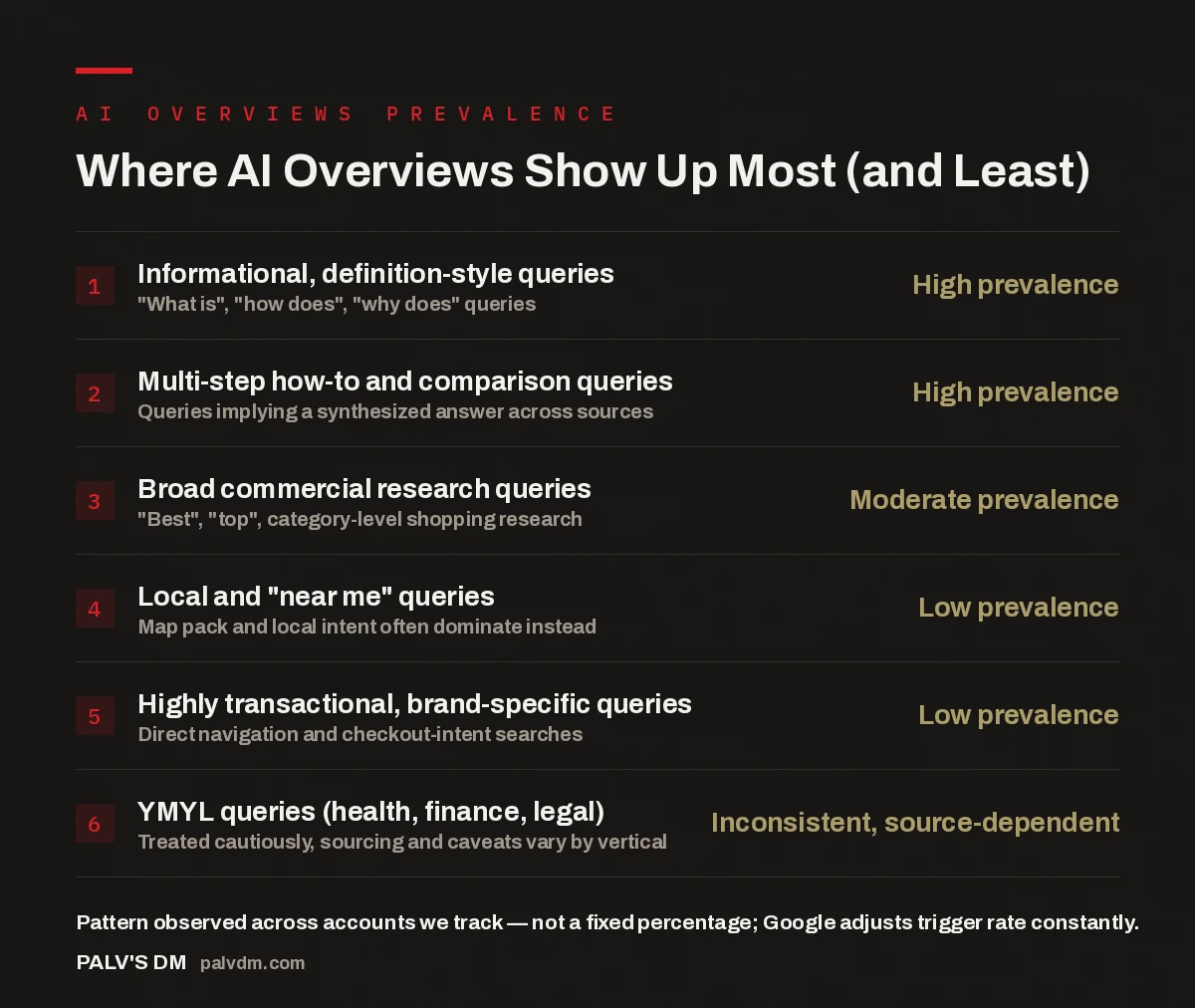
Where AI Overviews Show Up Most (and Least)
- Informational, definition-style queries — High prevalence. “What is”, “how does”, “why does” queries.
- Multi-step how-to and comparison queries — High prevalence. Queries implying a synthesized answer across sources.
- Broad commercial research queries — Moderate prevalence. “Best”, “top”, category-level shopping research.
- Local and “near me” queries — Low prevalence. Map pack and local intent often dominate instead.
- Highly transactional, brand-specific queries — Low prevalence. Direct navigation and checkout-intent searches.
- YMYL queries (health, finance, legal) — Inconsistent, source-dependent. Treated cautiously, sourcing and caveats vary by vertical.
Which query types trigger AI Overviews most often?
The clearest pattern in AI Overviews statistics, once you segment by query type instead of averaging everything together, is that informational intent drives appearance far more than any other factor. Queries that start with “what is,” “how does,” “why does,” or “difference between” are the ones where an AI Overview shows up most consistently in the accounts we track. These queries share a structure: they’re asking for an explanation that can be synthesized from multiple sources, which is exactly the job an AI Overview is built to do. A single authoritative page rarely “wins” these queries outright the way it might have in 2019 — instead, Google assembles an answer and cites several sources supporting it.
Multi-step how-to queries and comparison queries follow a similar pattern. If a query implies the person needs steps, a process, or a side-by-side judgment (“how to set up X,” “X vs Y for small business”), an AI Overview is likely to appear because that’s a format built for stitching together procedural or comparative information. Broad commercial research queries — “best project management software,” “top CRMs for startups” — sit a notch below that. They trigger AI Overviews often, but not as consistently, because commercial intent queries also compete with shopping units, ads, and comparison-style organic results that sometimes satisfy the query without an AI-generated summary.
Why do local and transactional queries rarely show an AI Overview?
Local and transactional queries sit at the opposite end of the pattern, and the reason is structural rather than mysterious. When someone searches “plumber near me” or “book a table at [restaurant],” Google already has a purpose-built answer format for that: the map pack, business listings, and direct-action links. An AI Overview would be redundant — it would be summarizing information the map pack already displays more usefully. The same logic applies to highly branded navigational queries like “Nike login” or “Zoom download.” These queries have one obvious answer, and Google’s systems generally recognize that a direct link or a knowledge panel serves the searcher faster than a generated summary.
This is worth internalizing if you’re building an AI visibility strategy for a local business or an e-commerce brand with heavy branded search volume: a low AI Overview appearance rate on those query types isn’t a visibility failure. It reflects how the surface is designed to work. The queries worth watching for AI Overview presence are the informational and comparative ones sitting earlier in the funnel — the “what is,” “how to,” and “best X for Y” searches your prospects run before they ever type your brand name.
How consistent is AI Overview behaviour on YMYL topics?
Health, finance, and legal queries — the “Your Money or Your Life” (YMYL) category — are the least predictable bucket in this pattern, and that’s an honest observation rather than a hedge. In some medical and financial sub-topics, AI Overviews appear frequently but are visibly more cautious: more qualifying language, more disclaimers, and citations skewed toward institutional or government sources. In other YMYL sub-topics, particularly ones touching active legal disputes or emerging health guidance, AI Overviews are noticeably rarer or absent, likely because the underlying systems are tuned to avoid summarizing contested or fast-changing information without stronger sourcing.
If your business operates in a YMYL vertical, don’t treat “AI Overview coverage” as a single benchmark to hit. Track it at the sub-topic level instead — compare how AI Overviews behave for your core money-page topics specifically, rather than assuming your industry’s average tells you anything useful about any one query.
The mistake most teams make with AI Overviews statistics is asking “what percentage of searches show one?” That’s the wrong question. The useful question is “which of my query types show one, and am I cited when they do?” One number tells you nothing actionable; the query-type breakdown tells you exactly where to focus.
Palash, Founder, PalV’s DM
What does this pattern mean for how you track AI Overview statistics?
Most published AI Overviews statistics are aggregate figures pulled from large, mixed keyword sets — a mix of local, transactional, informational, and YMYL queries all averaged into one trigger-rate number. That average is close to meaningless for planning purposes because it hides the underlying variance this article has walked through. A brand whose keyword set skews local and transactional will see a low aggregate AI Overview rate and might wrongly conclude AI Overviews “don’t matter” for their category. A brand whose keyword set skews informational and comparative will see the opposite and might overcorrect.
The more useful exercise is segmenting your own tracked keyword set by query type before you look at any AI Overview presence data. Group your keywords into informational, comparative/commercial, local, transactional, and YMYL buckets, then look at AI Overview appearance and citation rate within each bucket separately. This is directly related to a pattern we’ve written about elsewhere: the overlap between ranking #1 organically and being cited inside an AI Overview has been shrinking, and that shrinkage isn’t uniform either — it’s sharper in some query buckets than others. Reading zero-click behaviour the same way, by segmenting rather than averaging, tends to produce a much clearer picture of where traffic is actually being displaced versus where it never converted to a click in the first place.
How should this change what you optimise for?
Once you know which of your query types actually trigger AI Overviews, the optimisation decision becomes straightforward. Stop trying to “win” AI Overview presence on queries where it structurally won’t appear — a local “near me” page doesn’t need AI Overview optimisation, it needs a stronger map pack and listing presence. Concentrate AI-visibility effort on the informational and comparative queries feeding your funnel, since those are the ones where an AI Overview is likely to appear and where being cited (or not) has a real, compounding effect on how prospects first encounter your brand.
It’s also worth checking whether the queries in your highest-trigger bucket are being answered by Google’s classic AI Overviews or increasingly routed into Google’s separate AI Mode surface, since the two behave differently in terms of what gets cited and how. And because AI Overview presence changes as Google adjusts its triggering logic, a one-time audit goes stale fast — this is a case for ongoing tracking rather than a single report. Most marketing teams still aren’t set up to watch this on an ongoing basis, which is exactly the gap we cover in our piece on how few marketers actually track AI visibility.
Where to go next
If you want to know exactly which of your own query types trigger AI Overviews, and whether you’re cited when they do, that’s the first thing we build in an AI visibility engagement — a query-type breakdown specific to your keyword set, not an industry average.
FAQ
Do AI Overviews appear on every Google search now?
No. AI Overview appearance varies significantly by query type — it’s common on informational, definitional, and multi-step how-to queries, and much rarer on local, navigational, and hard transactional queries where a map pack or direct link already answers the query better.
Why don’t “near me” searches show AI Overviews as often?
Local searches are already served well by the map pack and business listings, which give a faster, more actionable answer than a generated text summary would. Google’s systems tend to favour the format that resolves the query most directly, and for local intent that’s rarely an AI Overview.
Is AI Overview presence the same across YMYL topics like health and finance?
No, it’s inconsistent even within YMYL. Some medical and financial sub-topics show AI Overviews frequently but with more caveats and institutional sourcing; others, especially contested or fast-changing topics, show them rarely. Track presence at the sub-topic level rather than assuming a single YMYL-wide rate.
Should I still care about AI Overviews if my keywords are mostly local or transactional?
Care less about AI Overview presence specifically, but don’t ignore AI visibility altogether. Check whether your prospects’ earlier-funnel research queries — the informational and comparative searches they run before they search your brand — are the kind that trigger AI Overviews, and focus your AI visibility work there instead.
How often should I re-check which of my query types trigger AI Overviews?
Treat it as ongoing rather than a one-time check. Google adjusts AI Overview triggering logic regularly, and a query type that rarely showed one six months ago can shift. A quarterly review of your tracked keyword set by query-type bucket is a reasonable baseline for most businesses.
Short version: AI Overview appearance isn’t random or flat — it tracks query intent. Informational, definitional, and comparative queries trigger AI Overviews consistently; local, navigational, and hard transactional queries rarely do; YMYL topics are inconsistent and need sub-topic-level tracking. Segment your own keyword set by query type before drawing conclusions from any published AI Overviews statistics, and put your AI-visibility effort where AI Overviews actually show up for your business, not where an industry-wide average says they do.