Trends & Industry Developments
Only a Fraction of Marketers Track AI Visibility: The Opportunity
AI visibility tracking adoption is still rare — most marketers track rankings but not AI Overview citations. Here's why the gap exists and how to close it.
Most marketing teams can tell you their Google ranking for a target keyword within seconds. Ask the same team how their brand is showing up inside ChatGPT, AI Overviews, or Perplexity answers, and the room usually goes quiet. That gap is the whole story behind low ai visibility tracking adoption: the tooling, habits, and reporting templates that marketers rely on were built for a search results page, not for an AI-generated answer, and most dashboards simply never got rebuilt. The teams that close that gap first aren’t smarter — they’re just measuring something almost nobody else is bothering to look at yet.
Key takeaway
- Rank tracking and GA4 organic reporting are near-universal; tracking of AI Overviews, AI Mode, and chatbot citations is still rare in the accounts and audits we review.
- The gap exists mostly because AI visibility is genuinely harder to measure — there’s no equivalent of a rank position — and because reporting templates haven’t caught up to how people now search.
- Because so few competitors are tracking AI visibility properly, the marketers who start now get an early, unearned read on a channel their competitors are flying blind on.
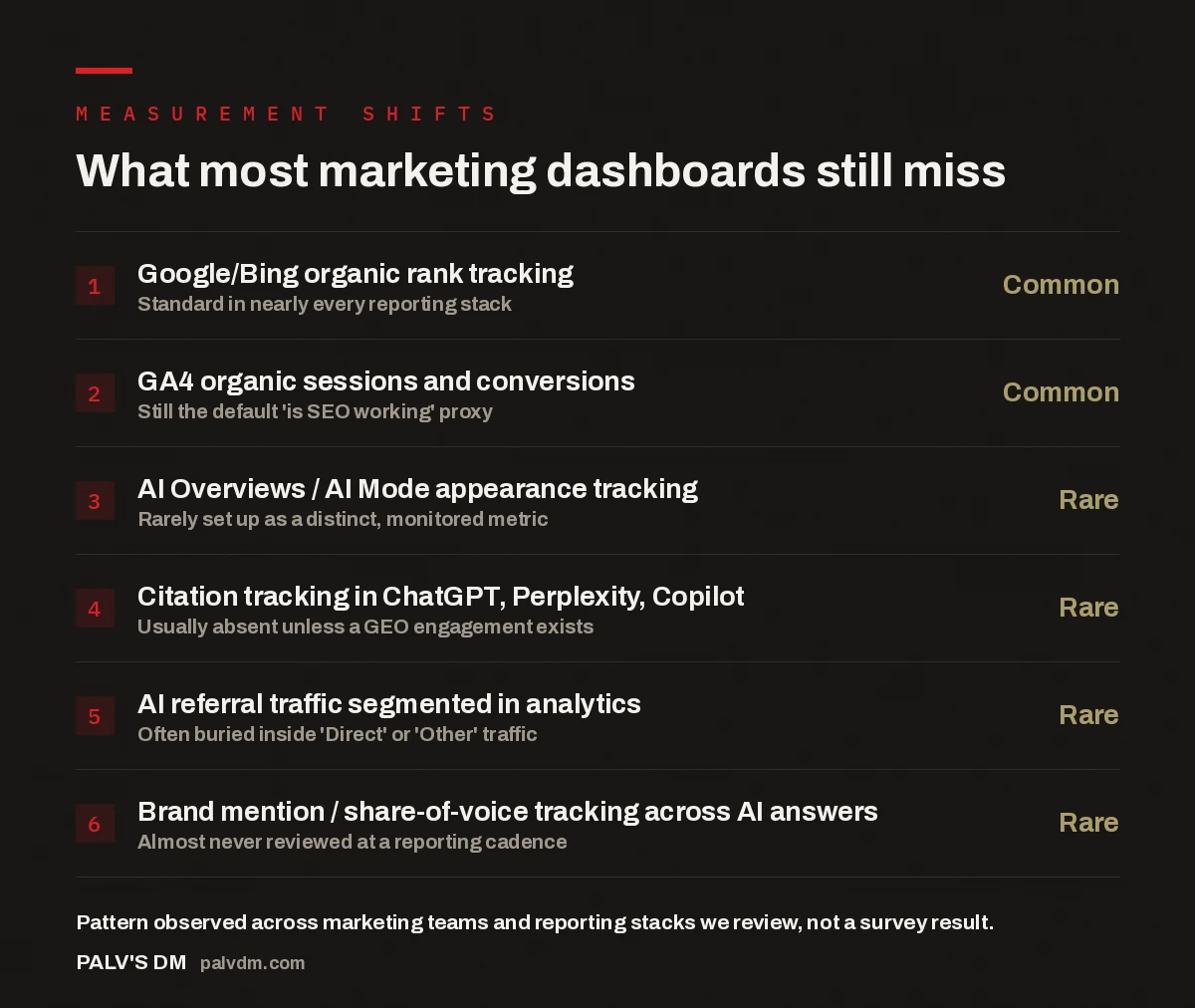
What most marketing dashboards still miss
- Google/Bing organic rank tracking — Common. Standard in nearly every reporting stack.
- GA4 organic sessions and conversions — Common. Still the default ‘is SEO working’ proxy.
- AI Overviews / AI Mode appearance tracking — Rare. Rarely set up as a distinct, monitored metric.
- Citation tracking in ChatGPT, Perplexity, Copilot — Rare. Usually absent unless a GEO engagement exists.
- AI referral traffic segmented in analytics — Rare. Often buried inside ‘Direct’ or ‘Other’ traffic.
- Brand mention / share-of-voice tracking across AI answers — Rare. Almost never reviewed at a reporting cadence.
Why is ai visibility tracking adoption still so low?
The honest answer is that most marketing reporting hasn’t changed shape in over a decade. Monthly decks still lead with organic sessions, keyword rankings, and a conversions table pulled from GA4 or a paid analytics platform. Those numbers are easy to pull because the tools that generate them — rank trackers, Search Console, GA4 — were purpose-built for exactly that job. Nothing comparable exists as a default in most marketing stacks for AI visibility. There’s no “AI Overview position 3” the way there’s a search position 3, and there’s no single dashboard that tells a CMO how often their brand gets cited when someone asks ChatGPT a category question. When the tooling doesn’t exist by default, the metric doesn’t get tracked by default either — not because marketers don’t care, but because nobody built the habit or the report template for it yet.
There’s a second, quieter reason: a lot of teams assume their existing SEO tracking already covers this. If organic traffic is flat or growing, the logic goes, visibility must be fine. That assumption breaks down once you separate where the traffic is actually coming from. Someone who gets a full, satisfying answer inside an AI Overview or a chatbot response often never clicks through at all — the interaction happens entirely off your analytics. Your rank tracker can show a stable position 2 while your actual presence in the answers people read has quietly eroded. Rank tracking measures whether you’re eligible to be seen. It says nothing about whether you’re actually being read, cited, or recommended inside an AI answer.
What does the visibility gap actually look like in practice?
Across the accounts and audits we work on, the pattern is consistent rather than universal: teams have a mature process for organic search and effectively no process for AI surfaces. That shows up in a few recognisable ways.
- No baseline exists. Nobody has manually checked, query by query, whether the brand appears in AI Overviews or AI Mode for its priority topics — so there’s no way to know if visibility is improving, flat, or declining.
- AI referral traffic is invisible or misattributed. Visits from AI platforms frequently land in “Direct” or an unlabelled “Other” bucket in GA4 rather than being segmented and reported on their own line.
- Citation tracking is treated as a nice-to-have. When it exists at all, it’s usually a one-off spot-check ahead of a pitch or a board deck, not a recurring line item reviewed alongside rankings.
- Content briefs still target rankings, not citability. Pages are optimised to rank rather than to be quotable — structured for a crawler and a click, not for an AI model deciding what to summarise.
None of this means the teams involved are careless. It means the reporting habits built for one era of search haven’t been rebuilt for the current one, and building that habit takes a deliberate decision rather than something that happens by default inside an existing tool.
Every client who comes to us worried about “AI search” already has a rank tracker running. Almost none of them has ever manually checked whether they show up inside the answer itself. That single gap is usually the first thing we fix, because it’s the cheapest insight in the entire engagement.
Palash, Founder, PalV’s DM
Why does this measurement gap count as an opportunity?
An unmeasured channel isn’t one competitors are deliberately managing — it’s one they don’t yet know they’re winning or losing in. That asymmetry is what makes the current gap in ai visibility tracking adoption genuinely useful, not just another compliance checkbox. A brand that starts tracking whether it’s cited in AI Overviews, AI Mode, and tools like Perplexity or ChatGPT before its direct competitors do gets an early, accurate read on where it stands, while everyone else is still working off search-only assumptions.
The opportunity isn’t just informational, either. Tracking creates the feedback loop that content and technical work need to improve. A team that has no idea whether a page gets cited has no way to test whether restructuring that page — clearer definitions, better source formatting, more direct answers to the exact question being asked — actually changes anything. Measurement is what turns “we should probably do something about AI search” into a testable, improvable process, the same way rank tracking turned SEO from guesswork into an iterative discipline twenty years ago.
How do you actually start tracking AI visibility?
Closing the gap doesn’t require replacing an entire analytics stack on day one. It requires adding a small number of deliberate checks that most teams have simply never scheduled.
- Build a manual query baseline. Take your 15-25 highest-priority commercial and informational queries and record, by hand, whether an AI Overview or AI Mode response appears, and whether your brand is cited within it. Repeat this on a fixed monthly cadence rather than once.
- Segment AI referral traffic in GA4. Set up channel groupings or regex-based segments for known AI referrer domains so that traffic from chatbots and AI search tools shows up as its own line, not buried inside “Direct.”
- Add a citation column to existing reporting. Instead of building a separate AI visibility report nobody reads, add a “cited in AI answers: yes/no” column next to the rank position in the report a team already reviews every month.
- Review, don’t just collect. A baseline that sits unread in a spreadsheet doesn’t count as tracking. The point is a recurring review where someone asks what changed and why, the same way rank movement gets reviewed today.
None of these steps require enterprise tooling to start. They require deciding that AI visibility is worth a recurring line item in existing reporting, then actually protecting the time to check it. Once the manual baseline is established, teams typically outgrow it fast — at that point it’s worth looking at how to build a proper multi-surface visibility scorecard that tracks search, AI Overviews, and chatbot citations side by side instead of juggling three separate spreadsheets. It’s also worth checking how AI referral traffic tends to convert differently from regular organic traffic, since that changes how much weight the new metric deserves in a report.
Where this usually goes next
A manual baseline is a good starting point, but it doesn’t scale past a handful of queries or stay consistent across a growing content library. If you want a structured read on where your brand actually stands across AI Overviews, AI Mode, and chatbot citations — not just a rank report — that’s exactly what our AI visibility work is built to set up and monitor.
Is closing the AI visibility tracking gap really worth the effort?
It’s fair to be skeptical of a new metric that sounds like it exists mainly to justify a new service line. The test worth applying is simple: does this measurement change a decision, or is it just another number on a slide? For AI visibility, it usually does change decisions, because the alternative is operating on an assumption that’s quietly getting less reliable. As zero-click search behaviour becomes more common and ranking well and being cited stop being the same thing, a team that only tracks rankings is measuring a proxy for visibility, not visibility itself. That’s not a reason to rebuild every report tomorrow — it’s a reason to add the missing line item before the gap widens further. Reviewing your reporting alongside a broader read of what’s actually changed in search this year is a reasonable place to start that conversation internally.
FAQ
What does “AI visibility tracking” actually mean?
It means regularly checking whether your brand appears and gets cited inside AI-generated answers — AI Overviews, AI Mode, and chatbots like ChatGPT or Perplexity — rather than only tracking your position on a traditional search results page. It covers both appearance (does an AI answer show up at all for a query) and citation (does it name or link to you within that answer).
Why don’t most marketing teams track this already?
Mostly because the default tools in a typical marketing stack — rank trackers, Search Console, GA4 — were built for the old search results page and never got a native equivalent for AI answers. Reporting templates and monthly review habits haven’t caught up either, so the gap tends to persist until someone deliberately decides to close it.
Can I track AI visibility without buying new software?
Yes, at least as a starting point. A manual monthly check across your 15-25 priority queries, combined with an AI-referral traffic segment set up inside GA4, gets you a real baseline. It won’t scale to hundreds of queries or automate itself, but it’s enough to know directionally whether you’re gaining or losing ground.
Does a good ranking mean I’m also being cited by AI answers?
Not necessarily. Ranking and being cited are related but increasingly separate outcomes — a page can hold a strong position on the results page while never being pulled into the AI-generated answer above it, or vice versa. Treating them as the same metric is one of the main reasons the tracking gap goes unnoticed for so long.
How often should AI visibility actually be reviewed?
Monthly is a reasonable default for most teams, matching the cadence most rank and traffic reports already run on. AI platforms change how they generate and cite answers often enough that a quarterly-only check can miss a meaningful shift before anyone notices it in the numbers.
Short version: ai visibility tracking adoption is low mainly because the tools and reporting habits built for traditional search never got rebuilt for AI answers, not because the shift in search behaviour isn’t real. Rankings and AI citations are no longer reliable proxies for each other, which means a rank-only report is quietly becoming a partial one. The fix doesn’t require an overhaul — a monthly manual baseline, a segmented AI-referral traffic view, and a citation column next to your existing rank report closes most of the gap. Because so few competitors have made that same small decision yet, doing it now is one of the more accurate reads on the market available in search reporting today.