Trends & Industry Developments
Building a Multi-Surface Visibility Scorecard
Multi surface SEO measurement means tracking organic, AI Overviews, AI Mode, and answer engines separately. Here's how to build a scorecard that does it right.

A multi-surface visibility scorecard is a single tracking sheet that records how a brand performs across every place buyers now search — Google organic, AI Overviews, AI Mode, and answer engines like ChatGPT and Perplexity — instead of just rank position on Google. Multi surface SEO measurement matters because a page can sit at position #3 in classic blue links and still be absent from an AI Overview, or get cited inside an AI answer while its organic ranking barely moves. Tracking one surface now tells you a fraction of the story. Below is how to build the scorecard row by row, what belongs in each row, and how to keep it honest when some of the underlying data simply isn’t reliable yet.
Key takeaway
- A scorecard needs one row per surface — organic, AI Overviews, AI Mode, and any answer engine you’re actually tested on — with its own metric, owner, and capture method, not one blended “visibility score.”
- Where you don’t have a reliable data source yet, mark the row “unmeasured” rather than forcing a number — a fabricated metric is worse than a visible gap.
- The scorecard only earns its keep if it’s reviewed on a fixed cadence and someone is accountable for acting on what moved, not just recording it.
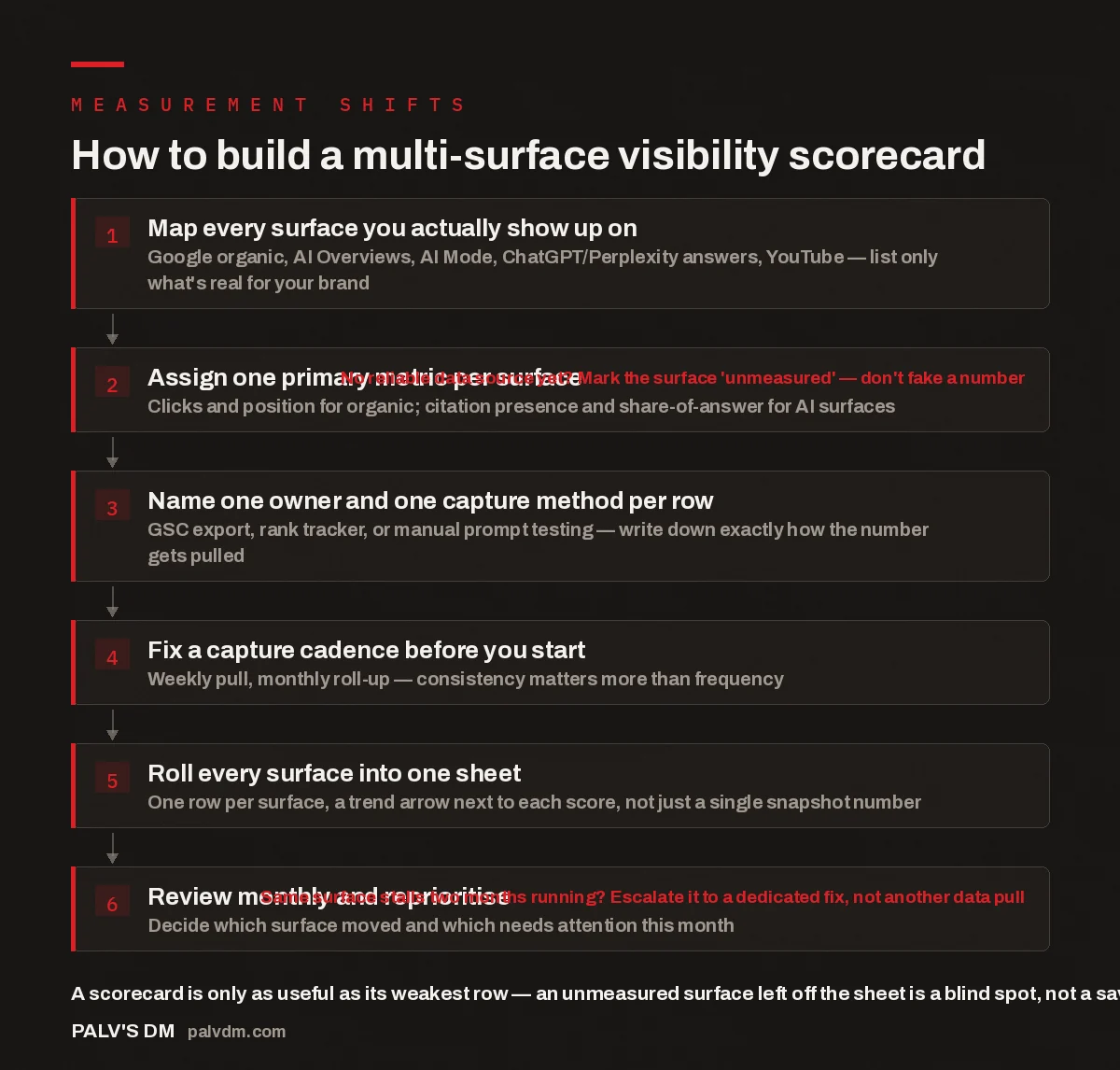
How to build a multi-surface visibility scorecard
- Map every surface you actually show up on. Google organic, AI Overviews, AI Mode, ChatGPT/Perplexity answers, YouTube — list only what’s real for your brand.
- Assign one primary metric per surface. Clicks and position for organic; citation presence and share-of-answer for AI surfaces. No reliable data source yet? Mark the surface ‘unmeasured’ — don’t fake a number
- Name one owner and one capture method per row. GSC export, rank tracker, or manual prompt testing — write down exactly how the number gets pulled.
- Fix a capture cadence before you start. Weekly pull, monthly roll-up — consistency matters more than frequency.
- Roll every surface into one sheet. One row per surface, a trend arrow next to each score, not just a single snapshot number.
- Review monthly and reprioritise. Decide which surface moved and which needs attention this month. Same surface stalls two months running? Escalate it to a dedicated fix, not another data pull
What counts as a “surface” in search measurement now?
A surface is any place a buyer can encounter your brand while trying to solve a problem, without you paying for the placement. A few years ago that was effectively one surface: the Google results page, mostly the organic listings on it. That’s no longer true, and it’s why multi surface SEO measurement exists as a discipline rather than being folded into ordinary rank tracking. Today the surfaces worth a row on your scorecard typically include classic Google organic results, Google’s AI Overviews, the separate AI Mode experience, third-party answer engines such as ChatGPT and Perplexity when users search inside them, and — depending on the business — YouTube search and marketplace search.
Not every business needs every row. A B2B SaaS company selling to procurement teams may find AI Mode and answer-engine citations matter more than YouTube; a DTC brand may find the reverse. The mistake isn’t leaving surfaces off the sheet — it’s leaving them off without deciding to. Our post on how ranking position and AI citation are increasingly separate outcomes goes deeper into why these surfaces have to be tracked independently rather than assumed to move together.
How do you build a multi-surface visibility scorecard step by step?
Building the scorecard is less about the spreadsheet template and more about the decisions you make before you open one. Here’s the sequence that holds up in practice.
- Start with the surfaces, not the tools. List every place a buyer might encounter your brand while searching, based on where your actual customers search. Cut anything you can’t credibly claim matters to your funnel.
- Give each surface exactly one primary metric. Resist tracking five numbers per surface in month one. Organic gets clicks (Search Console) and average position for a defined query set. AI Overviews and AI Mode get a binary presence check — does your brand appear, yes or no — tracked over time. Answer engines get the same check, run manually or through prompt testing, since most don’t expose this via API yet.
- Write the capture method next to the metric. “AI Overview presence — manual check, 20-query set, run every Monday” is a usable row. “AI visibility — improving” is not.
- Assign a named owner per surface, not per scorecard. One person owning the whole sheet means no one is accountable for the surface that’s actually slipping.
- Fix the cadence before the first review. Weekly capture with a monthly roll-up is the most common working rhythm — frequent enough to catch a drop before it compounds, infrequent enough to stay short.
- Put every surface on one page, with a trend, not a snapshot. A single “as of today” number tells you almost nothing next to a trend line showing whether the work is compounding.
If your team already runs a recurring reporting rhythm, this scorecard slots into it rather than replacing it — see how we structure ours in our own quarterly search roundup process for one way to fit surface-by-surface review into a regular cadence.
What should go in each row of the scorecard?
The table below is a starting structure, not a fixed template — drop rows that don’t apply and add ones that do. What matters is that every row names a metric your team can actually pull, and a source you trust enough to act on.
| Surface | Primary metric | Typical data source |
|---|---|---|
| Google organic | Clicks + average position for a defined query set | Google Search Console |
| AI Overviews | Presence/absence for the same query set | Manual check or an AI-tracking tool |
| AI Mode | Presence/absence + which sources get cited alongside you | Manual check (no official API yet) |
| Answer engines (ChatGPT, Perplexity, etc.) | Brand mention/citation for a fixed prompt set | Manual prompt testing, repeated on schedule |
| YouTube / video search | Impressions and click-through for target queries | YouTube Studio |
The “typical data source” column is where most scorecards quietly fail. Third-party rank trackers and AI-visibility tools have gotten less consistent as platforms tighten access, and organic rank tracking itself has gotten harder to interpret since Google’s results page stopped behaving as a single stable list. Before you commit to a vendor’s numbers as ground truth, read why third-party SEO data has gotten less reliable and what rank trackers can and can’t still tell you.
How often should you update it, and who should own it?
Weekly capture, monthly review is the cadence that holds up across most teams we work with — not because it’s optimal in the abstract, but because it survives contact with a busy calendar. Daily capture generates noise nobody has time to interpret; quarterly capture means a surface can decline for two months before anyone notices. Weekly numbers, reviewed once a month against the trend line, catch a slide early enough to act on it while keeping the review meeting short.
Ownership matters as much as cadence. The scorecard should have one name attached to each row — the person who pulls that number and is expected to flag it if it moves the wrong way. In smaller teams that’s often one person covering three or four surfaces; in larger ones it’s split by surface type, organic sitting with the SEO lead and AI-surface presence with whoever owns content and structured data. What doesn’t work is a shared, ownerless spreadsheet updated “when someone has time” — those decay within a quarter.
What mistakes make a visibility scorecard useless?
The most common failure is collapsing every surface into one blended “visibility score.” It feels efficient but hides exactly what the scorecard exists to surface. If organic clicks are flat while AI Overview presence is falling, a blended score can still read “stable,” and the AI surface keeps losing ground unnoticed. Keep the rows separate even when the summary you report upward is a single sentence.
The second is treating every surface’s number with the same precision. Organic click data from Search Console is reasonably solid. A manual check of whether your brand appears in an AI Overview for twenty queries is directional, not exact — it depends on location, personalization, and the query set chosen. Report it as directional; don’t round a presence check on twenty prompts into a precise “visibility percentage” the method can’t support.
The third, and the one that does the most damage, is simply not tracking AI surfaces at all because the tooling feels immature. It’s a genuine gap in a lot of teams’ measurement setups right now — see how few marketers are currently tracking AI visibility. Immature tooling is a reason to track manually and directionally, not a reason to skip the row entirely.
Clients don’t come to us because they’ve stopped ranking. They come because their scorecard only had one row on it, and the surface that was actually declining wasn’t on the sheet.
Palash, Founder, PalV’s DM
How does a multi-surface scorecard change what you act on?
Once the scorecard exists, it changes the conversation from “is SEO working” to “which surface needs attention.” A single blended trend line invites a single blended response, usually more content. A row-by-row scorecard tells you when the right response is narrower — a structured-data fix for AI Mode presence, a page restructure for AI Overview eligibility, or nothing at all if a surface is genuinely stable. That’s also the pattern behind the broader shift in how search results are put together, covered in more depth in our overview of what actually changed in search in 2026.
The scorecard doesn’t replace deeper diagnostic work — it tells you where to point that work next. A row showing AI Mode presence dropping for a query cluster is a prompt to investigate the pages ranking for those queries, not a finished answer on its own. Treat it as a triage tool that runs continuously, not a report built once a quarter and forgotten in between.
Where to go from here
If building and interpreting an AI-surface tracking process in-house is eating more time than it’s giving back in clarity, that’s exactly what our AI visibility work is built to take off your plate.
FAQ: multi-surface visibility scorecards
What’s the difference between a visibility scorecard and normal rank tracking?
Rank tracking measures one surface — position in classic Google organic results — for a set of keywords. A visibility scorecard adds separate rows for AI Overviews, AI Mode, and answer engines, because a page’s organic rank and its presence in an AI-generated answer no longer move together reliably. Rank tracking is one input to the scorecard, not a substitute for it.
Do I need a paid tool to track AI Overview and AI Mode presence?
No — a fixed query set checked manually on a schedule is a legitimate starting method, and it’s what most teams use until their query volume justifies a dedicated tool. What matters more than the tool is consistency: the same query set, checked the same way, on the same schedule, so the trend is comparable month to month.
How many queries should be in the tracking set for each surface?
Enough to be representative of the topics that actually drive business value, small enough to check consistently without it becoming a full-time task. Most teams land somewhere between fifteen and thirty queries per surface, weighted toward the topics closest to revenue rather than the broadest possible coverage.
Should every surface get equal weight in reporting?
No. Weight each surface by how much of your actual funnel it touches, not by how interesting it is to track. A B2C brand with heavy YouTube discovery should weight that row accordingly; a B2B brand whose buyers research through answer engines should weight that row instead. The scorecard should reflect your buyers’ behaviour, not a generic list of every surface that exists.
What if a surface’s data source disappears or changes?
Note the change on the scorecard itself rather than silently switching methods and comparing incompatible numbers. Platforms and third-party tools change access and methodology often enough in this space that a short note — “method changed on [date], trend line resets” — is what keeps the scorecard honest instead of misleading.
Short version: multi surface SEO measurement means one scorecard row per surface — organic, AI Overviews, AI Mode, and any answer engine that matters to your funnel — each with its own metric, named owner, and a capture method you can describe in one sentence. Mark what you can’t measure reliably as unmeasured, fix a weekly-capture, monthly-review cadence, and use the sheet to decide what to fix next, not just to report that something changed.