Trends & Industry Developments
Quarterly Search Roundup: How We Run Ours
Running your own seo news roundup? Here is the exact quarterly process we use to log, cluster, score, and act on SEO and AI search changes for clients.

A quarterly search roundup is a structured review of everything that changed in SEO and AI search over the previous three months, filtered down to what actually affects live client work. We run ours as a fixed process, not a scramble through old newsletters before a client call. Below is exactly how we do it: what we log, how we decide what matters, and what the finished brief looks like. If you’re trying to build your own seo news roundup instead of drowning in alerts, this is the workflow, step by step.
Key takeaway
- A quarterly cadence beats daily news-chasing because most individual updates don’t warrant a same-day reaction — grouping them by theme surfaces the pattern, not the noise.
- The process has six fixed steps: log, cluster, score against live work, sort into watch/test/ignore, write a one-page brief, and check last quarter’s calls before closing this one.
- Most of what shows up in a raw news feed gets filtered out at the scoring step — the roundup’s value is in what it leaves out, not what it includes.
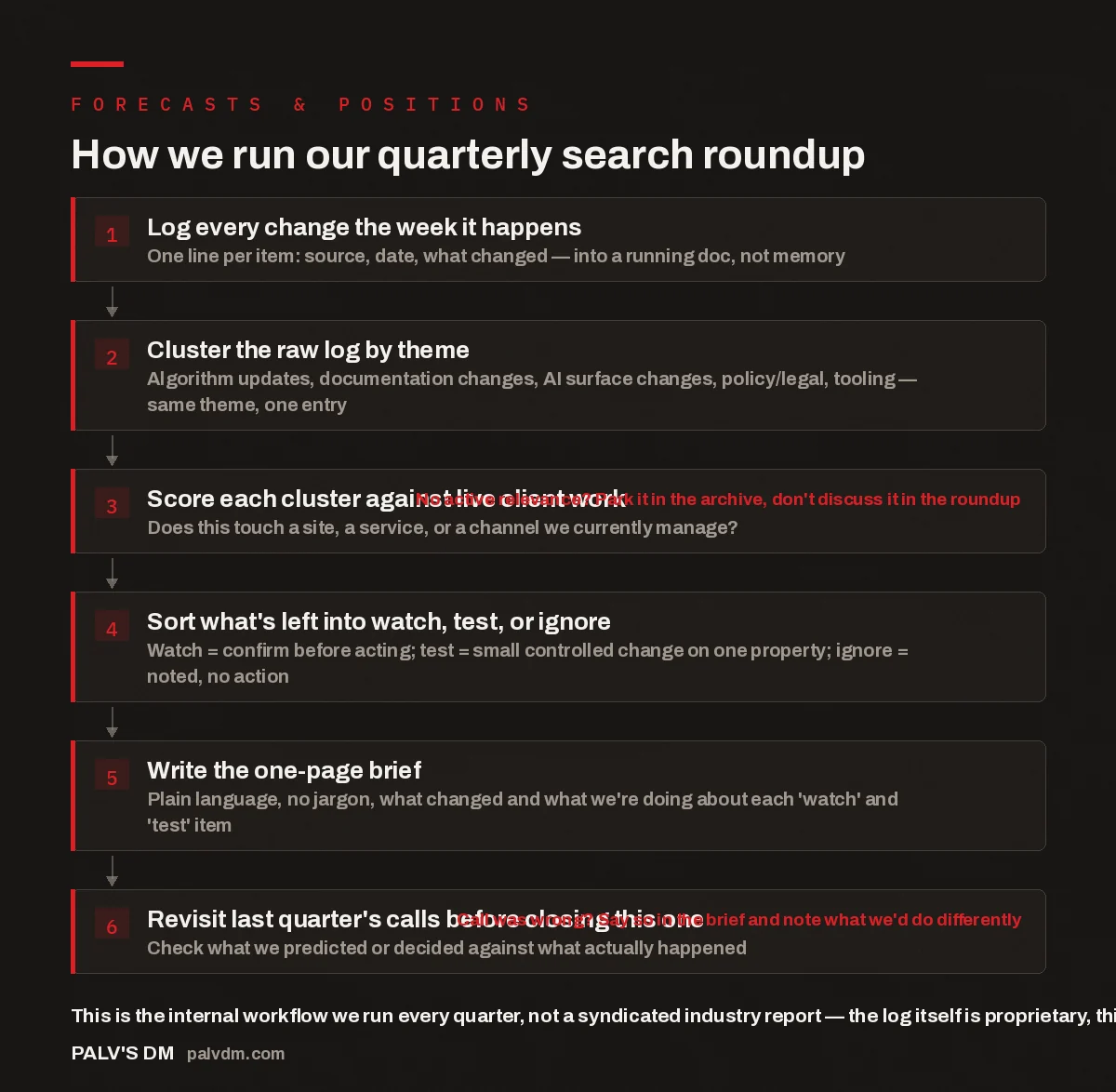
How we run our quarterly search roundup
- Log every change the week it happens. One line per item: source, date, what changed — into a running doc, not memory.
- Cluster the raw log by theme. Algorithm updates, documentation changes, AI surface changes, policy/legal, tooling — same theme, one entry.
- Score each cluster against live client work. Does this touch a site, a service, or a channel we currently manage?. No active relevance? Park it in the archive, don’t discuss it in the roundup
- Sort what’s left into watch, test, or ignore. Watch = confirm before acting; test = small controlled change on one property; ignore = noted, no action.
- Write the one-page brief. Plain language, no jargon, what changed and what we’re doing about each ‘watch’ and ‘test’ item.
- Revisit last quarter’s calls before closing this one. Check what we predicted or decided against what actually happened. Call was wrong? Say so in the brief and note what we’d do differently
Why run a quarterly seo news roundup instead of reacting to daily alerts?
Daily SEO alerts create a specific failure mode: every update looks urgent the day it lands, and almost none of them are. A documentation tweak, a forum comment from someone at Google, a screenshot of a new SERP feature in one market — each shows up in a feed with the same visual weight as something that actually changes how a site should be built. Reacting to each one individually means either ignoring most of them and missing the one that mattered, or chasing all of them and burning time on noise.
A quarterly window fixes this by forcing aggregation before judgment. Three months of individual items, once clustered by theme, show which changes were isolated one-offs and which were part of a broader shift. A single post about a new AI crawler name is trivia. Four separate items over a quarter — a new crawler name, a robots.txt update, a crawler-control feature from a CDN provider, and a crawl-budget documentation change — read as one story about how crawler access is being managed differently. That story doesn’t appear if each item is judged on the day it lands.
This doesn’t mean nothing gets acted on same-day. A confirmed, wide-reaching algorithm update or a documented ranking bug still gets flagged the moment it’s verified. The quarterly process is for everything else — the steady drip of documentation edits, minor SERP tests, and industry commentary that makes up the bulk of what crosses an SEO’s desk in a given week.
What sources actually go into the log?
The log only includes sources with a track record of being right, checked at a fixed interval rather than left to push notifications. The categories we track:
- Google’s own documentation — developer docs, the Search Central blog, and the quality-rater guidelines when revised
- Search Console and Search Central help pages, checked for silent edits, not just announced ones
- Public statements from Google’s Search team on record — interviews and conference talks, not anonymous forum claims
- Platform-level changes on AI surfaces — ChatGPT, Perplexity, and Google’s AI Mode and AI Overviews — as reported by multiple independent trackers agreeing
- Legal and policy developments that touch marketing directly — publisher lawsuits over AI content use, and data protection updates relevant to Indian and EU markets
- Our own Search Console and analytics data across managed accounts, often the fastest confirmation that something changed
What doesn’t go in the log: unverified rank-tracker screenshots without context, single-source rumours, and anything framed as a definitive ranking factor without Google confirming it. Those get watched informally, never logged as fact — logging something wrong is worse than logging nothing, since the whole point of the roundup is trusting the log without re-checking every line.
How do we turn a quarter of updates into a one-page brief?
The six-step process shown above is deliberately linear — each step exists to remove volume before the next one, so the final brief is short enough that someone actually reads it.
- Log in the week it happens. Waiting until quarter-end to reconstruct three months from memory produces a worse, thinner log than logging in real time. One line — source, date, what changed — takes under a minute and is the only step that happens weekly rather than quarterly.
- Cluster by theme, not by date. A chronological list of forty items tells you nothing. Grouped into five or six themes — algorithm behaviour, documentation, AI surfaces, crawling and indexing, policy — the same forty items show which parts of the industry actually moved and which had one noisy week.
- Score each cluster against live client work. This step does the most filtering. A change to how AI Mode handles product queries matters immediately if a client sells products; it’s a watch-item for a client running a purely local services business. Relevance is scored per cluster, which keeps this fast.
- Sort survivors into watch, test, or ignore. Watch means confirming the change independently before doing anything, usually by checking our own data or waiting for a second source. Test means running a small, controlled change on one property rather than rolling a reaction out across every account. Ignore means it’s logged but nobody acts on it.
- Write the brief in plain language. One page, structured as “what changed” and “what we’re doing about it” for each watch and test item. Anything that didn’t survive the scoring step doesn’t appear in the brief at all — it stays in the internal log only.
- Check last quarter’s calls before closing this one. Every brief opens by revisiting what got flagged as watch or test three months earlier and stating plainly what happened. A watch-item that turned into nothing gets noted as such; a test that didn’t move the needle gets said out loud, not quietly dropped.
The value of a quarterly roundup isn’t the list of things that changed. It’s the shorter list of things we decided not to react to, and being able to explain why.
Palash, Founder, PalV’s DM
How do we decide what to ignore?
Ignoring something is a decision, not a default, made against three questions rather than gut feel. First: does the change touch a surface any current client appears on? Second: is the source confirmed, or is it one screenshot and a lot of speculation? Third: even if it’s real and relevant, does it change what we’d actually do, or does the existing approach already cover it? A lot of “new” advice turns out to be a restatement of practice that’s been standard for years — worth noting, not worth treating as new work.
The failure mode we’re guarding against is the opposite of complacency: treating every update as equally actionable, which in practice means treating nothing as actionable because there’s no time to evaluate it properly. Ignoring most of the raw log is what makes it possible to properly evaluate what survives.
What does the finished roundup look like, and who reads it?
The internal version is a working document — the full log, the clustering, the scoring notes. The version that goes to clients is the one-page brief: what changed this quarter, grouped by theme, with a plain statement of what it means for their account and what, if anything, we’re doing differently. No jargon, no padding to make the update look bigger than it is. Some quarters the brief is genuinely short, because most of what happened in search that quarter didn’t touch the accounts we manage — that’s a legitimate outcome, not a failure to find enough content.
The closing-the-loop step keeps the process honest over time. A roundup that only reports new information and never revisits its own past judgment has no way of getting better. Ours is graded, informally, against how many of last quarter’s watch and test calls turned out to be worth the attention given to them.
If catching these shifts early — rather than three months late — matters for how AI Overviews, AI Mode, and answer engines cite your brand, that’s the kind of tracking we build into ongoing accounts, not just publish about quarterly.
Where this fits into a bigger picture
A single quarter’s changes rarely explain themselves — they read better against what’s changed in search overall. Our take on the bigger shift is in The State of Search in 2026: What Actually Changed. On the mechanics we track most closely, see what changed in Google’s documentation this quarter, how we build a multi-surface visibility scorecard, and why third-party SEO tool data got less reliable. We’ve also written honestly about the predictions we got wrong about AI search — the exact kind of check the last step of this process is built to catch.
See how we track AI search visibility for accounts we manage
How often should a business run its own search news roundup?
Quarterly works for most teams — frequent enough to catch real shifts before they compound, infrequent enough that clustering by theme actually reveals patterns. Teams managing many accounts across verticals sometimes run a lighter monthly check alongside it, but the deep clustering and scoring work still happens once a quarter.
What’s the difference between this and just reading SEO news weekly?
Reading weekly keeps you informed; a structured quarterly roundup forces a decision on each item. Weekly reading alone tends to produce a vague sense that “a lot has changed” without a record of what was acted on, tested, or deliberately ignored — and without that record, there’s nothing to check three months later.
Do you include AI search platforms like ChatGPT and Perplexity in the roundup, or just Google?
Both. AI search platforms get their own cluster in the log alongside traditional Google SEO changes, because the two are no longer separable for most accounts — a change in how an AI surface sources citations affects the same content strategy as a change in how Google ranks pages.
What tools do you use to build the log?
The log is a plain shared document, deliberately low-tech, because the value is in logging weekly and clustering honestly, not the tooling. We pull supporting data from Search Console and our rank-tracking setup during scoring, but the process doesn’t depend on any single platform.
What happens if something urgent happens mid-quarter?
It doesn’t wait for the quarterly cycle. A confirmed, wide-reaching algorithm update or a verified ranking bug gets flagged and acted on the same week, and still gets logged so it’s part of the record when the next quarterly brief is written. The quarterly process governs steady background noise, not genuine emergencies.
Short version: log changes weekly, cluster by theme quarterly, score against live client work, sort into watch/test/ignore, write a one-page brief in plain language, and check last quarter’s calls before closing this one. The discipline is in what gets left out, not in how much gets logged.