Trends & Industry Developments
What Changed in Google’s Documentation This Quarter
Google search documentation updates roll out continuously. Here's how to track crawling, canonical, structured data, and AI-features changes every quarter.
Outside those four, most changelog entries are maintenance: clarified examples, reorganised navigation, or language cleanup. Worth a glance, rarely worth a strategy change.
How do you build a repeatable quarterly documentation review?
The most reliable way to keep up with google search documentation updates without turning it into a full-time job is to treat it as a fixed quarterly task with a defined scope, not an ongoing background worry. A workable version of this process looks like the six-step pass in the checklist above: start at the official changelog, then work through crawling, canonicals, structured data, and AI-features documentation in that order, ending with a log of anything that needs a ticket.
Two habits make this process actually stick instead of lapsing after one quarter. First, keep a simple running document — even a shared spreadsheet — with one row per change, the date it was noticed, and the page or section it affects on your own site. Without that record, it’s easy to notice a change, mean to act on it, and lose track of it three weeks later. Second, separate “noted” from “actioned.” A documentation change that gets read and discussed but never turned into a ticket for the dev or content team has the same effect as never having read it at all.
This is also where a structured quarterly search roundup earns its keep — folding documentation review into the same cadence as your ranking and traffic review means the two get read together, and a documentation change can be matched against a metric shift you were already investigating.
Most sites treat Google’s documentation as something to check when rankings drop. By then you’re reacting to a change that was already written down weeks earlier. The accounts that stay ahead are the ones that read the changelog on a schedule, whether or not anything looks broken that week.
Palash, Founder, PalV’s DM
Which recent categories of change have mattered most?
Rather than naming a specific quarter’s edits — which will be out of date by the time this is read — it’s more useful to describe the pattern that shows up repeatedly across recent review cycles, because the pattern is what a quarterly process is actually designed to catch.
The crawling and indexing pages have been the most consistently active category over the past couple of years, largely driven by the introduction and refinement of new crawler identities as Google separated out crawlers for AI training and AI-search features from the core Googlebot. Sites that only maintained a robots.txt file written for classic Googlebot found themselves either blocking or unintentionally allowing crawlers they hadn’t accounted for, simply because the crawler-naming documentation had moved on. That’s the exact kind of change our post on keeping robots.txt current as AI crawler naming changes walks through in more depth.
Canonical guidance has also seen meaningful, if quieter, revision — mostly in how explicitly Google describes the signals it weighs when a canonical tag conflicts with other indicators like internal linking patterns or sitemap entries. If your canonicalisation strategy predates the current wording, it’s worth reading the canonical guidance updates worth re-reading rather than assuming the old advice still holds verbatim.
Crawl budget guidance specifically has been another recurring area of revision, generally trending toward more explicit statements about which site sizes and structures actually need to think about crawl budget at all, as opposed to it being a universal concern. That distinction affects how a site should prioritise crawl-related fixes, and it’s covered directly in our breakdown of the crawl budget guidance change and what the new documentation says.
How does documentation tracking connect to AI visibility work?
Classic SEO documentation tells you how Google crawls, indexes, and ranks a page. AI features documentation — the pages describing AI Overviews, AI Mode, and how content gets selected for AI-generated answers — tells you something different: how content gets read, summarised, and attributed inside a generated response rather than just listed as a blue link. That documentation is younger, changes faster, and is where the gap between what most sites monitor and what actually governs visibility is widest.
A site that keeps up with crawling and canonical documentation but never reads the AI features pages is optimising for half the surface Google now serves results on. This is the specific gap AI visibility (GEO/AEO) work is built to close — reading the documentation that governs how AI systems select and cite content, and translating wording changes into concrete site changes before a visibility gap shows up in the numbers.
Put this into practice
If you don’t have a standing process for tracking google search documentation updates — or you’re not sure which recent changes actually apply to your site — that’s exactly what an AI visibility review is for.
FAQ
Where does Google actually publish its search documentation updates?
Google maintains a public changelog on the Search Central site (developers.google.com/search/updates) that logs most substantive edits to its Search documentation, including what changed and roughly when. It’s sorted newest first and is the most direct source — faster and more precise than waiting for a third party to summarise a change.
How often should a site review Google’s documentation for changes?
A quarterly review is a practical minimum for most sites — frequent enough to catch changes before they compound, infrequent enough to stay a manageable task rather than a constant distraction. Sites in fast-moving categories, or ones that lean heavily on AI visibility, benefit from checking the AI features documentation specifically on a shorter cycle, since that category changes fastest.
Do documentation changes always mean a ranking algorithm update happened?
No. Many documentation edits are clarifications of existing behaviour rather than announcements of a new one — Google rewording a page to explain something more precisely, without the underlying system having changed. Others do describe a genuine shift. The way to tell the difference is to read the specific wording change rather than assuming every edit signals a live algorithm update.
Which documentation pages should a small site prioritise if it can’t review everything?
Start with the pages closest to your site’s actual risk: crawling and indexing guidance if you have a large or frequently updated site, canonical guidance if you run near-duplicate content across pages or locales, and AI features documentation if organic visibility inside AI-generated answers matters to your traffic. A small site rarely needs to track every category with equal depth.
Is tracking documentation changes a substitute for monitoring rankings and traffic?
No, the two are complementary. Documentation tracking is a leading indicator — it flags what Google says is changing before that change fully shows up in performance data. Ranking and traffic monitoring, including tools discussed in our piece on the state of search in 2026, remains the lagging confirmation that a documented change actually affected your specific site.
Short version: Google search documentation updates are continuous, not quarterly, but a fixed quarterly review — changelog, crawling, canonicals, structured data, AI features, then a logged action list — is the practical way to keep up without it becoming a daily habit. The categories that move fastest right now are crawler documentation and AI features pages, which is also where the gap between what’s written and what most sites have actually implemented tends to be widest.
- Crawling and indexing guidance — pages covering crawl budget, robots.txt handling, and crawler user-agents. These move whenever Google adjusts how it allocates crawl resources or adds a new crawler identity, which has happened repeatedly as AI-training and AI-search crawlers were introduced alongside the classic Googlebot.
- Canonical and duplicate-content rules — the wording on how Google selects a canonical URL among duplicates. Small phrasing shifts here change how aggressively you need to enforce canonical tags versus relying on Google’s own consolidation signals.
- Structured data documentation — new schema types get added, others get marked deprecated or merged into broader categories. A schema type your dev team implemented two years ago can quietly stop being documented as supported.
- AI features and Search Essentials pages — documentation describing AI Overviews, AI Mode, and the ranking systems overview. This is the newest and fastest-moving category, and the one most directly tied to AI visibility work rather than classic organic ranking.
Outside those four, most changelog entries are maintenance: clarified examples, reorganised navigation, or language cleanup. Worth a glance, rarely worth a strategy change.
How do you build a repeatable quarterly documentation review?
The most reliable way to keep up with google search documentation updates without turning it into a full-time job is to treat it as a fixed quarterly task with a defined scope, not an ongoing background worry. A workable version of this process looks like the six-step pass in the checklist above: start at the official changelog, then work through crawling, canonicals, structured data, and AI-features documentation in that order, ending with a log of anything that needs a ticket.
Two habits make this process actually stick instead of lapsing after one quarter. First, keep a simple running document — even a shared spreadsheet — with one row per change, the date it was noticed, and the page or section it affects on your own site. Without that record, it’s easy to notice a change, mean to act on it, and lose track of it three weeks later. Second, separate “noted” from “actioned.” A documentation change that gets read and discussed but never turned into a ticket for the dev or content team has the same effect as never having read it at all.
This is also where a structured quarterly search roundup earns its keep — folding documentation review into the same cadence as your ranking and traffic review means the two get read together, and a documentation change can be matched against a metric shift you were already investigating.
Most sites treat Google’s documentation as something to check when rankings drop. By then you’re reacting to a change that was already written down weeks earlier. The accounts that stay ahead are the ones that read the changelog on a schedule, whether or not anything looks broken that week.
Palash, Founder, PalV’s DM
Which recent categories of change have mattered most?
Rather than naming a specific quarter’s edits — which will be out of date by the time this is read — it’s more useful to describe the pattern that shows up repeatedly across recent review cycles, because the pattern is what a quarterly process is actually designed to catch.
The crawling and indexing pages have been the most consistently active category over the past couple of years, largely driven by the introduction and refinement of new crawler identities as Google separated out crawlers for AI training and AI-search features from the core Googlebot. Sites that only maintained a robots.txt file written for classic Googlebot found themselves either blocking or unintentionally allowing crawlers they hadn’t accounted for, simply because the crawler-naming documentation had moved on. That’s the exact kind of change our post on keeping robots.txt current as AI crawler naming changes walks through in more depth.
Canonical guidance has also seen meaningful, if quieter, revision — mostly in how explicitly Google describes the signals it weighs when a canonical tag conflicts with other indicators like internal linking patterns or sitemap entries. If your canonicalisation strategy predates the current wording, it’s worth reading the canonical guidance updates worth re-reading rather than assuming the old advice still holds verbatim.
Crawl budget guidance specifically has been another recurring area of revision, generally trending toward more explicit statements about which site sizes and structures actually need to think about crawl budget at all, as opposed to it being a universal concern. That distinction affects how a site should prioritise crawl-related fixes, and it’s covered directly in our breakdown of the crawl budget guidance change and what the new documentation says.
How does documentation tracking connect to AI visibility work?
Classic SEO documentation tells you how Google crawls, indexes, and ranks a page. AI features documentation — the pages describing AI Overviews, AI Mode, and how content gets selected for AI-generated answers — tells you something different: how content gets read, summarised, and attributed inside a generated response rather than just listed as a blue link. That documentation is younger, changes faster, and is where the gap between what most sites monitor and what actually governs visibility is widest.
A site that keeps up with crawling and canonical documentation but never reads the AI features pages is optimising for half the surface Google now serves results on. This is the specific gap AI visibility (GEO/AEO) work is built to close — reading the documentation that governs how AI systems select and cite content, and translating wording changes into concrete site changes before a visibility gap shows up in the numbers.
Put this into practice
If you don’t have a standing process for tracking google search documentation updates — or you’re not sure which recent changes actually apply to your site — that’s exactly what an AI visibility review is for.
FAQ
Where does Google actually publish its search documentation updates?
Google maintains a public changelog on the Search Central site (developers.google.com/search/updates) that logs most substantive edits to its Search documentation, including what changed and roughly when. It’s sorted newest first and is the most direct source — faster and more precise than waiting for a third party to summarise a change.
How often should a site review Google’s documentation for changes?
A quarterly review is a practical minimum for most sites — frequent enough to catch changes before they compound, infrequent enough to stay a manageable task rather than a constant distraction. Sites in fast-moving categories, or ones that lean heavily on AI visibility, benefit from checking the AI features documentation specifically on a shorter cycle, since that category changes fastest.
Do documentation changes always mean a ranking algorithm update happened?
No. Many documentation edits are clarifications of existing behaviour rather than announcements of a new one — Google rewording a page to explain something more precisely, without the underlying system having changed. Others do describe a genuine shift. The way to tell the difference is to read the specific wording change rather than assuming every edit signals a live algorithm update.
Which documentation pages should a small site prioritise if it can’t review everything?
Start with the pages closest to your site’s actual risk: crawling and indexing guidance if you have a large or frequently updated site, canonical guidance if you run near-duplicate content across pages or locales, and AI features documentation if organic visibility inside AI-generated answers matters to your traffic. A small site rarely needs to track every category with equal depth.
Is tracking documentation changes a substitute for monitoring rankings and traffic?
No, the two are complementary. Documentation tracking is a leading indicator — it flags what Google says is changing before that change fully shows up in performance data. Ranking and traffic monitoring, including tools discussed in our piece on the state of search in 2026, remains the lagging confirmation that a documented change actually affected your specific site.
Short version: Google search documentation updates are continuous, not quarterly, but a fixed quarterly review — changelog, crawling, canonicals, structured data, AI features, then a logged action list — is the practical way to keep up without it becoming a daily habit. The categories that move fastest right now are crawler documentation and AI features pages, which is also where the gap between what’s written and what most sites have actually implemented tends to be widest.
- Crawling and indexing guidance — pages covering crawl budget, robots.txt handling, and crawler user-agents. These move whenever Google adjusts how it allocates crawl resources or adds a new crawler identity, which has happened repeatedly as AI-training and AI-search crawlers were introduced alongside the classic Googlebot.
- Canonical and duplicate-content rules — the wording on how Google selects a canonical URL among duplicates. Small phrasing shifts here change how aggressively you need to enforce canonical tags versus relying on Google’s own consolidation signals.
- Structured data documentation — new schema types get added, others get marked deprecated or merged into broader categories. A schema type your dev team implemented two years ago can quietly stop being documented as supported.
- AI features and Search Essentials pages — documentation describing AI Overviews, AI Mode, and the ranking systems overview. This is the newest and fastest-moving category, and the one most directly tied to AI visibility work rather than classic organic ranking.
Outside those four, most changelog entries are maintenance: clarified examples, reorganised navigation, or language cleanup. Worth a glance, rarely worth a strategy change.
How do you build a repeatable quarterly documentation review?
The most reliable way to keep up with google search documentation updates without turning it into a full-time job is to treat it as a fixed quarterly task with a defined scope, not an ongoing background worry. A workable version of this process looks like the six-step pass in the checklist above: start at the official changelog, then work through crawling, canonicals, structured data, and AI-features documentation in that order, ending with a log of anything that needs a ticket.
Two habits make this process actually stick instead of lapsing after one quarter. First, keep a simple running document — even a shared spreadsheet — with one row per change, the date it was noticed, and the page or section it affects on your own site. Without that record, it’s easy to notice a change, mean to act on it, and lose track of it three weeks later. Second, separate “noted” from “actioned.” A documentation change that gets read and discussed but never turned into a ticket for the dev or content team has the same effect as never having read it at all.
This is also where a structured quarterly search roundup earns its keep — folding documentation review into the same cadence as your ranking and traffic review means the two get read together, and a documentation change can be matched against a metric shift you were already investigating.
Most sites treat Google’s documentation as something to check when rankings drop. By then you’re reacting to a change that was already written down weeks earlier. The accounts that stay ahead are the ones that read the changelog on a schedule, whether or not anything looks broken that week.
Palash, Founder, PalV’s DM
Which recent categories of change have mattered most?
Rather than naming a specific quarter’s edits — which will be out of date by the time this is read — it’s more useful to describe the pattern that shows up repeatedly across recent review cycles, because the pattern is what a quarterly process is actually designed to catch.
The crawling and indexing pages have been the most consistently active category over the past couple of years, largely driven by the introduction and refinement of new crawler identities as Google separated out crawlers for AI training and AI-search features from the core Googlebot. Sites that only maintained a robots.txt file written for classic Googlebot found themselves either blocking or unintentionally allowing crawlers they hadn’t accounted for, simply because the crawler-naming documentation had moved on. That’s the exact kind of change our post on keeping robots.txt current as AI crawler naming changes walks through in more depth.
Canonical guidance has also seen meaningful, if quieter, revision — mostly in how explicitly Google describes the signals it weighs when a canonical tag conflicts with other indicators like internal linking patterns or sitemap entries. If your canonicalisation strategy predates the current wording, it’s worth reading the canonical guidance updates worth re-reading rather than assuming the old advice still holds verbatim.
Crawl budget guidance specifically has been another recurring area of revision, generally trending toward more explicit statements about which site sizes and structures actually need to think about crawl budget at all, as opposed to it being a universal concern. That distinction affects how a site should prioritise crawl-related fixes, and it’s covered directly in our breakdown of the crawl budget guidance change and what the new documentation says.
How does documentation tracking connect to AI visibility work?
Classic SEO documentation tells you how Google crawls, indexes, and ranks a page. AI features documentation — the pages describing AI Overviews, AI Mode, and how content gets selected for AI-generated answers — tells you something different: how content gets read, summarised, and attributed inside a generated response rather than just listed as a blue link. That documentation is younger, changes faster, and is where the gap between what most sites monitor and what actually governs visibility is widest.
A site that keeps up with crawling and canonical documentation but never reads the AI features pages is optimising for half the surface Google now serves results on. This is the specific gap AI visibility (GEO/AEO) work is built to close — reading the documentation that governs how AI systems select and cite content, and translating wording changes into concrete site changes before a visibility gap shows up in the numbers.
Put this into practice
If you don’t have a standing process for tracking google search documentation updates — or you’re not sure which recent changes actually apply to your site — that’s exactly what an AI visibility review is for.
FAQ
Where does Google actually publish its search documentation updates?
Google maintains a public changelog on the Search Central site (developers.google.com/search/updates) that logs most substantive edits to its Search documentation, including what changed and roughly when. It’s sorted newest first and is the most direct source — faster and more precise than waiting for a third party to summarise a change.
How often should a site review Google’s documentation for changes?
A quarterly review is a practical minimum for most sites — frequent enough to catch changes before they compound, infrequent enough to stay a manageable task rather than a constant distraction. Sites in fast-moving categories, or ones that lean heavily on AI visibility, benefit from checking the AI features documentation specifically on a shorter cycle, since that category changes fastest.
Do documentation changes always mean a ranking algorithm update happened?
No. Many documentation edits are clarifications of existing behaviour rather than announcements of a new one — Google rewording a page to explain something more precisely, without the underlying system having changed. Others do describe a genuine shift. The way to tell the difference is to read the specific wording change rather than assuming every edit signals a live algorithm update.
Which documentation pages should a small site prioritise if it can’t review everything?
Start with the pages closest to your site’s actual risk: crawling and indexing guidance if you have a large or frequently updated site, canonical guidance if you run near-duplicate content across pages or locales, and AI features documentation if organic visibility inside AI-generated answers matters to your traffic. A small site rarely needs to track every category with equal depth.
Is tracking documentation changes a substitute for monitoring rankings and traffic?
No, the two are complementary. Documentation tracking is a leading indicator — it flags what Google says is changing before that change fully shows up in performance data. Ranking and traffic monitoring, including tools discussed in our piece on the state of search in 2026, remains the lagging confirmation that a documented change actually affected your specific site.
Short version: Google search documentation updates are continuous, not quarterly, but a fixed quarterly review — changelog, crawling, canonicals, structured data, AI features, then a logged action list — is the practical way to keep up without it becoming a daily habit. The categories that move fastest right now are crawler documentation and AI features pages, which is also where the gap between what’s written and what most sites have actually implemented tends to be widest.
Google search documentation updates happen almost every week, not once a quarter — but most sites only notice the ones that break something. Google’s Search Central team edits crawling guidance, canonical rules, structured data pages, and AI-features documentation on a rolling basis, and logs nearly all of it in a public changelog. The changes rarely arrive as a single headline announcement. They show up as a sentence rewritten on a crawl-budget page, a schema type marked deprecated, or a new line on the AI Overviews documentation clarifying how content gets used. None of that is dramatic on its own. Missed for two or three quarters in a row, it adds up to a site that’s optimising against guidance Google quietly moved away from.
Key takeaway
- Google’s Search Central changelog is public and updates continuously — the value is in reviewing it on a set schedule, not waiting for an SEO newsletter to flag something.
- The categories worth tracking every quarter are crawling and indexing, canonical and duplicate-content guidance, structured data, and AI features documentation — in that order of how often they move.
- Documentation edits are a leading indicator. They tend to describe a shift Google has already made internally, which is exactly why acting on the wording change early is worth more than acting on it after a ranking or visibility drop.
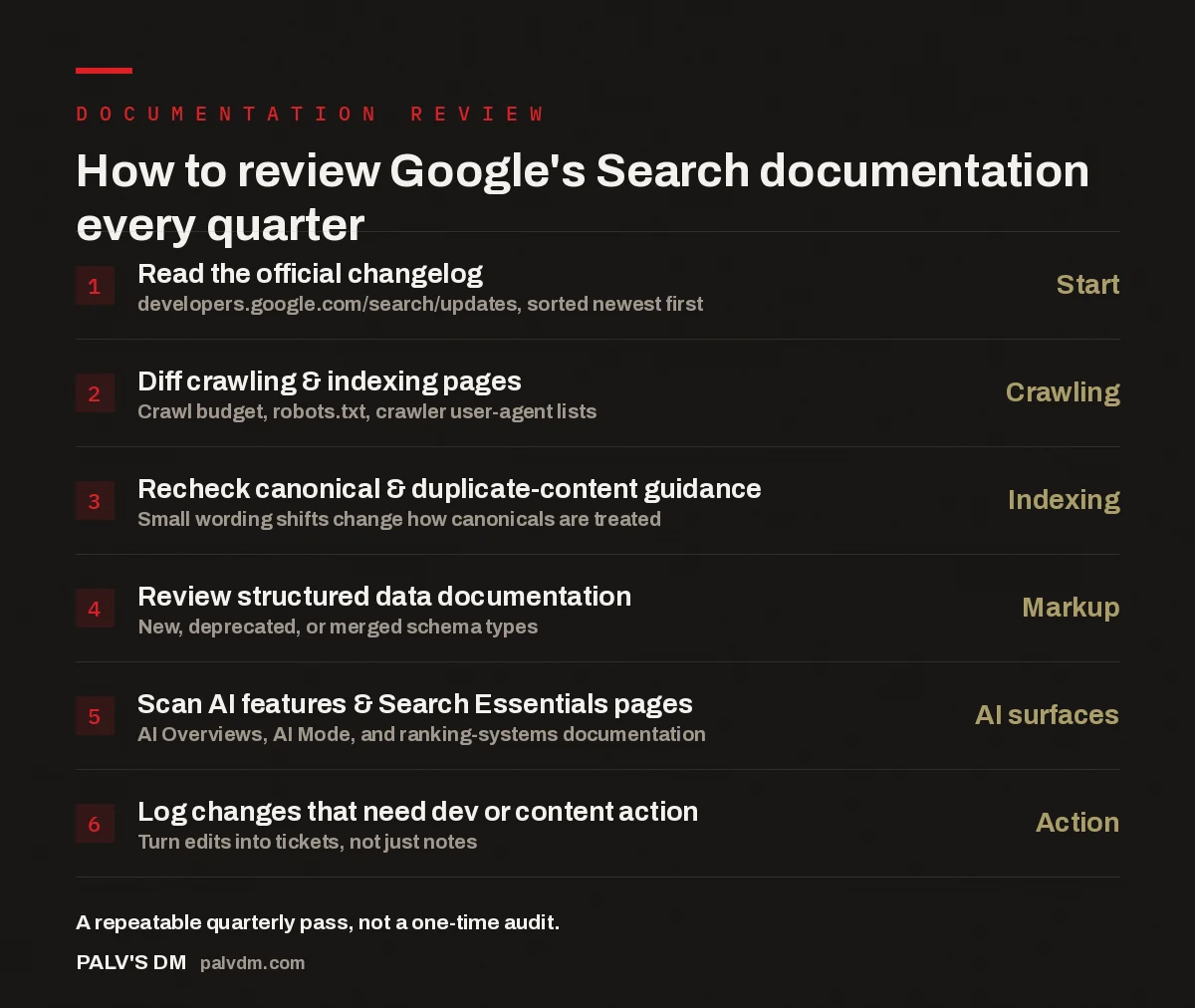
How to review Google’s Search documentation every quarter
- Read the official changelog — Start. developers.google.com/search/updates, sorted newest first.
- Diff crawling & indexing pages — Crawling. Crawl budget, robots.txt, crawler user-agent lists.
- Recheck canonical & duplicate-content guidance — Indexing. Small wording shifts change how canonicals are treated.
- Review structured data documentation — Markup. New, deprecated, or merged schema types.
- Scan AI features & Search Essentials pages — AI surfaces. AI Overviews, AI Mode, and ranking-systems documentation.
- Log changes that need dev or content action — Action. Turn edits into tickets, not just notes.
Why does Google keep changing its Search documentation?
Search Central documentation isn’t a static manual — it’s Google’s closest thing to a public interface for how ranking systems, crawling behaviour, and AI features actually work at a given point in time. When an algorithm update ships, a crawler’s behaviour changes, or a new AI surface launches, the documentation is usually the first place that shift gets described in plain language, well before it’s confirmed through observed ranking movement. Google’s own team has said openly that documentation is meant to be a living reference, updated as systems change rather than rewritten once a year. That’s precisely why treating google search documentation updates as a quarterly research task, not a one-off audit, matters: the pages you read in January can be worded differently by April, and the difference is rarely cosmetic.
The practical consequence for anyone running SEO or AI visibility work is that the source of truth moves. A page you optimised against six months ago might now be built around guidance Google has since narrowed, deprecated, or folded into a different document entirely. The teams that catch this early are the ones who read the documentation directly rather than relying entirely on secondhand summaries from SEO forums, which lag the source by days or weeks and sometimes miss nuance in translation.
What kinds of documentation changes are actually worth tracking?
Not every edit matters equally. Google’s changelog includes everything from typo fixes to guidance that reshapes how a whole category of pages should be built. Four categories consistently produce the changes worth acting on.
- Crawling and indexing guidance — pages covering crawl budget, robots.txt handling, and crawler user-agents. These move whenever Google adjusts how it allocates crawl resources or adds a new crawler identity, which has happened repeatedly as AI-training and AI-search crawlers were introduced alongside the classic Googlebot.
- Canonical and duplicate-content rules — the wording on how Google selects a canonical URL among duplicates. Small phrasing shifts here change how aggressively you need to enforce canonical tags versus relying on Google’s own consolidation signals.
- Structured data documentation — new schema types get added, others get marked deprecated or merged into broader categories. A schema type your dev team implemented two years ago can quietly stop being documented as supported.
- AI features and Search Essentials pages — documentation describing AI Overviews, AI Mode, and the ranking systems overview. This is the newest and fastest-moving category, and the one most directly tied to AI visibility work rather than classic organic ranking.
Outside those four, most changelog entries are maintenance: clarified examples, reorganised navigation, or language cleanup. Worth a glance, rarely worth a strategy change.
How do you build a repeatable quarterly documentation review?
The most reliable way to keep up with google search documentation updates without turning it into a full-time job is to treat it as a fixed quarterly task with a defined scope, not an ongoing background worry. A workable version of this process looks like the six-step pass in the checklist above: start at the official changelog, then work through crawling, canonicals, structured data, and AI-features documentation in that order, ending with a log of anything that needs a ticket.
Two habits make this process actually stick instead of lapsing after one quarter. First, keep a simple running document — even a shared spreadsheet — with one row per change, the date it was noticed, and the page or section it affects on your own site. Without that record, it’s easy to notice a change, mean to act on it, and lose track of it three weeks later. Second, separate “noted” from “actioned.” A documentation change that gets read and discussed but never turned into a ticket for the dev or content team has the same effect as never having read it at all.
This is also where a structured quarterly search roundup earns its keep — folding documentation review into the same cadence as your ranking and traffic review means the two get read together, and a documentation change can be matched against a metric shift you were already investigating.
Most sites treat Google’s documentation as something to check when rankings drop. By then you’re reacting to a change that was already written down weeks earlier. The accounts that stay ahead are the ones that read the changelog on a schedule, whether or not anything looks broken that week.
Palash, Founder, PalV’s DM
Which recent categories of change have mattered most?
Rather than naming a specific quarter’s edits — which will be out of date by the time this is read — it’s more useful to describe the pattern that shows up repeatedly across recent review cycles, because the pattern is what a quarterly process is actually designed to catch.
The crawling and indexing pages have been the most consistently active category over the past couple of years, largely driven by the introduction and refinement of new crawler identities as Google separated out crawlers for AI training and AI-search features from the core Googlebot. Sites that only maintained a robots.txt file written for classic Googlebot found themselves either blocking or unintentionally allowing crawlers they hadn’t accounted for, simply because the crawler-naming documentation had moved on. That’s the exact kind of change our post on keeping robots.txt current as AI crawler naming changes walks through in more depth.
Canonical guidance has also seen meaningful, if quieter, revision — mostly in how explicitly Google describes the signals it weighs when a canonical tag conflicts with other indicators like internal linking patterns or sitemap entries. If your canonicalisation strategy predates the current wording, it’s worth reading the canonical guidance updates worth re-reading rather than assuming the old advice still holds verbatim.
Crawl budget guidance specifically has been another recurring area of revision, generally trending toward more explicit statements about which site sizes and structures actually need to think about crawl budget at all, as opposed to it being a universal concern. That distinction affects how a site should prioritise crawl-related fixes, and it’s covered directly in our breakdown of the crawl budget guidance change and what the new documentation says.
How does documentation tracking connect to AI visibility work?
Classic SEO documentation tells you how Google crawls, indexes, and ranks a page. AI features documentation — the pages describing AI Overviews, AI Mode, and how content gets selected for AI-generated answers — tells you something different: how content gets read, summarised, and attributed inside a generated response rather than just listed as a blue link. That documentation is younger, changes faster, and is where the gap between what most sites monitor and what actually governs visibility is widest.
A site that keeps up with crawling and canonical documentation but never reads the AI features pages is optimising for half the surface Google now serves results on. This is the specific gap AI visibility (GEO/AEO) work is built to close — reading the documentation that governs how AI systems select and cite content, and translating wording changes into concrete site changes before a visibility gap shows up in the numbers.
Put this into practice
If you don’t have a standing process for tracking google search documentation updates — or you’re not sure which recent changes actually apply to your site — that’s exactly what an AI visibility review is for.
FAQ
Where does Google actually publish its search documentation updates?
Google maintains a public changelog on the Search Central site (developers.google.com/search/updates) that logs most substantive edits to its Search documentation, including what changed and roughly when. It’s sorted newest first and is the most direct source — faster and more precise than waiting for a third party to summarise a change.
How often should a site review Google’s documentation for changes?
A quarterly review is a practical minimum for most sites — frequent enough to catch changes before they compound, infrequent enough to stay a manageable task rather than a constant distraction. Sites in fast-moving categories, or ones that lean heavily on AI visibility, benefit from checking the AI features documentation specifically on a shorter cycle, since that category changes fastest.
Do documentation changes always mean a ranking algorithm update happened?
No. Many documentation edits are clarifications of existing behaviour rather than announcements of a new one — Google rewording a page to explain something more precisely, without the underlying system having changed. Others do describe a genuine shift. The way to tell the difference is to read the specific wording change rather than assuming every edit signals a live algorithm update.
Which documentation pages should a small site prioritise if it can’t review everything?
Start with the pages closest to your site’s actual risk: crawling and indexing guidance if you have a large or frequently updated site, canonical guidance if you run near-duplicate content across pages or locales, and AI features documentation if organic visibility inside AI-generated answers matters to your traffic. A small site rarely needs to track every category with equal depth.
Is tracking documentation changes a substitute for monitoring rankings and traffic?
No, the two are complementary. Documentation tracking is a leading indicator — it flags what Google says is changing before that change fully shows up in performance data. Ranking and traffic monitoring, including tools discussed in our piece on the state of search in 2026, remains the lagging confirmation that a documented change actually affected your specific site.
Short version: Google search documentation updates are continuous, not quarterly, but a fixed quarterly review — changelog, crawling, canonicals, structured data, AI features, then a logged action list — is the practical way to keep up without it becoming a daily habit. The categories that move fastest right now are crawler documentation and AI features pages, which is also where the gap between what’s written and what most sites have actually implemented tends to be widest.