Trends & Industry Developments
Canonical Guidance Updates Worth Re-Reading
Google's canonical guidance still calls rel=canonical a hint, but the current documentation frames it around consistency across signals. Here's what to re-check.

Google’s canonical guidance still says what it has said for years — rel=canonical is a hint, not a directive, and Google reserves the right to pick a different URL than the one you declared. What’s worth re-reading is how that guidance now explains the decision: it’s written around consolidated duplicate-content signals (canonical tags, redirects, internal linking, sitemaps, HTTPS preference) rather than the tag in isolation. If your canonical strategy still treats rel=canonical as a standalone switch, that’s the gap the current documentation is trying to close.
Key takeaway
- Google’s canonical guidance frames rel=canonical as one signal among several — internal links, sitemaps, redirects and HTTPS preference all feed the same decision.
- The “Google-selected canonical” in Search Console can legitimately differ from your declared one, and that gap is where most canonical debugging time goes.
- Most canonical problems teams hit aren’t caused by a missing tag — they’re caused by conflicting signals (a canonical pointing one way, internal links pointing another).
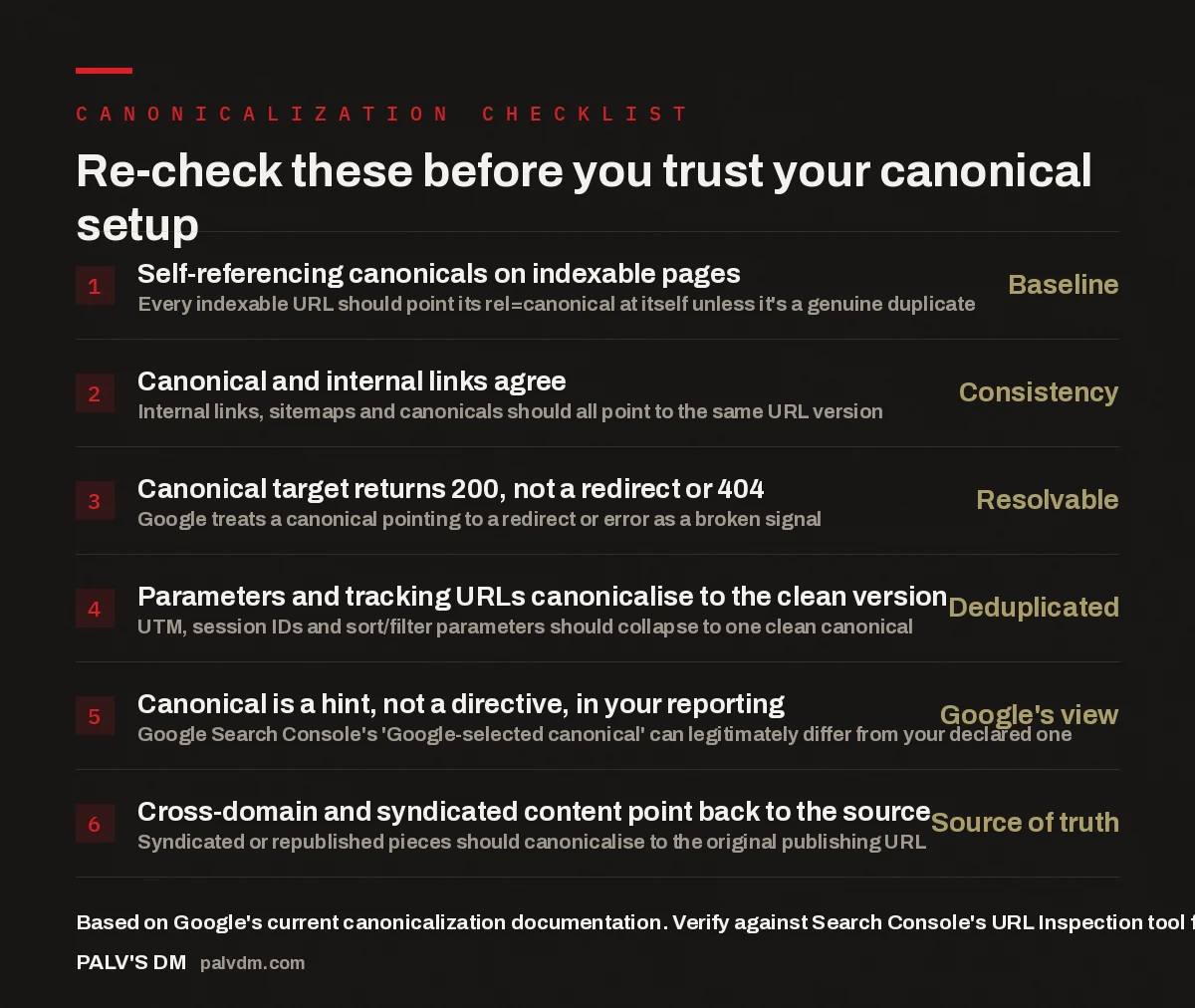
Re-check these before you trust your canonical setup
- Self-referencing canonicals on indexable pages — Baseline. Every indexable URL should point its rel=canonical at itself unless it’s a genuine duplicate.
- Canonical and internal links agree — Consistency. Internal links, sitemaps and canonicals should all point to the same URL version.
- Canonical target returns 200, not a redirect or 404 — Resolvable. Google treats a canonical pointing to a redirect or error as a broken signal.
- Parameters and tracking URLs canonicalise to the clean version — Deduplicated. UTM, session IDs and sort/filter parameters should collapse to one clean canonical.
- Canonical is a hint, not a directive, in your reporting — Google’s view. Google Search Console’s ‘Google-selected canonical’ can legitimately differ from your declared one.
- Cross-domain and syndicated content point back to the source — Source of truth. Syndicated or republished pieces should canonicalise to the original publishing URL.
What does Google’s canonical guidance actually say now?
Strip away the changelog and the current Google canonical guidance rests on one idea: canonicalization is a clustering problem, not a tagging problem. Google groups near-identical URLs into a cluster, then picks one member of that cluster to show in search results. Rel=canonical is the strongest signal you can hand it for which member that should be, but it sits alongside redirects, internal linking patterns, sitemap listings, and — where it applies — a preference for HTTPS over HTTP. None of those signals override the others automatically; Google weighs them together.
That’s the part practitioners tend to forget once they’ve internalised “just add a canonical tag.” The tag is necessary but it isn’t sufficient. If your sitemap lists the non-canonical version, if internal links point at a parameter’d URL while the canonical points at the clean one, or if the canonical target itself redirects somewhere else, you’ve handed Google conflicting signals — and conflicting signals are exactly what the documentation warns will produce a Google-selected canonical that doesn’t match what you declared.
Why is it worth re-reading if your team already “knows” canonicals?
Most SEOs learned canonicalization once, years ago, and haven’t opened the documentation since. The mechanics they memorised — self-referencing canonicals, one canonical per page, don’t combine canonical with noindex on the same URL — are still correct. What’s shifted is the framing around them, and framing changes what you check when something looks wrong.
The current guidance is explicit that canonical selection is a multi-signal decision, which means a canonical “problem” is rarely fixed by re-checking the tag alone. In the accounts we audit, the pattern that shows up repeatedly is a technically correct canonical tag sitting on a page whose internal links, XML sitemap, and hreflang cluster all disagree with it. The tag was never wrong. The surrounding signals were. Teams that only ever re-read the canonical documentation for the tag syntax miss that the rest of the page describes exactly this failure mode and how Google resolves it.
What’s changed in emphasis, not just wording?
A few emphasis shifts are worth calling out specifically, because they change where you should be looking during an audit rather than what you type into a meta tag.
- Consistency across signals is treated as the primary lever. The documentation now leads with “make signals consistent” rather than “add this tag,” because inconsistent signals are the most common real-world cause of Google overriding a declared canonical.
- Search Console’s canonical reporting is positioned as the debugging tool of record. The URL Inspection tool’s “Google-selected canonical” field is now the reference point the guidance points you toward when your declared canonical isn’t being honoured — not guesswork about crawl behaviour.
- Parameter handling gets more direct treatment. Tracking parameters, session IDs, and sort/filter combinations are called out plainly as duplicate-content sources that should canonicalise to a clean URL, rather than left as an implied edge case.
- Cross-domain syndication guidance is clearer about direction. Republished or syndicated content should canonicalise back to the original publishing URL, which matters more now that AI systems and aggregators redistribute content further and faster than a few years ago.
How do you audit your canonical setup against the current guidance?
- Pull the canonical tag and the Google-selected canonical side by side. Use the URL Inspection tool in Search Console on a sample of important URLs — templated product pages, paginated category pages, filtered listing pages — and compare the two fields directly.
- Check where the two disagree, then trace the signal that’s causing it. Look at internal links pointing to the page, its inclusion (or exclusion) from the XML sitemap, and whether the canonical target itself redirects or 404s.
- Audit parameterised URLs as a group, not one at a time. Export a list of URLs with query parameters from your crawler and confirm every variant canonicalises to the same clean version — sort order, filters, and tracking parameters included.
- Confirm canonical and hreflang agree on international pages. A canonical pointing away from a locale page while hreflang tags claim that locale as valid is a common source of the wrong page ranking in the wrong country.
- Re-run the check after any migration, template change, or CMS update. Canonical logic often lives in a template; one change to that template can silently rewrite canonicals sitewide.
Canonical tags don’t fail in isolation. When we trace a “Google ignored our canonical” complaint back to its cause, it’s almost never the tag itself — it’s a sitemap, an internal link pattern, or a redirect chain quietly telling Google something different.
Palash, Founder, PalV’s DM
Where do teams still get canonicals wrong?
Three patterns account for most of the canonical issues that surface in technical audits. The first is faceted navigation and filtering — e-commerce and listing sites generate combinations of filters and sort orders that each produce a unique URL, and unless every combination canonicalises back to the base category page, you end up with a sprawling set of near-duplicate URLs competing for the same intent. The second is migration debt — a domain move, HTTPS switch, or CMS change that updated most canonicals correctly but left legacy templates, older landing pages, or a forgotten subdirectory pointing at outdated targets. The third is syndication and cross-posting without a clear source-of-truth canonical, which matters more now that content gets redistributed through partner sites, aggregators, and AI systems faster than most teams update their canonicalization rules to keep up.
None of these require exotic fixes. They require the same discipline the current guidance is trying to instil: check the tag, then check everything around the tag, and treat any disagreement between them as the actual bug.
How does this connect to AI visibility, not just classic rankings?
Canonical consistency matters beyond the traditional ten blue links. AI systems that summarise or cite web content still rely on crawlable, well-signalled URLs to know which version of a page is authoritative — a page with conflicting canonical signals is just as confusing to a citation-generating system as it is to classic indexing. If your product pages, guides, or documentation exist in multiple near-duplicate URL forms and don’t consistently point to one canonical version, you’re making it harder for both search and AI-driven surfaces to settle on the version worth citing. Clean canonicalization is foundational plumbing for AI visibility work, not a separate task.
This is also where documentation changes stop being trivia and start being operational. tracking what changed in Google’s documentation each quarter gives you a standing check on whether your canonical logic, crawl handling, and date signals still match current guidance rather than the version you learned three years ago. It’s the same discipline as re-reading Google’s updated crawl budget guidance or checking your lastmod and date signal implementation against what Google’s documentation now actually says it uses — none of these are one-time reads.
Get it checked properly
Canonical inconsistencies are easy to carry for years without noticing, because the tag itself usually looks right. A proper technical audit checks the tag against every signal around it — internal links, sitemaps, redirects, hreflang — and against how AI-driven surfaces are reading your site today.
Is Google’s canonical guidance a rule or a suggestion?
It’s explicitly a hint. Google’s documentation states that rel=canonical is one signal it weighs alongside redirects, internal linking, sitemaps and HTTPS preference when deciding which URL to treat as canonical. Google can and does select a different URL than the one you declared when other signals disagree with your tag.
How do I check which canonical Google is actually using?
Use the URL Inspection tool in Google Search Console. It shows both the “User-declared canonical” (what your page’s tag says) and the “Google-selected canonical” (what Google chose). When those two differ, that’s your starting point for finding the conflicting signal.
Can a canonical tag and a noindex tag conflict?
Yes, and it’s a common misconfiguration. A page that canonicalises to itself but also carries a noindex tag sends a mixed message — you’re telling Google this URL is the authoritative version while also asking it not to be indexed. Keep canonical targets indexable and free of noindex.
Should every parameterised URL have its own canonical?
No. Parameterised variants — tracking parameters, sort orders, session IDs — should canonicalise to the clean base URL rather than each declaring itself canonical. The exception is when a parameter genuinely changes the page’s content enough that it deserves independent ranking, such as a distinct filtered category with unique products.
Does canonicalization affect how AI tools cite my content?
It can. AI systems that summarise or cite web content still need to resolve which URL is the authoritative version of a piece of content. Inconsistent canonical signals create the same ambiguity for these systems as they do for traditional indexing, which is one more reason to keep canonicalization clean rather than treating it as a legacy SEO task.
Short version: Google’s canonical guidance hasn’t changed its core rule — rel=canonical is a hint, not a directive — but it’s now framed around consistency across every signal that feeds Google’s canonicalization decision: the tag, internal links, sitemaps, redirects, and hreflang. Re-reading it isn’t about relearning syntax. It’s about checking whether the signals around your canonical tags still agree with it, especially after migrations, template changes, or CMS updates. That same consistency also underpins how well AI-driven surfaces can identify which version of your content to cite.