Trends & Industry Developments
Third-Party SEO Data Got Less Reliable: How to Compensate
SEO tool data accuracy has dropped as clickstream signal thins and Google's num=100 change broke deep rank tracking. Here's how to compensate.

Third-party SEO tools are still useful, but their numbers are no longer measurements in the way they used to be — they’re estimates built on shrinking, noisier signal. Search volume is modeled from panel and clickstream data that keeps thinning as more queries resolve inside AI Overviews and zero-click results. Rank tracking past the top of the page lost its cheap data source when Google removed the parameter that let tools pull 100 results in one call. Backlink indexes were always samples, not censuses, and AI visibility trackers are running their own prompts against models, not watching your actual customers. SEO tool data accuracy hasn’t collapsed — it’s shifted from “measured” to “modeled,” and the fix is compensating for that shift, not abandoning the tools.
Key takeaway
- Search volume, deep rank positions, and competitor traffic estimates are all now built on thinner source data than they were a few years ago — treat them as directional, not exact.
- Google’s removal of the
&num=100parameter specifically broke cheap, complete SERP scraping — most tools now sample or estimate positions beyond the first page. - The fix is triangulation: pair third-party tool data with first-party data (Search Console, server logs, analytics) and stop making single-number decisions off any one dashboard.
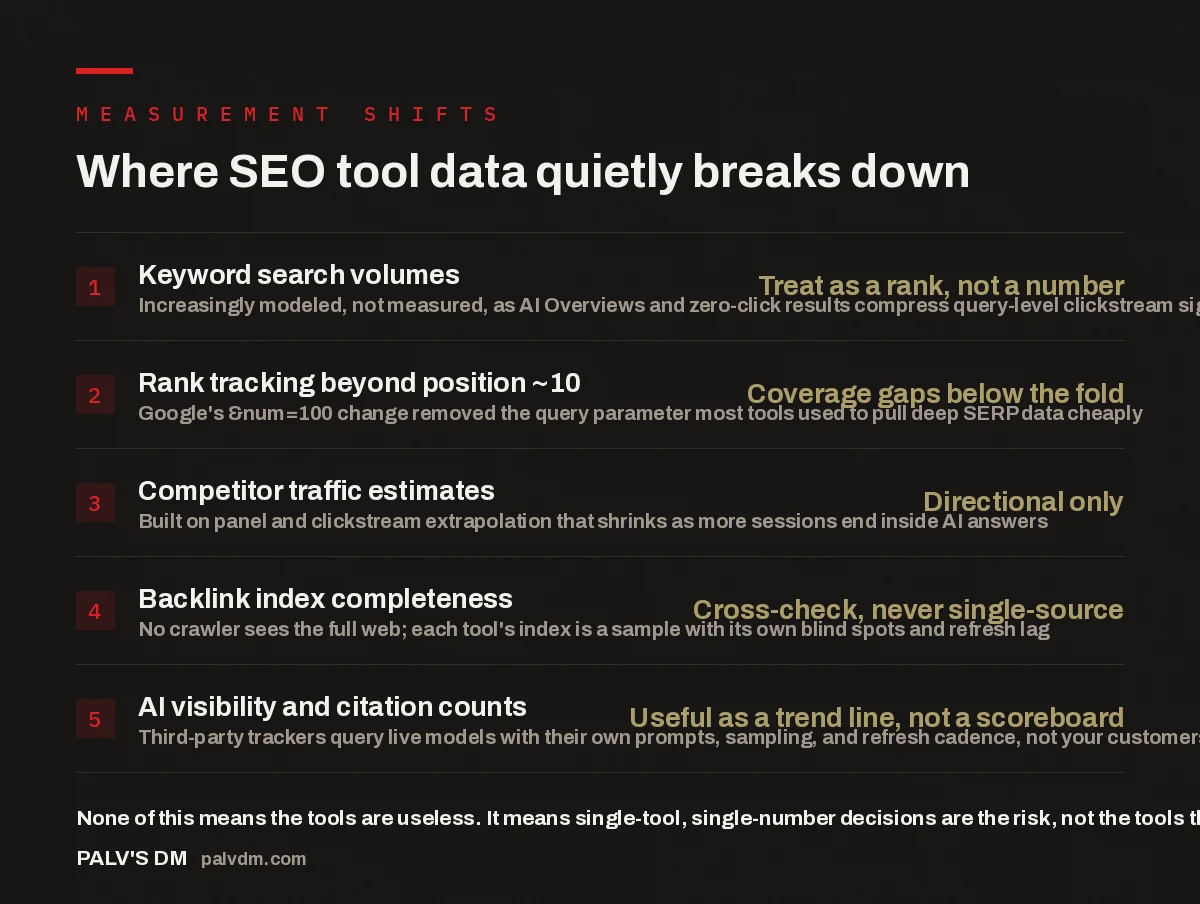
Where SEO tool data quietly breaks down
- Keyword search volumes — Treat as a rank, not a number. Increasingly modeled, not measured, as AI Overviews and zero-click results compress query-level clickstream signal.
- Rank tracking beyond position ~10 — Coverage gaps below the fold. Google’s &num=100 change removed the query parameter most tools used to pull deep SERP data cheaply.
- Competitor traffic estimates — Directional only. Built on panel and clickstream extrapolation that shrinks as more sessions end inside AI answers.
- Backlink index completeness — Cross-check, never single-source. No crawler sees the full web; each tool’s index is a sample with its own blind spots and refresh lag.
- AI visibility and citation counts — Useful as a trend line, not a scoreboard. Third-party trackers query live models with their own prompts, sampling, and refresh cadence, not your customers’ actual sessions.
Why did SEO tool data accuracy get worse?
Every third-party SEO tool depends on a data supply chain it doesn’t fully control: clickstream panels, crawled SERPs, sampled backlink indexes, and increasingly, live queries against AI models. Two structural changes hit that supply chain at once. First, more search sessions now end without a click — the answer appears in an AI Overview, a featured snippet, or an AI Mode response, so the clickstream data that keyword tools use to model search volume has less to work with per query. Second, Google removed the &num=100 URL parameter that let rank trackers pull 100 results per SERP in a single request. Tools that relied on it to cheaply capture positions 11 through 100 now have to make more requests, sample less frequently, or estimate — and most vendors quietly did some combination of all three rather than announce a drop in coverage.
Layer AI visibility tracking on top of that and the picture gets murkier still. There’s no server log equivalent for “how often did ChatGPT mention my brand” — trackers have to send their own sample prompts to each model and count what comes back, which means the number depends heavily on which prompts the tool chose to ask, how often it re-asks them, and how the model happened to respond that day. None of this is a scandal or a conspiracy. It’s what happens when an entire industry’s measurement layer was built for a search landscape that clicked through to a results page, and that landscape started answering more queries without a click.
Which specific metrics should you stop trusting at face value?
Not every metric degraded equally. Some are still close to reliable; others have drifted far enough from ground truth that treating them as exact is a mistake.
- Search volume ranges — still directionally useful for comparing two keywords against each other, but the absolute monthly number is a modeled estimate, not a count, and it moves between tools for the same term because each vendor’s model is different.
- Rankings below position 10 — the part of the SERP most affected by the
&num=100change. If a tool shows a keyword “not ranking” or jumping ten spots overnight with no site change, check whether it’s a tracking artifact before treating it as a real signal. - Competitor traffic estimates — useful for spotting large, sustained trend shifts in a competitor’s visibility, not for comparing your traffic to theirs down to a percentage point. These have always been estimates; the gap to reality has simply widened as clickstream panels shrink.
- Backlink counts and referring domain totals — every index is a sample of the web, refreshed on its own schedule. Two tools showing different totals for the same site isn’t an error in either one; it’s two different partial views.
- AI citation and mention counts — read these as a trend over time within one tool, not as an absolute count of how often a model actually surfaces your brand to real users. The methodology behind these numbers varies enough between vendors that cross-tool comparisons are close to meaningless.
The mistake we see most often isn’t trusting a third-party tool too much — it’s making a single decision off a single number from a single tool. That was always fragile. It’s just more obviously fragile now.
Palash, Founder, PalV’s DM
How do you compensate for less reliable SEO tool data?
The practical fix isn’t a better tool — it’s a different relationship with the data you already have. Four changes matter most.
- Anchor decisions in first-party data first. Google Search Console, server logs, and your own analytics are the closest thing you have to ground truth on how your site is actually performing. Search Console query and page data is sampled and privacy-thresholded too, but it reflects real impressions and clicks on your property, not a third-party estimate of the whole market. Use it as the reference point, and use third-party tools to add context around it — competitor comparisons, market-wide trends, keyword ideation — rather than as the primary source of truth for your own performance.
- Triangulate instead of single-sourcing. If a rank tracker, a backlink tool, and an AI visibility tracker all point the same direction over several weeks, that’s a real signal worth acting on. If only one tool shows movement and the others are flat, treat it as noise until it’s confirmed elsewhere. This is slower than trusting one dashboard, but it filters out the artifacts that come from any single tool’s sampling or methodology quirks.
- Track trends, not snapshots. A single week’s number from any modeled metric can move for reasons that have nothing to do with your site — a tool’s sample refreshed, a competitor’s estimate recalculated, a model vendor changed how it responds to a tracker’s sample prompts. A metric moving consistently over four to eight weeks is a far more trustworthy signal than the same metric moving once.
- Build your own log-level view where it matters most. For anything business-critical — which pages actually get crawled by AI agents, which queries actually drive conversions, which pages actually rank for your money terms — server logs and Search Console exports give you a direct read that doesn’t depend on any vendor’s sampling methodology. It takes more setup than opening a dashboard, but it’s the layer that doesn’t degrade when a third-party data source does.
Does this mean SEO tools are no longer worth paying for?
No — the tools still do things first-party data can’t: keyword discovery at scale, competitor visibility over time, technical crawling of your own site, and increasingly, some read on how AI platforms are treating your content. What changed is how much weight any single number from them deserves. A search volume estimate is still a reasonable way to prioritize a list of a thousand keyword ideas. It’s a poor basis for promising a client a specific traffic number. A rank tracker is still a fast way to see whether a page’s visibility is trending up or down. It’s a poor way to detect a one-position ranking change and assume it means something. The tools didn’t stop being useful; the confidence interval around their numbers got wider, and treating that wider interval as if it were still narrow is where teams get burned.
This is part of a broader shift in how search measurement changed heading into 2026 — the same forces reshaping tool data reliability are also behind the growing gap between ranking well and actually being cited in AI answers, and behind why teams increasingly need a scorecard that spans more than one surface.
Where this connects
- If your rank tracking data has been erratic lately, read what rank trackers can still reliably tell you after the &num=100 change for the mechanics behind it.
- If you’re relying on any single AI visibility number, building a multi-surface visibility scorecard is the structural fix — it spreads the risk across sources instead of one tool’s methodology.
- Most teams aren’t even tracking AI visibility yet, reliably or not — see how few marketers currently track it and what that gap means competitively.
Get a measurement audit that separates real signal from tool noise
Why did keyword search volume data get less accurate?
Search volume estimates are modeled from clickstream and panel data, and that data has less to work with as more queries resolve inside AI Overviews and zero-click results without a click ever reaching a results page. The underlying query still happens, but the signal tools use to estimate its frequency has thinned, so the resulting number is a rougher estimate than it used to be.
What was the &num=100 change and why does it matter for SEO tools?
Google removed support for the &num=100 URL parameter, which used to let rank tracking tools pull up to 100 search results in a single request. Without it, tools need more requests to capture the same depth of data, which is slower and costlier at scale — so many vendors now sample less frequently or estimate positions beyond the top of the page rather than tracking every position in full.
Should I switch to a different SEO tool if the data feels unreliable?
Usually not — the underlying data constraints affect every vendor in the category, since they’re all working from similar clickstream panels, crawled SERPs, and sampled indexes. Switching tools rarely fixes the reliability gap; triangulating across your current tool, first-party data, and one other independent source usually does more for accuracy than swapping vendors.
How can I tell if a ranking or traffic change is real or a tool artifact?
Check whether the change persists across multiple data pulls over two to four weeks and shows up in more than one source — for rankings, compare against Search Console’s own position data; for traffic, compare against your analytics. A change that only appears in one tool, on one day, with no corresponding site or market event behind it is more likely a sampling artifact than a real shift.
What’s the single biggest mistake teams make with third-party SEO data right now?
Making a specific, high-stakes decision — a traffic forecast, a client-facing target, a budget shift — off one number from one tool, on one day. The data still has value in aggregate and over time; the risk is treating a single modeled estimate as if it carried the precision of a direct measurement.
Short version: third-party SEO tool data — search volume, deep rankings, competitor traffic, backlink counts, AI citation counts — has shifted from measured to modeled as more search sessions end without a click and as key data sources like the &num=100 parameter disappeared. None of it is useless. The fix is to anchor decisions in first-party data (Search Console, logs, analytics), triangulate across more than one source before acting, watch trends over weeks rather than single snapshots, and stop treating any one dashboard’s number as precise. Teams that adjust their trust level to match the new data quality keep making good decisions; teams that don’t start making decisions on noise they think is signal.