Trends & Industry Developments
Predictions We Got Wrong About AI Search (And What We Learned)
A practitioner's honest review of the ai search predictions we got wrong on AI Overviews, citations, and SEO strategy, and what we changed because of it.
We got several of our AI search predictions wrong over the last two years, and the wrong ones follow a pattern: we mistook an early platform behaviour for a permanent one, and we mistook a client’s account for the whole market. This piece runs through the specific calls we made, why they didn’t hold up, and what we changed about how we forecast now. If you’re relying on anyone’s AI search predictions to plan a budget, including ours, this is the honest version of what “prediction” actually means in a market that reshapes itself every quarter.
Key takeaway
- We called traditional SEO “dead” too early — organic search still sends measurable traffic on most accounts we manage, it’s just no longer the whole answer.
- We overestimated how fast citations would replace rankings; the two are converging slowly, not collapsing into one metric overnight.
- We assumed one AI-visibility playbook would work everywhere; in practice, what earns a citation on one AI surface doesn’t reliably earn one on another.
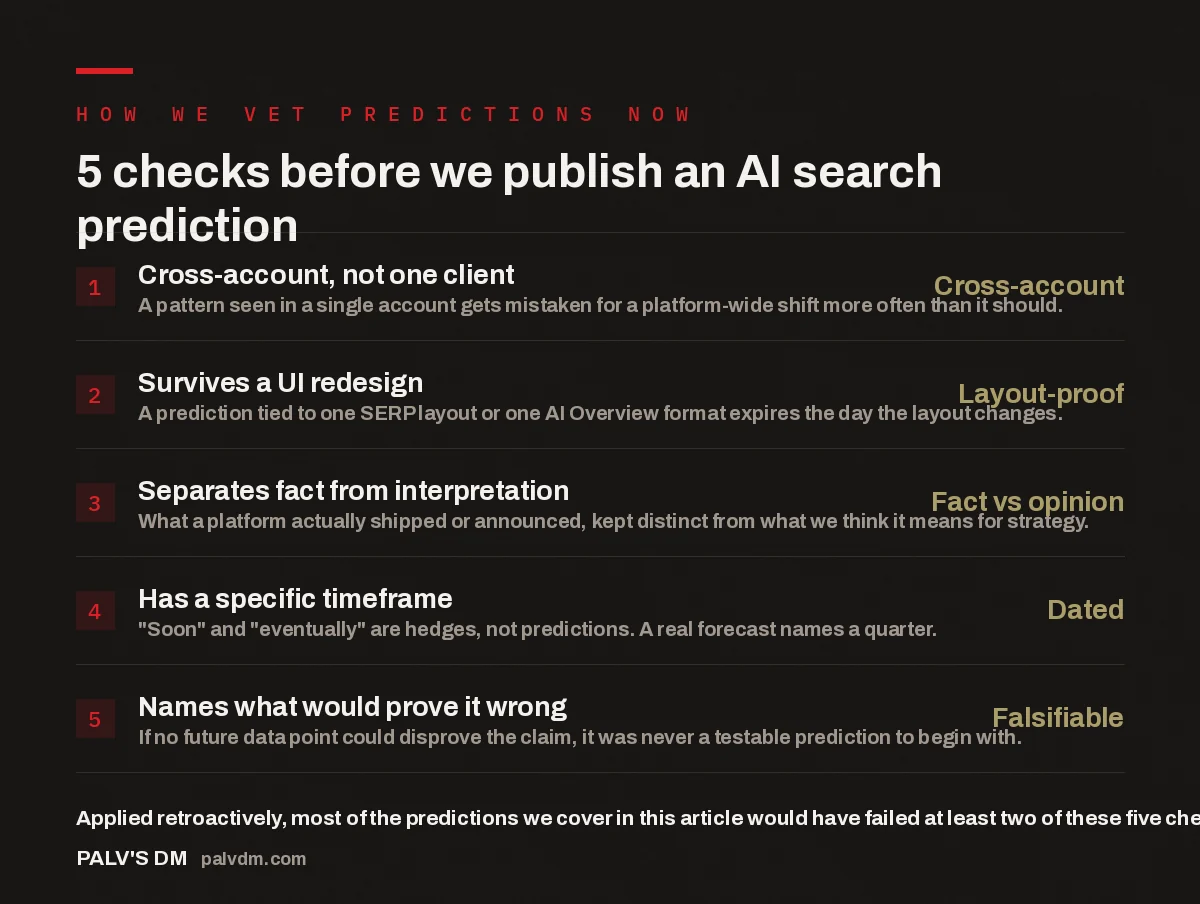
5 checks before we publish an AI search prediction
- Cross-account, not one client — Cross-account. A pattern seen in a single account gets mistaken for a platform-wide shift more often than it should.
- Survives a UI redesign — Layout-proof. A prediction tied to one SERP layout or one AI Overview format expires the day the layout changes.
- Separates fact from interpretation — Fact vs opinion. What a platform actually shipped or announced, kept distinct from what we think it means for strategy.
- Has a specific timeframe — Dated. “Soon” and “eventually” are hedges, not predictions. A real forecast names a quarter.
- Names what would prove it wrong — Falsifiable. If no future data point could disprove the claim, it was never a testable prediction to begin with.
Which AI search predictions did we get wrong?
Four calls stand out, in order of how confidently we made them and how wrong they turned out to be. The table below is the short version; the sections after it go through each one, what we actually saw happen in client accounts, and why the original prediction missed.
| What we predicted | What actually happened |
|---|---|
| Traditional SEO would be functionally dead within a year of AI Overviews rolling out widely | Organic traffic dropped on informational queries but held up on commercial and navigational ones; SEO changed scope, it didn’t disappear |
| Citations would replace rankings as the primary visibility metric almost immediately | Ranking #1 and being cited overlap less than they used to, but the overlap is eroding gradually, not vanishing in one update cycle |
| One AI-visibility playbook would transfer cleanly across every AI answer surface | What gets cited on one surface doesn’t reliably get cited on another; each surface pulls from different signals |
| Agentic, bot-initiated buying would already be a meaningful revenue channel for most of our clients | It’s real and growing on a handful of accounts, but it’s nowhere near the scale we forecast for this stage |
Why did we think traditional SEO would be dead by now?
The claim: when AI Overviews started appearing widely on informational queries, we told clients that ranking on page one of Google would stop mattering within roughly a year, and that budget should move almost entirely toward AI-visibility work.
The reality: that was true for a narrow slice of query types and false as a blanket statement. Informational queries with a quick factual answer did lose click-through volume to AI Overviews, and that decline is well documented across the industry. But transactional and navigational queries — the ones with commercial intent, where someone is comparing options or looking for a specific brand — kept sending traffic through classic blue links in the accounts we manage. The traffic mix shifted; it didn’t zero out. Treating “SEO is dead” as a single verdict ignored that search was never one query type to begin with.
What we changed: we stopped giving a single answer to “should we still invest in SEO” and started answering it per query category. For a client selling enterprise software, commercial-intent SEO still earns its budget. For a client answering common how-to questions, that traffic has genuinely thinned, and AI-visibility work has to pick up the slack. The prediction failed because it collapsed a segmented market into one number.
Why did we overestimate how fast citations would replace rankings?
The claim: we said that within a couple of quarters, “getting cited in an AI answer” would functionally replace “ranking in position one” as the metric that mattered, and that rank tracking would become close to obsolete for informational content.
The reality: the overlap between ranking #1 and being cited in an AI answer has genuinely been shrinking — that part of the prediction held. What we got wrong was the pace and the completeness. Rankings still feed citation systems in ways that are hard to fully decouple; a page that has never ranked at all is still unlikely to get cited consistently. The two signals are drifting apart, not separating cleanly. Rank tracking hasn’t gone obsolete, it’s become one input among several rather than the whole scoreboard.
What we changed: we kept rank tracking in every reporting stack we run, but we stopped treating it as the top-line metric. It now sits alongside citation tracking and referral data from AI platforms, reported together rather than one being declared the successor to the other.
Most of our bad AI search predictions weren’t wrong about direction. They were wrong about speed and about how uneven the change would be across query types, industries, and even individual clients in the same industry. That’s the part a headline prediction always flattens.
Palash, Founder, PalV’s DM
Why did we assume one playbook would work across every AI surface?
The claim: early on, we built a single AI-visibility checklist — structured data, clear answer formatting, authoritative sourcing — and told clients it would improve their odds of citation across AI Overviews, AI Mode, and third-party AI assistants more or less equally.
The reality: the surfaces don’t pull from the same signals in the same proportions. A page that gets cited reliably in one AI surface can be invisible in another, even with identical on-page optimisation. Some surfaces lean harder on structured, extractable answers; others lean on broader topical authority and how often a domain gets referenced elsewhere, including in earned media and third-party coverage rather than the page itself. Treating “AI visibility” as one target meant we were optimising for an average that didn’t describe any single surface well.
What we changed: we now track citation performance by surface, not as a blended score, and we tell clients upfront that improving visibility on one AI platform doesn’t guarantee movement on another. It’s slower to report and less tidy in a slide deck, but it’s the accurate version.
Why did we underestimate how slowly agentic search would arrive?
The claim: we told clients that AI agents completing purchases or bookings on a user’s behalf — agentic search — would become a meaningful revenue channel worth building for across most of our accounts within a relatively short window.
The reality: agentic buying is real, and it’s growing, but it’s concentrated in specific categories and specific platforms rather than showing up broadly. For most of the businesses we work with, day-to-day revenue still comes from a human clicking through and deciding. We were right that agents would arrive; we were wrong about how quickly they’d become something a typical mid-market business needed to actively optimise for rather than just monitor.
What we changed: we moved agentic-search readiness from “build now” to “prepare the data now, build the workflow when volume justifies it” for most accounts. The exception is clients in categories where agent-mediated transactions are already showing up in server logs — for those, we did bring the work forward.
What should you actually do with anyone’s AI search predictions?
Treat every prediction, including the ones in this article, as a directional read rather than a fixed date on a calendar. The pattern that shows up repeatedly across the accounts we manage is that AI search change moves in the right direction faster than expected and reaches full effect slower than expected — early movement gets mistaken for the whole shift. Before you act on someone’s forecast, ask what it’s based on: one account or several, one platform update or a sustained pattern, and what would have to happen for the forecast to be proven wrong. If a prediction can’t fail a falsifiability test, it’s marketing copy dressed as analysis.
The practical implication is that AI-visibility planning works better as an ongoing, re-checked process than a one-time strategy built off a single forecast. Query types shift, platforms update their citation logic, and what worked for a competitor’s content six months ago may not transfer to yours today.
Key takeaway
- Build AI visibility as a per-surface, per-query-type effort rather than one blended strategy.
- Keep rank tracking and citation tracking side by side instead of assuming one replaces the other.
- Re-test your own assumptions on a quarterly cycle rather than locking in a strategy off a single prediction.
Get an AI visibility audit built on what’s actually happening in your accounts
Related reading on how AI search is actually changing
If you want the underlying data behind some of the claims above rather than our summary of them, these cover the specifics: the collapsing overlap between ranking #1 and being cited goes deeper into the citation-versus-ranking drift referenced earlier, how often AI Overviews actually appear by query type backs up the point that the impact isn’t uniform, the zero-click search data quantifies how much traffic genuinely disappeared versus shifted, and our current position on whether traditional SEO is still worth investing in is the fuller answer to the question this article touches on. For the broader picture of what changed in search overall, see our review of the state of search in 2026.
Why do AI search predictions get made in the first place if they’re so often wrong?
Because businesses have to plan budget and resourcing before certainty exists, and a directional forecast, even an imperfect one, is more useful than waiting for proof. The mistake isn’t making predictions, it’s presenting them with more confidence than the underlying evidence supports.
Is traditional SEO actually still worth investing in given how much has changed?
In the accounts we manage, yes for commercial and navigational queries, and less so for purely informational ones that AI Overviews now answer directly. The honest answer depends on your query mix, not a blanket industry-wide verdict.
How often should a business revisit its AI search strategy?
Quarterly is a reasonable cadence given how often platforms adjust citation logic and interface layouts. A strategy built on last year’s platform behaviour is likely already out of date, even if the underlying content is still good.
What’s the single biggest reason AI search predictions miss the mark?
Generalising from a narrow sample, usually one platform update or one client account, into a claim about the whole market. The direction of the prediction is often right; the scope and timeline are usually where it breaks down.
Should agentic search be a priority for a mid-market business right now?
For most businesses, preparing the underlying product and service data for agents to read is worth doing now, while building an active agentic-commerce workflow can usually wait until server logs show agent traffic at meaningful volume in your specific category.
Short version: we called SEO’s death too early, called the citation takeover too fast, treated every AI surface as one target instead of several, and called agentic buying’s arrival ahead of schedule for most clients. The direction of each prediction was defensible; the confidence and the timelines weren’t. If you’re weighing anyone’s AI search predictions, including ours, ask what evidence they’re built on and what would prove them wrong before you build a budget around them.