Trends & Industry Developments
Is Traditional SEO Worth Investing In Anymore? Our Position
Is SEO worth it in 2026? Yes, but the payoff has shifted from rank position to AI visibility too. See what to keep funding and what to reprioritise now.

Yes, SEO is still worth investing in 2026, but not the version of SEO most teams are still budgeting for. The myth is that AI Overviews and chatbots have made search optimisation obsolete. The reality is narrower and more useful: the technical, content, and authority work that SEO has always required is still the foundation everything else sits on, but the scoreboard has changed. Ranking #1 on a results page is no longer the finish line, being the source an AI system pulls from and cites is now part of the job. Teams that stopped investing because “SEO is dead” are quietly losing ground on both fronts at once.
Key takeaway
- SEO fundamentals — technical health, intent-matched content, and earned authority — haven’t stopped mattering; they’re the base layer AI systems also draw on.
- What’s genuinely changed is the payoff: a #1 ranking is no longer a reliable proxy for traffic or influence, because clicks and citations have started to separate.
- “Worth it” in 2026 means measuring SEO against a wider goal — visibility across classic results and AI answer surfaces — not against rank position alone.
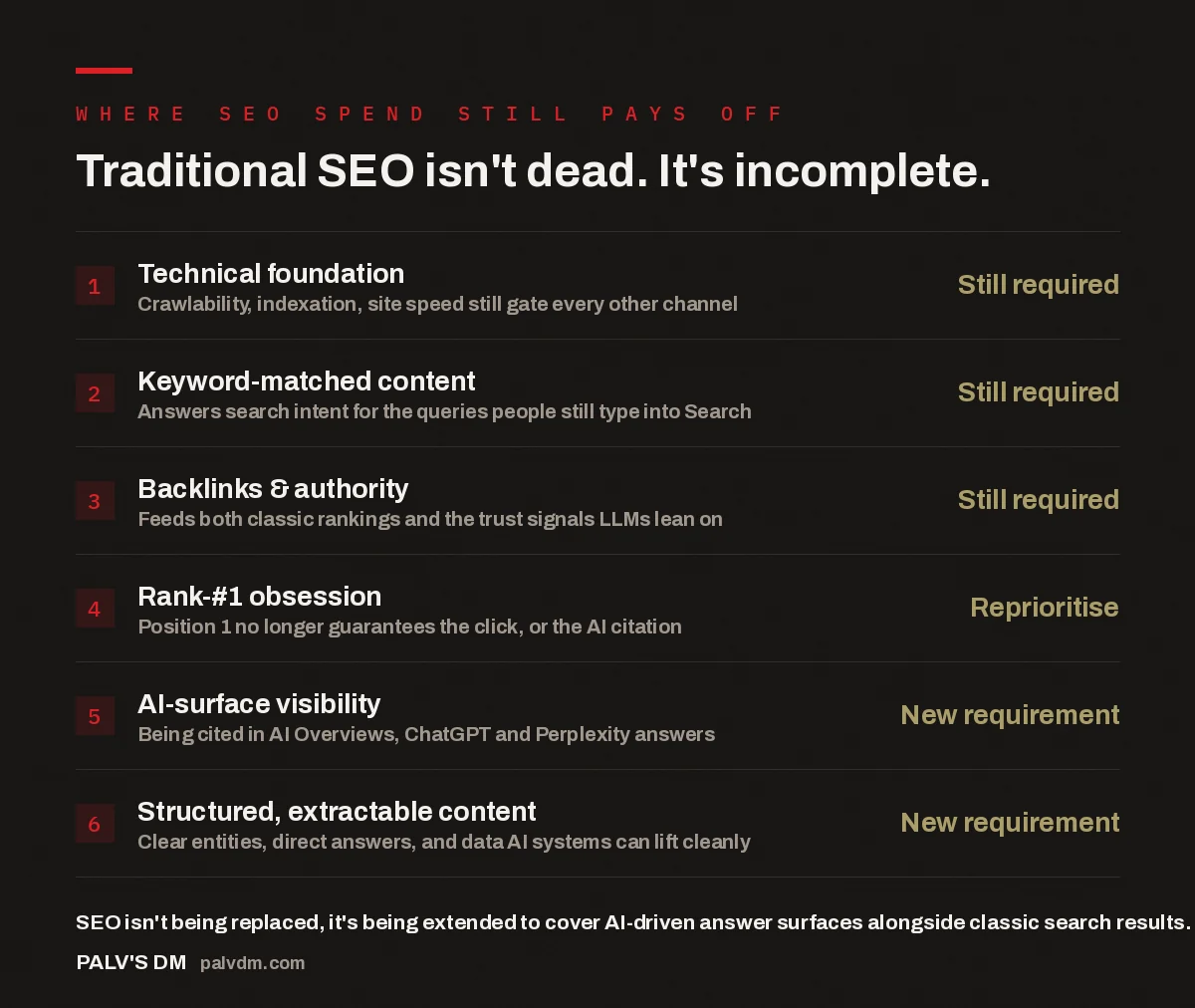
Traditional SEO isn’t dead. It’s incomplete.
- Technical foundation — Still required. Crawlability, indexation, site speed still gate every other channel.
- Keyword-matched content — Still required. Answers search intent for the queries people still type into Search.
- Backlinks & authority — Still required. Feeds both classic rankings and the trust signals LLMs lean on.
- Rank-#1 obsession — Reprioritise. Position 1 no longer guarantees the click, or the AI citation.
- AI-surface visibility — New requirement. Being cited in AI Overviews, ChatGPT and Perplexity answers.
- Structured, extractable content — New requirement. Clear entities, direct answers, and data AI systems can lift cleanly.
What are people actually asking when they say “is SEO worth it in 2026”?
Underneath the question is usually a budget conversation. A marketing lead sees AI Overviews sitting above the organic results on queries that used to send clicks straight to their site, hears that zero-click search is eating into referral traffic, and reasonably asks whether the SEO retainer still earns its place next to paid search and AI visibility work. What’s different in 2026 is that the honest answer requires separating two things that used to move together: ranking well in classic search results, and being visible in the AI-generated answers that now sit on top of those results. They used to be nearly the same job. They aren’t anymore, and that split is the actual shift worth reacting to, not a blanket verdict that SEO itself stopped working.
Is the myth that SEO is dead actually true?
The claim: AI Overviews, AI Mode, and chatbot answers have replaced the traditional search results page, so optimising a website for Google’s algorithm is a wasted line item.
The reality: traditional search results haven’t gone away, they’ve been pushed down the page in some verticals, and AI-generated answers on Google, ChatGPT, and Perplexity are still largely built from crawled, indexed web content — the same content that SEO work produces and structures. In the accounts we work on, the pages that get cited in AI Overviews or pulled into a chatbot’s answer are disproportionately the ones that already rank well, load fast, and are structured clearly enough for a machine to parse quickly. AI systems didn’t invent a parallel content ecosystem; they’re reading the same web, just synthesising it differently. Kill your SEO investment and you become harder to find, understand, and cite, since the second increasingly depends on the first.
What has genuinely changed, and what hasn’t?
Separate the parts of SEO that are still doing exactly what they always did from the parts where the payoff has shifted.
- Technical SEO hasn’t changed its job. Crawlability, clean indexation, and fast load times are still prerequisites — not just for ranking, but for AI crawlers to reliably fetch your pages at all.
- Content that answers real search intent hasn’t stopped working. People still click through for anything that requires depth, comparison, or trust, and AI summaries still need source material to draw from.
- Backlinks and topical authority still compound. They were always a trust signal for classic rankings, and the same signals — who links to you, who cites you — are what LLMs lean on when deciding which sources to trust.
- The relationship between rank position and outcome has changed. On an increasing share of informational queries, the top organic result now sits below an AI-generated answer box, so #1 on the page no longer guarantees #1 in the AI’s attention.
- Being cited and ranking #1 are becoming distinct goals. A page can rank well and never get pulled into an AI answer, while a lower-ranked page can still be quoted directly, depending on how clearly it states facts.
We’ve written more on the mechanics of that split in our look at the collapsing overlap between ranking #1 and being cited — it’s worth reading if you want the pattern in more detail than fits here.
Where does the ROI math on SEO genuinely get harder?
This is the part worth being honest about, because pretending nothing changed is its own kind of myth. Two things make the ROI case for pure traditional SEO harder to make on its own in 2026.
First, informational queries — the “what is,” “how does,” “why does” searches that used to send steady top-of-funnel traffic to blog content — are the queries most likely to get a full answer directly on the results page or inside an AI chat window, with no click required. If your SEO investment has historically leaned on high volumes of informational content driving traffic purely through pageviews, that channel is under more pressure than it was a few years ago, a pattern that shows up consistently in how much traffic zero-click search has actually pulled away. Second, measurement itself is harder. Rank tracking and keyword volume estimates are built on assumptions from an era when the results page looked one way, and several of those assumptions are now visibly out of date, which makes it easy to overreact to a dashboard measuring the wrong thing.
Neither of these means SEO stopped paying off. They mean the specific bet — rank #1 and traffic follows at the old rate — is weaker than it was. That’s a reason to change what you’re optimising for, not a reason to stop optimising.
Every client who asks us “should we drop SEO for AI visibility” is asking the wrong question. It’s not a swap. The sites that show up cleanly in AI Overviews are, almost without exception, the sites that already had their technical and content fundamentals sorted. You don’t get to skip the foundation.
Palash, Founder, PalV’s DM
What does “worth it” actually mean for SEO in 2026?
“Worth it” only makes sense against a defined goal, and the goal itself needs updating before the ROI question can be answered honestly. Judging SEO purely on keyword rank position or raw organic sessions is judging it against a scoreboard that’s stopped reflecting how people actually find answers. A more accurate scoreboard for 2026 tracks visibility across every surface a buyer might encounter you on: classic organic rankings, yes, but also whether you’re being cited inside AI Overviews and AI Mode, and whether the traffic that does still arrive from search converts at a rate that justifies the investment. That last point matters — traffic that arrives via an AI citation tends to behave differently from traffic that arrives via a ranked link, often showing up further along in the decision than a typical organic visitor.
Under that wider scoreboard, SEO is still one of the highest-leverage investments available, because it’s the only channel that improves your standing on both surfaces at once using largely the same underlying work: a technically sound site, content that directly and clearly answers what someone is asking, and a body of earned authority that both Google’s ranking systems and AI models treat as a trust signal. Skip SEO entirely and you’re not just missing rankings, you’re also making yourself harder for AI systems to find, understand, and trust enough to cite.
So should you keep investing in SEO in 2026?
If your SEO strategy is unchanged from three years ago — chase keyword rankings, publish more informational content, wait for pageviews — it’s fair to question whether that specific version is still worth the spend, because its return has genuinely softened. But the underlying discipline, get technically found, answer intent clearly, earn authority that outside sources vouch for, is not optional in 2026, it’s table stakes for both classic search and AI visibility. Teams pulling back entirely will struggle most to show up anywhere, ranked result or AI answer, a year from now. The teams worth watching are the ones extending their existing SEO investment to cover AI answer surfaces explicitly, rather than treating the two as a budget line to choose between.
Where to go from here
Not sure whether your current SEO spend is still pulling weight, or where the gaps in your AI visibility actually are? We audit both together, not as separate line items.
Is SEO still worth it in 2026 for a small business?
Yes, arguably more so, because smaller sites can’t outspend competitors on paid ads indefinitely and SEO remains one of the few channels where fundamentals compound over time. The work looks slightly different — structured, clearly answerable content matters alongside keyword targeting — but a technically healthy, well-written site still pays back for small businesses.
Has AI search actually reduced organic traffic?
On specific query types, particularly short informational questions with a single clear answer, yes, traffic patterns have shifted as answers appear directly on the results page or inside AI chat tools. On queries that involve comparison, nuance, pricing, or a purchase decision, click-through to a website still tends to hold up better, because those queries usually need more than a one-line answer.
Should I switch my SEO budget to AI visibility (GEO/AEO) instead?
Switching entirely is the wrong move, because AI visibility work relies on the same technical and content foundation SEO builds. The more useful move is extending your existing SEO scope to explicitly include AI-surface visibility — structured content, clear entity signals, and citation tracking — rather than treating them as competing budgets.
How do I know if my SEO investment is actually working in 2026?
Rank position and organic sessions alone won’t give you the full picture anymore. Pair them with visibility tracking across AI Overviews, AI Mode, and chatbot answers for your core topics, and look at how the traffic you do get from search actually converts, since AI-referred visitors often behave differently from traditional organic visitors.
What SEO skills matter most going into 2026?
The traditional core — technical audits, on-page optimisation, link building — is still necessary, but it now sits alongside newer skills like structuring content for AI extraction, tracking citations across AI answer surfaces, and reading data from tools that weren’t built with AI search in mind. We go through the full shift in the skills an SEO needs now that they didn’t in 2023.
Short version: SEO isn’t dead in 2026, but the version of SEO that only chases rank position is running out of runway. The technical, content, and authority fundamentals it’s always required are exactly what AI systems also use to decide what to cite, so the investment doesn’t disappear, it gets reallocated toward a wider goal. For the full picture of what’s shifted across search this year, see our rundown of the state of search in 2026; for how often AI Overviews are actually showing up on the queries that matter to you, this breakdown by query type is worth checking before you decide where to put next quarter’s budget.