Trends & Industry Developments
The Skills an SEO Needs Now That They Didn’t in 2023
SEO skills 2026: what changed since 2023 — extraction-friendly writing, entity fluency, AI-crawler literacy, and multi-surface measurement explained.
The SEO skills that mattered most in 2023 — keyword mapping, backlink outreach, on-page optimisation for a single ranking algorithm — haven’t disappeared, but they’re no longer sufficient on their own. The skills an SEO needs now that they didn’t in 2023 cluster around one shift: search results are no longer the only surface, and a growing share of answers are assembled by an AI model rather than clicked through from a list of ten blue links. That changes what “optimising” actually means, and it changes what a competent SEO is expected to know how to do.
Key takeaway
- SEO skills for 2026 add a layer on top of classical SEO — they don’t replace keyword research, technical hygiene, or link building, which are still load-bearing.
- The new work clusters around three areas: writing for extraction (not just readability), understanding how AI crawlers and citations behave, and reading data across more surfaces than a single rank tracker.
- Most of these skills are learnable in weeks, not years — the bigger barrier is usually mindset, not technical difficulty.
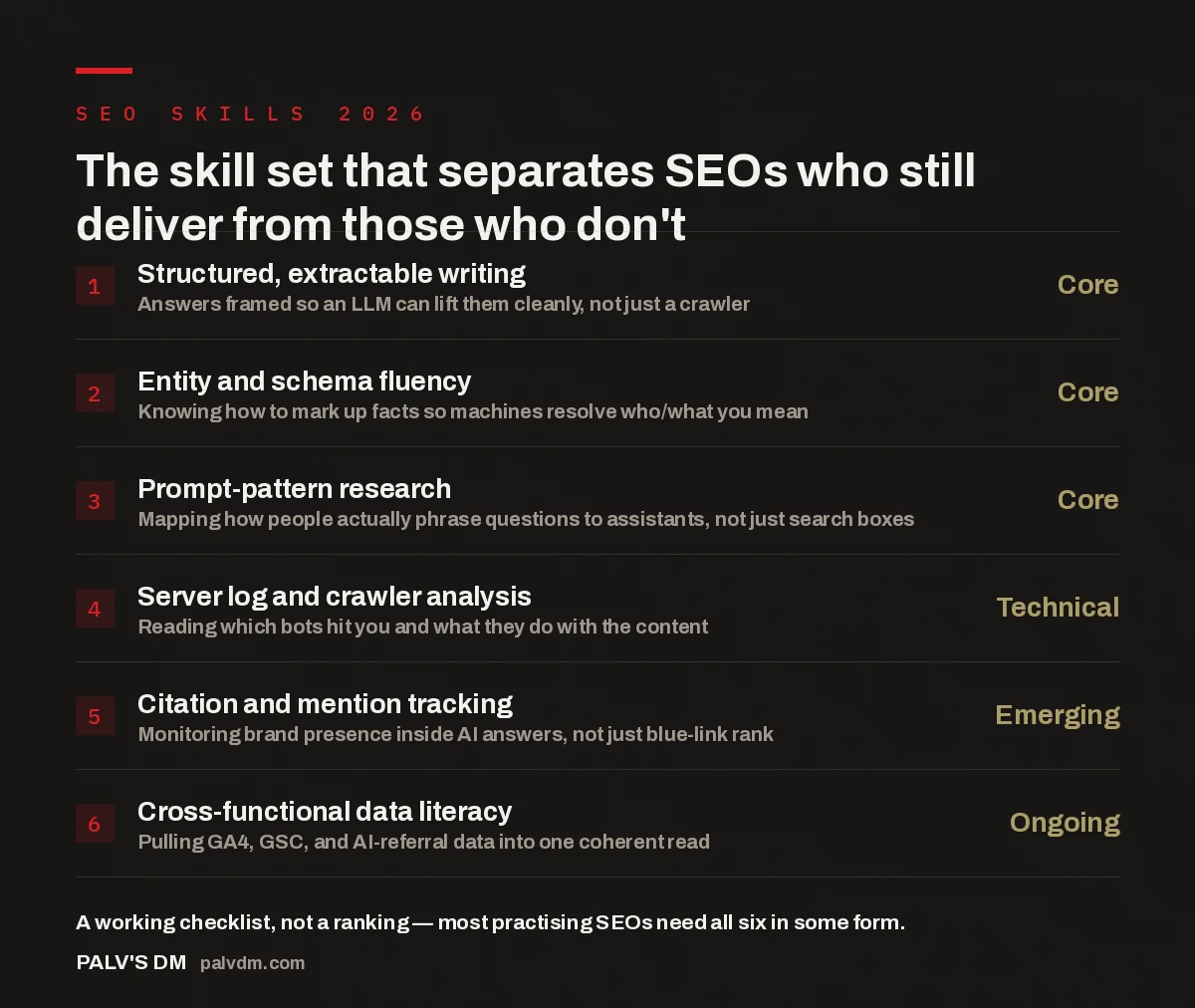
The skill set that separates SEOs who still deliver from those who don’t
- Structured, extractable writing — Core. Answers framed so an LLM can lift them cleanly, not just a crawler.
- Entity and schema fluency — Core. Knowing how to mark up facts so machines resolve who/what you mean.
- Prompt-pattern research — Core. Mapping how people actually phrase questions to assistants, not just search boxes.
- Server log and crawler analysis — Technical. Reading which bots hit you and what they do with the content.
- Citation and mention tracking — Emerging. Monitoring brand presence inside AI answers, not just blue-link rank.
- Cross-functional data literacy — Ongoing. Pulling GA4, GSC, and AI-referral data into one coherent read.
Why did the SEO skill set change at all?
In 2023, the job was still fundamentally about a single algorithm and a single results page. You researched what people typed, built pages that answered it better than competitors, earned links that signalled authority, and tracked position for a defined set of keywords. That model assumed one consumption pattern: a person searches, scans ten results, clicks one.
That assumption doesn’t hold as cleanly anymore. AI Overviews, AI Mode, and standalone assistants now answer a meaningful share of queries directly on the results page or inside a chat window, without a click ever happening. The searcher hasn’t gone away — but the path between question and answer has grown a second, AI-mediated route that runs alongside the traditional one. An SEO who only optimises for the traditional route is optimising for a shrinking share of how people actually get answered. The skills that matter now are the ones that cover both routes at once, not the ones that abandon the first for the second.
What does “writing for extraction” actually mean?
Writing for extraction means structuring a page so that a specific fact, definition, or recommendation can be lifted cleanly by a language model and reproduced as part of an answer — without losing accuracy or attribution context. In practice this is a writing discipline, not a technical one:
- Leading a section with the direct answer, then supporting it — the inverted-pyramid habit good journalists already had, now applied to every H2.
- Making each section self-contained, so a model pulling one paragraph out of context doesn’t lose the “what” it’s talking about.
- Using precise nouns instead of pronouns across section breaks — naming the subject again rather than relying on “this” or “it.”
- Structuring comparisons, steps, and criteria as actual lists or tables instead of burying them in prose paragraphs.
None of this is new writing theory. What’s new is treating it as a ranking-relevant skill rather than a nice-to-have for readability. An SEO in 2023 could get away with dense, keyword-loaded paragraphs because a crawler mostly cared about term frequency and link context. A model deciding whether to cite your page cares whether it can lift a clean, correct, self-contained answer from it.
Why does entity and schema fluency matter more now?
Entity and schema fluency matters more now because AI systems lean heavily on structured, disambiguated data to decide who or what a page is actually about before they’ll trust it as a source. Schema markup was a technical afterthought for a lot of 2023-era SEO work — added for rich snippets, rarely audited beyond that. In 2026, it’s closer to a prerequisite for being understood correctly at all.
The practical skill here isn’t memorising every schema.org type. It’s understanding entities: knowing that a business, a person, a product, and a service are distinct things that need to be defined and consistently linked across a site (and ideally across the web) so a machine doesn’t have to guess which “Palash” or which “AI Visibility service” you mean. This is where an SEO’s job starts to overlap with what used to be a developer’s job, and why the sites that do well in AI-driven surfaces tend to be the ones where the SEO and the dev team actually talk to each other about markup, not just meta tags. For a deeper look at what this involves in practice, see preparing product and service data for AI agents.
How does prompt-pattern research differ from keyword research?
Prompt-pattern research differs from keyword research in that it maps how people phrase multi-turn, conversational questions to an assistant, rather than the short, fragmented phrases they type into a search box. A 2023-era keyword tool was built around search volume for “best CRM for small business.” A prompt someone actually types into an assistant today might be “I run a 12-person agency and need a CRM that doesn’t need a dedicated admin — what should I look at” — longer, more contextual, and often part of a back-and-forth rather than a single query.
This doesn’t make keyword research obsolete — it still tells you what problem space people care about. But an SEO who only researches short-tail keyword volume is missing the actual language people use when they’re getting a direct answer from an AI system. Building this skill means spending real time inside the assistants your audience uses, testing how they phrase questions in your category, and noting where the model’s answer draws on structured comparisons versus narrative explanation. It’s closer to qualitative UX research than to keyword-tool spreadsheet work, which is exactly why a lot of SEOs haven’t picked it up yet.
The SEOs still delivering results in 2026 aren’t the ones who abandoned the fundamentals for AI tricks — they’re the ones who kept the fundamentals and added a layer of extraction, entity, and crawler literacy on top. Nobody gets to skip the base layer.
Palash, Founder, PalV’s DM
What technical skills got added to the job?
Two technical skills that were niche or non-existent for most SEOs in 2023 are now closer to standard practice: server log analysis focused specifically on AI crawlers, and crawler-directive management for a fast-growing list of AI-specific user agents. Neither is difficult once you’ve done it a few times, but both require habits most SEOs didn’t need to build before.
Reading server logs isn’t new to technical SEO — but reading them specifically to see whether GPTBot, ClaudeBot, PerplexityBot, and similar crawlers are actually reaching your key pages is a 2024-onward habit. It tells you something a rank tracker never could: whether the systems generating AI answers can even see the content you’re hoping gets cited. Combine that with keeping robots.txt and crawler allow-lists current as AI companies rename or add bots — a task that used to be “set once and forget” and is now something worth checking on a recurring basis.
| Skill area | Typical 2023 baseline | Typical 2026 baseline |
|---|---|---|
| Content writing | Optimised for readability and keyword coverage | Also structured for clean extraction and citation by AI models |
| Markup | Schema added for rich snippets, rarely audited | Entity-consistent schema treated as a trust signal |
| Query research | Short-tail keyword volume and intent buckets | Adds conversational, multi-turn prompt patterns |
| Crawler management | Googlebot and a handful of known bots | A growing, shifting list of AI crawlers to track and allow or block deliberately |
| Measurement | Rank position and organic sessions | Adds citation presence and AI-referral behaviour alongside rank |
How should an SEO track success across more than one surface?
Tracking success across more than one surface means building a measurement habit that puts rank position, AI citation presence, and AI-referral traffic side by side, instead of treating a rank tracker as the whole picture. This is arguably the hardest skill on this list to build, not because it’s technically complex, but because most SEOs were trained on one dashboard and one number to defend in a client or leadership meeting.
The pattern that shows up repeatedly in accounts we work on: a page can lose rank position while gaining visibility inside AI answers, or vice versa, and if you’re only watching one metric you’ll misread what’s actually happening to that page’s performance. Building the habit of checking whether your brand or content is being cited in AI answers for relevant queries — even manually, by running the same set of prompts on a schedule — is a more accessible starting point than most SEOs assume. It’s worth reading how few marketers currently do this systematically in only a fraction of marketers track AI visibility, and what a fuller version of this habit looks like in building a multi-surface visibility scorecard.
Rank tracking itself also changed enough to need a refreshed skill: since Google made results-per-page parameters unreliable for scraping, tools have had to adapt how they even pull position data, and understanding what a rank tracker can and can’t tell you now is worth a read in rank tracking after &num=100.
Do the old SEO skills still matter?
Yes — the old SEO skills still matter, and treating this shift as a replacement rather than an addition is the most common mistake we see. Technical hygiene (crawlability, site speed, indexation), genuine keyword and intent research, and earned links or mentions from credible sources are still the base a page needs before any AI-specific work has anything to build on. A page a search engine can’t index cleanly and a page an AI model has no reason to trust are both going to struggle, no matter how well the newer skills are applied on top.
What changed is the ceiling, not the floor. In 2023, doing the fundamentals well was often enough to win. In 2026, the fundamentals get you into contention, and the newer skills — extraction-friendly writing, entity fluency, crawler literacy, multi-surface measurement — determine whether you actually show up in the growing share of answers that never involve a traditional click at all. For a broader view of how the search landscape itself has shifted, the state of search in 2026 lays out the changes this skill set is responding to.
Where this goes next
If you’re trying to work out whether your team has the right mix of these skills — or whether your content is actually visible in AI answers today — that’s a scoped, practical conversation, not a guessing game.
See how our AI Visibility service builds these skills into your content
Frequently asked questions
Do I need to learn to code to pick up these new SEO skills?
No. Most of what’s described here — extraction-friendly writing, entity consistency, prompt-pattern research, reading server logs for AI crawlers — is learnable without writing code. Schema implementation is easier with basic technical literacy, but plenty of SEOs manage it through plugins and generators rather than hand-coding JSON-LD.
Is traditional keyword research still worth doing in 2026?
Yes. Keyword research still tells you what problems and topics your audience actually cares about, which is the foundation for everything else. Prompt-pattern research is an addition on top of it — a way of understanding the longer, more conversational phrasing people use with AI assistants — not a replacement for understanding search demand.
How long does it take to build these skills if I’m starting from a traditional SEO background?
Most of these are a matter of weeks, not years, if you’ve already got a solid technical and content SEO base. Writing for extraction and prompt-pattern research are largely habit changes you can start applying immediately. Server log analysis and multi-surface measurement take a bit longer because they require setting up new tracking and getting comfortable reading the data.
Should an SEO team hire specialists for AI visibility or upskill existing staff?
In most cases upskilling existing SEOs makes more sense than hiring separate specialists, because the skills described here build directly on top of existing SEO knowledge rather than replacing it. A hybrid path — one or two people going deep on entity/schema and crawler literacy while the rest of the team adjusts their writing habits — tends to work better than treating AI visibility as a fully separate discipline.
What’s the single most impactful skill to start with?
Writing for extraction, because it costs the least to start and touches every piece of content you already produce. Restructuring how you open sections — leading with the direct answer, keeping each section self-contained — improves both traditional readability and how easily an AI model can lift and cite your content, with no new tools required.
Short version: the SEO skills that mattered in 2023 — keyword research, technical hygiene, link earning — are still the floor, not the ceiling. What’s new is writing for extraction, entity and schema fluency, prompt-pattern research, AI-crawler literacy, and measuring across more than one surface. None of it requires abandoning what already worked; it requires adding a layer on top of it.