Trends & Industry Developments
AI Mode vs AI Overviews: Two Surfaces, Different Citations
AI Mode vs AI Overviews cite sources differently: see how these two distinct AI search surfaces differ, and what it means for your content strategy today.
AI Mode vs AI Overviews comes down to this: AI Overviews is the summary box that appears inline on a normal Google results page for a wide range of queries, while AI Mode is a separate, dedicated search experience users switch into for more complex, multi-part questions. They pull citations differently, too — AI Overviews tends to cite a small set of sources tied to a concise answer, while AI Mode draws on a broader, more conversational set of sources across a longer session. If you optimise for one and assume it covers the other, you are leaving visibility on the table.
Key takeaway
- AI Overviews sits inline on the standard SERP and answers short, single-intent queries; AI Mode is a separate tab built for longer, multi-turn questions.
- Citation patterns differ: AI Overviews leans on compact, directly-answering passages, while AI Mode draws from more comprehensive pages that hold up across follow-up questions.
- Treating the two as one surface means optimising for only half the picture — pages need both an extractable answer near the top and enough depth to survive a multi-turn thread.
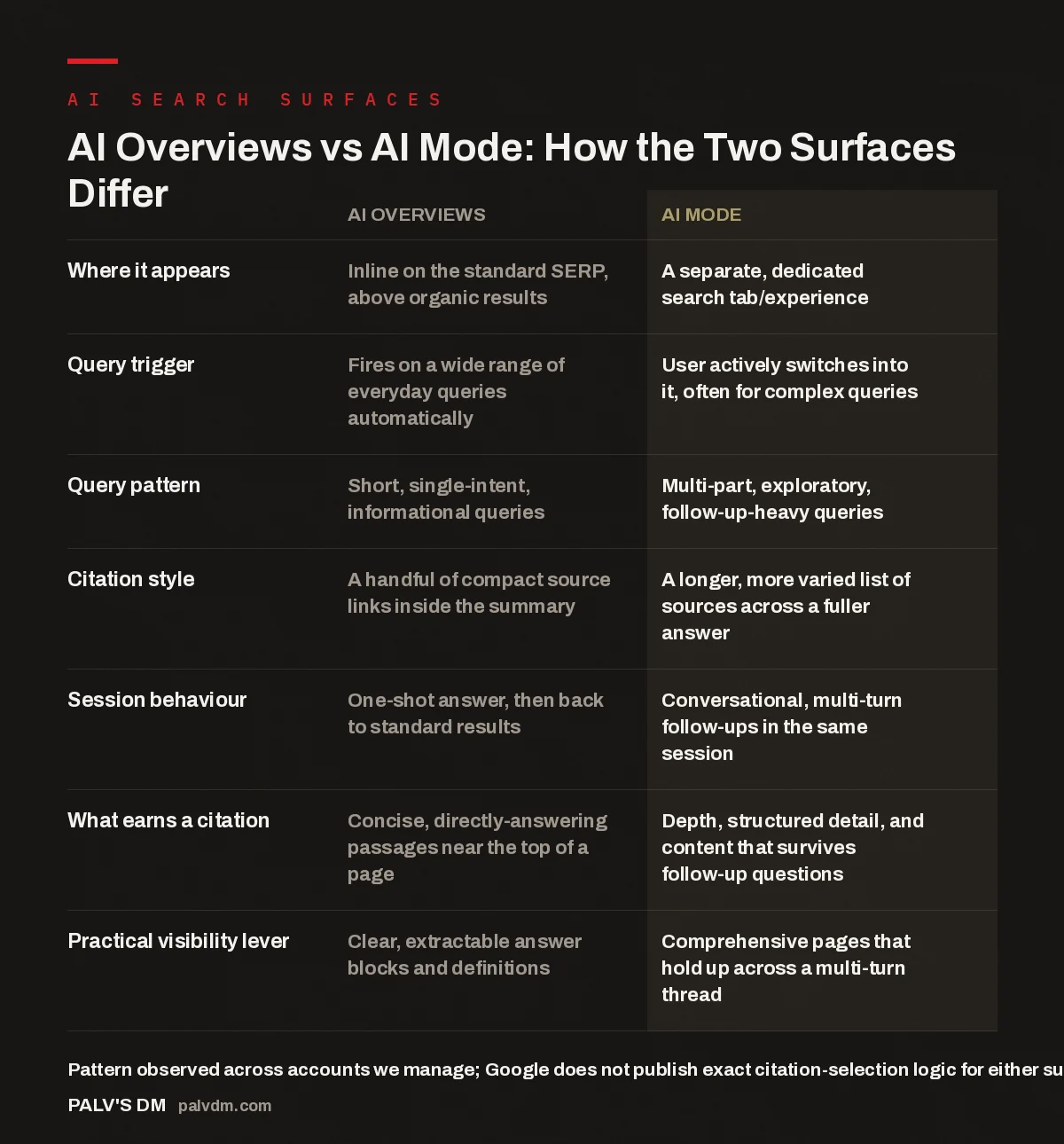
AI Overviews vs AI Mode: How the Two Surfaces Differ
| AI Overviews | AI Mode | |
|---|---|---|
| Where it appears | Inline on the standard SERP, above organic results | A separate, dedicated search tab/experience |
| Query trigger | Fires on a wide range of everyday queries automatically | User actively switches into it, often for complex queries |
| Query pattern | Short, single-intent, informational queries | Multi-part, exploratory, follow-up-heavy queries |
| Citation style | A handful of compact source links inside the summary | A longer, more varied list of sources across a fuller answer |
| Session behaviour | One-shot answer, then back to standard results | Conversational, multi-turn follow-ups in the same session |
| What earns a citation | Concise, directly-answering passages near the top of a page | Depth, structured detail, and content that survives follow-up questions |
| Practical visibility lever | Clear, extractable answer blocks and definitions | Comprehensive pages that hold up across a multi-turn thread |
What is the actual difference between AI Mode and AI Overviews?
AI Overviews is a feature bolted onto the regular Google search results page. Type a query, and if it qualifies, a generated summary appears near the top, above the usual blue links, with a small set of source citations woven in. You stay on the familiar SERP the whole time. Google AI Mode, on the other hand, is a distinct search mode you opt into — a separate tab next to “All,” “Images,” and “News” — designed around a conversational, back-and-forth interaction rather than a single query-and-answer exchange.
The practical difference for a marketer is where the moment of visibility happens. In AI Overviews, you are competing for a spot inside a short summary that most users glance at before scrolling to organic results anyway. In AI Mode, you are competing to be part of a longer, more exploratory answer that a user is actively building through follow-up questions — and that answer often references several sources across the exchange, not just one.
Why do the two surfaces cite sources differently?
The citation behaviour follows directly from the query type each surface is built for. AI Overviews is tuned for quick, single-intent questions — “what is X,” “how does Y work,” “best time to do Z.” The system needs to extract a tight, defensible answer fast, so it tends to pull from passages that already read like direct answers: a clear definition, a short list, a one-paragraph explanation sitting near the top of a page. That is consistent with the pattern we see across accounts we manage — pages that lead with the answer before the explanation get pulled into AI Overviews citations more often than pages that bury the answer under three paragraphs of preamble.
AI Mode is built for a different job. A user asking a multi-part question, then following up with “what about for a smaller budget” or “does that apply in India,” is having something closer to a conversation. The surface needs to maintain context across turns, which means it draws on pages that hold enough depth to answer not just the first question but the ones that follow. In the accounts we work on, pages that get cited repeatedly inside AI Mode threads tend to be the comprehensive, well-structured guides — the ones that anticipate follow-up questions inside the same piece of content, rather than pages built around a single, narrow answer.
This lines up with what we already know from the collapsing overlap between ranking #1 and being cited: the page that wins the click is increasingly not the same page that wins the citation, and now we can add a second layer — the page that wins an AI Overviews citation is not always the same page that wins an AI Mode citation either.
Most teams still optimise for “getting cited by AI” as if it’s one target. It isn’t. AI Overviews wants a fast, extractable answer near the top of the page. AI Mode wants a page that can survive a conversation. Build for both and you cover most of what actually shows up in a modern SERP.
Palash, Founder, PalV’s DM
How often does each surface actually appear?
AI Overviews shows up far more often in day-to-day search behaviour simply because it is the default — it fires automatically on qualifying queries without the user doing anything differently. We break this pattern down by query type in how often AI Overviews appear, by query type: informational, definitional, and comparison queries trigger it most consistently, while highly transactional or hyper-local queries trigger it less.
AI Mode, by contrast, requires an active choice from the user — a tab switch, or in some markets a toggle inside the search experience. That means its reach depends heavily on adoption and habit-forming, not just query type. It shows up more in research-heavy, comparison-heavy, and planning-heavy sessions, where someone genuinely wants to go back and forth rather than get a single fast answer. If your audience is booking a service, comparing options, or working through a considered purchase, AI Mode is a more relevant surface to plan for than the traffic numbers for a single query might suggest.
Which one should you optimise for first?
Start with AI Overviews if you are working from a limited budget or time, because it touches more query volume and rewards changes that are cheap to make: a clear, direct answer in the first 100-150 words of a page, a definition formatted as an actual definition, and a structure that lets a crawler lift a clean passage without editing it. These are the same fundamentals that improve normal SEO performance, so the investment is not wasted even where AI Overviews doesn’t trigger.
Move to AI Mode once your core pages already answer the primary question well. AI Mode rewards pages that hold up under follow-up pressure — so the next layer of work is adding the sections a real follow-up question would need: pricing nuance, edge cases, comparisons, regional differences, “what if” scenarios. Think of it as building the page to survive an interview, not just answer the first question asked.
Neither surface responds well to keyword stuffing or vague, generalist content. Both reward specificity — concrete numbers where you have them, named scenarios, and content that reads like it was written by someone who has actually done the thing being described.
How do you track visibility across both surfaces?
Most rank tracking tools were built for a single blue-link SERP and have not fully caught up to a world with two distinct AI surfaces layered on top. That is a real gap — only a fraction of marketers currently track AI visibility at all, let alone track it separately by surface. Treating “AI citations” as one undifferentiated bucket in a report hides the fact that a page might be doing well in AI Overviews and invisible in AI Mode, or vice versa.
The more useful approach is to log, query by query, which surface cited which URL, and for what kind of question. Over time that builds a picture of which of your pages are functioning as “quick answer” assets and which are functioning as “deep reference” assets — and where you have gaps in either category. We cover how to structure this kind of tracking in building a multi-surface visibility scorecard, which treats AI Overviews, AI Mode, and standard organic rankings as three separate rows rather than one combined metric.
What does this mean for content strategy going forward?
The practical shift is that a single page increasingly needs to do two jobs at once: open with an answer tight enough to be lifted whole into an AI Overview, then continue into enough depth to hold its own inside an AI Mode conversation. That is a different brief than “write 1,500 words on this topic” — it is closer to “answer the question in the first paragraph, then keep answering the questions a reasonable person would ask next.”
This is also part of a broader shift covered in the state of search in 2026: search is no longer one surface with one set of rules, and content built for a single, generic SERP is increasingly under-optimised for the surfaces that actually decide whether you get cited at all.
Where PalV’s DM comes in
Auditing content for AI Overviews and AI Mode separately, structuring pages to work for both, and tracking citations by surface rather than as one blended number is exactly the kind of work our AI Visibility service is built around.
Is AI Mode replacing AI Overviews?
No, they run alongside each other. AI Overviews stays on the default search results page for qualifying queries, while AI Mode remains a separate, opt-in tab for users who want a more conversational, multi-turn search experience. Expect both to keep evolving rather than one absorbing the other.
Do I need separate content for AI Mode versus AI Overviews?
Usually not separate pages — one well-structured page can serve both. Lead with a concise, directly-answering opening that AI Overviews can lift cleanly, then build out depth, edge cases, and follow-up-style sections underneath that give AI Mode enough substance to draw from across a longer exchange.
Which surface sends more referral traffic?
It varies by query type and is still shifting as both surfaces mature, so we would not put a fixed number on it. What’s clearer is that traffic that does arrive from either surface tends to convert differently than traditional organic traffic — we go into that in AI referral traffic converts differently.
Can a page get cited in AI Overviews but not AI Mode?
Yes, and it happens often. A page with a sharp, extractable answer but little supporting depth can perform well in AI Overviews while being passed over in AI Mode, which favours pages that can sustain a multi-turn conversation. The reverse is also common with long, comprehensive guides that bury their core answer too deep to be lifted quickly.
How do I check if my site is showing up in AI Mode at all?
Manually run your priority queries inside the AI Mode tab and note which domains get cited across the full thread, including follow-up questions, not just the first answer. It’s slower than checking standard rankings, but there is no fully reliable automated substitute yet — most third-party tools are still catching up to this surface.
Short version: AI Overviews and AI Mode are not the same target. AI Overviews lives on the standard SERP and rewards short, extractable answers to single-intent queries. AI Mode is a separate, conversational surface that rewards depth and content that survives follow-up questions. Build pages that open with a clean answer and then go deep, track citations by surface rather than as one number, and you cover most of what actually shows up across a modern AI-influenced SERP.