Trends & Industry Developments
Google AI Mode: What It Is and How to Be Visible In It
Google AI Mode explained: how it works, how query fan-out changes citations, and the exact structural fixes that make your pages visible inside it today.
Google AI Mode is a conversational search experience, launched inside Google Search and the Google app, that answers a query with a synthesized, multi-source response instead of a page of ten blue links. It runs on a version of Gemini, breaks your question into several sub-questions behind the scenes (a process Google calls “query fan-out”), and pulls citations from multiple pages to build one answer. If you want to be visible in Google AI Mode, you need pages that answer a narrow question directly, carry verifiable claims, and are actually crawlable by the systems feeding it — ranking #1 in classic search is no longer sufficient on its own.
Key takeaway
- AI Mode is a separate, more conversational search surface from AI Overviews — it fans a single query out into several sub-queries and stitches the citations together.
- Being visible in it depends less on a page’s overall authority and more on whether individual sections answer a specific sub-question cleanly and verifiably.
- Crawl access, entity clarity, and citable evidence matter more here than they do for a normal blue-link ranking.
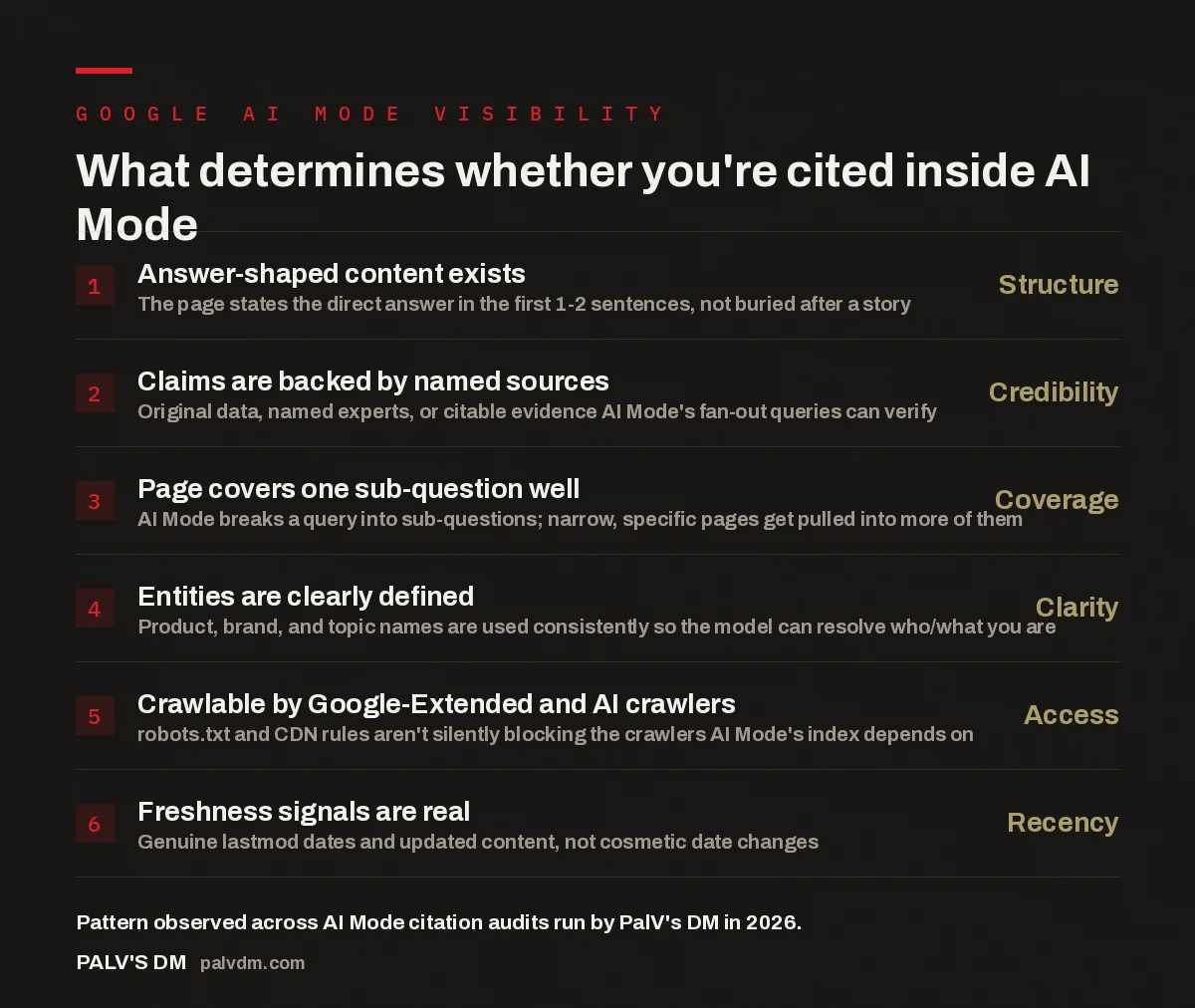
What determines whether you’re cited inside AI Mode
- Answer-shaped content exists — Structure. The page states the direct answer in the first 1-2 sentences, not buried after a story.
- Claims are backed by named sources — Credibility. Original data, named experts, or citable evidence AI Mode’s fan-out queries can verify.
- Page covers one sub-question well — Coverage. AI Mode breaks a query into sub-questions; narrow, specific pages get pulled into more of them.
- Entities are clearly defined — Clarity. Product, brand, and topic names are used consistently so the model can resolve who/what you are.
- Crawlable by Google-Extended and AI crawlers — Access. robots.txt and CDN rules aren’t silently blocking the crawlers AI Mode’s index depends on.
- Freshness signals are real — Recency. Genuine lastmod dates and updated content, not cosmetic date changes.
What exactly is Google AI Mode?
Google AI Mode is a dedicated tab and search mode where, instead of typing a query and scanning a results page, you get a written, conversational answer that Google assembles in real time. You can ask a follow-up question and it keeps the thread, closer to how a chat interface behaves than how classic Search behaves. Under the hood, the query you type is expanded into several related sub-questions — this is the “fan-out” behaviour — and Google runs searches against each of those sub-questions separately, then synthesizes the results into one response with inline citations and a set of linked sources.
That fan-out mechanic is the single most important thing to understand about how AI Mode differs from ordinary search, and it’s the reason visibility in AI Mode doesn’t map cleanly onto your existing keyword rankings. A page that ranks #1 for your target keyword might contribute nothing to an AI Mode answer, while a page ranking #6 or #7 — one that happens to answer one of the generated sub-questions precisely — gets pulled in and cited. We cover this related surface, AI Overviews, and how the two differ in citation behaviour in our comparison of AI Mode and AI Overviews.
How does query fan-out change what gets cited?
When someone types a broad question into AI Mode — say, something like “best way to structure a small business website for local SEO” — the system doesn’t search that phrase once. It generates a set of adjacent sub-questions: what makes a website structure crawlable, how local business schema works, what page depth is reasonable, how to handle location pages at scale, and so on. Each of those sub-questions runs as its own retrieval pass, and the citations in the final answer are drawn from whichever pages best answer each individual piece.
The practical consequence is that a single comprehensive 4,000-word guide covering everything about a topic is not automatically the strongest candidate for citation. What performs better, directionally, is a page (or a set of pages) where each section is self-contained enough to function as the answer to one narrow sub-question on its own — a clear definition, a clear list, a clear procedure — rather than a section that only makes sense after reading three paragraphs of setup. In the AI Mode citation patterns we track across client accounts, pages with clearly delineated H2/H3 sections that each resolve one specific question get pulled into more distinct AI Mode answers than pages that bury the same information inside continuous narrative prose.
This is closely related to how often AI Overviews-style surfaces trigger in the first place, which varies a lot by query type and intent — we break that pattern down in how often AI Overviews appear, by query type. Informational and comparison queries trigger these AI-generated answers far more consistently than transactional or highly localized ones, and AI Mode follows a similar pattern, which matters when you’re deciding which pages on your site are even worth optimizing for this surface.
Most teams still optimize for the query. AI Mode optimizes for the sub-question. Until you write for the second one, you’re playing a different game than the one that’s actually running.
Palash, Founder, PalV’s DM
What makes a page visible in Google AI Mode?
Four factors show up consistently across the pages that do get cited, based on the AI Mode visibility audits we run for clients:
- The answer comes first. The direct answer to the implied question sits in the opening sentence or two of a section, not after a story, a definition of terms, or a history lesson. AI Mode’s retrieval step rewards content it can extract cleanly without needing to infer meaning from context.
- Claims are attributable. A statement like “response times improved” is weaker than one attached to a specific, named, verifiable source — a study, a named practitioner, a dataset you can point to. AI Mode’s fan-out queries are, in effect, cross-checking claims against multiple sources, so unattributed assertions are easier to skip over in favour of a page that shows its work.
- Entities are unambiguous. If your page talks about “the platform” or “the tool” for three paragraphs before naming it, that’s a resolution problem for a model trying to figure out what entity your content is actually describing. Name the product, the brand, and the category explicitly and repeatedly.
- Crawl access is intact. This sounds basic, but it’s the most common failure we find in AI Mode visibility audits: robots.txt rules, CDN-level bot blocking, or JavaScript-rendered content that never gets crawled by the systems feeding AI Mode. If Google-Extended or the relevant crawler can’t reach the page, none of the content quality work matters. We track how these crawler identifiers keep shifting in keeping your robots.txt current as AI crawler naming changes — it’s worth checking that file more often than most teams do.
Does structured data actually help AI Mode understand your page?
Structured data (schema.org markup) doesn’t directly cause a citation, but it removes ambiguity that otherwise has to be inferred, and inference is where content gets skipped. Product schema, FAQ schema, and Article schema with clear author and organization fields all give the retrieval systems behind AI Mode a faster, more reliable way to confirm what an entity is and who is making a claim about it. This matters even more once you start thinking about your site being read by automated agents rather than only by human visitors clicking through search results — a shift we go into in preparing product and service data for AI agents. The pattern is the same one showing up across AI Mode, shopping-agent surfaces, and other machine-read contexts: the more explicitly your data is labeled, the less the system has to guess, and the less it has to guess, the more confidently it cites you.
None of this replaces the underlying content quality. Schema on a thin, generic page doesn’t manufacture authority — it just makes an already-strong page easier to parse correctly. Think of it as removing friction rather than adding weight.
How is Google AI Mode different from a normal AI Overview?
AI Overviews sit at the top of a standard Google Search results page, alongside the usual blue links, and answer the query as typed with a relatively compact synthesized summary. AI Mode is a separate, dedicated experience where the entire interaction is conversational — there’s no results page underneath it in the same sense, and the fan-out behaviour is more aggressive because the system expects follow-up questions and needs a broader base of retrieved material to draw on. In practice this means AI Mode answers tend to cite a wider spread of sources per query than an AI Overview does for the same topic, and the sources cited skew toward pages that nail a specific angle rather than pages that are broadly authoritative on the whole topic. A deeper, source-by-source comparison of the two lives in our piece on AI Mode versus AI Overviews and how their citations differ, which is worth reading before you build an optimization plan around either one specifically, since the tactics that work for one don’t transfer cleanly to the other.
Both surfaces are part of the same broader shift, one we track in more depth in our overview of what actually changed in search in 2026: search results are increasingly synthesized rather than listed, and the unit of optimization is shifting from “the page” to “the specific claim or section within the page.”
What should you actually do this month to improve AI Mode visibility?
Start with an audit, not a rewrite. Pick your ten highest-intent informational pages and check three things on each: does the opening of every major section answer its heading directly, are the load-bearing claims attached to something citable, and does the page actually get crawled without obstruction. Most sites we look at fail on at least one of these across most of their content, and fixing it is largely an editing exercise — restructuring what’s already there so a fan-out query can extract it cleanly, not writing net-new pages. Once the structural issues are fixed, layer in schema markup, tighten entity naming, and re-check crawl access periodically, since the crawler identifiers involved here change often enough that a rule written six months ago can silently start blocking access today.
Where to go from here
Auditing a full site’s AI Mode readiness against fan-out behaviour, crawl access, and entity clarity is exactly the kind of work that’s easy to get half-right on your own. If you want a second set of eyes on where your pages stand.
Is Google AI Mode available in India yet?
Google has been rolling AI Mode out progressively across markets and it has become widely accessible in India through the Google app and Search Labs settings. Availability by account and region can vary at any given moment, so the safest check is opening the Google app and looking for the AI Mode tab or a Labs opt-in prompt directly.
Do I need separate content for AI Mode versus regular SEO?
No — you need the same content restructured for clarity, not a parallel content set. Pages that lead with a direct answer, attribute their claims, and are cleanly crawlable tend to perform in both classic rankings and AI Mode citations. The work is editing for extractability, not duplicating your content library.
Can a low-traffic page still get cited in AI Mode?
Yes. Because AI Mode retrieves at the sub-question level rather than ranking whole pages against each other, a page with modest overall traffic but a precise, well-attributed answer to a narrow question can be cited over a higher-traffic page that only covers the topic broadly. Specificity matters more than site-wide authority for this particular surface.
Will blocking AI crawlers protect my traffic from AI Mode?
Blocking the relevant crawlers removes you from being cited in AI Mode answers, but it doesn’t shield your existing organic rankings if the same or an overlapping crawler is also used for standard indexing. Before changing robots.txt rules, confirm exactly which crawler identifiers you’re blocking and what else depends on them, since these identifiers change periodically.
How long does it take to see AI Mode citations after fixing a page?
There’s no fixed timeline, since it depends on recrawl frequency and how often the query patterns tied to your topic get re-run. In the accounts we monitor, structural fixes to high-intent pages tend to show up in citation tracking within a few crawl cycles, but this varies enough by site and topic that it’s worth tracking rather than assuming.
Short version: Google AI Mode is a conversational search surface that fans a single query out into multiple sub-questions and cites the pages that answer each one most directly. Visibility depends on section-level clarity, attributable claims, unambiguous entity naming, and uninterrupted crawl access — not on your overall page authority alone. Fix the structure of your highest-intent pages first, verify crawl access, and treat this as an editing problem on existing content rather than a reason to build a parallel content strategy.