Landing Page SEO vs Blog Post SEO: Different Jobs
Landing pages and blog posts target different search intents and funnel stages. Optimizing one like the other is a common source of underperformance for both.
A landing page and a blog post are built for different search intents and shouldn’t be optimized the same way: a landing page targets a commercial or transactional query with a focused conversion path, while a blog post targets an informational query with comprehensive, evidence-backed coverage. Applying blog-post tactics — long-form depth, multiple subtopics, an educational tone — to a landing page dilutes the conversion path it needs. Applying landing-page tactics — short, persuasive, CTA-heavy copy — to a blog post makes it read like an ad instead of an answer, and informational searchers bounce from that fast.
The mistake is usually well-intentioned: a team notices blog posts outrank landing pages for competitive terms and tries to make the landing page “more like a blog post” by padding it with content. That fixes the wrong problem. If a landing page isn’t ranking for an informational query, that’s often correct — it’s not supposed to.
Landing page SEO vs blog post SEO: the direct comparison
| Factor | Landing page | Blog post |
|---|---|---|
| Primary search intent | Commercial or transactional | Informational |
| Funnel stage | Bottom or middle of funnel | Top or middle of funnel |
| Typical length | Short to medium, focused on conversion | Long-form, comprehensive coverage |
| Primary goal | A specific action — signup, purchase, quote request | Answer the query fully; build topical authority |
| Content structure | Benefits, proof, objection handling, a clear CTA | Multiple H2s covering subtopics, examples, evidence |
| Internal linking role | Destination — receives links from relevant posts | Source — links out to related posts and to landing pages |
| Update cadence | Updated when the offer or product changes | Updated when facts, data, or best practices change |
Neither format is inherently “better for SEO.” Each ranks well for the intent it’s built for and poorly for the intent it isn’t. The comparison only matters when a team is deciding which format to build for a given keyword, not as a verdict on which format to invest in overall.
How do you decide which format fits a given keyword?
Look at what’s already ranking. If the current top results for a keyword are dominated by product or service pages with pricing, demos, and signup forms, that’s a commercial query and a landing page is the right build. If the top results are long articles, guides, or comparison posts with no direct offer, that’s an informational query, and a landing page built for that keyword will struggle regardless of how well it’s optimized, because it’s answering a different question than what searchers are actually asking.
This lines up with Google’s own emphasis on people-first content: content built to satisfy an existing audience’s actual need, not content built primarily to rank. A landing page built to answer “what is [topic]” when the searcher wants a definition and comparison, not a purchase decision, isn’t people-first for that query — it’s the wrong format wearing the right keyword.
What does a landing page need to do well that a blog post doesn’t?
- State the offer and value proposition immediately, above the fold, without making a visitor scroll to understand what’s being offered.
- Handle objections directly — pricing concerns, trust signals, comparisons to alternatives — rather than assuming a reader will research those separately.
- Reduce friction to the conversion action, with a single clear CTA repeated at logical points rather than competing CTAs or distracting internal links pulling attention away from the goal.
- Match commercial search intent precisely in the title, H1, and opening copy — a landing page trying to also rank for a broad informational term usually ranks for neither.
None of these are blog-post priorities. A blog post that handled every possible objection to a purchase decision in the middle of an educational article would be exhausting to read and would undercut the trust it’s trying to build by feeling like a sales pitch.
What does a blog post need to do well that a landing page doesn’t?
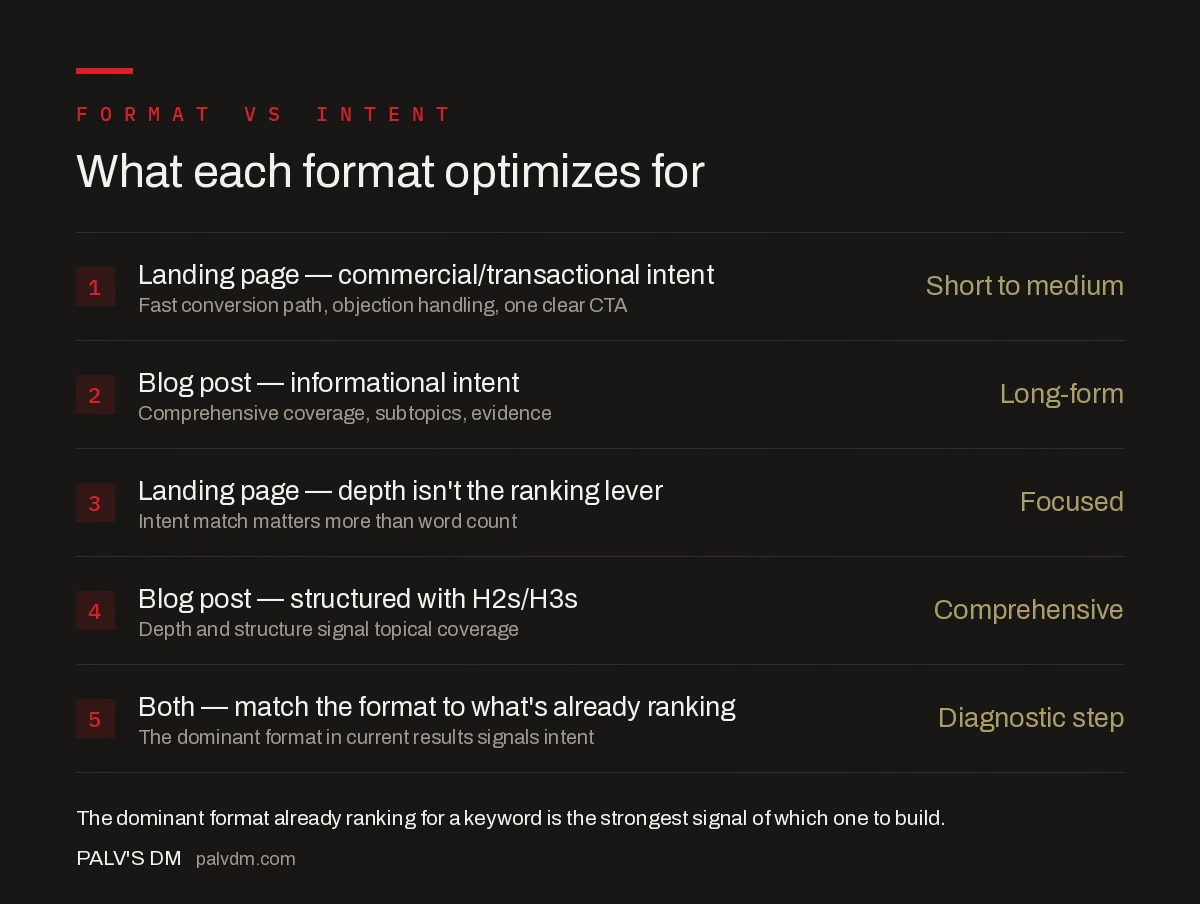
What each format optimizes for
- Landing page — Commercial/transactional intent — Fast conversion path, objection handling, one clear CTA.
- Blog post — Informational intent — Comprehensive coverage, subtopics, evidence, internal links to related content.
- Landing page — Short to medium length — Depth isn’t the ranking lever; intent match is.
- Blog post — Long-form, structured with H2s/H3s — Depth and structure signal topical coverage.
- Both — Match the format to what’s already ranking for the target keyword — The dominant format in the current results is the strongest signal of intent.
Blog posts earn ranking through comprehensiveness and evidence: covering the subtopics a reader with that query would reasonably still have questions about, backing claims with real sources, and structuring the page so both readers and Google can navigate it via heading hierarchy that mirrors the topic’s natural structure — though that’s a separate discussion. What a blog post shouldn’t do is chase a conversion the way a landing page does; a single relevant, low-pressure CTA at the end respects the reader’s original informational intent.
How should the two formats link to each other?
Blog posts should link out to relevant landing pages at natural points — when a post covers a concept the business also offers as a service, a contextual link to that landing page serves a reader who’s moved from research into consideration. Landing pages, by contrast, generally shouldn’t link out heavily to blog content; every outbound link is a chance for a visitor close to converting to leave the conversion path instead. This is the same logic behind structuring comparison pages to rank and convert — comparison pages sit closer to the landing-page end of the spectrum and should be built with the same conversion discipline, even though they often need more evidence and detail than a typical landing page.
The two formats work best as a pair rather than in competition: the blog post captures and educates the top-of-funnel searcher, and a well-placed internal link hands that reader off to the landing page once they’re ready to evaluate an actual offer. Treating them as competing for the same keyword usually means picking a fight neither page is built to win.
What’s the verdict — which format should you default to?
Neither wins by default; the keyword decides. For any given target keyword, check what Google is already ranking: if the first page is a mix of product pages, pricing pages, and service pages with clear offers, that’s a strong signal to build a landing page. If the first page is guides, explainers, and long articles with no direct offer, build a blog post instead. Trying to force a business’s preferred format — landing pages because they convert, or blog posts because they’re easier to produce at volume — onto a keyword that clearly wants the other format is fighting the intent Google has already confirmed through the existing results.
The exception worth naming: some keywords are genuinely mixed-intent, where Google shows both formats on page one. Comparison and “best X” queries often fall here — a mix of vendor landing pages and independent blog-style comparison content. In that case, either format can work, and the deciding factor becomes which one the business can execute better: a landing page with strong proof and objection handling, or a blog post with genuinely useful, unbiased comparison depth.
What common mistakes come from mixing the two formats?
- A landing page padded with generic educational content to “improve SEO,” which buries the offer and value proposition a converting visitor came to find, hurting conversion rate without a corresponding ranking gain for the commercial keyword it was already targeting correctly.
- A blog post built around a single hard-sell CTA repeated throughout, which reads as an ad to a reader who arrived with an informational question, increasing bounce rate and undermining the trust the content needed to build.
- Duplicate targeting — a landing page and a blog post both built around the exact same keyword, competing with each other in search results instead of covering the commercial and informational versions of that topic separately.
- Treating a blog post’s ranking success as proof a landing page for the same term should exist, when the blog post’s ranking is often evidence the query is informational, not commercial, and doesn’t need a landing page at all.
Frequently asked questions
Can a landing page rank for informational keywords?
Rarely, and usually not well. A landing page is built to convert someone who already has commercial or transactional intent, so it lacks the depth, examples, and comprehensive coverage that informational queries expect. Trying to make one page do both jobs typically means it does neither well.
Should a blog post have a strong call to action like a landing page?
It should have a relevant one, but not a landing page’s level of persuasion. A blog post’s primary job is answering the informational query well; a single, contextual CTA at the end or within the content respects that job, while a landing-page-style hard sell throughout undermines the trust the informational content is building.
Do landing pages need as much text as blog posts to rank?
No, and forcing word count onto a landing page usually hurts conversion without helping rankings. Landing pages rank on matching commercial intent precisely, with clear, focused copy — not on comprehensive length. Word count is a blog-post lever for topical coverage, not a landing-page one.
Can a single URL serve as both a landing page and a blog post?
Not effectively. The two formats serve different search intents, different reader expectations, and usually different funnel stages, so combining them dilutes both jobs. It’s almost always better to build a focused landing page for the commercial query and a separate blog post for the informational one, linked to each other.
Sources
- Creating Helpful, Reliable, People-First Content — Google Search Central
- On-Page SEO Checklist: The Complete Reference
- Comparison Pages: Structuring Them to Rank and Convert
- Getting Into the Top Stories Carousel
- List Snippets: Formatting for Ordered and Unordered Capture
Want this done on your site?
Every PalV’s DM engagement starts with a free audit of your actual website — a 12-point
crawl covering what is blocking indexation, on-page gaps against your primary keywords, speed
findings, and the three to five fixes worth making first. Delivered in two working days. No
payment details, and the findings are yours whether you hire us or not.