Service Support — One-Time Services
Link Insertion vs Guest Post: Which to Buy
Link insertion vs guest post: what each actually buys, when to choose one over the other, and what to check before you pay for either link type on a site.
A link insertion is cheaper and faster because you’re paying for a slot on a page that already exists. A guest post costs more and takes longer because you’re paying for that slot plus a new article to hold it. If you already know the exact page and anchor text you want, buy the link insertion. If you need topical coverage on the host site as well as the link, buy the guest post. Everything else in the “link insertion vs guest post” decision is really just working out which of those two situations you’re actually in.
Key takeaway
- A link insertion buys placement only; a guest post buys placement plus a new article to carry it, which is why guest posts almost always cost more and take longer.
- Link insertions are constrained by whatever the host page already covers; guest posts let you control the topic, anchor context, and surrounding content directly.
- Neither is inherently the “better” link — the right choice depends on whether you need a fast, narrow placement or a genuinely new piece of topical coverage on that domain.
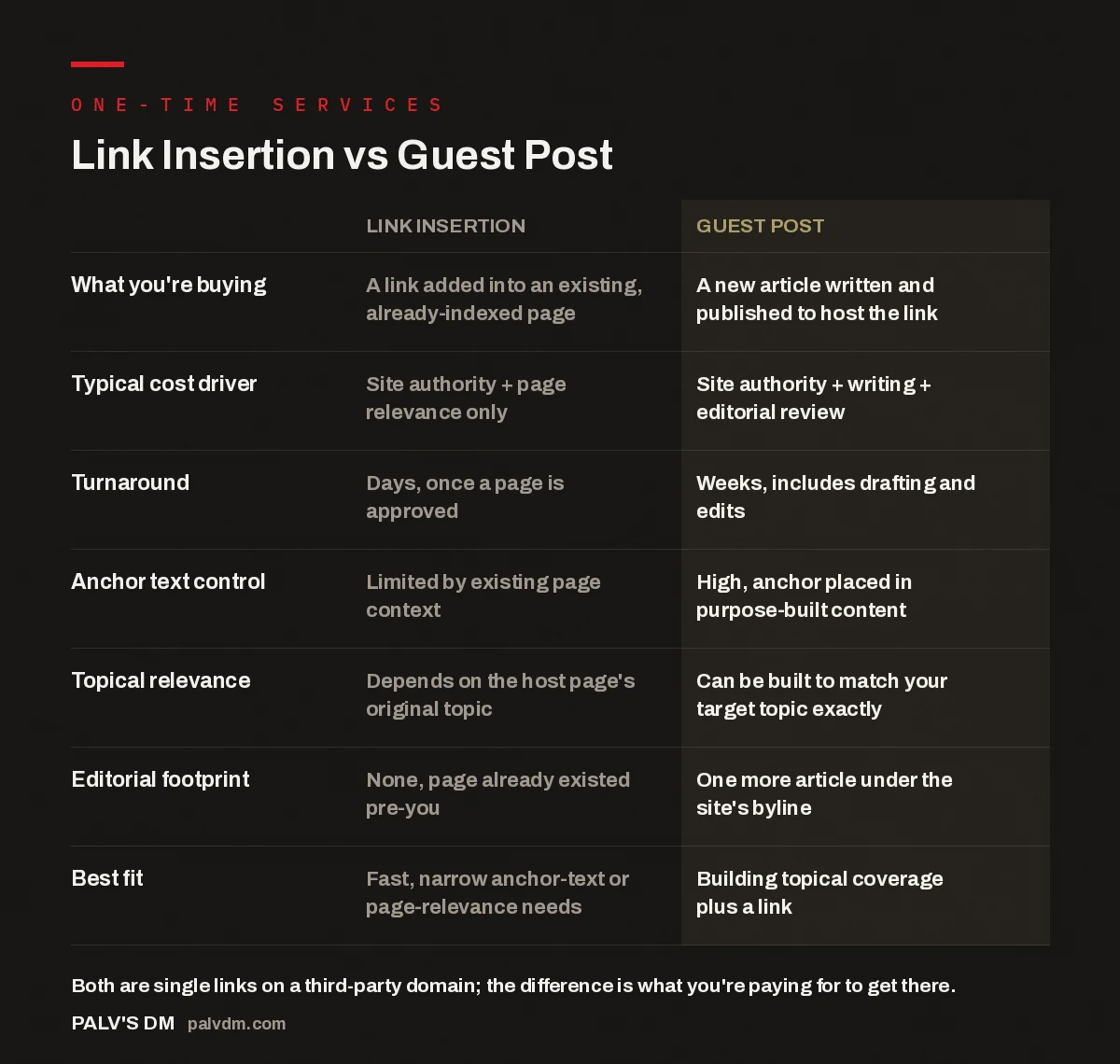
Link Insertion vs Guest Post
| Link Insertion | Guest Post | |
|---|---|---|
| What you’re buying | A link added into an existing, already-indexed page | A new article written and published to host the link |
| Typical cost driver | Site authority + page relevance only | Site authority + writing + editorial review |
| Turnaround | Days, once a page is approved | Weeks, includes drafting and edits |
| Anchor text control | Limited by existing page context | High, anchor placed in purpose-built content |
| Topical relevance | Depends on the host page’s original topic | Can be built to match your target topic exactly |
| Editorial footprint | None, page already existed pre-you | One more article under the site’s byline |
| Best fit | Fast, narrow anchor-text or page-relevance needs | Building topical coverage plus a link |
What’s the actual difference between a link insertion and a guest post?
A link insertion means a publisher adds your link into a page that’s already live, already indexed, and already has whatever history and rankings it earned before you showed up. Nothing new gets published. The publisher opens the existing article, works your link into a relevant sentence or paragraph, and republishes the page with a minor update timestamp. You’re paying for access to that page’s existing authority and audience, not for any new content.
A guest post means the publisher creates a brand-new page specifically to carry your link. Someone writes an article — sometimes you supply it, sometimes the publisher does, sometimes it’s a joint effort — and that article gets published as a new URL on their domain, with your link embedded naturally inside it. You’re paying for the placement plus the labour and editorial judgement of producing an entire new piece of content.
That single distinction — existing page versus new page — explains almost every other difference between the two: cost, turnaround, how much control you get over anchor text and context, and how closely the surrounding content can match your actual target topic.
When does a link insertion make more sense?
A link insertion is the right buy when you already know exactly what you’re trying to fix and the fix is narrow. Common cases we see on client accounts:
- You’ve identified a specific existing page — through a review of the site’s off-page link profile — that’s already ranking for a topic close to yours, and getting mentioned on it would be genuinely relevant.
- You need a particular anchor text or contextual sentence and can accept whatever surrounding topic the host page already covers, as long as it’s close enough to be credible.
- You’re working against a shorter timeline and can’t wait weeks for an article to be drafted, reviewed, and scheduled.
- Budget is the binding constraint and you’d rather get more placements at a lower cost per link than fewer, more elaborate ones.
The trade-off is real, though. You don’t get to choose the surrounding narrative, and a link inserted into a five-year-old article about a loosely related topic reads differently to both users and search engines than a link sitting inside content written specifically about your subject. The pattern that shows up repeatedly in the accounts we work on: insertions perform best when the host page’s existing topic is already close to yours, not when you’re trying to force relevance onto an unrelated page.
When does a guest post make more sense?
A guest post earns its higher price when the thing you actually need is a piece of content built around your topic, not just a link dropped into someone else’s. That matters more than it sounds. A newly written article can be structured so your target keyword, your anchor text, and the surrounding argument all point the same direction — which is harder to engineer inside a page someone else wrote for a different purpose years ago.
Guest posts also tend to make more sense when you’re trying to build a presence on a domain over time rather than get a single, one-off mention. A publication that’s run three or four of your articles across a year reads differently — to readers and to anyone evaluating the link profile — than a publication where your only footprint is a link that got quietly slotted into someone else’s older post.
Clients often ask us which one is “better” for SEO. That’s the wrong question. A link insertion and a guest post are two different tools solving two different problems — the question is which problem you actually have this month.
Palash, Founder, PalV’s DM
How does pricing typically work for each?
Neither service is priced off a fixed formula, and anyone quoting an identical rate card for every domain is skipping a step. But the underlying cost drivers are consistent and worth understanding before you buy either one.
For a link insertion, the price is almost entirely a function of the host site’s authority and how relevant the existing page already is to your topic — you’re not paying for writing time, so the cost tends to track the domain rather than the content. For a guest post, you’re paying for that same domain access plus the writer’s time, the publisher’s editorial review, and often a placement fee on top, which is why guest posts on comparable domains routinely cost more than an insertion on the same site. If you see a guest post and a link insertion on the same domain priced identically, that’s worth a second look — it usually means one of the two isn’t being valued correctly, or the “guest post” is really a thin, low-effort placement dressed up with a new URL.
What should you check before buying either one?
Whichever format you choose, the diligence checklist is largely the same, because the risk in both cases is buying a link on a domain that doesn’t hold up:
- Confirm the site actually gets organic traffic, not just a domain authority score — a high metric on a site with no real visitors tells you less than it looks like it does.
- Check whether the page you’re targeting (for an insertion) or the section you’ll be published under (for a guest post) is topically close to your own site — not just “in the same broad industry.”
- Ask whether the link will be marked as sponsored/nofollow or passed as a standard editorial link, and get that in writing before you pay, not after.
- Look at what else is already linked from that page or that publisher’s other guest content — a page or site stuffed with unrelated commercial links is a signal to walk away, regardless of the metrics.
This is the same checklist that applies to buying a single do-follow link in general — link insertions and guest posts are both just delivery mechanisms for that same underlying link, so the quality bar doesn’t change with the format.
Which one should you actually buy?
If you’re buying one link at a time as a standalone service rather than as part of an ongoing programme, start with what you’re actually trying to solve this month, not with a general preference for one format over the other. Need a fast, narrow placement on a page that’s already close to your topic and don’t have weeks to wait? Buy the link insertion. Need to build a real presence on a specific domain, control the anchor context precisely, or don’t have an existing page on that site relevant enough to insert into? Buy the guest post.
If you’re not sure which situation applies, or you’re buying links as one part of a wider stack of one-off services, it’s worth reading the order to buy one-time SEO services in before committing budget to either — link building usually isn’t the first thing worth spending on, and buying it too early against a site with unresolved technical or content gaps wastes the placement. It’s also worth checking when a one-time SEO service beats a retainer if you’re trying to work out whether occasional link purchases like this are even the right model for where your site is right now.
Not sure which one fits your site
We review the target page or domain with you and recommend a link insertion or guest post based on what’s actually there — not a default upsell.
FAQ
Is a guest post always stronger for SEO than a link insertion?
Not automatically. A guest post gives you more control over anchor text and surrounding content, but a link insertion on a page that’s already highly relevant to your topic can be just as strong a signal, often at a lower cost. Relevance and the host domain’s genuine authority matter more than the format itself.
Why do guest posts usually cost more than link insertions on the same site?
Because you’re paying for two things instead of one: access to the domain, and the writing and editorial time needed to produce a new article. A link insertion only requires the first, since the page you’re placed on already exists, which is why it’s typically the cheaper and faster of the two options.
Can I request a specific anchor text with a link insertion?
Usually, within reason — but the publisher will still want the anchor to fit naturally into the existing sentence and topic of the page. If your desired anchor doesn’t fit the page’s existing context without sounding forced, that’s a sign a guest post, where the content is written around your anchor, is the better fit.
How long does each one typically take to go live?
A link insertion can usually go live within days once a suitable page is identified and approved, since no new content needs to be produced. A guest post takes longer — typically a few weeks — because it involves drafting, editorial review, and scheduling the new article into the publisher’s calendar.
Should I buy several link insertions instead of one guest post for the same budget?
It depends on what those insertions actually offer. Several relevant insertions on genuinely strong, topically close pages can be worth more than one guest post. But several insertions bought purely to hit a link count, on pages that aren’t relevant, are usually worth less than a single well-placed guest post — volume isn’t the goal, relevance is.
Short version: a link insertion buys you a spot in a page that already exists, so it’s cheaper and faster but limited by that page’s existing topic. A guest post buys you a spot in a page built specifically for you, so it costs more and takes longer but gives you control over the anchor, the context, and how closely the content matches your actual target keyword. Match the choice to what you actually need this round of budget to do — not to which one sounds more impressive.