Service Support — One-Time Services
What an Off-Page Check Reveals About Your Link Profile
A backlink audit service maps your complete link inventory, flags toxic or spammy links, and reveals anchor text ratios and competitor gap opportunities.
A paid off-page check reveals how many domains actually link to your site, which of those links are helping or hurting you, where your anchor text is skewed, which competitor links you’re missing, and which of your own past links have gone dead. It’s a standalone diagnostic — usually delivered as a report, not a subscription — that gives you a factual picture of your link profile before you decide whether to buy more links, disavow anything, or do nothing at all. If you’ve only ever glanced at a “domain authority” number in a free tool, this is the version that actually explains what’s behind it.
Key takeaway
- A backlink audit service maps every referring domain, flags toxic or spammy links, and checks anchor text ratios — not just a top-line “how many backlinks” count.
- Good ones also pull competitor gap links (who links to them but not you) and identify lost links you could recover.
- The output should be a prioritised list — not a raw export — because a spreadsheet of 4,000 rows tells you nothing on its own.
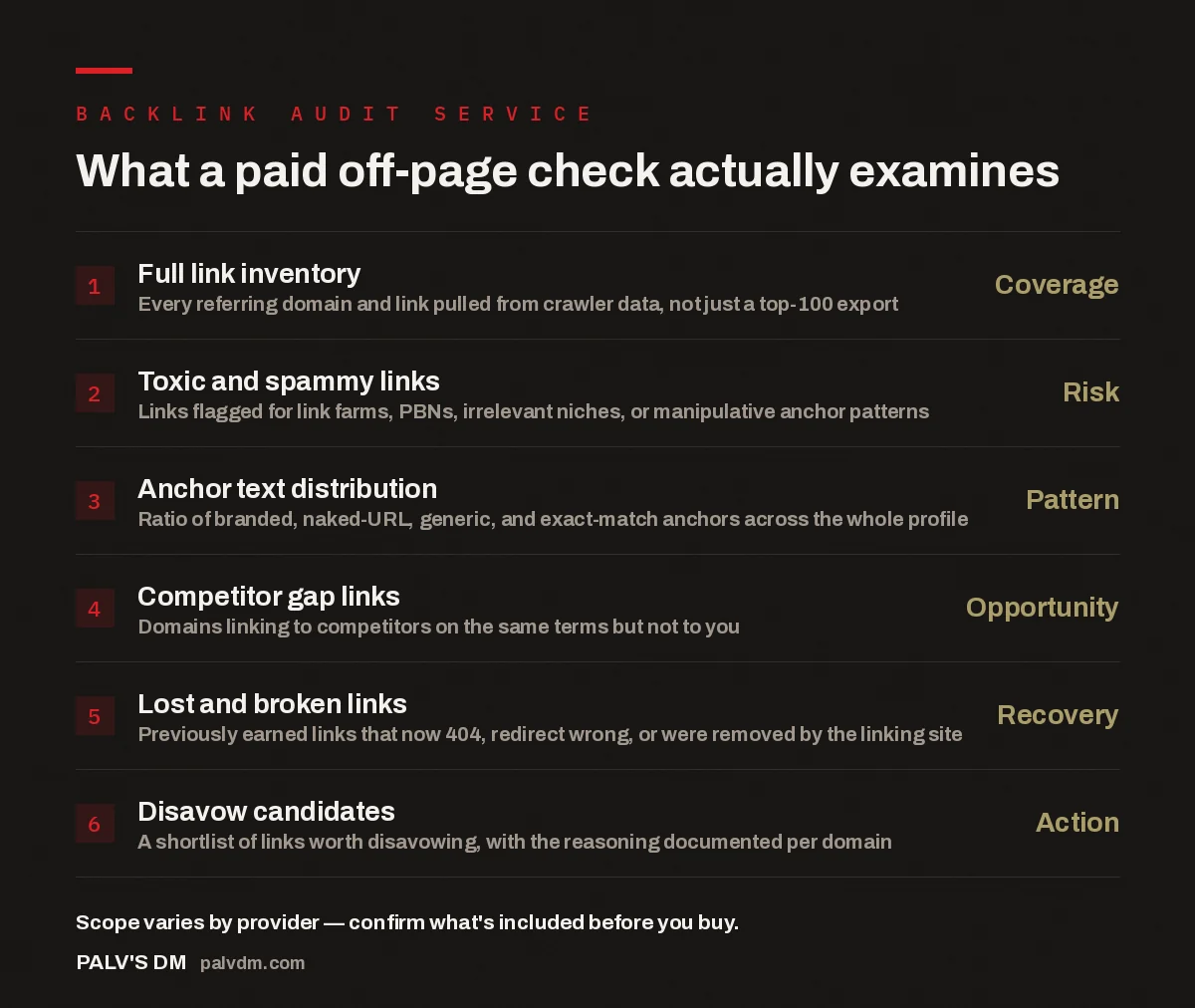
What a paid off-page check actually examines
- Full link inventory — Coverage. Every referring domain and link pulled from crawler data, not just a top-100 export.
- Toxic and spammy links — Risk. Links flagged for link farms, PBNs, irrelevant niches, or manipulative anchor patterns.
- Anchor text distribution — Pattern. Ratio of branded, naked-URL, generic, and exact-match anchors across the whole profile.
- Competitor gap links — Opportunity. Domains linking to competitors on the same terms but not to you.
- Lost and broken links — Recovery. Previously earned links that now 404, redirect wrong, or were removed by the linking site.
- Disavow candidates — Action. A shortlist of links worth disavowing, with the reasoning documented per domain.
What does “off-page check” actually mean?
An off-page check is an audit of everything that affects your site’s authority from outside your own domain — mainly your backlink profile, but also brand mentions, directory listings, and in some scopes, social signals. It’s the counterpart to a technical or on-page check, which only looks at what’s happening on your own pages. If you’ve read about what a paid technical SEO check actually covers, this is the same idea applied to links instead of code and content.
The confusion usually starts because free tools already show you a version of this — a backlink count, a domain rating, maybe a top-10 list of referring domains. That’s a snapshot, not an audit. A paid backlink audit service goes deeper on three things a free dashboard can’t: it pulls the full link list rather than a capped sample, it evaluates link quality instead of just counting links, and it hands you a judgment call on which links to leave alone, which to fix, and which to disavow.
How does a backlink audit service build the link inventory?
The starting point is a crawler-based export, usually pulling from one or more independent link indexes rather than a single source, since no crawler sees the entire web. This produces a raw list of every referring domain and link pointing at your site, including old links you may have forgotten existed. In the accounts we work on, it’s common for a business to remember maybe a dozen links they actively built, while the audit turns up several times that number from directories, old partnerships, and press mentions nobody tracked at the time.
That raw list then gets deduplicated to the domain level, because ten links from one low-value domain matter far less than ten links from ten different real websites. The audit should tell you your total referring domain count, not just your total link count — the domain number is the one that correlates more closely with how search engines and AI answer engines weigh authority.
How does the audit tell a good link from a bad one?
This is the part a free tool genuinely can’t do well, because it requires judgment, not just a metric. A competent off-page check evaluates each significant referring domain against a handful of concrete signals: topical relevance to your industry, whether the site itself looks legitimate (real content, real traffic pattern, not a template dumped with ads), whether it sits in a known link-farm or private blog network, and whether the anchor text looks natural or manipulated.
None of this produces a single trustworthy “toxicity score” — automated scores are directionally useful at best, and wrong often enough that acting on them blindly can cause more harm than the supposed toxic links. What the audit should produce instead is a shortlist: a small number of domains flagged with the specific reason each one is a concern, so a human can make the actual call.
Most link profiles don’t need a disavow file. They need someone to actually look at the list and say which ten links matter, instead of reacting to a toxicity score nobody can explain.
Palash, Founder, PalV’s DM
What does anchor text distribution reveal?
Anchor text — the clickable words in a link — gets grouped into a few buckets: branded (your company name), naked URL (the bare web address), generic (“click here”, “read more”), and exact-match or partial-match keyword anchors (“backlink audit service” pointing straight at a service page). A natural link profile, the kind that accumulates from being mentioned, referenced, and shared, leans heavily branded and naked-URL, with generic and keyword anchors making up a smaller share.
When exact-match keyword anchors dominate, that’s usually a sign of past manipulative link building — either bought links or an old campaign that over-optimised anchor text on purpose. The audit surfaces this ratio so you can see whether your profile looks like something a real audience built, or something a link-buying campaign built. This matters more for the service pages you actually want to rank, so the audit should break the ratio down by destination page rather than report one blended number for the whole site.
What are competitor gap links, and why does the audit include them?
A competitor gap analysis compares your referring domains against two or three competitors’ referring domains and surfaces the sites linking to them but not to you. This is usually the most immediately useful output of an off-page check, because it converts a diagnostic exercise into a to-do list: a set of real, named websites you could realistically reach out to, because they’ve already shown they’re willing to link to a business like yours.
Not every gap link is worth chasing — some will be paid directory listings, some will be one-off press mentions that aren’t repeatable. But the list is grounded in evidence rather than a generic “go get some backlinks” instruction. If you’re weighing whether to buy outreach separately, it’s worth reading what to expect when buying a single do-follow link before committing budget to individual placements.
What happens to lost and broken links?
Links die quietly. A site you were mentioned on gets redesigned and the page disappears. A partner changes their footer and drops the link they used to carry. None of this shows up unless someone specifically checks, because there’s no notification when an external site removes a link to you.
A proper off-page check compares your current link profile against a historical snapshot and flags what’s gone missing since the last check, or since the domain’s earliest indexed link data if this is the first audit. Recovering a lost link is often just an email — pointing out the broken link or the removed mention and asking if it can be restored — and it tends to have a noticeably higher success rate than cold outreach for a brand-new link, because there was already a relationship or a reason for the link to exist in the first place.
Should you actually disavow anything the audit flags?
Rarely, and not automatically. The disavow tool exists for cases of genuine, deliberate spam — a negative SEO attack, or links from a past provider who did something you’d never have approved. It is not meant to be run against every link scoring low on an automated metric, and treating it that way is one of the more common mistakes we see when reviewing a site someone else audited. Disavowing a link removes any credit it might have been passing, so disavowing links that were actually harmless just throws away authority for no benefit.
The output you want is a short, specifically-reasoned list — five or ten domains, not five hundred — each with a one-line explanation of why it’s genuinely concerning. If your audit recommends disavowing a large share of your profile, that usually means the tool did the flagging and nobody reviewed it, not that your link profile is actually in trouble.
How does this fit with other one-time SEO services?
An off-page check is usually one piece of a broader one-time diagnostic, alongside a technical check and an on-page check — see what an on-page check finds that a manual review won’t for the on-site counterpart. Together, the three cover what’s broken on your pages, what’s broken in your code, and what’s happening in your link profile. If you’re deciding which to buy first, the order to buy one-time SEO services in is worth reading before you spend on any of them.
The audit itself is also just a starting point. A report full of flagged links and gap opportunities doesn’t do anything sitting in a folder — it needs to become an actual sequence of outreach emails, disavow decisions, and fixes. If you’re not sure how to move from the findings to real work, turning an audit into a prioritised action plan covers exactly that step.
Key takeaway
- A real off-page check delivers a full referring-domain inventory, a reasoned toxic-link shortlist, anchor text ratios, competitor gap links, and lost-link recovery targets.
- Don’t disavow off a raw toxicity score — the audit should give you a short list with reasons, not a spreadsheet you’re expected to act on blindly.
- The value comes from what you do after the report lands, not the report itself.
Frequently asked questions
How is an off-page check different from a free backlink checker?
Free tools usually cap how many links they show and rely on a single index, so you see a partial, top-line view. A paid check pulls a fuller inventory, evaluates link quality with human judgment rather than just a score, and adds competitor gap and lost-link analysis that free tools generally don’t include.
Will an off-page check tell me my exact ranking impact from bad links?
No, and be wary of anyone who claims it can. What it can honestly tell you is which links look risky and why, based on patterns like domain quality and anchor text. Ranking impact from any individual link is not something you can isolate and measure directly.
Do I need an off-page check if I’ve never actively built links?
Yes, arguably more so. Sites accumulate links passively through mentions, directories, and partnerships even without a deliberate campaign, and you have no visibility into whether any of those are problematic until someone checks. It’s also common to discover more links than expected, some worth reinforcing.
How often should I run a backlink audit?
Once as a baseline is the minimum. After that, it depends on how active your link profile is — a site doing regular outreach or PR benefits from a check every few months, while a quieter site might only need one annually or after a major event like a negative SEO scare or a site migration.
Can I do a basic off-page check myself without buying the service?
You can get a rough sense of your link count and top domains from free tools, which is a reasonable starting point. What’s harder to do yourself is the judgment layer — deciding which links are genuinely risky, building the competitor gap list, and prioritising what to act on — which is where a paid check earns its cost.