Outbound Links: Do They Help or Leak Authority
Outbound links don't drain ranking power the way the old link-juice-hoarding myth claims. Five myths about linking out, and what Google's own guidance says instead.
Outbound links do not drain a page’s ranking power — that idea comes from an outdated and mathematically incorrect reading of how PageRank distributes, and Google’s own link guidance describes relevant external linking as a positive quality signal, not a liability. The real risk isn’t linking out at all; it’s linking to low-quality or irrelevant sites in volume, which makes a page look like a link farm regardless of whether the links pass equity.
This myth persists because it used to have a kernel of truth in early PageRank models, where link equity genuinely divided across every outbound link on a page. Search engines have long since moved past that simple model, but the caution it created — “don’t link out, you’ll lose ranking power” — outlived the mechanism that justified it.
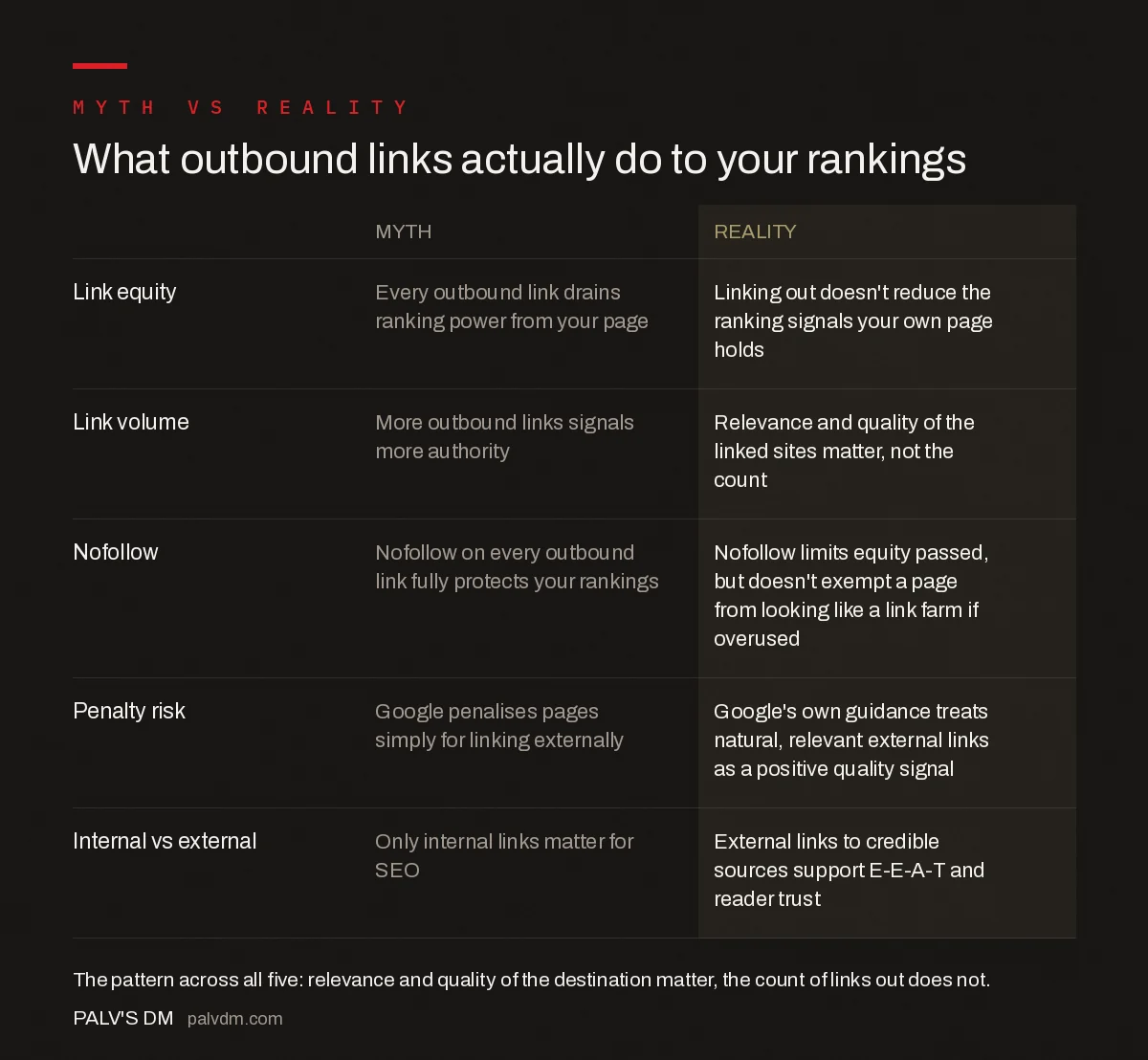
What outbound links actually do to your rankings
| Myth | Reality | |
|---|---|---|
| Link equity | Every outbound link drains ranking power from your page | Linking out doesn’t reduce the ranking signals your own page holds |
| Link volume | More outbound links signals more authority | Relevance and quality of the linked sites matter, not the count |
| Nofollow | Nofollow on every outbound link fully protects your rankings | Nofollow limits equity passed, but doesn’t exempt a page from looking like a link farm if overused |
| Penalty risk | Google penalises pages simply for linking externally | Google’s own guidance treats natural, relevant external links as a positive quality signal |
| Internal vs external | Only internal links matter for SEO | External links to credible sources support E-E-A-T and reader trust |
Myth: every outbound link drains your page’s ranking power
Claim: Linking to another site hands over some of your page’s authority, so fewer outbound links means more ranking power kept for yourself.
Reality: The amount of ranking signal your own page carries doesn’t shrink because you linked elsewhere. Whether a page has one outbound link or twenty, the ranking factors search engines use to evaluate that page — its own content quality, its own inbound links, its own relevance — are unaffected by what it links out to.
Why the confusion exists: Early explanations of PageRank described a fixed amount of “link juice” splitting across every link on a page, external and internal alike, which made “protect your juice” sound like sound strategy. Google’s ranking systems have evolved considerably since that simplified model, and independent testing and statements from Google’s own search advocates have repeatedly contradicted the hoarding theory, but the advice kept circulating in SEO folklore long after the underlying model changed.
Myth: more outbound links always looks more authoritative
Claim: Citing lots of sources makes an article look well-researched, so piling on outbound links is a straightforward credibility boost.
Reality: Quality and relevance of the destination matter far more than the count. Three links to primary, authoritative sources that directly support specific claims outperform fifteen links scattered across tangentially related pages, several of which the reader will never click.
Why the confusion exists: “Cite your sources” is genuinely good practice for credibility, and it’s easy to overcorrect from “cite the right sources” into “cite as many sources as possible.” The overcorrection produces content that reads like a link directory rather than an article, which undermines the exact credibility the links were meant to build.
Myth: nofollow on every outbound link protects your rankings
Claim: Adding rel="nofollow" to all external links removes any downside risk, so it’s safer to nofollow everything by default.
Reality: Nofollow tells search engines not to pass ranking credit through that specific link — it’s meant for links to sources you don’t fully vouch for, paid placements, or user-submitted content. Since linking out to genuinely relevant, high-quality sources was never a ranking risk in the first place, blanket nofollowing doesn’t protect against anything real; it just removes a signal that would have worked in your favor.
Why the confusion exists: Nofollow’s original purpose — combating comment spam — got generalized into “nofollow anything external” as a defensive habit, without the distinction between “links I don’t trust” and “links I’m citing on purpose” surviving the simplification.
Myth: Google penalises any page with external links
Claim: Linking off-site risks a manual action or algorithmic penalty, so the safest content has no external links at all.
Reality: Google’s link documentation explicitly describes linking to other sites as something that “can help establish trustworthiness” when it makes sense in context. The penalty risk that does exist targets manipulative link schemes — paid links passing PageRank without disclosure, link exchanges, automated link generation — not the act of citing a source or referencing a related resource.
Why the confusion exists: Penalty risk is real for a specific category of external linking, and that specificity gets lost when the advice travels secondhand as “external links are risky” instead of “manipulative external links are risky.”
Myth: only internal links matter for SEO
Claim: Internal linking is within your control and demonstrably useful, so external links are optional at best and shouldn’t be prioritised.
Reality: Internal links and external links do different jobs. Internal links distribute authority and crawl paths across your own site. External links to credible, relevant sources support the trust and expertise signals that both readers and Google’s quality raters look for — a technical claim backed by a citation to the primary source reads as more credible than the same claim stated without support.
Why the confusion exists: Internal linking has a more direct, measurable connection to your own site’s structure, which makes it easier to prioritise. External linking’s benefit is less directly visible in analytics, so it gets deprioritised even though it serves a genuinely different function.
Does linking out matter for AI-generated answers, not just Google rankings?
It’s becoming more relevant, not less. AI systems generating summarised answers — Google’s AI Overviews, ChatGPT’s browsing mode, Perplexity — tend to favor content that reads as well-sourced and verifiable, because that’s what makes a claim safe to cite or paraphrase. A page that states a statistic without attribution gives an AI system nothing to point to if it wants to verify or cite the number; a page that links the claim to its origin gives the system a path to confirm it. This doesn’t mean stuffing citations everywhere — it means the same discipline that helps human trust (cite what you didn’t originate yourself) increasingly helps machine-generated answers treat your content as a reliable input rather than an unverifiable one.
Frequently asked questions
Do outbound links hurt my page’s SEO?
Not when they point to relevant, credible sources. Linking out to back up a claim or point readers to a primary source doesn’t reduce the ranking signals your page holds, and Google’s own guidance treats it as a positive quality signal rather than something to avoid.
How many outbound links should a blog post have?
There’s no fixed number. The right count is however many genuinely support the content — a technical article citing one authoritative source and a couple of related internal pages needs far fewer than a resource roundup. What matters is relevance, not hitting a target count.
Should I nofollow all outbound links to protect my rankings?
No. Nofollow is meant for links you don’t want to vouch for — paid placements, user-generated content, or sources you don’t fully trust. Blanket nofollowing every external link doesn’t add protection since linking out to quality sources isn’t a risk in the first place.
Does linking to a competitor hurt my rankings?
No, not for the linking itself. If a competitor genuinely has the best resource on a topic and linking there serves the reader, Google doesn’t penalise the reference. The concern is usually more about sending traffic to a competitor than about any ranking effect.
Do outbound links to authoritative sites improve E-E-A-T signals?
They support it indirectly. Citing primary sources, research, or documentation shows the content is grounded in verifiable information, which is part of how both readers and Google’s quality raters assess expertise and trustworthiness — though outbound links alone don’t establish E-E-A-T on their own.
How do you decide which outbound links actually need nofollow?
Three categories genuinely call for it: links you were compensated for in any way, which Google’s guidelines require marking as sponsored or nofollow; links to content you can’t vouch for, like a guest author’s personal site included as a courtesy rather than an endorsement; and user-generated content such as blog comments, where you have no control over what gets linked. A citation to a government statistics page, a competitor’s genuinely useful resource, or a tool you recommend doesn’t belong in any of those categories, and nofollowing it removes a signal that would otherwise work in the content’s favor for no corresponding benefit.
Sources
- SEO Link Best Practices for Google — Google Search Central
- On-Page SEO Checklist
- Where to Place Your Keyword on a Page (And Where Not To)
- Content Readability: Writing for Scanning, Not Scoring
Want this done on your site?
Every PalV’s DM engagement starts with a free audit of your actual website — a 12-point
crawl covering what is blocking indexation, on-page gaps against your primary keywords, speed
findings, and the three to five fixes worth making first. Delivered in two working days. No
payment details, and the findings are yours whether you hire us or not.