Should You Publish Your Prices? The Data and the Trade-Offs
Publishing prices builds trust and filters unqualified leads for most deal sizes. Here's when transparency helps and when gating pricing is defensible.
For most businesses, publishing at least a starting price improves lead quality more than it hurts sales. The exceptions are real but narrower than most owners assume: genuinely complex, highly customised deals, and contracts large enough that buyers expect a conversation before a number. Everything else does better with some form of visible pricing, even if it’s a range or a “starting at” figure rather than a full price list.
This question comes up constantly from clients who assume hiding pricing protects them from looking cheap, or from losing a deal to a competitor who undercuts a published number. The data mostly points the other way. Visitors who can’t find a price don’t assume you’re premium, they assume you’re expensive, slow to deal with, or not worth the effort of filling out a form to find out.
We used to gate our own pricing behind a contact form. Dropping that and publishing real numbers didn’t hurt close rates. It changed who filled out the form in the first place, and the calls got shorter because nobody was showing up shocked by the number three minutes in.
What does the data actually say about publishing prices?
Displaying price is a documented good practice for improving conversion rates on B2B sites, and pricing transparency functions as a trust signal, communicating that you treat every customer the same way rather than negotiating case by case. When a visitor lands on a page with no pricing information anywhere, the default assumption isn’t “premium,” it’s one of three things: the product is too expensive for them, the sales process will eat their time, or they should look at a competitor who’s more upfront. None of those assumptions help you close a deal.
The lead-quality effect is usually the bigger win than the raw conversion-rate number. Publishing pricing, even just a starting figure, filters out visitors whose budget was never going to match before they ever talk to your sales team. That’s fewer discovery calls that go nowhere, not necessarily more total leads.
When does it actually make sense to hide pricing?
A useful framework, drawn from how B2B pricing decisions typically get made: for contract values under roughly $25,000 (or the rupee equivalent), lean toward full transparency. Over roughly $100,000, you have a legitimate case for gating pricing behind a conversation, because deals at that size usually involve custom scoping that a single published number couldn’t represent honestly anyway. Between those two points, the right call depends on how standardised your offering actually is, not on deal size alone.
| Deal size | Recommendation | Why |
|---|---|---|
| Under $25,000 | Publish pricing | Buyers expect self-serve research; hiding price adds friction without adding perceived value |
| $25,000 – $100,000 | Depends on standardisation | Packaged offerings should publish starting prices; genuinely custom scopes can gate |
| Over $100,000 | Gating is defensible | Deals at this size typically require scoping conversations a published price can’t replace |
What are the actual signs your business should publish pricing?
Run through this before deciding either way.
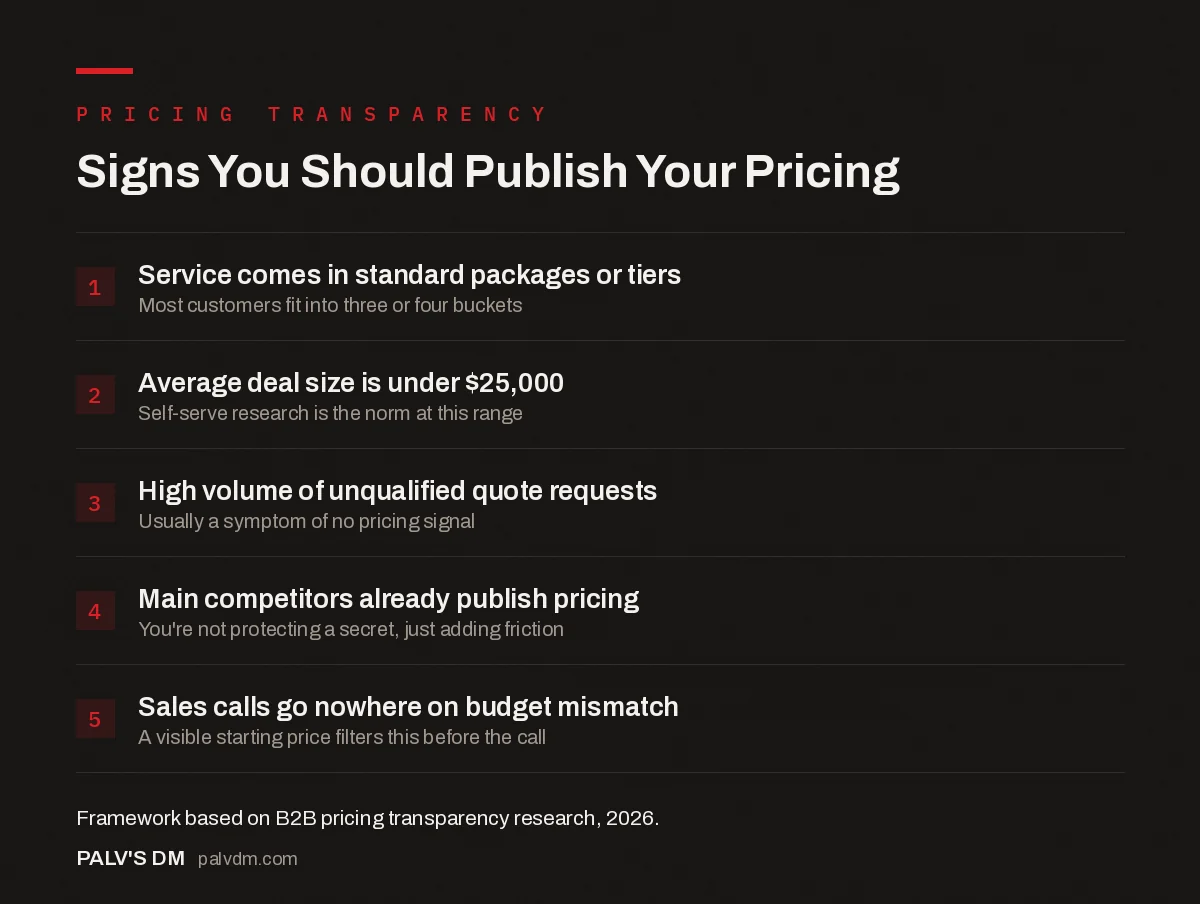
Signs You Should Publish Your Pricing
- Your service comes in standard packages or tiers. If most customers fit into three or four buckets, publish those buckets.
- Your average deal size is under $25,000. Self-serve research is the norm at this range; hiding pricing just adds friction.
- You’re getting a high volume of unqualified ‘request a quote’ submissions. That’s usually a symptom of no pricing signal, not strong demand.
- Your main competitors already publish pricing. You’re not protecting a secret; you’re just making buyers work harder to compare you.
- Your sales team spends real time on calls that go nowhere due to budget mismatch. A visible starting price filters those out before the call gets booked.
What about the ‘request a quote’ button specifically?
It’s usually working against the business that uses it. A “request a quote” button in place of any pricing signal tends to attract more unqualified submissions, not fewer, because visitors with a mismatched budget fill out the form hoping for a fit just as readily as visitors with the right budget. We’ve written more on this specific pattern in why “request a quote” costs you qualified leads, which covers the mechanics of why the form itself doesn’t do the filtering job business owners assume it does.
How should a pricing page actually be structured if you do publish?
Concise and organised beats exhaustive. Lead with the answer to “what does this cost,” structure plans around who each tier is for rather than a raw feature dump, and show enough detail that a visitor can self-select the right tier without needing a call just to understand the options. We go deeper on the layout and psychology of this in our pricing page design guide, including how anchoring the middle tier changes which plan most visitors pick.
What about genuinely variable, custom-scoped work?
Publish a floor, not silence. “Projects start at Rs 80,000” or “Plans from $499/month” gives a visitor a real anchor without committing you to a number that doesn’t fit every situation. What doesn’t work is publishing nothing and hoping the sales conversation will “position value” before price comes up. In our experience running SEO engagements ourselves, a visitor who can’t find a starting number rarely gives you the benefit of the doubt long enough to book that conversation in the first place. That’s part of why we publish our own SEO plan pricing rather than routing everyone through a quote form.
Does published pricing help with search and AI visibility too?
It does, in a way most owners don’t think about. Pages with a clear, specific price are easier for Google to match to price-led search queries like “SEO plans cost” or “website pricing India,” and they’re easier for AI answer engines to cite directly when someone asks an assistant to compare vendors on cost. A page that says “contact us for pricing” gives a search engine or an AI system nothing concrete to surface. A page with “Plans start at Rs 15,000/month” gives it an answerable fact. We’re seeing more buyer research start inside a chat interface instead of a search results page, and a vague pricing page simply doesn’t get quoted back to the person asking.
Indian buyers specifically respond to price framing in ways that differ a little from Western audiences: round-number anchors and visible payment flexibility (monthly vs annual, EMI options) tend to matter more here than in markets where subscription pricing is already the default mental model. That’s a separate topic from whether to publish at all, but worth knowing once you’ve decided transparency is the right call.
Does hiding pricing actually protect you from competitors undercutting you?
Less than owners assume. Buyers comparing options usually find a way to estimate competitor pricing anyway, through a sales call, a review site, an old proposal a colleague shares, or simple word of mouth. What hiding pricing does reliably cost you is the trust benefit: buyers notice when a business is upfront about cost and give that business credit for it, especially in categories where every competitor routes people through the same opaque quote form.
Frequently asked questions
Does publishing pricing actually improve conversion rate?
For most deal sizes, yes, because it removes a step visitors would otherwise take to find the price elsewhere or abandon the search. It doesn’t guarantee more sales; it filters visitors earlier so the leads reaching your sales team are closer to ready, which shows up as better lead quality more reliably than as a raw traffic-to-lead percentage jump.
When is it acceptable to hide pricing on a website?
When deals are genuinely complex and no two customers pay the same structure for defensible reasons, like enterprise software with usage-based components, or when the deal size is large enough (roughly six figures and up) that buyers expect a consultative conversation before a number gets discussed.
Does ‘request a quote’ hurt lead quality?
It tends to attract more unqualified leads, not fewer, because visitors with a small budget submit the form hoping for a match just as often as visitors with the right budget. Without any pricing signal, your sales team spends time qualifying people a published starting price would have filtered out automatically.
What if my prices genuinely vary a lot between customers?
Publish a starting price or a package structure instead of a single number. “Plans start at Rs X” or tiered packages give visitors a usable anchor without committing you to quoting every possible configuration on the page itself.
Do competitors gain an advantage if I publish prices and they don’t?
Rarely in practice. Buyers researching a purchase usually find a way to estimate competitor pricing anyway, through sales calls, review sites, or word of mouth. What you gain by publishing is that visitors credit you with being upfront, which becomes a trust signal competitors hiding their pricing don’t get.
Sources
- 9 Best Practices for a High-Converting Pricing Page, HubSpot
- Should B2B Companies Put Prices on Their Website?, mktoolboxsuite
- Why We Publish Our Prices Instead of Sending Custom Quotes
- Why ‘Request a Quote’ Costs You Qualified Leads
- Pricing Page Design: Structure, Anchoring, Clarity
- Trust Signals That Work in the Indian Market
Want this done on your site?
Every PalV’s DM engagement starts with a free audit of your actual website — a 12-point
crawl covering what is blocking indexation, on-page gaps against your primary keywords, speed
findings, and the three to five fixes worth making first. Delivered in two working days. No
payment details, and the findings are yours whether you hire us or not.
Get your free SEO audit
See Web Development plans and prices