Why We Publish Our Prices Instead of Sending Custom Quotes
We publish transparent SEO pricing instead of sending custom quotes, so you see the exact tiers, scope, and cost before ever booking a sales call with us.
We publish our prices because a custom quote is usually a negotiation dressed up as an estimate. Transparent SEO pricing means the number you see on the page is the number every visitor sees — not a figure adjusted after a salesperson reads your industry, your website’s design budget, or how urgent you sound on a discovery call. It removes the guesswork of “what will this actually cost me” and replaces it with a page you can screenshot, compare, and hold us to.
That’s the short version. The longer version is about what custom quoting actually optimises for, and why most agencies still default to it even though almost every buyer says they hate it.
Key takeaway
- Custom quotes let an agency price to what you’ll pay, not to what the work costs — published prices remove that lever.
- A published price only means something if it comes with a published scope; price without scope is just a number you can’t verify.
- Publishing prices doesn’t mean one-size-fits-all — it means the tiers, and what moves you between them, are visible before you talk to us.
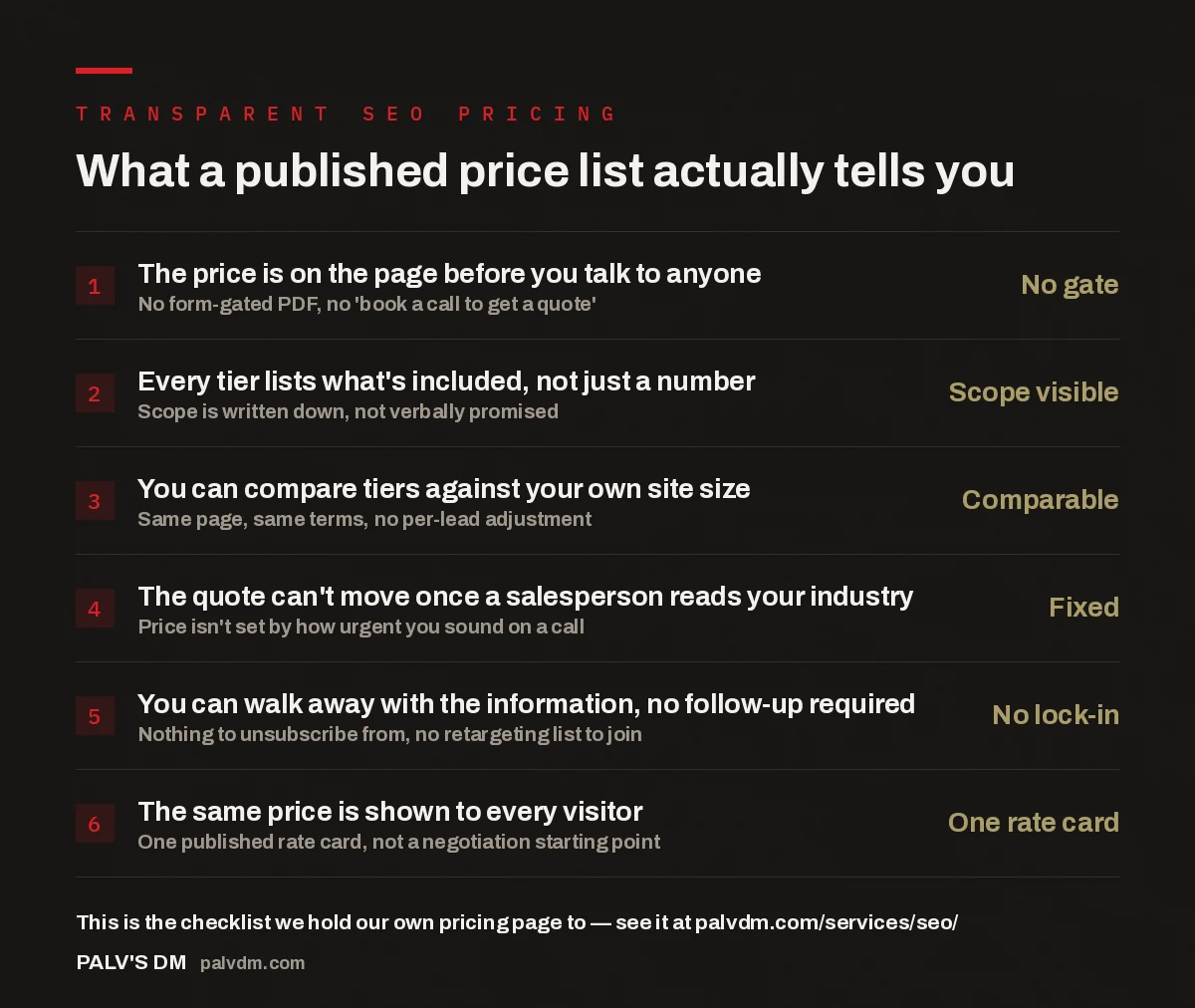
What a published price list actually tells you
- The price is on the page before you talk to anyone — No gate. No form-gated PDF, no ‘book a call to get a quote’.
- Every tier lists what’s included, not just a number — Scope visible. Scope is written down, not verbally promised.
- You can compare tiers against your own site size — Comparable. Same page, same terms, no per-lead adjustment.
- The quote can’t move once a salesperson reads your industry — Fixed. Price isn’t set by how urgent you sound on a call.
- You can walk away with the information, no follow-up required — No lock-in. Nothing to unsubscribe from, no retargeting list to join.
- The same price is shown to every visitor — One rate card. One published rate card, not a negotiation starting point.
Why do most SEO agencies send custom quotes instead of listing prices?
Custom quoting exists because it lets an agency price to what a prospect will pay rather than what the work actually costs to deliver. A “discovery call” before pricing is, in practice, a chance to gauge budget signals — the size of your team, the tools already in your stack, how polished your website looks, how quickly you say yes to the first number. None of that changes what a competitor audit, a technical crawl, or a month of content production actually takes to do. It changes what the agency thinks it can charge.
There’s a legitimate version of custom quoting too — enterprise SEO engagements with genuinely unique scopes, multiple domains, or migration work that doesn’t fit a template. That’s real. But for a standard monthly SEO retainer on a single site, the inputs (site size, current visibility, competitive density, content gaps) are knowable within a short conversation, and the pricing logic behind them can be written down once and reused for every client instead of re-negotiated every time.
What does a published price actually protect you from?
A published price protects you from three specific things that show up repeatedly in accounts we take over from other agencies: quote creep after the first call, scope that shrinks quietly once the contract is signed, and pricing that’s anchored to your perceived budget rather than the work involved. Custom quotes make all three easier to do, because nothing is written down for a prospect to point back to.
It also protects your ability to compare agencies against each other. If Agency A publishes a scope and a price, and Agency B sends you a PDF after a call, you’re not actually comparing two prices — you’re comparing a fixed number against a number that could still move. Transparent SEO pricing turns that into an apples-to-apples comparison, because the terms are visible before either side has invested time in a sales conversation.
A price you can’t screenshot isn’t a price. It’s an opening offer. We’d rather compete on the work than on who can read a prospect’s budget best.
Palash, Founder, PalV’s DM
Does publishing prices mean every client pays the same amount?
No — it means the tiers and what moves you between them are published, not that every business pays identically. What we’ve written about what a smaller monthly SEO budget actually buys lays out one end of that range concretely: at a lower monthly spend, the plan is narrower in scope, and that narrowing is stated up front rather than discovered three months in. A larger site with deeper competitive gaps needs more hours, so it sits in a higher published tier — and you can see exactly why before you commit, because the plan differs by site size in ways that are visible on the pricing page itself, not buried in a proposal deck.
The variable isn’t “how much can this client afford” — it’s “how much work does this site genuinely need,” and that’s a question with a defensible, repeatable answer once you know the site’s size, current rankings, and content gaps. That’s a fundamentally different pricing logic from custom quoting, even though the final invoice amount can still differ from client to client.
How do we decide what’s inside each published tier?
Each tier maps to a fixed set of deliverables, not a fixed number of hours we quietly reallocate depending on the client. We’ve documented what’s actually included in a monthly SEO retainer at each level — technical audits, content cadence, link building activity, reporting frequency — precisely so a prospect doesn’t have to take our word for it during a sales call. If the scope is written down before you sign, there’s no ambiguity to resolve later about whether something was “included” or was always going to be an upsell.
This also forces discipline on our side. When the scope for a tier is public, we can’t quietly narrow it for one client and not another without it being obvious against our own published page. The same logic runs through what we won’t do as part of an SEO engagement — publishing the boundaries of the work is as important as publishing the price, because a price without a clear boundary is just a number you can’t actually verify against what you receive.
What are the trade-offs of publishing prices?
Publishing prices isn’t free of downsides, and it’s worth naming them rather than pretending transparency has no cost. A published price list means competitors can see our rates and undercut them on paper, without disclosing what they’d cut from the scope to hit a lower number. It also means we occasionally lose a prospect who assumed — reasonably, given how the industry usually works — that the published number was a floor they could negotiate down. It isn’t; the number reflects the actual cost of the work, not an opening bid.
The trade we’re making is a longer sales cycle in exchange for a shorter trust-building one. A prospect who reads the pricing page, compares it against what similar agencies advertise (or don’t), and still books a call has already answered most of the “can we afford this, and what do we get” questions themselves. That call becomes about your specific site and goals instead of a pricing negotiation — which is a better use of time for both sides.
How should you use a published price list when comparing agencies?
Treat a published price as a starting filter, not a final answer. Read the scope attached to each tier as closely as the number itself — a lower published price with a thin scope description is often more expensive in practice than a higher price with a detailed one, once you account for what gets billed as an add-on later. Check whether the page tells you what happens in the first month of work, since that’s usually where scope disputes originate; we’ve written about what goes into a client’s first 90 days for exactly that reason, so there’s no gap between what’s promised on the pricing page and what actually happens after signing.
Also ask what happens if the published price no longer fits — most legitimate agencies have a documented path for that too. We cover the logic behind when to upgrade an SEO plan, and when not to, because a transparent pricing model should extend to changes in scope, not just the entry price. If an agency can’t tell you how or when pricing changes, the initial transparency doesn’t count for much.
See the actual pricing
Our SEO tiers, what’s included in each, and how they map to site size are all on one page — no call required to see the number.
Frequently asked questions about transparent SEO pricing
Isn’t a published price just a starting point agencies still negotiate down?
Not if the agency means it. A genuinely transparent pricing page states what’s included at each tier, so there’s nothing left to negotiate away without also removing scope — which then becomes visible against the published description. If a “published” price still moves significantly on a call, it wasn’t really published; it was a suggested opening figure.
Why do some agencies say custom quotes let them serve clients better?
For genuinely unique work — multi-domain enterprise SEO, complex migrations, unusual technical setups — a custom scope can be legitimate. But for a standard monthly SEO retainer on one site, the inputs that drive cost are knowable quickly, and there’s little reason those inputs can’t map to a published tier instead of a private quote.
Does a published price mean the agency can’t adjust scope for my specific site?
No. Published pricing usually works as tiers, and which tier fits your site depends on real factors like page count, current visibility, and competitive gaps. The point isn’t that every site gets identical treatment — it’s that the logic for which tier you land in, and what that tier includes, is visible before you sign anything.
What should I check on a pricing page besides the number itself?
Check what’s explicitly included and excluded at each tier, what happens in the first month, and how the agency handles a scope change later — upgrade path, downgrade path, or neither. A price without a documented scope is hard to hold anyone to, no matter how specific the number looks.
Will a published price ever be higher than what I’d get on a custom quote call?
It’s possible in isolated cases, but that’s not usually how custom quoting plays out. Custom quotes tend to start higher for prospects who seem to have budget and can drop for those who push back — which means the “discount” some buyers negotiate is often just the agency landing closer to its real price. A published number removes that variance entirely.
Short version: we publish our SEO prices because a number you can see, screenshot, and compare is worth more than a number a salesperson reads off your budget. Transparent SEO pricing isn’t a marketing angle — it’s what happens when the scope behind each price is written down first, and the number just follows from that.