How We Decide What Goes Into a Client’s First 90 Days
Our SEO 90 day plan runs in a strict order: technical audit and account access first, cleanup second, priority pages and content next, authority work last.

An SEO 90 day plan should follow one rule: fix what’s broken before you build what’s new, and don’t touch authority work until the site itself is clean. At PalV’s DM, the first 90 days of every engagement follow the same sequence — technical baseline and access first, cleanup second, priority on-page and content work third, and link/citation work only once the earlier stages are done. The order matters more than the individual tasks, because doing link building on a site with indexation problems just wastes the links.
Key takeaway
- The first two weeks are spent on access, audit and tracking — not “quick wins” — because you can’t fix what you haven’t measured.
- Weeks three and four fix indexation, duplication and structural issues before a single new page is written.
- Months two and three are for priority pages, content gaps and the first authority work — in that order, not all at once.
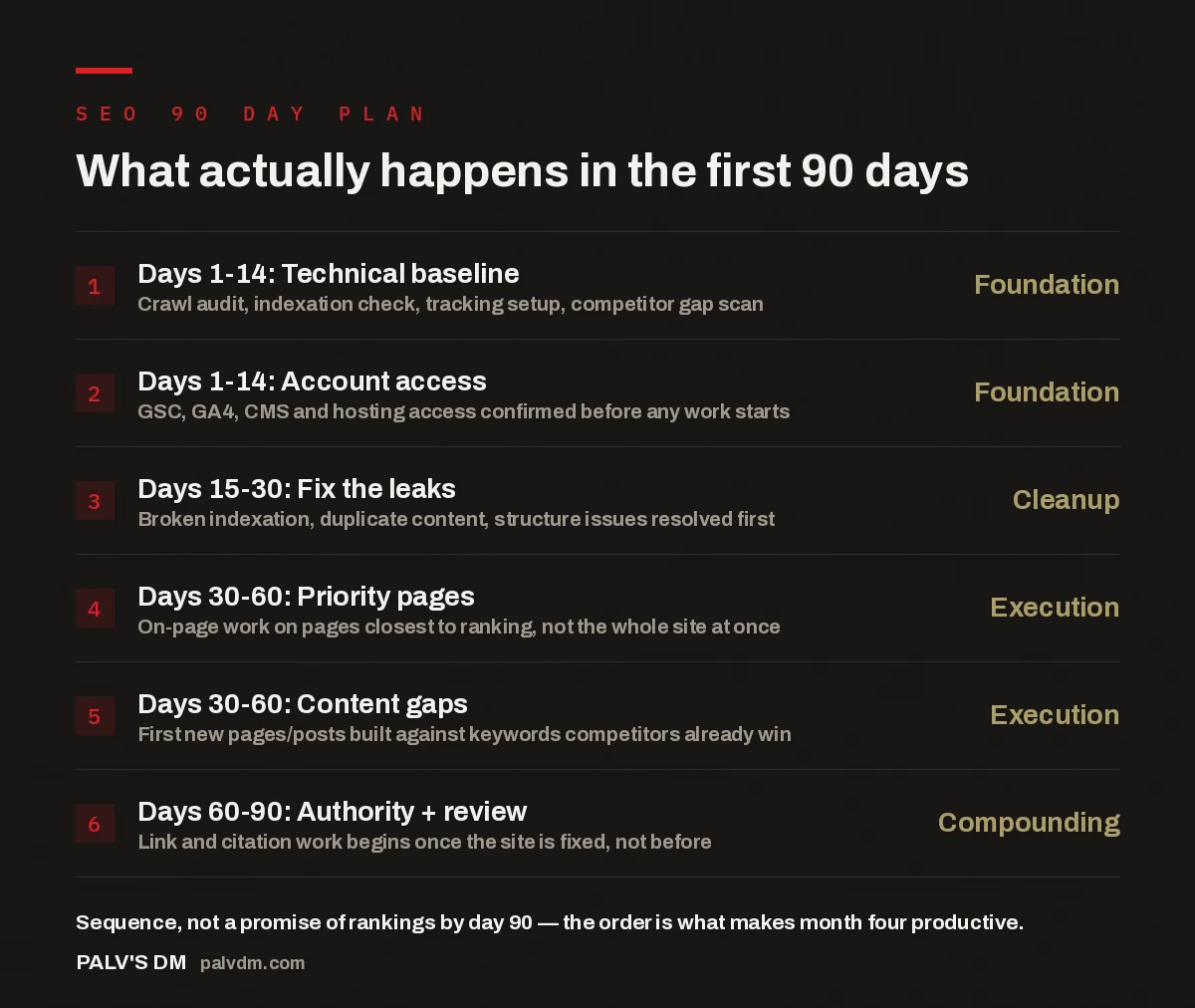
What actually happens in the first 90 days
- Days 1-14: Technical baseline — Foundation. Crawl audit, indexation check, tracking setup, competitor gap scan.
- Days 1-14: Account access — Foundation. GSC, GA4, CMS and hosting access confirmed before any work starts.
- Days 15-30: Fix the leaks — Cleanup. Broken indexation, duplicate content, structure issues resolved first.
- Days 30-60: Priority pages — Execution. On-page work on pages closest to ranking, not the whole site at once.
- Days 30-60: Content gaps — Execution. First new pages/posts built against keywords competitors already win.
- Days 60-90: Authority + review — Compounding. Link and citation work begins once the site is fixed, not before.
Why does the first 90 days matter more than the rest of year one?
Because it’s the only stretch where you’re allowed to be slow on purpose. Every SEO 90 day plan we run starts with two weeks that produce almost nothing visible — no new pages, no new backlinks, no ranking movement. That’s deliberate. The site’s actual condition — what’s indexed, what’s duplicated, what Google has already decided about the domain, what the competitors immediately above you are doing differently — has to be established before any spend goes toward new work. Skip that step and you’re optimising pages you don’t fully understand, on a site whose problems you haven’t mapped, against competitors you’re guessing about.
The accounts we’ve had to rebuild after a bad prior agency almost always show the same pattern: month one was spent producing blog posts or “optimising” pages, while a crawl issue or a canonicalisation error sat underneath the whole site, quietly capping what any of that content work could achieve. Ninety days is long enough to fix that root cause and still get real execution done afterward — which is why we protect the sequence even when a client is impatient to see content go live.
What happens in weeks one and two?
Weeks one and two are access and audit. Access first: Google Search Console, GA4, the CMS, hosting or DNS if we need it, and any existing tracking or tag manager setup. We don’t start technical work on assumptions about what’s installed — we confirm it. Alongside that, a full crawl of the site (using tools like Screaming Frog or Sitebulb, cross-checked against GSC’s own coverage report) tells us what’s actually indexed versus what should be, where duplicate or thin pages exist, and where the site’s internal linking is quietly burying pages that should be easy to rank.
The last piece of weeks one and two is a competitor gap scan — not a generic “who ranks for your industry” report, but a specific look at the handful of competitors already ranking for the keywords the client cares about, and what those pages do that the client’s site doesn’t. This becomes the backbone of the keyword and content decisions made in month two. If you want the detail on how we turn that scan into an actual priority order, we’ve written separately about how we choose which keywords to chase first.
What gets fixed before anything gets built?
Weeks three and four are cleanup, and cleanup is unglamorous by design. Typical items: pages that should be indexed but aren’t (or the reverse — pages indexed that shouldn’t be, diluting the site’s relevance signals), duplicate or near-duplicate content across category and product pages, broken or missing canonical tags, redirect chains left over from a past migration, and internal linking that routes all authority to the homepage instead of the pages that actually need it. None of this is exciting to report on, but all of it determines whether the content work in months two and three has anywhere to land.
This is also usually the point where a client asks why we’re not writing new content yet. The honest answer: publishing new pages onto a site with unresolved indexation or duplication problems is like adding rooms to a house with a cracked foundation — the new work doesn’t fail immediately, but it never performs as well as it should, and eventually you have to go back and redo it anyway. For more on why this specific stage gets skipped elsewhere, see what we do in month one that most agencies skip.
Every SEO plan we’ve had to rescue had one thing in common — someone skipped the boring part. The first 90 days exist so we never have to go back and redo month one’s work in month six.
Palash, Founder, PalV’s DM
How does priority get decided in month two?
Month two is where visible execution starts, and it starts narrow, not broad. Rather than spreading effort evenly across a site — which is what happens when an agency treats every page as equally important — we work from the competitor gap scan and the crawl data to identify pages that are already close to ranking, or that target keywords where the current top results are genuinely beatable. Those pages get on-page work first: title and heading structure, internal linking, content depth relative to what’s currently ranking, and schema where it’s applicable.
Only after the existing pages closest to ranking are addressed do we move to new content — and even then, new pages are built against specific gaps the competitor scan identified, not a generic content calendar. A site with no in-house writer isn’t at a disadvantage here; we’ve written about how that specific constraint gets handled in SEO for a site with no content team. The goal for month two isn’t volume. It’s making sure every page we touch or create in the first 90 days has a specific reason to exist tied back to the keyword research, not a slot on a calendar that needed filling.
Why does authority work wait until month three?
Link building, digital PR outreach and citation work start in month three, and only in month three, for a simple reason: authority signals amplify whatever the site already is. Pointing links at pages that aren’t indexed correctly, or that have thin or duplicated content, amplifies the problem rather than the site’s ranking potential. By month three, the technical cleanup from weeks three and four has had time to be recrawled and reprocessed by Google, and the priority pages from month two have live, improved content for any authority work to point at.
This is also when the first full reporting cycle closes the loop — what changed technically, what content shipped, what the early keyword movement looks like, and what month four’s priorities should be based on actual data rather than the original assumptions from week one. If you want to see exactly what that reporting looks like, we cover it in how we report: what’s in every monthly update, and the underlying process documents we use to keep each stage consistent across accounts are described in the workbooks behind our SEO delivery.
What should you actually expect to see by day 90?
Not first-page rankings — anyone promising that inside 90 days on a competitive keyword is either overpromising or picked keywords with no real search demand to make the number look good. What you should see by day 90: a documented technical baseline and a list of what was fixed, a small set of priority pages with completed on-page work and early signs of improved crawling or indexing behaviour, the first pieces of new content live and targeting specific gaps, and the first authority outreach underway. Early keyword movement — a page moving from position 40 to position 18, for example — is a realistic signal at this stage. Page-one rankings for competitive terms typically show up later, once the authority work from month three has had a few more months to compound.
The pattern that shows up repeatedly across accounts we run is that the sites where month one was spent on access and audit — rather than rushed into content — end up with faster, more durable movement by month six than sites where content started immediately and the technical fixes got squeezed in later, or not at all.
Want this sequence run on your own site?
We’ll map your first 90 days against your actual site condition, not a template — starting with the audit that decides everything else.
Will I see ranking improvements in the first 90 days?
You may see early movement on lower-competition keywords, especially pages that were already close to ranking before technical fixes were applied. Page-one results for competitive terms usually take longer, since authority work — which typically has the biggest impact on those keywords — doesn’t start until month three of the plan.
Why don’t you start with content or link building?
Because content and links amplify whatever state the site is already in. If there are indexation, duplication or crawling issues underneath, new content and new links compound the existing problem instead of fixing it. The technical baseline in weeks one and two exists so later work isn’t wasted.
Does the 90-day plan change based on site size or industry?
The sequence stays the same — audit, cleanup, priority execution, authority work — but the specific tasks inside each stage scale with the site. A 10-page site’s technical audit takes far less time than a 500-page site’s, which changes how much of the 90 days is left for content and outreach.
What if the audit finds more problems than expected?
We flag it immediately rather than quietly absorbing it into the existing timeline. A site with a larger technical backlog than expected may need weeks three and four extended before month two’s execution work begins — better to adjust the plan early than to build content on a foundation that isn’t actually fixed yet.
Who decides which pages are “priority” in month two?
The competitor gap scan and crawl data from weeks one and two, not a generic checklist. Pages already close to ranking, or targeting keywords where the current top results are genuinely beatable, get worked on first — the same logic we use for ongoing keyword prioritisation after the first 90 days end.
Short version: a proper SEO 90 day plan spends its first two weeks on access and audit, its next two on fixing what the audit found, month two on priority pages and content gaps identified by real competitor data, and month three on authority work — because links and outreach only compound a site that’s already been fixed. Rushing that order doesn’t save time; it just moves the same work to month six, with less patience left to do it properly.