How We Choose Which Keywords to Chase First
A clear look at our SEO keyword prioritisation process: how we filter for business fit, ranking distance and page strength before sequencing keywords into sprints.

Our SEO keyword prioritisation process runs on six checks, applied before any keyword is scheduled: business fit, current ranking position, difficulty against the actual page (not the domain), funnel stage, content readiness, and sprint capacity. A keyword only gets worked on once it clears all six — search volume alone never decides the order. This is the same sequence we run on every account, whether the site has forty pages or four hundred.
Key takeaway
- Search volume is the last thing we look at, not the first — business fit and ranking distance decide far more of the order.
- Difficulty gets measured against the specific page that would target the keyword, not against the domain’s overall authority.
- Keywords are sequenced into sprints across several months, not dumped into one flat priority list that never gets revisited.
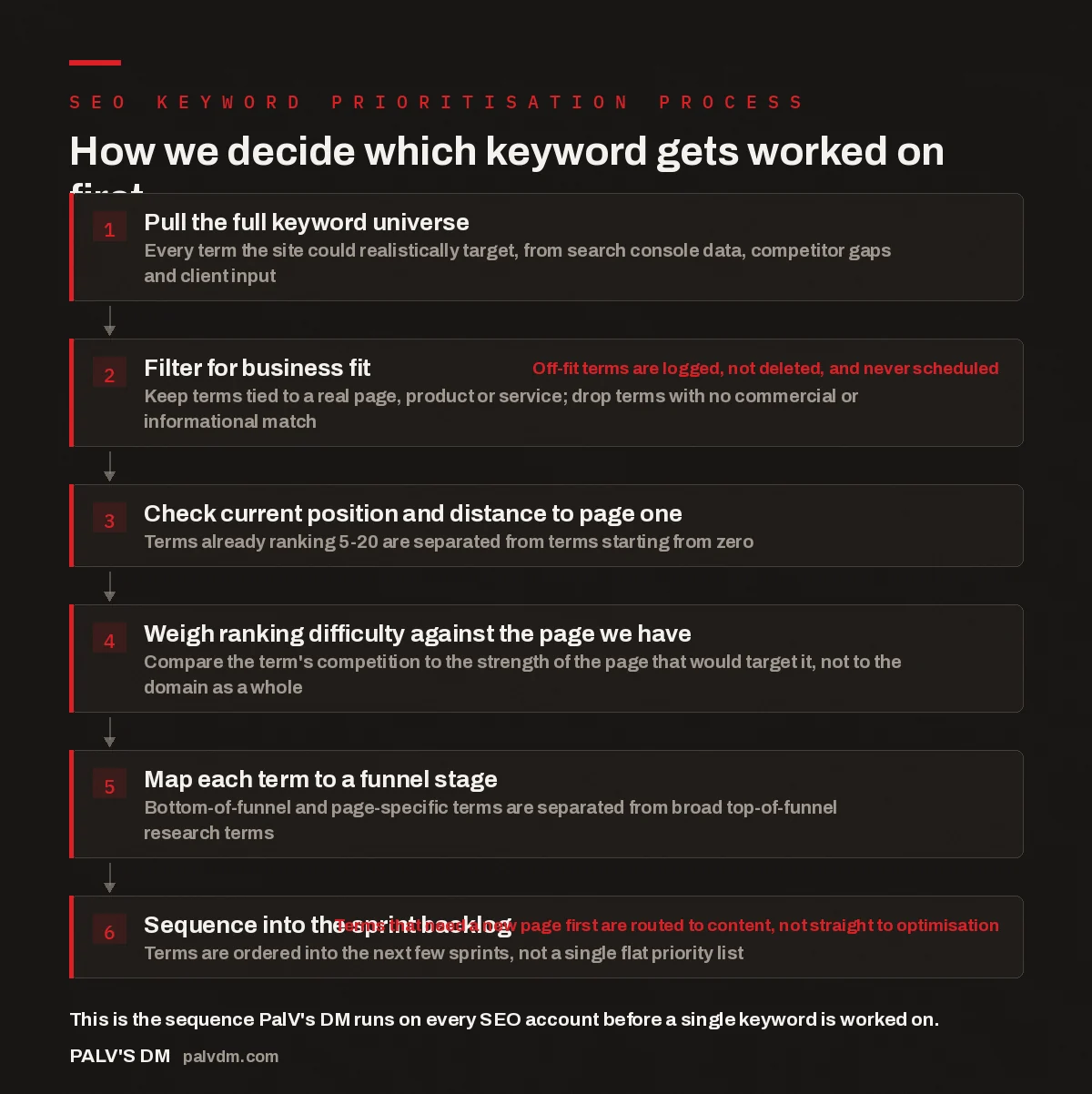
How we decide which keyword gets worked on first
- Pull the full keyword universe. Every term the site could realistically target, from search console data, competitor gaps and client input.
- Filter for business fit. Keep terms tied to a real page, product or service; drop terms with no commercial or informational match. Off-fit terms are logged, not deleted, and never scheduled
- Check current position and distance to page one. Terms already ranking 5-20 are separated from terms starting from zero.
- Weigh ranking difficulty against the page we have. Compare the term’s competition to the strength of the page that would target it, not to the domain as a whole.
- Map each term to a funnel stage. Bottom-of-funnel and page-specific terms are separated from broad top-of-funnel research terms.
- Sequence into the sprint backlog. Terms are ordered into the next few sprints, not a single flat priority list. Terms that need a new page first are routed to content, not straight to optimisation
Why isn’t search volume the starting point?
Most inherited keyword lists are sorted by volume, high to low. It looks like a plan. It isn’t one. A high-volume keyword with no real link to what the business sells is a dead end dressed up as an opportunity — you can rank for it and still send traffic that never converts, because the searcher wanted something the page doesn’t offer. We’ve taken over accounts where the “priority” list was years old, sorted purely by volume, with no column for whether a term had any relationship to what the client did.
Volume tells you how many people search a term. It tells you nothing about whether ranking for it moves the business forward, how hard it is to rank, or whether the site has anything worth showing those searchers. That’s why it’s the last filter we apply, not the first — a scale check once everything else already qualifies.
Step 1: What goes into the keyword universe before anything gets prioritised?
Before any prioritisation happens, we build the full list of keywords the site could realistically target, from four sources: Search Console (terms already getting impressions, even at position 40), competitor gap analysis (terms competitors rank for that this site doesn’t touch), the client’s own language for their services, and existing page content the site half-targets already, without a dedicated page.
This step deliberately over-collects. It’s easier to filter a long list down than to notice a gap in a short one. A site with a narrow service offering can still end up with a keyword universe running into the hundreds of terms before any cutting starts — most will never be worked on individually, but they need to be on the list first.
Step 2: How does business fit filter the list down?
Every keyword in the universe gets checked against one question: is there a page on this site, or one we’re planning to build, that genuinely deserves to rank for this term? A keyword with no honest match — where ranking for it would mean writing a page purely to catch traffic, not serve a real visitor — gets parked here, not deleted. It might become relevant once the business adds a service line, and revisiting the list is part of the process, not a one-off exercise.
This filter removes the most keywords, by far. A local service business chasing “how does SEO work” competes with entire industries of educational content for a term that will almost never turn into a client. Not a bad keyword in the abstract — a bad fit for that site’s priorities right now.
Step 3: Why does ranking distance matter more than difficulty scores?
Once the list is filtered for business fit, we split it by where the site currently stands. A keyword already ranking at position 8 to 15 usually needs less work to move to page one than a keyword the site has never ranked for — the page exists, has some authority, and the gap to close is often specific on-page and internal linking fixes rather than building from zero. Keywords starting from nothing need a page built or substantially rewritten, competing for the same content capacity as everything else in the plan.
Third-party difficulty scores get used as a rough sense-check here, not the deciding number. Two sites face very different real difficulty for the same keyword depending on how strong their target page already is, which is the next check.
Step 4: Why weigh difficulty against the page, not the domain?
A tool scoring keyword difficulty is usually scoring it against domain-level signals — overall backlink profile, overall authority. That misses the real question: can this specific page, as it exists or as we plan to build it, realistically compete for this term. A domain with strong authority can still have a thin page targeting a competitive term, and that page will struggle regardless of how strong the rest of the site looks.
So the real comparison is: what does page one currently look like for this term, and how does our page compare, in depth, structure and specificity. A keyword can look easy by domain-level scores and still be hard because our competing page is genuinely thinner than what’s already ranking. That mismatch only shows up checking page against page, not domain against keyword.
Step 5: How does funnel stage change the order?
Every keyword that survives the first four checks gets tagged by funnel stage — roughly, whether the searcher is close to a buying decision or still researching. Bottom-of-funnel terms tied to a specific page usually get worked on earlier, since the path from ranking to enquiry is short and easy to see. Top-of-funnel research terms still matter, particularly for sites building topical depth or reducing paid-channel reliance, but they’re sequenced knowing the payoff is slower.
AI-driven search results change this calculation slightly. Broad, informational queries are increasingly answered inside AI-generated summaries before a searcher reaches a list of blue links, which makes some top-of-funnel terms worth targeting for a different reason — being the source an AI answer cites — rather than for direct click volume. That doesn’t remove informational keywords from the plan, it changes what “winning” that keyword looks like.
Step 6: How do keywords actually get sequenced into work?
The final step turns a filtered, tagged list into an actual schedule. Keywords needing only on-page and internal linking work go into near-term sprints, because that work finishes faster. Keywords needing a new page or a substantial rewrite get routed into the content plan first, then scheduled for optimisation once that page exists and has had time to be indexed. Nothing sits on a single flat “priority list” ranked one to two hundred — that format looks organised but breaks down the moment anything changes, because reordering two hundred items after one client update rarely happens in practice.
Instead, we work in shorter horizons — enough keywords mapped for the next few sprints, re-sequenced as rankings move and priorities shift. A keyword third in line can drop several places if a competitor outranks a page we hadn’t flagged as urgent, or move up if search console shows a jump in impressions signalling Google is already testing the page.
A keyword list sorted by volume is a spreadsheet. A keyword list sorted by fit, ranking distance and page readiness is a plan. The difference only shows up three months in, when one of them has actually moved rankings and the other hasn’t.
Palash, Founder, PalV’s DM
What happens to the keywords that don’t make the cut?
Deprioritised isn’t the same as discarded. A keyword failing the business-fit check today might fit once a client launches a new service line. A keyword too difficult for the current page might become realistic once that page has had months of link building and content depth added. The full keyword universe stays on record and gets revisited alongside broader plan reviews.
Clients sometimes push back here, understandably. A high-volume term that isn’t scheduled can look ignored. Usually the term either doesn’t match a real page yet, or it’s queued behind keywords with a shorter path to results. Explaining that trade-off directly lands better than pretending every keyword is worked on at once — which no account actually does.
How does this fit into the wider SEO plan?
Keyword prioritisation isn’t a one-time exercise done before a contract starts — it’s a recurring input into how a weekly SEO sprint gets planned, and one of the decisions set during the first 90 days of a new account, before the longer cadence takes over. Some of it happens in month one specifically, alongside work that most agencies skip past for faster-looking wins. The keyword universe, its filters and its current sequencing live in the same working documents we use for the rest of delivery — the workbooks behind SEO delivery — so prioritisation stays visible and revisited, not a decision made once and forgotten.
Want this run on your site?
If your current keyword list is a volume-sorted spreadsheet with no sequencing behind it, this six-step process is exactly what we run for every SEO client, from the first month onward.
FAQ: keyword prioritisation in SEO
What’s the biggest mistake in most keyword prioritisation processes?
Sorting purely by search volume. It looks decisive but ignores whether a keyword fits the business, how far the site is from ranking for it, and whether there’s a page strong enough to compete. Volume is a useful final check, not a starting filter.
Should keyword difficulty scores from SEO tools be trusted?
As a rough sense-check, yes; as a final answer, no. Most difficulty scores are calculated against domain-level authority, not the specific page that would target the keyword. A weak page on a strong domain can still struggle for a term the tool marks “easy.”
How often should a keyword priority list be reviewed?
Regularly enough that ranking changes, new pages going live and shifts in the client’s business get reflected — in practice this happens alongside the ongoing sprint cadence rather than a rigid fixed interval, since a static list stops matching reality within weeks.
What happens to keywords that don’t get prioritised right away?
They stay in the full keyword universe rather than being discarded. A term that doesn’t fit today, or needs a page that doesn’t exist yet, can move up later once conditions change — a new service line, a rebuilt page, or fresh ranking data.
Does AI search change how keywords should be prioritised?
It changes what “winning” a broad, informational keyword means, since some of those queries now get answered inside AI-generated summaries before a searcher clicks through. It doesn’t remove informational keywords from a plan, but it affects why a term is prioritised.
Short version: our SEO keyword prioritisation process filters the full keyword universe for business fit first, checks ranking distance and page strength second, tags for funnel stage third, and only then sequences everything into sprints. Search volume is a final sense-check, not the sorting column. A keyword without a real page behind it gets parked and revisited, not worked on out of order.