How a Weekly SEO Sprint Actually Runs
Inside our weekly SEO sprint process: how review, research, briefing, build, QA and reporting actually run across five days, every single week of the plan.

A weekly SEO sprint process is a fixed five-day cycle — review, research, build, QA, log — that turns a quarterly SEO plan into shippable work every single week instead of a vague monthly retainer. Most agencies talk about “ongoing optimisation.” A sprint is what that phrase looks like when you actually open the calendar: Monday planning, Tuesday research and briefing, Wednesday–Thursday execution, Friday QA and reporting. Here’s what happens inside each of those days, and why the structure matters more than the hours logged.
Key takeaway
- A sprint runs Monday to Friday: review last week’s results, research and brief the next round of work, build it, QA it against the brief, then log what shipped before the cycle repeats.
- The brief written on Tuesday is the control document — nothing gets built Wednesday or Thursday that isn’t traceable back to it, which is what stops SEO work from drifting off-plan.
- Friday’s QA and log step is the one most agencies skip, and it’s the reason clients on loosely run retainers can’t tell you what actually happened last month.
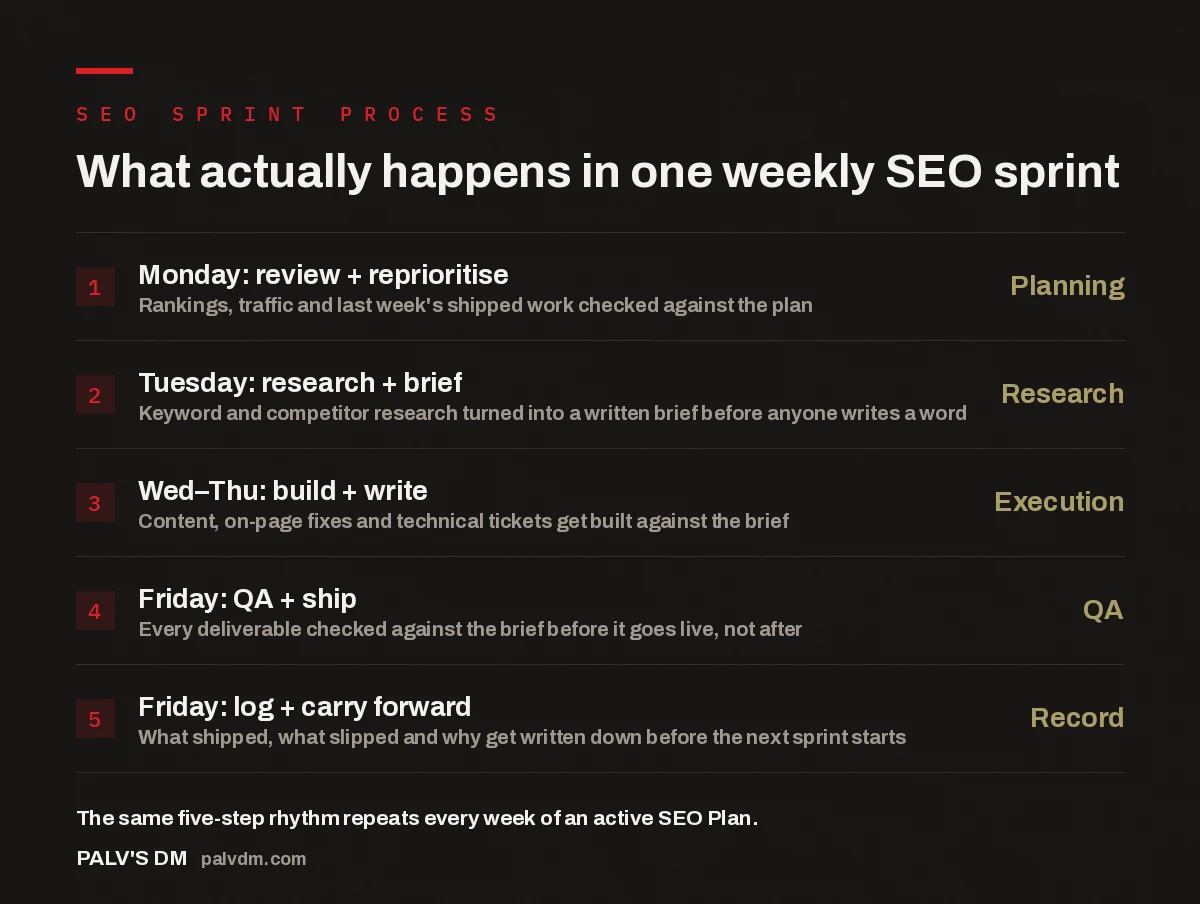
What actually happens in one weekly SEO sprint
- Monday: review + reprioritise — Planning. Rankings, traffic and last week’s shipped work checked against the plan.
- Tuesday: research + brief — Research. Keyword and competitor research turned into a written brief before anyone writes a word.
- Wed–Thu: build + write — Execution. Content, on-page fixes and technical tickets get built against the brief.
- Friday: QA + ship — QA. Every deliverable checked against the brief before it goes live, not after.
- Friday: log + carry forward — Record. What shipped, what slipped and why get written down before the next sprint starts.
What does a weekly SEO sprint actually look like day by day?
The sprint starts on Monday with a review, not a to-do list. Before anyone opens a document to plan the week ahead, we look at what actually happened the previous week — which pages moved in rankings, which pieces got published, which technical fixes went live, and whether any of it produced a change in traffic or leads worth noting. This sounds obvious, but it’s the step most retainers quietly drop once the account has been running for a few months. Without it, “ongoing SEO” turns into a list of tasks nobody re-checks against outcomes.
- Monday — review and reprioritise. Rank and traffic movement from the past week gets checked, last week’s deliverables get marked done or carried over, and the week’s priority list gets set based on what actually needs attention, not just what’s next on a static roadmap.
- Tuesday — research and brief. Whatever the priority list calls for — a new page, a competitor gap, a technical fix — gets researched and turned into a written brief: target keyword, search intent, competing pages, structure, and what the page needs to say that competing pages don’t.
- Wednesday and Thursday — build. Writers, the technical lead and whoever owns on-page work execute against the brief. Nothing gets built from memory or from a general sense of “what usually works” — it gets built against the document from Tuesday.
- Friday — QA and ship. Every deliverable is checked against its brief before it goes live: does the page actually answer the intent it was briefed for, do the technical fixes hold up in a live crawl, does the on-page work match what was scoped. Then it ships.
- Friday — log and carry forward. What shipped, what slipped, and why, gets written down in the account’s running log before the next Monday’s review. This is the record that feeds the monthly report and stops institutional knowledge from living only in someone’s head.
Notice what’s missing from that list: there’s no “content creation day” floating free of a brief, and no technical fix that ships without being checked against what it was meant to do. That’s deliberate. The sprint’s whole value is that every hour worked traces back to a decision made earlier in the same week.
Why run SEO in weekly sprints instead of a loose monthly plan?
A monthly SEO plan tells you what should happen over four weeks. It doesn’t tell you what happens when week two’s keyword research turns up something week one’s plan didn’t account for, or when a technical fix takes longer than expected and eats into content time. A sprint structure exists to handle exactly that — replanning happens every Monday, not once a month after the damage is already baked in.
The other reason is accountability at a granular level. On a purely monthly cadence, the honest answer to “what did you do for us this month” is usually reconstructed after the fact from memory and file timestamps. A sprint that logs its own output every Friday gives that question an actual paper trail — weekly logs stitched into one monthly report, not a report written from recollection at month’s end.
This matters more the longer an account runs. In month one, almost any process looks disciplined because the backlog of obvious work is large and forgiving. The sprint structure earns its keep in month six, once the obvious wins are gone and work has to be prioritised correctly week over week — exactly when loosely run retainers tend to plateau.
Who does what during the sprint?
A sprint only works if the roles inside it are clear, because a brief written by the wrong person, or QA done by the same person who built the page, defeats the purpose of having the stages at all. In practice a sprint splits across a small number of functions: someone owns the Monday review and weekly prioritisation, someone owns Tuesday’s research and briefing, someone else executes against the brief, and someone independent of the build checks it on Friday before it ships. On smaller accounts some of these roles sit with the same person across different days — the point isn’t headcount, it’s that each stage happens as a distinct, checkable step rather than blurring into one continuous “working on your SEO” activity.
This is also where a lot of client confusion about retainers comes from — not knowing who is actually doing what, or whether the person writing content even saw the research behind it. A sprint makes that visible by design: Tuesday produces a brief, Thursday produces a draft, Friday produces a QA note and a log entry.
The brief is the control document. If a page can’t be traced back to a written brief from earlier in the same week, we don’t ship it — no matter how good it looks on its own.
Palash, Founder, PalV’s DM
What goes wrong when agencies skip the sprint structure?
The most common failure mode we see when inheriting an account from another agency isn’t bad individual work — it’s the absence of a repeatable process connecting one week’s output to the next. Content gets written without a brief, so it targets whatever keyword seemed reasonable that day rather than one actually prioritised. Technical fixes get made without a QA step, so they sometimes get partially undone by the next update. And because nothing is logged week to week, the monthly report becomes a reconstruction exercise instead of a summary of a documented process.
None of this shows up as one dramatic mistake. It shows up as drift — months of “work” that, laid end to end, don’t add up to a coherent push on any particular set of pages, because nothing forced each week’s work to connect to the last. A sprint structure doesn’t prevent every mistake, but it makes drift harder to hide, because Monday’s review forces last week’s output to be checked against the plan out loud, every week.
Skipping this structure also tends to produce scope creep in the wrong direction — an account slowly turning into ad-hoc requests instead of prioritised work. Without a Monday reprioritisation step, whoever emails last tends to get their item worked on next, regardless of whether it’s actually the highest-value thing to do that week.
How does the sprint connect to your monthly report?
A monthly report is only as good as what fed it. If the underlying work was done in a sprint structure — reviewed, briefed, built, QA’d and logged every week — the monthly report is essentially an assembly of four or five weekly logs plus the rank and traffic movement over that window. If the underlying work wasn’t run this way, the report has to be written from memory close to the deadline, which is how reports end up vague (“continued optimisation efforts”) instead of specific (“published three briefed pages targeting X, Y, Z; fixed duplicate title tags on 14 category pages; reprioritised keyword Z after a competitor moved into position two”).
This is also why the sprint’s Friday log matters even in a slow week. A week where nothing dramatic happened still gets logged — what was reviewed, what was decided, what got carried forward and why — so that the record of an account’s SEO work is continuous rather than having gaps whenever there’s less to report.
Want this sprint structure running on your own site?
This is the exact weekly process behind every SEO Plan we run — reviewed, briefed, built, QA’d and logged, every week, with a monthly report built from that log rather than reconstructed from memory.
Frequently asked questions about running an SEO sprint
Is a weekly SEO sprint the same as an Agile development sprint?
Not exactly, though it borrows the same idea of a fixed, repeatable cycle rather than open-ended work. There’s no story-pointing or standup ceremony — the structure is simpler: review, brief, build, QA, log, repeated weekly. The point is the same as Agile’s, though: work gets planned in short cycles and checked against a plan rather than drifting.
Does every SEO plan tier get the same sprint structure?
The five-stage rhythm — review, brief, build, QA, log — stays the same across tiers; what changes is how much gets built inside each Wednesday–Thursday window. A smaller site’s sprint might ship one briefed page and a handful of on-page fixes, while a larger account’s sprint ships more in parallel. The process doesn’t get skipped to save time on a lighter plan.
What happens if a sprint week has nothing urgent to work on?
The Monday review still happens, and the week’s priorities still get set from the plan — usually pulling forward the next scheduled item, like a page from the content calendar or a technical item from the backlog. A quiet week still gets a Friday log entry, so the record of the account stays continuous instead of having unexplained gaps.
Can a client see the weekly brief and log, or only the monthly report?
Clients aren’t limited to the monthly summary — the underlying briefs and weekly logs are part of what you retain access to as the account runs, since you own every account, login and asset behind the work. The monthly report is a rollup for convenience, not the only record that exists.
How long before a sprint-based process shows results?
The sprint structure itself is visible from week one — you’ll see briefs, builds and logs immediately. Ranking and traffic movement, which depend on the wider SEO plan rather than the process alone, typically take longer to show, and vary by site age, competition and starting position. The value of the sprint process in that window is that you can see exactly what was worked on while you wait, rather than being told to trust that “optimisation” is happening.
The short version
A weekly SEO sprint process runs Monday to Friday: review last week’s results and reprioritise, research and write a brief, build against that brief, QA and ship on Friday, then log what happened before the cycle repeats. The brief is the control document that stops work from drifting, and the Friday log turns a month of work into a report assembled from evidence rather than reconstructed from memory. For the rest of the process this sprint feeds into, see what’s actually included in a monthly SEO retainer, how keywords get prioritised before they’re briefed, who works on an account at each stage, and what goes into the monthly report itself.