What Changes When You Move From On-Page-Only to Competitor-Led SEO
See exactly what changes when you move from on-page-only SEO to competitor led SEO: what sets priority, content briefs, link work and reporting all shift.

Moving from on-page-only SEO to competitor-led SEO changes what decides your priorities. On-page-only work fixes what’s wrong on your own pages — titles, meta descriptions, headings, internal links — against a generic best-practices checklist. Competitor-led SEO starts from a different question: what is the page currently outranking you actually doing that you are not, and how do you close that specific gap. The tactics overlap — you still fix titles, you still build internal links — but the sequencing, the content decisions, and the definition of “done” all change once competitors, not a checklist, are setting the priority list.
Key takeaway
- On-page-only SEO fixes your pages against a checklist; competitor-led SEO fixes your pages against whoever is actually ranking above you for the query you want.
- The move usually happens because on-page fixes ran out of ceiling — the obvious problems are gone, but rankings still haven’t moved on the keywords that matter commercially.
- Competitor-led SEO isn’t a bigger checklist. It changes what “priority” means, what content gets written, how links get earned, and what gets reported.
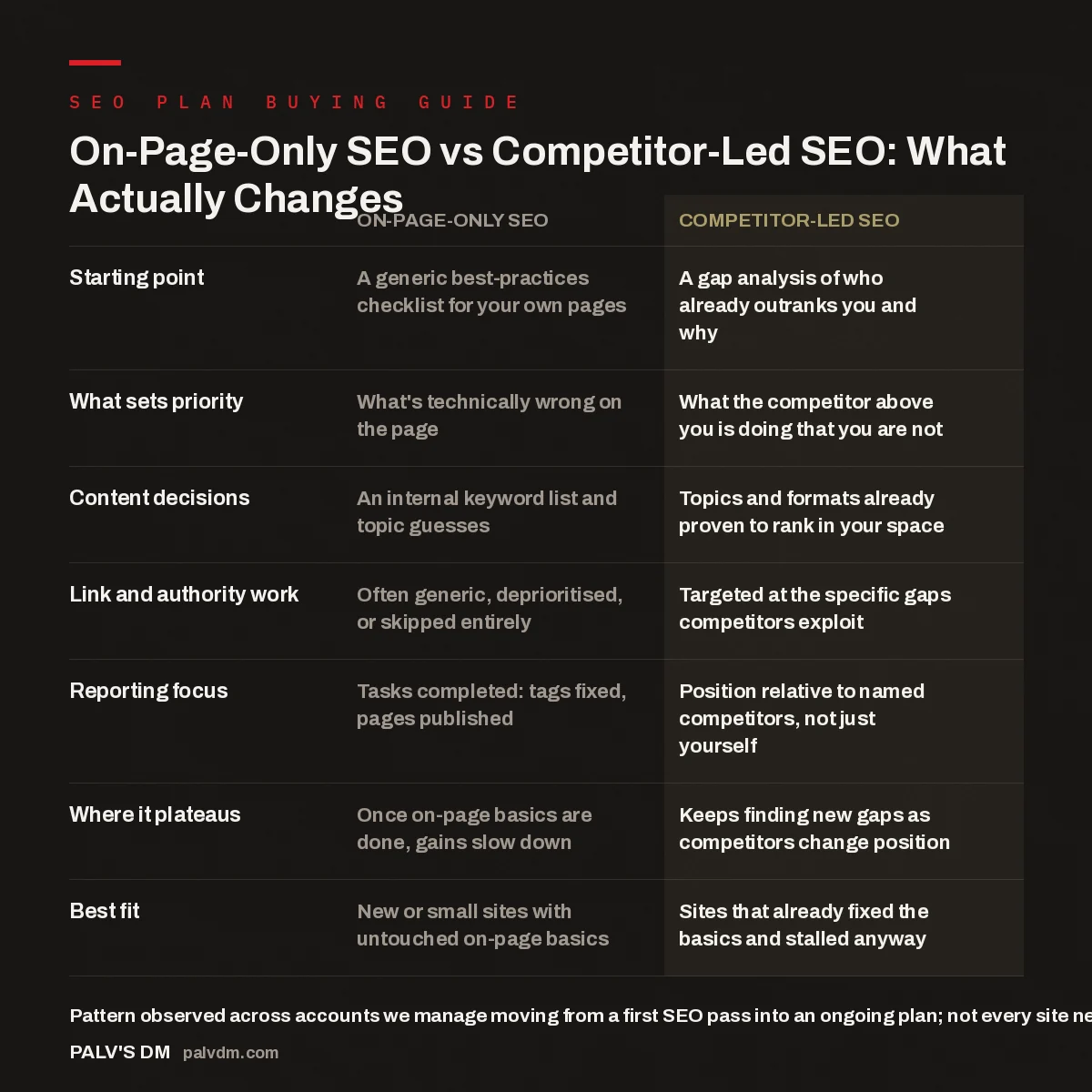
On-Page-Only SEO vs Competitor-Led SEO: What Actually Changes
| On-page-only SEO | Competitor-led SEO | |
|---|---|---|
| Starting point | A generic best-practices checklist for your own pages | A gap analysis of who already outranks you and why |
| What sets priority | What’s technically wrong on the page | What the competitor above you is doing that you are not |
| Content decisions | An internal keyword list and topic guesses | Topics and formats already proven to rank in your space |
| Link and authority work | Often generic, deprioritised, or skipped entirely | Targeted at the specific gaps competitors exploit |
| Reporting focus | Tasks completed: tags fixed, pages published | Position relative to named competitors, not just yourself |
| Where it plateaus | Once on-page basics are done, gains slow down | Keeps finding new gaps as competitors change position |
| Best fit | New or small sites with untouched on-page basics | Sites that already fixed the basics and stalled anyway |
What does “on-page-only SEO” actually mean?
On-page-only SEO is work that starts and ends on your own site. It’s title tags, meta descriptions, header structure, image alt text, internal linking, page speed, and making sure each page targets one clear keyword instead of three vague ones. It’s a real discipline, and most sites need it — a site with duplicate title tags and no H1 structure will not outrank anyone regardless of how good the strategy above it is.
The limitation isn’t the tactics, it’s the reference point. On-page-only work checks your page against a best-practices standard — does the title contain the keyword, is the meta description the right length, is there one H1. It doesn’t ask what the page in position one is doing that yours isn’t. Two sites can both pass every item on an on-page checklist and still sit ten positions apart, because the checklist never looked at the competition in the first place.
This is why on-page-only work tends to produce a fast early lift, then a plateau. The first pass catches real problems — missing meta descriptions, thin pages, broken internal links — and rankings often respond. Once those are fixed, there’s nothing left on the checklist to improve, but the site still isn’t ranking for the keywords that bring in business.
What does competitor-led SEO mean in practice?
Competitor-led SEO starts from the search results page, not the checklist. For each keyword that matters commercially, the question is: who is currently ranking above us, and what does their page have that ours doesn’t. Sometimes it’s content depth — they answer five sub-questions we don’t. Sometimes it’s structure — they have comparison tables or FAQ sections that make the page easier to skim and easier for AI systems to cite. Sometimes it’s simply that they have more relevant pages linking into that page from elsewhere on their own site, and we have one orphaned page trying to do all the work.
In practice this changes three things at once. First, priority: instead of working through pages in whatever order they were built, work goes to pages where a specific competitor gap has been identified and closing it is realistic. Second, content: new pages get briefed against what’s actually ranking for that query today, not against an internal guess at what visitors want. Third, measurement: progress gets tracked against named competitors’ positions, not just your own site’s history, because “improved” only matters if it means passing the page currently in front of you.
On-page-only SEO answers “is this page correct.” Competitor-led SEO answers “is this page better than the one currently beating it.” Those are different questions, and past a certain point only the second one moves rankings.
Palash, Founder, PalV’s DM
How do you know it’s time to make the switch?
The pattern that shows up repeatedly across accounts we take on mid-plan is a site where the on-page checklist is genuinely clean — no duplicate tags, decent page speed, sensible internal linking — but rankings for the priority keywords haven’t moved in months. That’s usually the signal, not a calendar date. A brand-new site with thin pages and no meta descriptions doesn’t need competitor-led SEO yet; it needs the basics done first, because there’s no point studying a competitor’s link profile when your own product pages don’t have unique titles.
A second, more concrete signal is a keyword where you can see the competition directly: you search the term, your page is on page two, and a competitor’s page — often a page you know is not better written or more useful than yours — sits in position three or four. When the content quality gap doesn’t obviously explain the ranking gap, the explanation usually lives outside your own page: their link profile, their site’s overall relevance to the topic, or structural choices your page hasn’t made yet. That’s a competitor-led question, not an on-page one.
The switch also tends to happen naturally as a plan matures. Early months on any SEO retainer are usually weighted toward on-page and technical cleanup, because that work has to happen before anything else compounds. Later months shift weight toward content built against specific keyword gaps and authority work aimed at named competitors, because by then the low-hanging on-page fixes are done and the remaining gains sit in gaps a checklist was never designed to find.
What changes in the day-to-day work?
On-page-only work is largely site-side: audit the pages you have, fix what’s wrong, publish new pages against an internal topic list. Competitor-led work adds a research step in front of every piece of work — before a page gets briefed, before a link target gets chosen, before a keyword gets prioritised, someone looks at who currently ranks there and why. That research step is what most agencies skip, because it’s slower and less mechanical than running a site through a technical audit tool.
- Keyword prioritisation shifts from “what do we want to rank for” to “where is the gap between us and the competitor small enough to close this quarter.”
- Content briefs shift from an internal outline to a brief built by reading the pages currently ranking and identifying what they cover that we don’t.
- Link building shifts from generic outreach to targeting the type of sites and pages that are actually linking into the competitor page you’re trying to pass.
- Reporting shifts from “here’s what we did” to “here’s where we stand relative to the three competitors you actually compete with for this keyword.”
None of this replaces on-page work — a competitor-led plan still fixes titles and internal links along the way. What changes is which page gets attention first, what a new content page is briefed against, and what “finished” means for a given keyword.
What are the risks of switching at the wrong time?
Switching too early wastes effort. A site with unfixed on-page basics doesn’t benefit much from a detailed competitor gap analysis, because the gap is often simpler than that — missing title tags, no internal linking, thin pages — and no amount of competitor research changes that diagnosis. Doing the competitor work first is like studying an opponent’s game film before you’ve learned the rules; it produces a report, not a ranking improvement.
Switching too late is more common and more costly, because it looks like the plan is working right up until it visibly isn’t. A site can pass every on-page audit for months while rankings on priority keywords stay flat, and it’s easy to read that as “keep refining the on-page work” when the real issue is that on-page work has already delivered what it can for that page. The tell is in the reporting: if monthly updates keep listing on-page tasks completed while the position column barely moves, that’s the point to look at competitors directly instead of at your own pages in isolation.
There’s also a resourcing risk worth naming honestly: competitor-led work takes more time per keyword, because it requires research before execution. A retainer sized for pure on-page maintenance may not have hours budgeted for that step, which is one reason the switch usually comes with a conversation about scope, not just a change in approach.
Sibling reading on how this fits into a broader plan: how the first 90 days of an SEO plan are typically sequenced, what usually gets done in month one that many agencies skip, how keyword priority gets decided once the basics are covered, and when it makes sense to upgrade an SEO plan rather than keep repeating the same scope.
Where this fits
If your on-page checklist is already clean and your priority keywords still aren’t moving, the next step is usually a competitor-led review of the specific pages you’re losing to — not another pass over your own site.
Frequently asked questions
Is competitor-led SEO a replacement for on-page SEO?
No. Competitor-led SEO adds a research step in front of on-page decisions; it doesn’t remove the need for clean titles, internal linking or fast pages. Most competitor-led plans still include ongoing on-page work — the difference is that page priority and content briefs are set by what competitors are doing, not by an internal checklist alone.
How do you actually identify what a competitor is doing better?
By reading the ranking page directly against yours: what sub-questions it answers that yours doesn’t, how it’s structured, what internal pages link into it, and roughly what kind of external sites link to it. It’s manual comparison work supported by SEO tooling, not a single automated score — the useful insight is usually in the specific gap, not a summary number.
Does every site eventually need competitor-led SEO?
Not every site, and not immediately. A new site or one with significant unfixed on-page issues gets more value from finishing that work first. Competitor-led SEO earns its place once the on-page basics are handled and rankings on priority keywords have stopped responding to further on-page changes.
Will competitor-led SEO cost more than on-page-only work?
It usually takes more hours per keyword, because it requires research before execution rather than working straight down a checklist. Whether that means a higher retainer depends on how the existing plan is scoped — some plans already include this as scope matures, others need an explicit conversation about adding it.
What’s the fastest way to tell if on-page work has plateaued?
Check whether your monthly reports keep listing on-page tasks as complete while position for your priority keywords stays flat over several reporting cycles. If the on-page checklist is clean and rankings still haven’t moved against the pages actually outranking you, that’s the signal to look at competitors directly.
Short version: on-page-only SEO fixes your pages against a checklist and runs out of ceiling once the checklist is clean. Competitor-led SEO fixes your pages against whoever is actually beating you for a given keyword, which changes what gets prioritised, how content gets briefed, where link work goes, and what gets reported. Most sites need on-page work first and competitor-led work once that work has plateaued — not one instead of the other.