What We Do in Month One That Most Agencies Skip
SEO first month deliverables explained: the technical audit, analytics fixes, keyword map, and a dated plan that comes before any new content goes live.

The honest answer to “what are the SEO first month deliverables” is: almost no visible ranking movement, and a lot of unglamorous groundwork that decides whether the next eleven months work. In month one, a properly run SEO engagement produces a full technical audit, a fixed analytics setup, a competitor and SERP-feature map, a keyword list tied to revenue pages, on-page fixes to existing pages, and a dated content and outreach brief for weeks five through twelve. What it does not produce, and should not, is a stack of new blog posts published on day three. That’s the part most agencies skip because it doesn’t look busy enough to show a client.
Key takeaway
- The core SEO first month deliverables are diagnostic, not creative: a technical crawl, an analytics audit, a competitor map, and a prioritised keyword list — all before new content gets written.
- Agencies that skip this stage usually do it to look productive fast, which means they’re guessing at priorities instead of working from a verified baseline.
- Month one should end with a dated plan for weeks five to twelve, not a vague “we’ll keep optimising” roadmap slide.
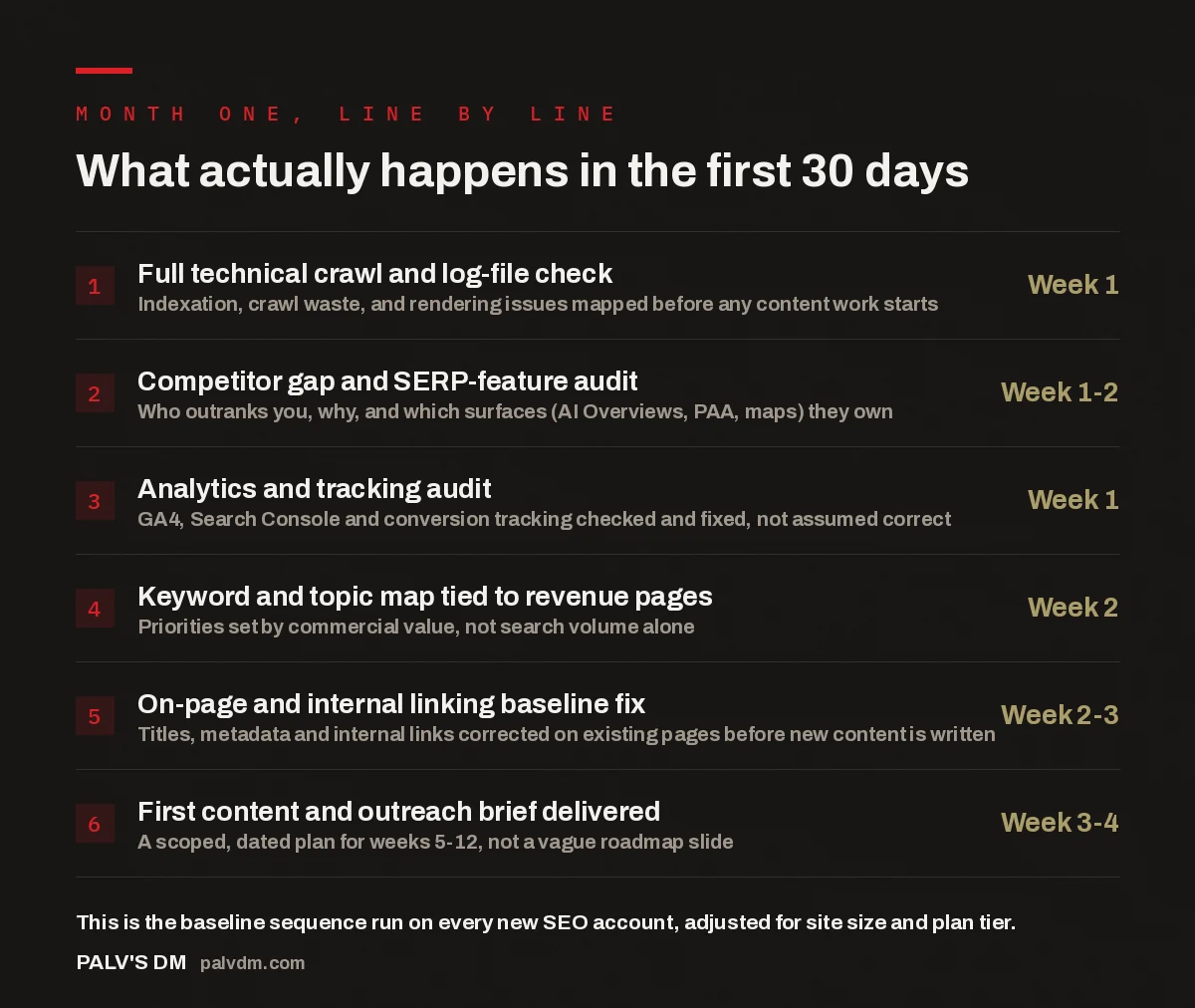
What actually happens in the first 30 days
- Full technical crawl and log-file check — Week 1. Indexation, crawl waste, and rendering issues mapped before any content work starts.
- Competitor gap and SERP-feature audit — Week 1-2. Who outranks you, why, and which surfaces (AI Overviews, PAA, maps) they own.
- Analytics and tracking audit — Week 1. GA4, Search Console and conversion tracking checked and fixed, not assumed correct.
- Keyword and topic map tied to revenue pages — Week 2. Priorities set by commercial value, not search volume alone.
- On-page and internal linking baseline fix — Week 2-3. Titles, metadata and internal links corrected on existing pages before new content is written.
- First content and outreach brief delivered — Week 3-4. A scoped, dated plan for weeks 5-12, not a vague roadmap slide.
Why does month one look slow compared to what agencies promise?
Because most of what actually moves rankings later depends on data that doesn’t exist yet on day one. You cannot prioritise keywords sensibly until you know which pages already have some authority and which are invisible to Google. You cannot brief a writer until you know what’s ranking above you and why. You cannot trust a traffic report until you’ve confirmed GA4 and Search Console are tracking the right events on the right pages — and on a surprising number of sites we inherit, they aren’t. Skipping straight to “publish content” without this groundwork isn’t a shortcut. It’s a guess dressed up as a plan.
A site with broken canonical tags, duplicate category pages, or a crawl budget wasted on faceted filter URLs will not benefit from ten new articles. The new pages either don’t get crawled promptly, get indexed against the wrong canonical, or compete with existing pages for the same query. That’s the pattern that shows up repeatedly on accounts we take over from a previous agency: content volume without a fixed foundation underneath it.
What does the technical and analytics audit actually check?
The technical crawl looks at indexation status page by page — which URLs Google has actually indexed versus which ones return “crawled, not indexed” or “discovered, not indexed” in Search Console. It checks canonical tags, redirect chains, robots.txt rules, XML sitemap accuracy, Core Web Vitals, and whether JavaScript-rendered content is actually visible to crawlers. On larger sites, a log-file review shows how Googlebot is actually spending its crawl budget, which is often different from what the sitemap suggests it should be spending.
The analytics side is separate and just as important. We check that GA4 events map to real conversions, that Search Console is verified against the right property (a common gap: only the non-www or only the HTTPS version verified, missing half the data), and that goal tracking hasn’t silently broken after a past site migration. Reporting on the wrong numbers for eleven months is worse than reporting late.
How does competitor and keyword research work in month one?
Keyword research in month one isn’t a spreadsheet of search volumes. It starts with the competitors who are already ranking for the terms that would move your revenue, and works backward from there: what pages of theirs are ranking, what those pages cover that yours don’t, and which SERP features (AI Overviews, People Also Ask, local map packs, video carousels) are already claimed by someone else. That last part matters more each year — a keyword with high volume but a SERP dominated by an AI Overview and three established brands is a different bet than a keyword with a genuinely open field.
From that competitive picture, we build a keyword and topic map tied directly to the pages that generate revenue — service pages, product pages, booking pages — rather than a generic blog calendar. If you want the fuller version of how the ranking logic behind that gets built, we’ve written separately about how we choose which keywords to chase first.
Every agency says month one is “onboarding and research.” Most of them mean a kickoff call and a template audit they run on every client regardless of what’s actually broken on that site. Ours means we can point to the specific page, the specific redirect, the specific tracking gap — and explain why fixing it comes before anything else.
Palash, Founder, PalV’s DM
What on-page fixes happen before any new content is written?
Most sites already have pages that rank somewhere between position 8 and position 25 — close enough to move with a fix, far enough that nobody notices them. Month one includes going through existing pages and correcting titles that don’t match search intent, meta descriptions that were never written (WordPress default excerpts, in a lot of cases), heading structures that skip from H1 straight to H4, and internal links that point everywhere except the pages that actually need authority.
This is deliberately unglamorous work, and it’s also usually the fastest lever available. A page already earning some trust from Google, with a corrected title tag and better internal linking, can move faster than a brand-new page starting from zero — because it isn’t starting from zero. New content still gets planned in month one; it just gets written to a brief informed by the audit, not published on instinct in week one before anyone knows what’s actually missing.
What should be in the plan by the end of month one?
By day 30, a client should have a dated brief covering weeks five through twelve — not a slide that says “content, links, technical, repeat.” The brief should name which pages get built or rewritten first, which keywords they target and why, what internal linking changes support them, and what outreach or digital PR angles are being pursued for which pages. If a plan can’t survive being read by someone outside the agency who checks whether the dates and priorities actually make sense, it isn’t a plan yet.
This is also where month one connects to what comes after it. The audit and keyword map done in the first thirty days are the inputs for the next stretch of work, not a one-off report that gets filed away. We’ve written in more detail about how we decide what goes into a client’s first 90 days, and about how a weekly SEO sprint actually runs once the plan is in motion.
Why do some agencies skip this stage?
Partly incentive, partly capability. A full technical crawl, a log-file review, and a manual competitor audit take real analyst time and don’t produce anything a client can screenshot and feel good about in week one. Publishing five blog posts does. So does a “we’ve already started building links” update. Agencies running thin margins on a large client roster often can’t afford the analyst hours a proper month-one audit takes, so they run a templated checklist instead — the same audit format regardless of whether the site is a 12-page local business or a 400-page e-commerce catalogue.
The other reason is simpler: some agencies genuinely don’t have anyone senior enough to read a log file or interpret a Search Console coverage report properly, so they skip straight to the parts of SEO that don’t require that skill — content and basic link building. That gap tends to surface around month four or five, when rankings plateau and nobody can explain why, because nobody actually knows what’s happening at the technical layer. If you want to see what’s typically bundled into ongoing work once month one is done, what’s actually included in a monthly SEO retainer covers that in full.
If you’re evaluating an SEO agency
- Ask what’s specifically included in the first 30 days, not just “onboarding and audit.”
- Ask to see a sample of an actual technical or analytics finding, not a generic checklist.
- Ask when you’ll receive a dated plan for weeks five through twelve, and hold them to that date.
What are the standard SEO first month deliverables?
A full technical crawl and indexation check, an analytics and tracking audit, a competitor and SERP-feature analysis, a keyword map tied to revenue pages, on-page fixes to existing pages, and a dated content and outreach plan for the following two to three months. New published content is planned in month one but usually goes live from month two onward, once it’s briefed against real findings.
Should I expect ranking movement in month one?
Not much, and be wary of anyone who promises it. Some early movement can happen from quick on-page fixes to pages that were already close to ranking, but the bulk of month one is diagnostic work that sets up movement in the months after. Sites with major technical issues sometimes see visible gains once those are fixed, simply because previously unindexed or miscategorised pages start being crawled correctly.
Why not just start publishing content in week one to build momentum?
Because content published before the technical and keyword groundwork is done is more likely to be misdirected — targeting the wrong terms, competing with existing pages, or getting stuck behind unresolved crawl and indexation issues. It creates the appearance of activity without necessarily creating results, and it’s harder to course-correct once a batch of pages is already live.
How long does the month-one audit actually take?
Roughly the full first month, though the depth scales with site size. A small local-business site with a dozen pages can have its technical and keyword audit substantially done inside two weeks, leaving more of month one for on-page fixes. A large e-commerce or SaaS site with hundreds of URLs typically needs the fuller thirty days, since log-file analysis and page-by-page indexation checks take longer at scale.
What happens if my analytics turn out to be broken?
It gets fixed before it gets reported on, and you’re told exactly what was wrong and for how long. This comes up more often than most business owners expect — a tracking gap from a past redesign, a conversion event firing on the wrong page, or a Search Console property that was never fully verified. Reporting against broken tracking just compounds the problem into month two and beyond.
Short version: the real SEO first month deliverables are a technical audit, an analytics check, a competitor and keyword map, on-page fixes to what already exists, and a dated plan for the months after — not a burst of new content published before anyone knows what’s actually wrong with the site. If an agency’s month-one pitch is mostly about how much they’ll publish in week one, ask what they checked before deciding to publish it.