What’s Actually Included in a Monthly SEO Retainer
A clear breakdown of what is included in SEO services each month: technical work, content, links, AI visibility work, and reporting, plus what's excluded.

What is included in SEO services from a proper monthly retainer breaks down into five buckets: technical fixes, content work, authority (link) building, AI visibility checks, and reporting that shows what actually happened. If a retainer only covers one or two of these — usually content and a vague “optimisation” line — you’re paying for a fraction of the work and calling it the whole thing. Below is what should show up on your invoice’s description line every single month, and what’s fair to leave out.
Key takeaway
- A real SEO retainer covers technical health, content, authority building, AI visibility, and monthly reporting — not just “we’ll write some blogs and check rankings.”
- What’s excluded matters as much as what’s included: paid ads, web design overhauls, and generic social media management usually sit outside an SEO scope, and a retainer that quietly bundles them in is often diluting the actual SEO work.
- The mix of technical, content, and authority work should shift as a site matures — early months lean technical and foundational, later months lean into content depth and authority.
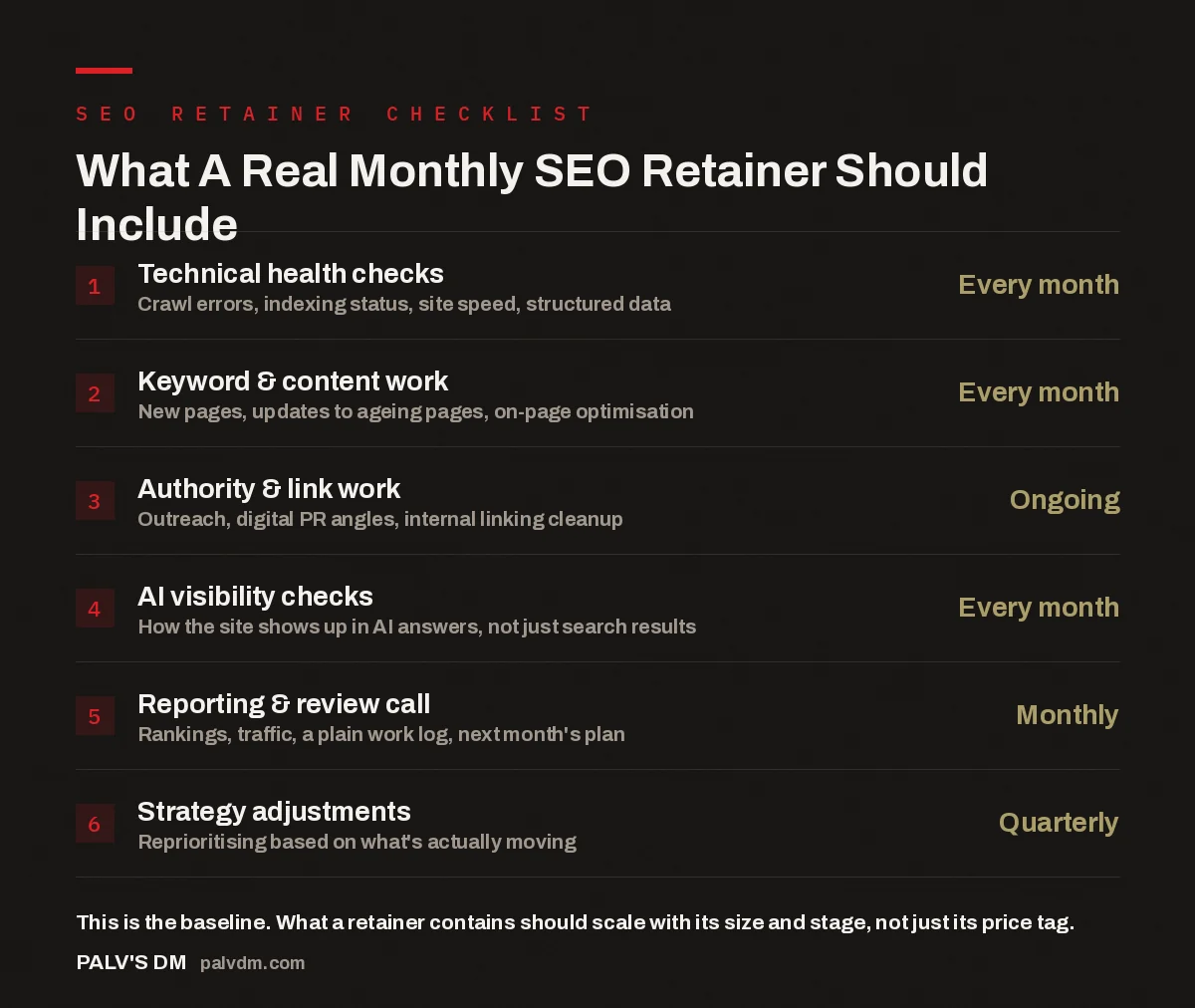
What A Real Monthly SEO Retainer Should Include
- Technical health checks — Every month. Crawl errors, indexing status, site speed, structured data.
- Keyword & content work — Every month. New pages, updates to ageing pages, on-page optimisation.
- Authority & link work — Ongoing. Outreach, digital PR angles, internal linking cleanup.
- AI visibility checks — Every month. How the site shows up in AI answers, not just search results.
- Reporting & review call — Monthly. Rankings, traffic, a plain work log, next month’s plan.
- Strategy adjustments — Quarterly. Reprioritising based on what’s actually moving.
What does a typical month of SEO work actually cover?
A month of SEO work should touch the site itself, the content on it, the site’s standing relative to competitors, and how it shows up beyond the traditional blue links. That means technical maintenance (so the site can be crawled and indexed properly), content production or refreshes (so there’s something worth ranking), authority-building (so search engines trust the domain enough to rank it), and increasingly, checks on how the brand appears in AI-generated answers. None of these run on their own — a technical fix without content has nothing to rank, and content without technical health can get published and never get indexed.
The proportion of each shifts depending on where the site is in its lifecycle. A brand-new site or one recovering from a bad build usually needs more technical and foundational work in its early months. A site with a clean technical base and a content backlog needs more writing and page-level optimisation. A site that’s technically fine and well-written but stuck on page two usually needs authority work — links, mentions, and internal linking — more than either of the other two.
What technical work is included every month?
Technical SEO work in a monthly retainer should include a crawl of the site to catch broken links, redirect chains, duplicate pages, and indexing errors — the kind of issues that quietly stop good content from ever showing up in search. It should also include a check on site speed (particularly on mobile, since that’s how most search traffic arrives), a look at structured data (schema markup) to confirm search engines and AI crawlers can parse what a page is actually about, and a review of the robots.txt and XML sitemap to make sure nothing important is accidentally blocked.
This isn’t a one-time audit repeated for appearances — a competent retainer treats technical health as ongoing maintenance. Sites change: a developer pushes an update, a plugin breaks a template, a migration leaves old URLs unredirected. Technical SEO in month six should look different from month one because it’s responding to what actually changed, not running the same checklist on autopilot.
What content work should be in the retainer?
Content work should include both new pages built around keywords the site doesn’t currently rank for, and updates to existing pages that rank on page two or three but haven’t been touched in a while. Most agencies default to only the first — new blog posts every month — because it’s easier to show as a “deliverable.” But updating a page that already has some authority and traffic is often the faster path to a ranking improvement than starting from zero.
On-page optimisation belongs here too: title tags, meta descriptions, header structure, internal links from relevant existing pages, and — increasingly — making sure a page answers the underlying question clearly enough that an AI system summarising search results can lift the answer accurately. This last part matters more each year as AI-generated answers sit above traditional results for a growing share of queries. A page that’s stuffed with keywords but never actually answers the question plainly is losing visibility in both traditional search and AI answers at the same time.
For a closer look at how we sequence this content work in a client’s earliest months, see how we decide what goes into a client’s first 90 days.
Where does link building and authority work fit in?
Authority work covers anything that builds the site’s credibility beyond the content on the page itself: earning links from other relevant sites, digital PR angles that get a brand mentioned in industry coverage, and — often overlooked — internal linking, where existing pages on the same site link to each other in a way that signals which pages matter most. Internal linking is the cheapest form of authority work available and it’s routinely skipped because it doesn’t look impressive on a report.
What shouldn’t be in this bucket is bulk, low-quality link building — paid link networks, directory submissions, or guest posts on sites with no real audience. These tactics can create short-term ranking bumps and long-term risk, and a retainer that leans on them because they’re cheap to deliver is optimising for the invoice, not the client’s site. Real authority work is slower and harder to package into a neat monthly count, which is exactly why it’s worth asking an agency directly how they build links before signing anything.
The retainers that fall apart aren’t the ones doing too little — they’re the ones doing one thing well and calling it everything. Content-only, links-only, technical-only. A real SEO retainer has to move all three levers, because a site doesn’t rank on any single one of them.
Palash, Founder, PalV’s DM
What reporting should you receive, and how often?
A monthly SEO retainer should come with a monthly report and, ideally, a short review call — not just an automated dashboard link. The report should cover where rankings moved (up and down, not just wins), organic traffic trends, a plain-language log of what work was actually done, and what’s planned next. If a report only shows rankings without a work log next to it, there’s no way to connect cause and effect — you can’t tell whether a change came from the agency’s work, an algorithm update, or something a competitor did.
We’ve written a separate, more detailed breakdown of what’s in every monthly update we send clients, including how we handle months where rankings genuinely don’t move.
What’s usually not included, and why that matters?
Paid advertising (Google Ads, Meta Ads) is a separate discipline with its own budget, and shouldn’t be bundled into an SEO retainer unless it’s explicitly priced as an add-on. A full website rebuild is also usually out of scope — a retainer might recommend structural or UX changes, but building them is typically a separate project. Generic social media posting, unrelated to SEO or content distribution, is another common bundle-filler that dilutes the hours actually going into search work.
Knowing what’s excluded is as useful as knowing what’s included, because it tells you where an agency’s actual focus sits. A retainer priced like a full-service marketing package but delivered by one person doing SEO part-time usually means thin coverage everywhere rather than solid coverage of search. It’s worth asking directly what an agency won’t do as part of a plan — we’ve laid out our own boundaries in what we will not do, and why.
How do inclusions change as the retainer grows?
A smaller retainer, working on a smaller site, naturally covers fewer pages and fewer link targets per month, but it shouldn’t drop entire categories of work — it should just do less volume within each one. A larger retainer, typically for a bigger site or a more competitive niche, adds more content velocity, more link and authority work, and more granular technical work (things like log file analysis or deeper structured data implementation that only make sense once the basics are solid).
What a retainer includes should also shift with the site’s own history. A site with years of undocumented, inconsistent past SEO work often needs a first phase of cleanup before new content or link building will show much return — pushing hard on new content while ignoring a messy technical foundation tends to waste the budget. A business’s own priorities change too: a founder with no time to manage marketing needs a retainer weighted toward autonomous execution and clear monthly summaries, while a team with in-house capacity might want the agency to focus narrowly on the technical and strategic layers. Who’s actually doing this work each month matters too — see who works on your account and what each person does.
Inclusions also shift in the first month itself. Most agencies run a lighter version of the standard monthly work in month one, even though month one is usually when the biggest structural problems get found and fixed. We’ve covered what we do in month one that most agencies skip in more detail — it’s often the difference between a retainer showing movement by month three and one still finding its footing by month six.
Check your own retainer against this
If your current SEO plan only shows content deliverables or only shows a ranking chart, you’re likely missing the technical, authority, or AI visibility work that makes the content and rankings sustainable. A free audit will show you exactly what’s covered and what’s missing in your current setup.
Frequently asked questions
What is included in SEO services at the most basic level?
At minimum, a monthly SEO retainer should include technical health checks (crawl errors, indexing, speed), content work (new pages and updates to existing ones), authority building (links and internal linking), and a monthly report showing what was done and what changed. Anything narrower than this is covering part of SEO, not the whole discipline.
How many blog posts or pages should be included per month?
There’s no universal number — it depends on the retainer size and the site’s competitive landscape. What matters more than a fixed count is whether content work also includes updates to existing pages, not just new ones, and whether each piece is tied to a keyword or topic the site is genuinely trying to win, not just filler for the sake of a deliverable count.
Should AI visibility work be part of an SEO retainer now?
Yes, in some form. As AI-generated answers take up more space above traditional search results, checking whether a site’s content is structured clearly enough to be cited or summarised accurately is now a reasonable part of an SEO scope, even if it isn’t the majority of the work yet. If a retainer makes no mention of it at all, ask directly how it’s being handled.
Why do two agencies quote similar prices but include very different work?
Pricing alone doesn’t tell you the mix of technical, content, and authority work behind it — one agency might spend most of the retainer on content production with almost no technical or link work, while another splits it more evenly. Ask for a specific breakdown of what’s done monthly, not just a total hours or deliverables number.
What should I ask before signing an SEO retainer?
Ask what’s covered each month across technical, content, and authority work; how link building is actually done; what the monthly report looks like and whether it includes a work log; and what’s explicitly excluded from the scope. An agency that can answer all four clearly and specifically, without vague language, is usually one that’s actually doing the work described.
Short version: a genuine monthly SEO retainer includes technical maintenance, content creation and updates, authority and link work, AI visibility checks, and a clear monthly report tying the work to what changed. What’s excluded — paid ads, full site redesigns, generic social posting — is just as telling as what’s included. If your current plan can’t be broken down into these categories with specifics attached, it’s worth asking your agency to walk through exactly what you’re paying for each month.