Who Works on Your Account and What Each Person Does
SEO team roles explained: the account lead, strategist, writer, technical SEO, outreach, and QA that run a working retainer, and how to spot a real one.

Most SEO retainers list “your team” as a single line on a proposal, but a working account is actually run by a small set of distinct SEO team roles: an account lead who owns the strategy and the relationship, a strategist who decides what gets prioritised, a writer who drafts and edits the pages, a technical SEO who fixes what’s broken under the hood, someone running outreach when link earning is part of the plan, and a reporting/QA layer that checks the work before it reaches you. On smaller retainers, one person often wears two or three of these hats. On larger ones, each role is a different person. Either way, knowing who does what is the fastest way to tell whether an agency is actually staffed to deliver, or just staffed to sell.
Key takeaway
- A real SEO account is run by six functions — account lead, strategist, writer, technical SEO, outreach, and reporting/QA — even when fewer than six people fill them.
- The account lead is your single point of contact; if you can’t get a straight answer about who that is before you sign, that’s a signal in itself.
- Smaller retainers combine roles across fewer people — that’s not a red flag by itself, but it changes what you should expect in terms of turnaround and depth.
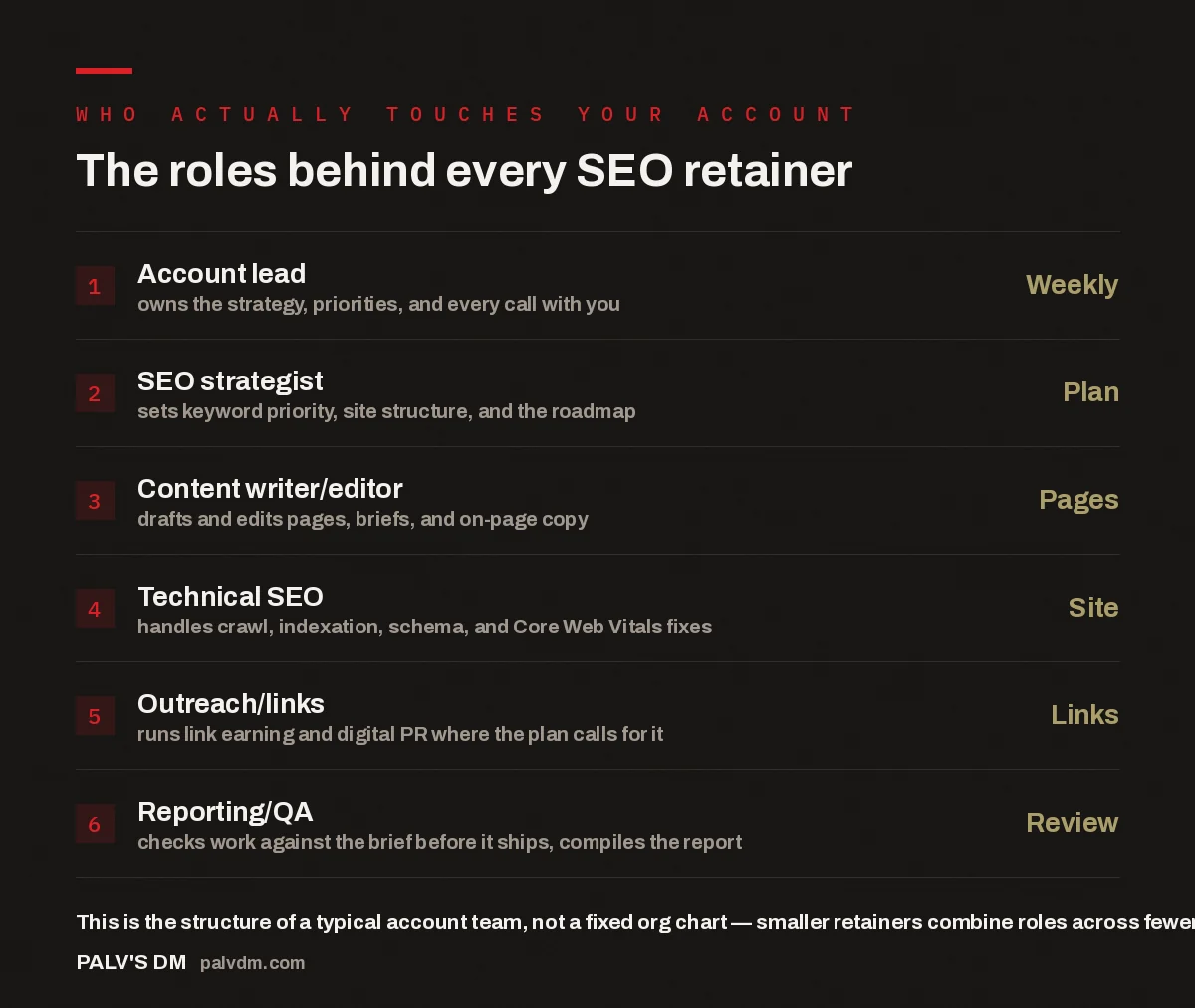
The roles behind every SEO retainer
- Account lead — Weekly. owns the strategy, priorities, and every call with you.
- SEO strategist — Plan. sets keyword priority, site structure, and the roadmap.
- Content writer/editor — Pages. drafts and edits pages, briefs, and on-page copy.
- Technical SEO — Site. handles crawl, indexation, schema, and Core Web Vitals fixes.
- Outreach/links — Links. runs link earning and digital PR where the plan calls for it.
- Reporting/QA — Review. checks work against the brief before it ships, compiles the report.
Who is the account lead, and what do they actually own?
The account lead is the person you actually talk to — the one on your monthly call, the one who answers when you email asking why a page dropped, the one who’s accountable if the plan isn’t working. Their job isn’t to write or fix anything themselves; it’s to hold the whole account together so nothing falls between two specialists. They own the priority list, they’re the one who says no to a request that would derail the roadmap for a small, unimportant win, and they’re the one who has to explain, in plain language, why a technical fix took three weeks instead of one.
This is also the role most likely to be missing on cheap or badly staffed retainers. If a proposal doesn’t name a specific person as your point of contact — if every email comes from a shared inbox and every call is with whoever’s free — there’s a good chance nobody actually owns the account. That’s worth asking about directly before signing: who is my account lead, and what’s their background in SEO specifically, not marketing generally.
What does an SEO strategist actually decide?
The strategist decides what gets worked on and in what order — which keywords are worth chasing given the site’s current authority and competitive set, which pages need a structural rework versus a light edit, and where the site’s architecture is quietly working against it. This is the role that turns a keyword list into a sequence of actual work, and it’s the one that determines whether a retainer feels focused or scattered. A good strategist can explain, for any piece of work in a given month, why it’s happening now and not later.
On smaller accounts, the account lead and the strategist are frequently the same person — one senior SEO who both plans the work and manages the relationship. That’s a normal and often efficient setup, not a shortcut, as long as that person has the technical depth to actually prioritise well and isn’t just relaying a checklist that’s identical across every client.
Who writes and edits the content, and how closely do they work with the strategist?
The writer takes a content brief — target keyword, search intent, the questions a page needs to answer, competing pages already ranking for it — and turns it into a page that’s actually useful to a reader, not just stuffed with the target phrase. On accounts with real content volume, there’s usually a separate editor who checks drafts against the brief before publishing: is the intent actually answered, does the page say something a competing page doesn’t, is it factually accurate, does the structure match how the topic is naturally searched.
The writer and strategist need a tight feedback loop, because content briefs go stale fast — a keyword’s competitive set shifts, a client’s product changes, a page that made sense to write six weeks ago might need reprioritising today. When those two roles don’t talk to each other regularly, you get pages published against briefs that were accurate when written but wrong by the time they went live.
What does the technical SEO role cover that content roles don’t?
Technical SEO is the plumbing: making sure search engines can crawl the site efficiently, that important pages are indexed and unimportant ones aren’t wasting crawl budget, that structured data (schema) is implemented correctly so pages are eligible for rich results, and that Core Web Vitals — load speed, interactivity, visual stability — aren’t quietly capping how well otherwise-good content can perform. None of this is visible to a reader looking at a published page, which is exactly why it gets skipped by agencies that only staff for content.
This role matters more on some sites than others. A ten-page brochure site has a small technical surface area. A five-hundred-page e-commerce catalogue or a site built on a platform with known quirks has a large one, and without someone specifically responsible for it, technical issues accumulate quietly until a migration or a platform update surfaces them all at once.
Who handles outreach and link earning, and is it always part of the account?
Not every retainer includes active outreach — for sites in a strong position already, or for early-stage plans focused on on-page and technical fixes first, links aren’t the immediate priority. Where outreach is part of the plan, it’s typically a distinct role from content writing, because pitching a piece of coverage or a resource to another site is a different skill from writing an on-page article: it’s part research (who would plausibly link to this and why), part outreach copywriting, and part relationship follow-up over weeks.
If link earning is on your plan, ask specifically what “outreach” means in practice — how many pitches typically go out, what a realistic response rate looks like, and whether the person doing it is working your account alongside a dozen others or has real bandwidth for it. Vague promises of “we’ll build links” without a named person and a described process are usually a sign the work isn’t actually staffed, just budgeted for.
Who checks the work before it reaches you?
This is the role most agencies skip entirely, and it’s the one that catches the most avoidable mistakes: a page published against the wrong keyword, a schema markup error that would have made a page ineligible for rich results, a report that overstates a ranking win the data doesn’t actually support. QA is a second set of eyes that isn’t the person who did the original work — because everyone, including senior strategists, misses their own errors more often than someone else’s.
The same function usually compiles the monthly report, which is a natural pairing: the person checking work against the brief all month is well placed to summarise what actually shipped and why it matters, rather than a generic template that gets filled in without anyone verifying it against the real work.
The fastest way to judge an SEO proposal isn’t the price on it — it’s whether the person pitching you can name who, specifically, will do the work, and describe what they’ll actually be doing week to week.
Palash, Founder, PalV’s DM
How many people should actually be working on a smaller retainer?
On a smaller monthly retainer, it’s normal and often sensible for one senior generalist to cover the account lead, strategist, and technical SEO roles, with a dedicated writer handling content and a shared QA pass before anything ships. That’s not understaffing — it’s appropriate staffing for the scope. What matters isn’t the headcount, it’s whether every one of the six functions is genuinely covered by someone who’s actually doing it, versus quietly dropped because nobody’s job description includes it.
The pattern worth watching for is a retainer priced for a small team where, in practice, one person tries to cover all six functions with no time left for QA or technical depth. That’s usually where quality erodes first — briefs that don’t get double-checked, technical issues that don’t get caught early, a report that’s really a status update dressed up as analysis. Asking how the roles map to actual people on your specific plan size is a fair question at any stage of a client relationship, not just before signing.
Understanding these roles also makes it easier to read what’s actually included in a retainer and how the weekly work gets sequenced — see what’s actually included in a monthly SEO retainer and how a weekly SEO sprint actually runs for the mechanics behind who does what and when. The reporting layer this team produces is covered in more detail in how we report: what’s in every monthly update, and the internal process documents that keep these roles coordinated are described in the workbooks behind our SEO delivery.
Want to know exactly who’d work on your account?
We’ll tell you, by name and role, before you sign anything — not after.
FAQ
How many people work on a typical SEO account?
It depends on the retainer size, but the honest answer is: enough people to cover six functions — account leadership, strategy, content, technical SEO, outreach where relevant, and QA/reporting — even if that means two or three people wearing multiple hats rather than six separate specialists.
Is it a problem if one person covers multiple SEO roles?
Not by itself. Combining roles is normal on smaller retainers and can mean faster decisions since fewer people need to align. It becomes a problem when the combined role leaves no time for a second set of eyes on the work, or when technical depth gets sacrificed because the same person is also writing content and managing the relationship.
What should I ask an agency before signing, based on their team structure?
Ask who your specific account lead will be, whether that person has hands-on SEO experience or is primarily a salesperson, who checks work before it’s delivered, and whether the technical SEO function is covered by a named person or bundled loosely into “the team.” Vague answers to any of these are worth pressing on.
Do freelancers offer the same range of SEO roles as an agency?
Rarely all of them at a consistently high level. A skilled freelancer can genuinely cover strategy and technical work well, but writing, outreach, and independent QA are harder for one person to do at volume without either slowing down or letting quality slip on at least one function.
Does the team change as an SEO plan grows?
Yes, typically. As scope grows — more pages, more competitive keywords, active outreach — roles that were combined tend to split into dedicated people, most often technical SEO and outreach splitting off first, since those require the most specialised, uninterrupted focus.
Short version: a working SEO account is run by six functions — account lead, strategist, writer/editor, technical SEO, outreach, and reporting/QA — whether that’s six people or two people covering multiple roles well. The staffing model itself isn’t the red flag; not being able to name who’s doing the work is.