SEO for a Site With No Content Team
Running SEO without writers is possible: shift from a content calendar to technical fixes, schema, and mining existing material for pages that already rank.

Yes, you can run SEO without writers — but not by cutting content out of the plan. The fix isn’t to skip content; it’s to change where it comes from. Agencies run SEO for sites with zero in-house writers all the time, by pulling structured material out of what the business already produces — product specs, support tickets, sales call notes, technical documentation — and shaping it into pages that both search engines and AI answer engines can read. “SEO without writers” doesn’t mean SEO without content. It means content assembled from existing knowledge instead of commissioned from a blog calendar you don’t have the staff to run.
Key takeaway
- Having no content team isn’t a blocker for SEO — it changes where content comes from (existing docs, support tickets, product data) rather than removing content from the plan entirely.
- Technical SEO, schema markup, internal linking, and page structure recover meaningful ranking ground, and none of it depends on word count or a writer’s calendar.
- The honest ceiling without any writing capacity is a stable, well-optimised core site — not a growing content library that keeps outrunning competitors who do publish.
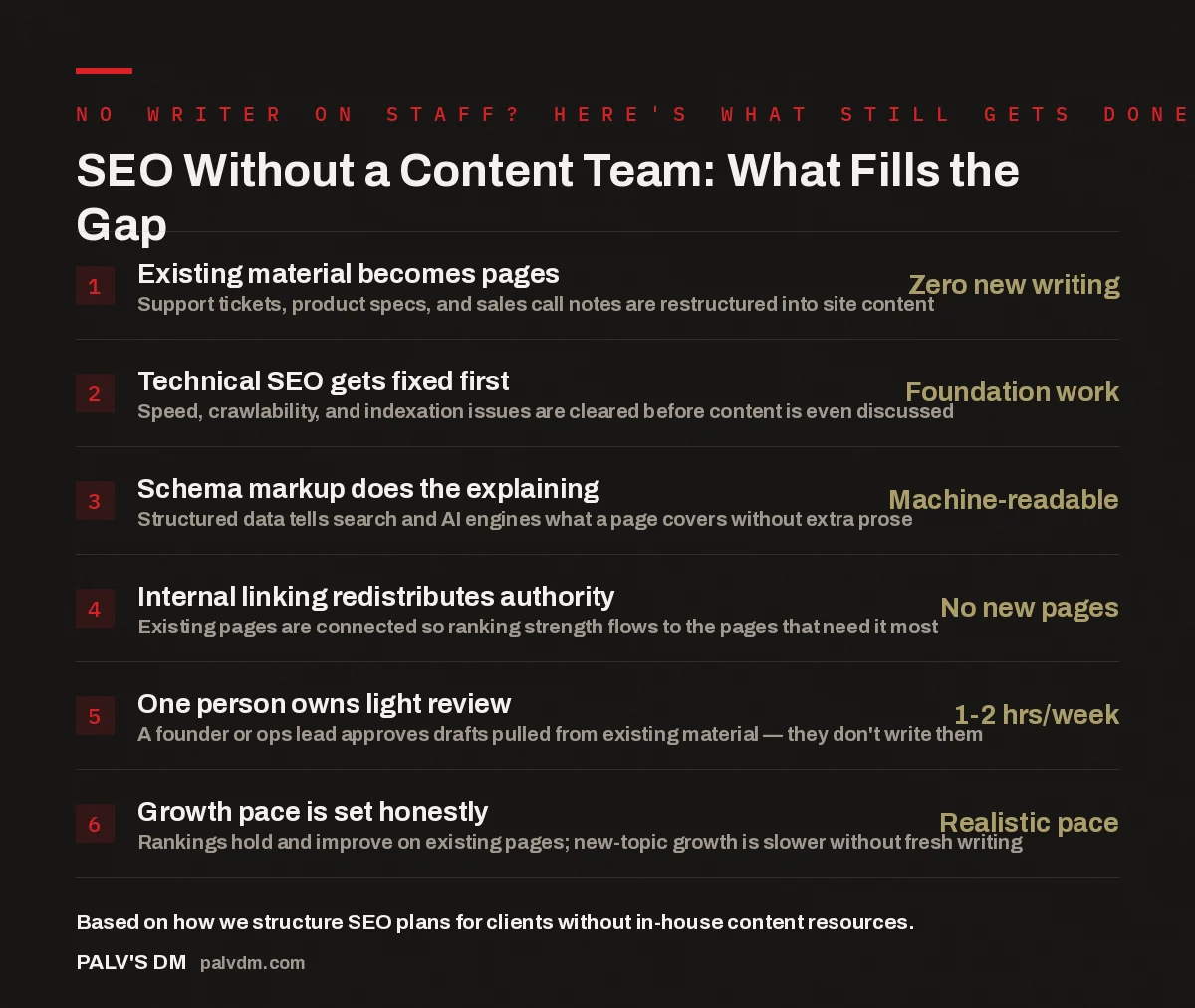
SEO Without a Content Team: What Fills the Gap
- Existing material becomes pages — Zero new writing. Support tickets, product specs, and sales call notes are restructured into site content.
- Technical SEO gets fixed first — Foundation work. Speed, crawlability, and indexation issues are cleared before content is even discussed.
- Schema markup does the explaining — Machine-readable. Structured data tells search and AI engines what a page covers without extra prose.
- Internal linking redistributes authority — No new pages. Existing pages are connected so ranking strength flows to the pages that need it most.
- One person owns light review — 1-2 hrs/week. A founder or ops lead approves drafts pulled from existing material — they don’t write them.
- Growth pace is set honestly — Realistic pace. Rankings hold and improve on existing pages; new-topic growth is slower without fresh writing.
What does “no content team” actually mean for SEO?
Most businesses that say “we have no content team” don’t mean they have no expertise — they mean nobody’s job title includes the word “writer.” That’s a different problem. A founder answering the same five questions on every sales call is producing raw content daily; it just isn’t written down where a search engine can crawl it. A support inbox full of the same three troubleshooting threads is a ready-made FAQ page nobody has assembled. The gap usually isn’t a lack of expertise or material — it’s a lack of the specific time and skill needed to turn spoken or scattered knowledge into a structured web page.
That distinction changes the plan. If the real problem were “this business knows nothing worth publishing,” no amount of agency effort would fix it. But that’s rarely the case. The actual problem is almost always structural: the knowledge exists inside emails, call recordings, WhatsApp threads, and one person’s head, and none of it has been extracted, organised, and put on a page with proper headings and internal links pointing to it.
How does SEO work without an in-house writer?
SEO without writers leans on levers that don’t require producing new prose on a schedule. In practice, this is what fills the gap where a content calendar would normally sit:
- Technical SEO fixes. Page speed, crawl errors, broken internal links, and indexation gaps are worth ranking points that have nothing to do with content volume. On most sites we take on, this alone accounts for a meaningful share of the recoverable gains in month one.
- On-page optimisation of pages that already exist. Service, product, and category pages usually have headings and body copy never properly matched to what people actually search for. Restructuring what’s already live isn’t “writing new content” in the blog-calendar sense — it’s editing.
- Schema markup. Structured data (FAQ, product, service, review schema) tells search engines and AI answer engines exactly what a page covers, in a format they parse directly. It multiplies the value of the copy you already have.
- Mining existing material. Support tickets, onboarding documents, and sales notes are functionally a first draft. Someone still has to extract and structure them, but that’s editing existing knowledge, not generating new expertise from nothing.
- Internal linking and information architecture. Redistributing authority across existing pages — linking your highest-authority page to the money pages that need it — is pure structural work requiring zero new words.
- Listings, citations, and review management. For local and service businesses especially, Google Business Profile optimisation and review responses build relevance signals without a single blog post.
None of this is a workaround or a lesser version of “real” SEO. For many small and mid-sized sites, this is where most of the available ranking improvement sits untouched, because the previous approach assumed the only lever was publishing more articles.
The businesses that think they can’t do SEO because they don’t have a writer are usually one interview away from having more content than they need — they just don’t recognise it as content yet.
Palash, Founder, PalV’s DM
What can you realistically achieve without a writer, and what can’t you?
Set expectations honestly, because this is where most disappointment with SEO comes from. Without any writing capacity — in-house or agency-provided — you can realistically stabilise and improve rankings for pages that already describe what you sell, close technical gaps competitors haven’t bothered fixing, and capture search demand from people who already know your category exists. What you can’t do is compete for long-tail informational queries that require a growing library of answers — “how does X compare to Y,” “what does X cost in [city],” “is X worth it for [use case]” — because those pages don’t exist yet, and someone has to write them.
Businesses hurt most by having no content capacity are the ones competing where rivals publish regularly. If competitors are shipping new comparison and buying-guide pages every month and you’re shipping zero, the coverage gap compounds — not because your existing pages get worse, but because theirs keep multiplying the number of queries they can be found for.
| Approach | What it costs you | What it gets you |
|---|---|---|
| Hire a full-time content writer | Salary and management overhead, plus time to find the right person | Steady output for broad topic coverage — often more than a small site actually needs |
| Contract writers per article | Pay per piece, revision cycles, no bench strength if one leaves | Fills specific content gaps without permanent headcount |
| Agency structures existing material | Founder or team time for interviews and approval, not writing | Content grounded in real expertise, ships without a hire, scales slowly |
| Skip content work entirely | Nothing spent now | Technical and structural SEO plateaus; publishing competitors gradually pull ahead on coverage |
What should month one look like if there’s no writing capacity at all?
A sensible first month, when there’s genuinely no one available to write, starts with the site as it exists today rather than a plan for new pages. That means a technical audit to find and fix crawl, speed, and indexation issues; a review of existing service and product pages against what people actually search for; schema markup added to pages that lack it; and one or two short structured interviews with whoever on your team fields the most customer questions — usually a founder, a salesperson, or support staff. Those interviews get turned into two or three pages answering real, recurring questions, without the interviewee writing a single word. This is close to the approach in how we decide what goes into a client’s first 90 days, and it maps onto the work we prioritise in month one that most agencies skip — technical and structural fixes that don’t depend on anyone’s writing schedule.
If you’re evaluating a retainer and wondering what’s actually included when you have no writer of your own, it’s worth checking what’s actually included in a monthly SEO retainer — content production is usually one line item among several, not the entire scope.
What are the risks of skipping content work altogether?
The main risk isn’t that your existing pages stop ranking — well-optimised pages tend to hold their ground. The risk is invisibility on everything you don’t already have a page for. AI answer engines like ChatGPT, Perplexity, and Google’s AI Overviews favour pages that directly and clearly answer a specific question. If none of your pages answer “how much does X cost,” “how long does X take,” or “is X better than Y,” you won’t get cited for those queries — not because your site is weak, but because nothing on it answers what’s being asked. It’s a slower, quieter risk than a ranking drop, and the one most site owners with no content team underestimate.
There’s also a resourcing risk worth asking about directly: some agencies quietly reduce scope when a client has no writer, without telling the client what’s being dropped. It’s worth understanding who actually works on your account and what each person does before assuming “content” was ever part of the plan you’re paying for. If you’re a founder without time to manage any of this yourself, the constraints are similar to SEO for a founder who has no time for marketing — the fix in both cases is the same: shift the work to whoever has the capacity to do it, rather than waiting for capacity that isn’t coming.
Where to start
If your site has no content team and you want a plan built around what you actually have — not a content calendar you can’t staff — that’s a scoping conversation, not a guessing game.
FAQ: SEO without a content team
Can I really do SEO without ever publishing a blog post?
Yes, for a stretch — technical fixes, on-page optimisation, schema, and internal linking can meaningfully improve rankings on existing pages without a single new blog post. What you lose without any writing is the ability to expand into new topics and queries over time, since that expansion requires new pages to exist.
What if my team can review drafts but nobody can write them from scratch?
That’s enough to work with. A short structured interview with someone who knows the subject, turned into a draft by whoever is doing your SEO, then reviewed and approved by your team, produces accurate content without requiring anyone in-house to write from a blank page.
Is a content team ever strictly required for SEO?
Not for every business. A local service business with a handful of pages can often maintain solid rankings on technical and structural work alone. A business competing in a crowded, information-heavy category — where buyers research extensively before purchasing — needs a growing set of pages over time, and that requires writing capacity from somewhere, in-house or outsourced.
Does having no content team hurt visibility in AI answers like ChatGPT or Perplexity specifically?
It hurts visibility for questions your site doesn’t already answer on a page. AI answer engines tend to cite pages that directly and clearly address a specific question. Technical SEO and schema help these engines parse what you already have, but they can’t cite a question you’ve never put a page against.
What’s the very first thing to fix if I have zero content resources?
Start with the technical audit — crawl errors, page speed, and indexation issues — since these affect every existing page at once and need no new writing at all. After that, optimising the on-page copy already live on your core service pages usually delivers the next-biggest gain for the least effort.
Short version: SEO without writers isn’t a workaround — it’s a different allocation of the same work. Technical fixes, schema, on-page optimisation, and internal linking don’t need a content team, and they usually hold more untapped ranking value than site owners assume. What a content team buys is expansion — new pages for new queries over time. Without that capacity yet, the honest plan is to fix everything that doesn’t require it first, then decide whether writing capacity is worth adding later.