SEO for a Founder Who Has No Time for Marketing
SEO for founders with no time to spare works when your role shrinks to approvals and answers—here's exactly what to delegate and what never to.

SEO for founders who have no spare hours works when the founder’s job shrinks to three things: approving direction, answering questions only they can answer, and reading a report once a month. Everything else — keyword research, writing, technical fixes, link building — has to sit with someone else entirely. If your SEO plan assumes you’ll “find time” for it every week, it’s not built for a busy founder. It’s built for a marketing hire you don’t have.
Key takeaway
- A founder-friendly SEO plan needs your input in minutes, not hours — mainly approvals and answers to questions only you can give.
- The work that eats time (research, writing, technical audits, outreach) has to be fully owned by the agency or team, not “shared” with you.
- The founder’s real risk isn’t doing too little SEO work — it’s being the bottleneck that slows down someone else’s work.
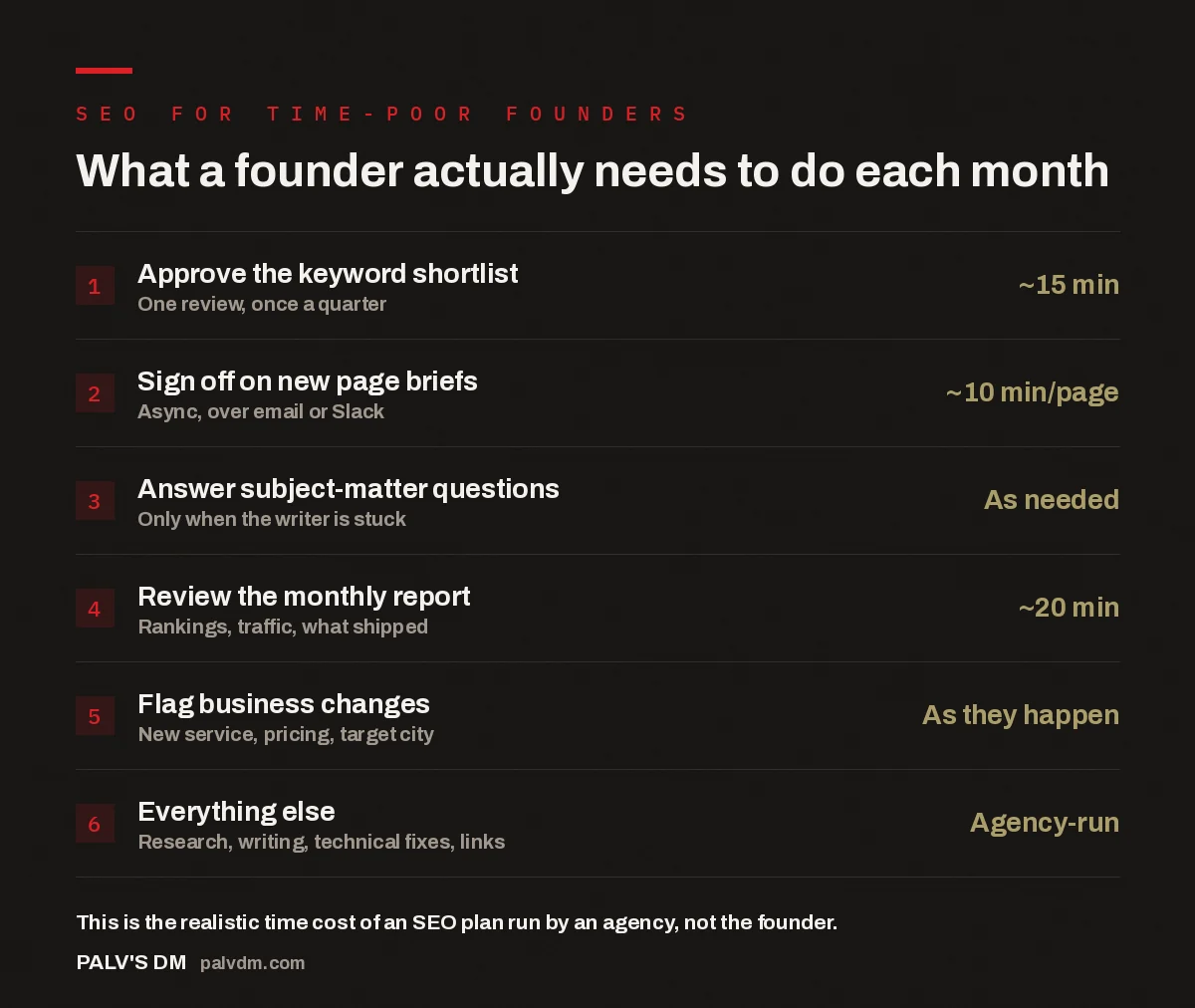
What a founder actually needs to do each month
- Approve the keyword shortlist — ~15 min. One review, once a quarter.
- Sign off on new page briefs — ~10 min/page. Async, over email or Slack.
- Answer subject-matter questions — As needed. Only when the writer is stuck.
- Review the monthly report — ~20 min. Rankings, traffic, what shipped.
- Flag business changes — As they happen. New service, pricing, target city.
- Everything else — Agency-run. Research, writing, technical fixes, links.
What does “no time for marketing” actually mean for SEO?
Most founders who say they have no time for marketing don’t mean they can’t spare fifteen minutes. They mean they can’t be the person a project depends on. If the writer needs your input to move forward, and you’re three days behind on email, the project stalls with you. That’s the actual failure mode — not lack of SEO knowledge, lack of availability to unblock other people’s work.
SEO for founders in this position has to be designed around that constraint from day one. It means the agency writes content without waiting on a founder-supplied outline. It means technical fixes get shipped and reported, not proposed and left pending for sign-off. It means the founder is asked for input only where their judgment is genuinely irreplaceable — pricing, positioning, what the business will and won’t do — and nowhere else.
How much time does SEO for founders actually require?
Structured correctly, a founder’s monthly time commitment is closer to an hour than a workweek. That hour breaks down into a handful of short, specific touchpoints rather than one long block: a quick nod on which keywords to go after this quarter, a skim of new page briefs before they go to a writer, quick answers when a writer hits a question only the founder can settle (how a service actually works, what makes the business different from the obvious competitor), and a read of the monthly report.
What eats a founder’s time isn’t SEO itself — it’s SEO run without a defined process, where every deliverable needs a meeting to move forward. A retainer built for busy founders should specify, in writing, exactly which decisions need the founder and which don’t. If that line isn’t drawn explicitly, it gets redrawn every week in whoever’s favour is loudest, and it’s usually not yours.
What should a founder personally never delegate?
A short list, deliberately kept short:
- What the business actually does and doesn’t do. No outside writer can invent this accurately — it has to come from the founder, once, and then get reused.
- Which markets or services to prioritise. An agency can rank keywords by opportunity, but only the founder knows which of those opportunities the business can actually deliver on.
- Claims that carry legal or reputational weight. Certifications, guarantees, pricing commitments — these need a founder’s sign-off, not a content writer’s assumption.
- Whether the plan still matches the business. If the business pivots or a service gets dropped, only the founder knows to say so — an agency won’t catch it on its own.
Notice what’s not on that list: writing, technical audits, backlink outreach, keyword research, competitor analysis. None of that needs a founder’s direct involvement, and treating it as if it does is usually what turns “SEO for founders” into another unpaid job.
What should be delegated completely?
Everything that requires research skill, writing time, or technical execution belongs entirely with the team doing the work — not shared, not co-owned, not “drafted by us, finished by you.” That includes finding the keywords worth targeting, writing the actual pages, fixing crawl errors and page speed issues, building internal links between pages, and pursuing backlinks. If a founder is editing drafts line by line every week, the plan has quietly reverted to the founder doing marketing with extra steps.
This is also where a lot of agency relationships go wrong for busy founders specifically. An agency that sends a blog draft “for your review and edits” every single week isn’t saving the founder time — it’s outsourcing the time cost back onto the person who had none to begin with. The review step should exist, but it should be a fast approval against an agreed brief, not a rewrite.
The founders who get the most out of SEO with the least time spent aren’t the ones who know the most about SEO. They’re the ones who know exactly which three questions only they can answer, and let everything else move without them.
Palash, Founder, PalV’s DM
What does a month look like in practice?
In a plan built for a time-poor founder, the month runs roughly like this: at the start, the agency proposes what’s shipping — which pages, which fixes, which outreach targets — based on the previous month’s data and the standing brief. The founder skims that plan once, flags anything that’s off (a service being sunset, a new city being added), and the work proceeds without further check-ins unless something genuinely needs a decision only the founder can make.
Through the month, the founder’s inbox gets the occasional specific question — never a vague “thoughts on this?” — and a report lands at the end covering what shipped, what moved in rankings and traffic, and what’s planned next. The founder reads it, asks questions if something’s unclear, and the cycle repeats. There’s no weekly call unless the founder wants one, and no pending approvals sitting in a queue for a week because nobody scheduled time to look at them.
How do you know SEO is working if you’re not watching it closely?
This is the part that makes busy founders nervous, reasonably. If you’re not in the weeds, how do you catch a plan that’s quietly drifting off track? The honest answer is that you shouldn’t need to watch closely — the monthly report should be built to surface exactly that, without requiring you to interpret a dashboard yourself. It should say, in plain language, what moved and why, what didn’t move and what’s being tried next, and whether the trajectory matches what was expected for this stage of the plan.
If a report can’t answer “is this working” in a two-minute read, the reporting is the problem, not the founder’s attention span. A founder shouldn’t have to become an SEO analyst to know whether the plan they’re paying for is on track — that translation work is part of what the retainer is for.
Where to start
If your current SEO setup needs more of your week than you have to give, the fix usually isn’t doing less SEO — it’s restructuring who owns what. That’s what our SEO plans are built around.
See how our SEO plans work for founders with no time to spare
How many hours a month does SEO realistically take for a founder?
With a properly structured plan, it’s closer to an hour spread across a few short touchpoints — approving a keyword shortlist, skimming page briefs, answering the occasional question only you can answer, and reading a monthly report. If it’s taking more than that regularly, the plan is likely relying on you for work that should sit with the agency.
Can SEO work at all if the founder can’t review every piece of content?
Yes, provided the writer has a clear brief and access to the founder for the handful of questions only they can answer. Line-by-line review by the founder isn’t a requirement of good SEO — it’s usually a sign the brief wasn’t specific enough to begin with, forcing the writer to guess and the founder to correct.
What’s the one thing a busy founder should never skip in an SEO plan?
Reading the monthly report. Everything else can be delegated without much risk, but a founder who never looks at results has no way to catch a plan that’s drifted off course, or to flag a business change — a new service, a dropped one — that the agency has no way of knowing about on its own.
Is SEO a bad fit for a founder with no marketing team at all?
No — it’s actually one of the more common situations agencies plan around. The absence of an in-house marketing team just means the agency needs to own execution fully rather than assuming a founder or a junior hire will fill gaps. What matters is whether the plan is designed for that from the outset, not retrofitted after the founder runs out of time.
How is this different from just running Google Ads instead?
Ads and SEO solve different problems and usually aren’t a substitute for one another — ads buy visibility while you’re paying for it, SEO builds visibility that stays after you stop. A founder with no time still needs someone managing either channel; the time cost isn’t unique to SEO, it’s a byproduct of not having anyone dedicated to marketing at all.
The short version
SEO for founders with no time to give isn’t a smaller version of normal SEO — it’s normal SEO with a different ownership map. The founder keeps the decisions only they can make: what the business is, what it prioritises, what it will put its name behind. Everything else — research, writing, technical work, outreach, reporting written in plain language — moves to the team doing the work. Get that split wrong, in either direction, and either the SEO stalls waiting on you, or you lose the judgment calls that keep it aimed at the right things. Related reading: how we decide what goes into a client’s first 90 days, what’s actually included in a monthly SEO retainer, what’s in every monthly update we send, and how SEO works for a site with no content team.