Which SEO Plan Fits a 10-Page Site vs a 500-Page Site
The right seo package for small website needs looks nothing like an enterprise plan. See how page count and template structure decide the SEO tier that fits.
The short answer: a 10-page site needs a foundational SEO package built around technical fixes and on-page work for the pages you already have, while a 500-page site needs a plan built around crawl budget, templated on-page rules, and indexation management across categories. The right SEO package for a small website is deliberately narrow — you don’t need a content team producing 15 articles a month if you only have 10 pages to optimise. The mistake most site owners make is picking a plan based on budget alone, when the plan should be picked based on how many pages, templates, and categories actually exist to be optimised.
Key takeaway
- Page count is the first filter for plan size — a 10-page brochure site and a 500-page marketplace need structurally different SEO work, not just “more or less” of the same thing.
- Small sites (under ~20 pages) rarely need a dedicated content team; the leverage is in technical cleanup and sharpening the pages that already exist.
- Once a site crosses into hundreds of pages, the work shifts from page-by-page fixes to template-level rules, crawl budget management, and keyword prioritisation across categories.
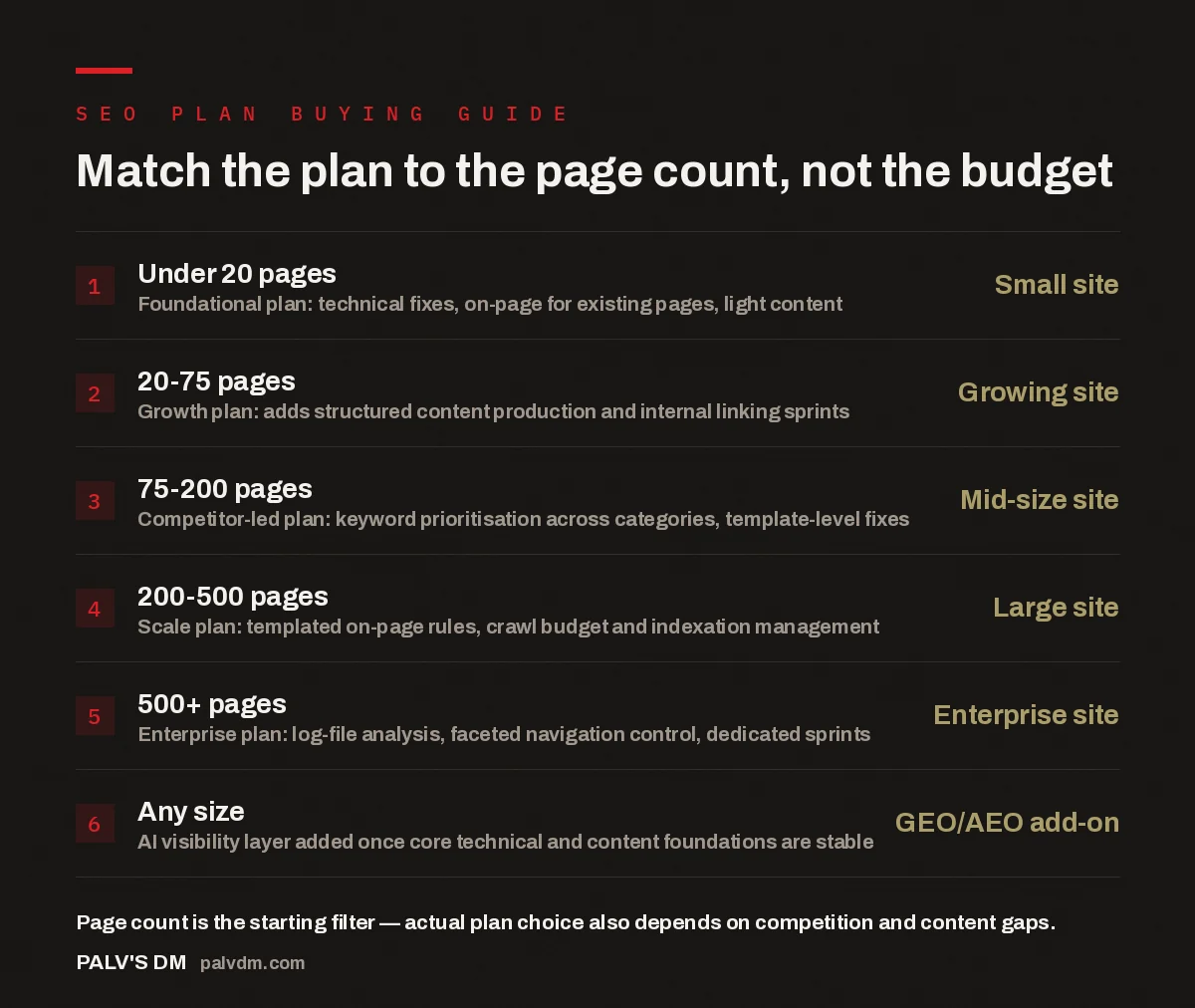
Match the plan to the page count, not the budget
- Under 20 pages — Small site. Foundational plan: technical fixes, on-page for existing pages, light content.
- 20-75 pages — Growing site. Growth plan: adds structured content production and internal linking sprints.
- 75-200 pages — Mid-size site. Competitor-led plan: keyword prioritisation across categories, template-level fixes.
- 200-500 pages — Large site. Scale plan: templated on-page rules, crawl budget and indexation management.
- 500+ pages — Enterprise site. Enterprise plan: log-file analysis, faceted navigation control, dedicated sprints.
- Any size — GEO/AEO add-on. AI visibility layer added once core technical and content foundations are stable.
How does site size change what an SEO plan needs to include?
Site size changes the unit of work. On a 10-page site, the unit of work is the page — you can look at every single URL, decide what it should rank for, and fix it individually. On a 500-page site, looking at every URL one at a time isn’t realistic, so the unit of work becomes the template: the category page template, the product page template, the blog post template. Fix the template once and it applies to hundreds of pages at once. This is the single biggest reason a “one-size-fits-all” SEO package doesn’t work well — a plan priced and scoped for page-by-page attention on a small site will barely scratch the surface of a 500-page site, and a plan built around template-level automation will be overkill and wasted spend on a 10-page site where there’s no template repetition to exploit.
The second thing that changes is where the ranking opportunity sits. On a small site, missed opportunity is usually on-page: thin title tags, missing internal links, a homepage competing with the service page it should be pointing to. On a large site, missed opportunity is more often structural — pages cannibalising each other for the same keyword, categories never mapped to search intent, or whole sections crawled inefficiently. Same discipline, different diagnosis.
What does a small site under 20 pages actually need?
A site with 10 to 20 pages — a typical services business, a local shop, a single-product startup — needs a foundational plan, not a content factory. In practice that means: fixing technical issues that block indexing or slow the site down, rewriting on-page elements (titles, headers, meta descriptions) so each existing page targets a distinct, realistic keyword instead of pages competing with each other, cleaning up internal linking so authority flows to the pages that matter commercially, and only then adding new content where there’s an actual gap — not a fixed monthly article quota. A site this size that’s paying for eight blog posts a month is usually paying for volume it doesn’t have the page architecture to support yet.
This is also the size where an agency’s instinct to “sell content” can work against the client. If a 12-page site has three pages ranking on page three of Google because the titles are generic and internal linking is thin, the fastest, cheapest fix is rewriting those three pages — not commissioning new blog posts while the existing pages sit unoptimised. A properly scoped small-site plan should show technical and on-page fixes as the majority of month one, with content added only where the keyword research shows an actual missing page.
What changes once a site crosses into the 75-to-500-page range?
Somewhere between roughly 75 and 200 pages, individual page-by-page review stops being efficient, and the plan needs to shift toward keyword prioritisation across categories rather than treating every page as equally important. Not every category can be worked on in the same month, so the plan needs an explicit method for deciding what gets attention first — usually a mix of commercial value, current ranking position, and competitive difficulty.
By the time a site reaches 200 to 500 pages, the plan needs template-level thinking baked in from the start: standardised title tag formulas by page type, internal linking rules that apply automatically as new pages are added, and crawl budget management so search engines are spending their limited crawling attention on the pages that matter rather than getting lost in filtered or duplicate URLs. This is also usually where indexation issues show up for the first time — pages that technically exist but were never properly indexed, or pages competing against near-duplicates. A plan for this size site that doesn’t include a crawl and indexation audit as a core deliverable, not an optional add-on, is under-scoped.
What does a 500-plus page site need that a smaller site doesn’t?
At enterprise scale, a few things become necessary that aren’t relevant on a small site. Log-file analysis — checking what crawlers are actually requesting, not just what’s technically crawlable — becomes worth the time because crawl budget is a real constraint at this scale in a way it isn’t for a 15-page site. Faceted navigation (filters, sort orders, tag combinations that can generate thousands of near-duplicate URLs on a marketplace or listings site) needs explicit rules for what gets indexed and what gets blocked. Reporting also has to move from “here are the pages we worked on” to “here’s how indexation and crawl efficiency are trending,” because individual page rankings are too numerous to review one by one every month.
Team structure usually changes too. A 15-page site can be handled by one person doing on-page work and light content. A 500-page site typically needs someone focused specifically on technical SEO and crawl health, running alongside whoever prioritises keywords and content.
The question we get most from prospective clients isn’t “how much does SEO cost” — it’s “how much of this plan actually applies to a site my size.” A 500-page enterprise plan sold to a 12-page business is padding. A 12-page foundational plan sold to a 500-page catalogue site is a plan that will never touch most of the site.
Palash, Founder, PalV’s DM
Is page count the only thing that decides plan size?
No — page count is the starting filter, not the whole answer. Two sites with the same number of pages can need different plans depending on how competitive their market is and how much content already exists. A 40-page site in a low-competition local category might need very little beyond the foundational fixes. A 40-page site in a crowded, high-value category (legal services, SaaS, finance) might need a growth-tier plan even though the page count alone would suggest something smaller, simply because competitors are publishing and optimising more aggressively. This is the same reasoning that separates on-page-only SEO from competitor-led SEO — page count tells you how much surface area there is to work with, but competitive pressure tells you how much of that surface area actually needs defending right now.
It’s also worth being honest that a plan isn’t fixed forever. A site that starts at 15 pages and grows to 60 over a year needs its plan reassessed, not left on the original foundational tier by default. If you’re not sure whether your current plan still matches your site, it’s worth reading about when to upgrade your SEO plan, and when not to before assuming bigger is automatically better. And if you want to see what a real foundational-tier engagement looks like at a specific price point, what Rs 8,000 a month of SEO actually buys is a useful comparison point for smaller sites specifically.
How do you know if you’re being sold the wrong tier?
Ask what percentage of the monthly work is content production versus technical and on-page work, and check that ratio against your page count. A 12-page site being sold a plan that’s 80% content production is a mismatch — there aren’t enough existing pages to justify that much new content before the basics are fixed. A 300-page site being sold a plan that’s entirely content with no technical or crawl component is also a mismatch, because at that scale technical issues compound and usually need dedicated attention. The clearest sign of a well-scoped plan is that it can explain, in plain terms, why the specific mix of technical, on-page, and content work matches the specific size and structure of your site — not a generic package description that would read the same for any client. It’s also worth checking what’s actually inside the retainer month to month rather than assuming — what’s actually included in a monthly SEO retainer breaks down the deliverables that should be itemised regardless of site size.
Not sure which tier fits your site?
We scope SEO plans by actual page count, template structure, and competitive pressure — not a flat package menu. See how the tiers break down for your site.
FAQ: SEO packages for small vs large websites
What’s a realistic SEO package for a small website with under 20 pages?
A foundational package: a technical audit and fix pass, on-page optimisation for every existing page, internal linking cleanup, and new content only where keyword research shows a genuine gap. Most of the monthly effort should go into sharpening pages you already have rather than a fixed content quota.
Do I need a bigger SEO plan just because I have more pages?
Not automatically. Page count changes what kind of work is needed — more template-level fixes, more crawl and indexation management — but a large site in a low-competition category can still need less aggressive content production than a smaller site in a crowded market. Page count is a starting filter, not the only variable.
At what page count does crawl budget become a real concern?
It typically starts mattering somewhere in the low hundreds of pages, and becomes a core part of the plan by the time a site has faceted navigation, filters, or large product catalogues generating thousands of URL variations. Below that, the more common problem is simply that pages aren’t optimised, not that crawlers can’t reach them.
Should a small business ever pay for an enterprise-tier SEO plan?
Generally no, unless the business operates in an unusually competitive niche relative to its site size. Enterprise-tier work — log-file analysis, faceted navigation rules, dedicated technical resourcing — solves problems that mostly exist at scale. Paying for it on a 15-page site means paying for deliverables that don’t apply.
How often should the plan tier be reassessed as a site grows?
Roughly every time the site’s page count or structure changes meaningfully — a new product line, a new content section, a site migration — rather than on a fixed schedule. A plan built for 20 pages stops making sense well before a site actually hits 100, so it’s worth checking in as growth happens, not just annually.
Short version: match the SEO plan to the site’s actual page count and template structure, not to a flat budget tier. Under 20 pages needs foundational technical and on-page work with light, gap-driven content. The 75-to-500-page range needs keyword prioritisation across categories and template-level fixes. Above 500 pages, crawl budget, log-file analysis, and indexation management become core deliverables rather than extras. Competitive pressure can shift a site up or down a tier regardless of page count, so the right package is the one that can explain, specifically, why its mix of work matches your site — not a generic package that reads the same for everyone.