Rank Tracking Tools Compared for Indian SERPs
Rank tracking tools compared for city-level accuracy on Indian SERPs, pricing, and which one actually handles Google.co.in and regional-language tracking well.
For tracking Indian SERPs accurately, prioritize a tool with genuine city-level geotargeting through residential proxies over one that just tracks Google.co.in at a national level. The difference matters more here than in most markets, because the same keyword can sit at a very different position depending on which Indian city the search happens from.
A lot of rank tracking comparisons are written for a US or UK audience where location personalization is a smaller factor. India’s search results shift meaningfully by city, and sometimes by language, which changes which tools are actually worth paying for here. Below is what we’ve found comparing the options directly on this specific requirement.
Why does location matter this much for Indian rankings?
Google determines the SERP it shows using a combination of signals: IP address, the Google domain being queried, and device location data when available. In a market as large and city-diverse as India, that means a keyword genuinely can rank third in Delhi and eleventh in Chennai for the same business, at the same time, for reasons that have nothing to do with content quality and everything to do with which local competitors and local-intent signals Google is weighing in each city. A tool reporting one blended national number for that keyword is hiding the exact information a local business needs most.
The technical requirement that follows from this: accurate local tracking needs residential proxies genuinely located in the target city, not a generic country-level IP. Google can often detect and discount data center IPs or approximated locations, which is where cheaper or less rigorous tools quietly lose accuracy without telling you.
How do the main options actually compare?
Pricing and feature details below were checked against each tool’s own site and current listings as of August 2026; always confirm current pricing before committing, since SEO tool pricing changes often.
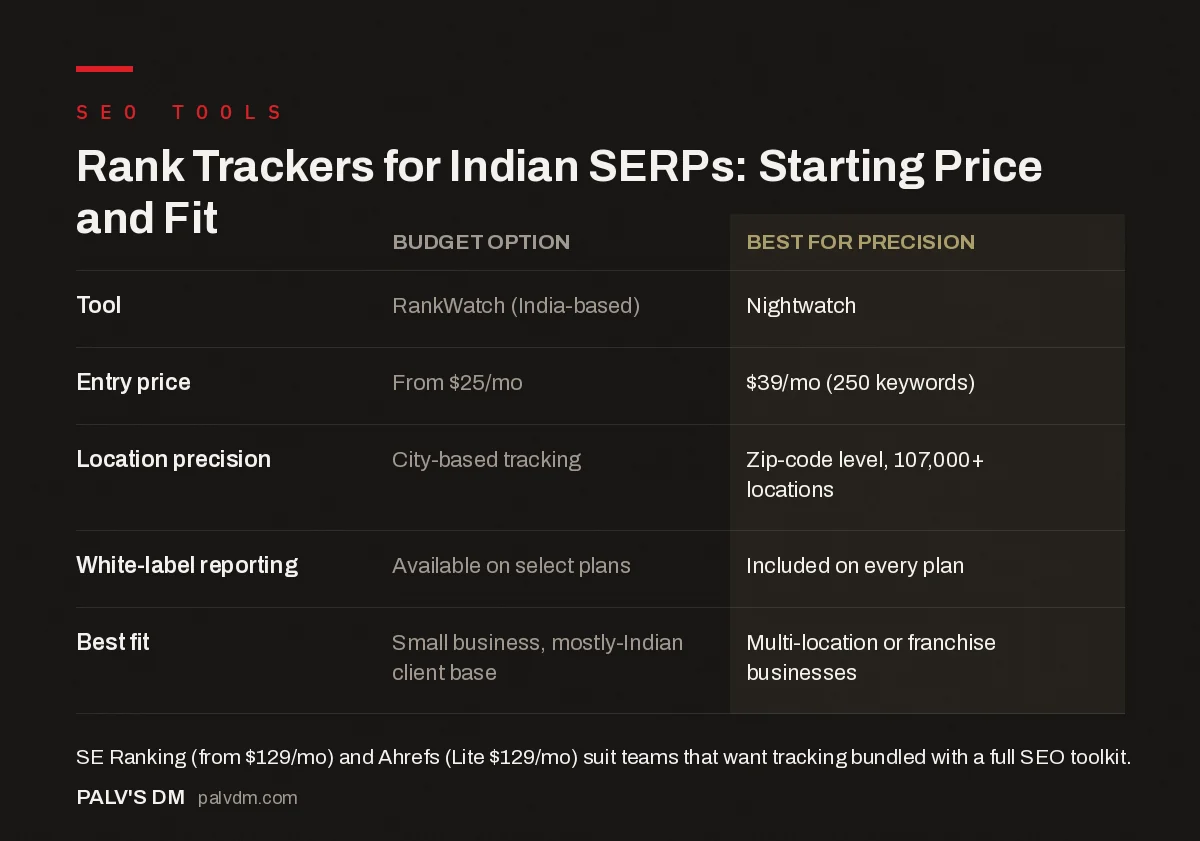
Rank Trackers for Indian SERPs: Starting Price and Fit
| Budget option | Best for precision | |
|---|---|---|
| Tool | RankWatch (India-based) | Nightwatch |
| Entry price | From $25/mo | $39/mo (250 keywords) |
| Location precision | City-based tracking | Zip-code level, 107,000+ locations |
| White-label reporting | Available on select plans | Included on every plan |
| Best fit | Small business, mostly-Indian client base | Multi-location or franchise businesses |
What does each tool actually get you?
RankWatch
An India-headquartered platform built specifically around rank tracking, competitor analysis, site auditing and backlink research in one dashboard. It supports city-based results and claims tracking across 170-plus countries and major languages, which makes it a natural fit if most of your client base or business is Indian and you want a tool built with that market as the default, not an afterthought.
Nightwatch
Built around precision location tracking, down to specific zip codes across a very large number of tracked locations worldwide. If hyper-local accuracy for a multi-city Indian business (or a chain with several branches) is the priority, this level of granularity is hard to match. White-label reporting is included on every plan, useful for agencies presenting this data to clients directly.
SE Ranking
A full SEO platform where rank tracking is one strong module among several (site audit, backlink analysis, on-page tools, AI search visibility tracking). Every plan includes a handful of tracked locations by default, with additional locations purchasable as an add-on, which is worth budgeting for if you’re tracking many Indian cities on one account.
Ahrefs
Best suited to teams that need rank tracking bundled with genuinely strong backlink and keyword research data in the same tool. Its rank tracker supports desktop and mobile tracking with weekly update frequency on the entry Lite tier; daily tracking and larger keyword volumes require stepping up a tier. Location granularity is solid but not the tool’s specific selling point the way it is for Nightwatch or a dedicated local tracker.
What should actually decide this for you?
- Number of cities you need tracked. If it’s three to five, most tools handle it inside the base plan. Ten-plus cities across multiple client accounts starts to make per-location add-on costs a real budget line.
- Update frequency you genuinely need. Daily tracking sounds appealing but mostly matters for volatile, highly competitive keywords. Weekly tracking is enough for the majority of long-tail and stable terms, and it’s usually cheaper.
- Whether you need the rest of the platform too. If you’re already paying for Ahrefs or SE Ranking for keyword research and audits, their built-in rank tracker may be effectively free marginal cost. If you only need tracking, a dedicated tool like Nightwatch or RankWatch avoids paying for a full suite you won’t use.
- Whether clients see the reports directly. White-label reporting is a genuine time-saver for agencies; check whether it’s included by default or a paid add-on, since this varies a lot between tools.
What about regional-language keyword tracking?
This is where a lot of tools quietly fall short. Tracking a keyword typed in Hindi, Gujarati, or another regional script requires the tool to handle non-Latin character input correctly and return an accurate SERP for that exact query, not a transliterated approximation. Before committing to a tool for a business targeting regional-language search, run a small test batch of your actual regional keywords and check the results against a manual search from a VPN or proxy located in the target city. Don’t take a vendor’s marketing claim about language support at face value; verify it against your specific keyword list before signing an annual contract.
Is a free or near-free option ever good enough?
For a genuinely small operation tracking a handful of keywords in one or two cities, yes, a lower-cost entry plan is often sufficient, and paying for enterprise-grade daily zip-code tracking would be overkill. The mistake is the other direction: businesses that have outgrown a basic plan, now managing multiple locations or a growing keyword list, staying on it out of inertia and making decisions off data that’s now too coarse to be useful. Revisit the fit every six months or so, not just at the point something visibly breaks.
What does switching tools actually cost you in practice?
Beyond the subscription price, switching rank trackers means losing historical trend data unless you export it first, and re-verifying every tracked keyword and location in the new tool before trusting its numbers. This is annoying enough that a lot of teams stay on a tool that’s no longer the best fit simply to avoid the migration. Before signing a new annual contract, export at least twelve months of historical position data from your current tool, even if you’re not switching yet. That data becomes genuinely hard to reconstruct later, and having it on hand removes one of the biggest reasons teams get stuck with a tool they’ve outgrown.
One thing we check before recommending a switch to a client: whether the new tool’s numbers roughly agree with the old one on a sample of shared keywords during a short overlap period. A jump from position 8 to position 3 overnight usually means the tools measure differently (different location precision, different device default), not that rankings genuinely moved. Treat a tool switch as a data reset, and communicate that clearly if you’re reporting these numbers to a client or a boss.
What about mobile versus desktop rankings in India?
India is an overwhelmingly mobile-first search market, and mobile and desktop rankings for the same keyword frequently diverge, sometimes by several positions. A tool that defaults to desktop tracking, or bundles mobile tracking as a paid add-on, can leave you optimizing against the wrong number if most of your actual traffic and customers arrive on a phone. Confirm which device a tool tracks by default before assuming the position it reports reflects what most of your visitors actually see.
Frequently asked questions
Why does city-level rank tracking matter so much in India?
Because Google personalizes results by location, the same keyword can rank very differently in Mumbai versus Chennai versus a Tier-2 city. A national average position hides that spread and can make a locally strong campaign look mediocre, or vice versa.
Do I need a rank tracker built specifically for India?
Not necessarily a purpose-built Indian tool, but you do need one that supports genuine city-level or zip-code-level geotargeting on Google.co.in, not just country-level tracking. Several international tools handle this well; some budget tools only fake it with IP-based approximation.
Is a cheap rank tracker good enough for a small business?
Often yes, if your keyword list is modest and you only need a handful of cities tracked. The gap between budget and premium tools widens as your keyword count, location count, and update frequency needs grow, not at the entry level.
How often should rankings actually be checked?
Daily tracking is useful for volatile, competitive keywords where you need to catch a drop fast. For most long-tail or stable keywords, weekly tracking is sufficient and cheaper, since daily data on a slow-moving keyword mostly just adds noise.
Can I just check rankings manually in an incognito window instead?
You can, but it’s unreliable. Incognito mode doesn’t fully remove personalization signals like IP-based location, and manually checking dozens of keywords across multiple cities isn’t sustainable. It’s fine for a one-off spot check, not for ongoing measurement.
Sources
- Search Console Performance report documentation, Google
- Nightwatch pricing and plans
- Keyword Research: A Complete, Repeatable Process
- Keyword Tools Compared on Indian Search Volume Accuracy
- SEMrush vs Ahrefs: Choosing Between Them
- How to Verify a Tool’s Data Before You Trust It
Want this done on your site?
Every PalV’s DM engagement starts with a free audit of your actual website — a 12-point
crawl covering what is blocking indexation, on-page gaps against your primary keywords, speed
findings, and the three to five fixes worth making first. Delivered in two working days. No
payment details, and the findings are yours whether you hire us or not.
Get your free SEO audit
See One-Time Services plans and prices