Vanity Metrics in SEO Reporting and What to Replace Them With
Total keywords ranked and Domain Authority don't predict revenue. Here's which SEO metrics are vanity and what to report instead.

Published August 2026. A vanity metric is any number that goes up reliably without changing a single business decision — total keywords ranked, raw impressions, Domain Authority, or total indexed pages. They make a report look busy and impressive while telling you nothing about whether SEO is generating leads or revenue. A site can rank for ten thousand keywords and close zero deals if none of those keywords carry commercial intent. Here’s which metrics to retire and what to track instead.
What Makes a Metric “Vanity” Instead of Useful?
A metric is a vanity metric if it’s disconnected from a business outcome and doesn’t change what anyone does next. It’s not that these numbers are fake or meaningless in every context — total keywords ranked can be a legitimate leading indicator of content breadth. The problem is treating it as a headline success metric when it doesn’t actually predict revenue, leads, or growth.
A useful test: if this number doubled next month, would the client’s business be measurably better off, and would you be able to explain why? If the answer is “not really” or “it depends on factors this metric doesn’t capture,” it’s a vanity metric for reporting purposes, even if it’s still worth tracking internally as a diagnostic.
Which Common SEO Metrics Are Mostly Vanity?
| Metric | Why It’s Misleading Alone | Better Alternative |
|---|---|---|
| Total keywords ranked | Includes irrelevant, zero-intent, and branded terms | Keywords ranked in top 10 with commercial intent |
| Total organic traffic | Doesn’t distinguish converting from non-converting visits | Organic traffic to money pages, plus conversion rate |
| Domain Authority / similar scores | Third-party estimate, not a Google ranking factor | Actual ranking movement on target keywords |
| Total indexed pages | More pages isn’t inherently good if quality is thin | Indexed pages that receive organic clicks |
| Impressions with no CTR context | High impressions with low clicks signals a title/snippet problem, not success | Impressions paired with CTR by query |
| Social shares of blog content | Rarely correlates with search rankings or leads | Organic traffic and conversions from that content |
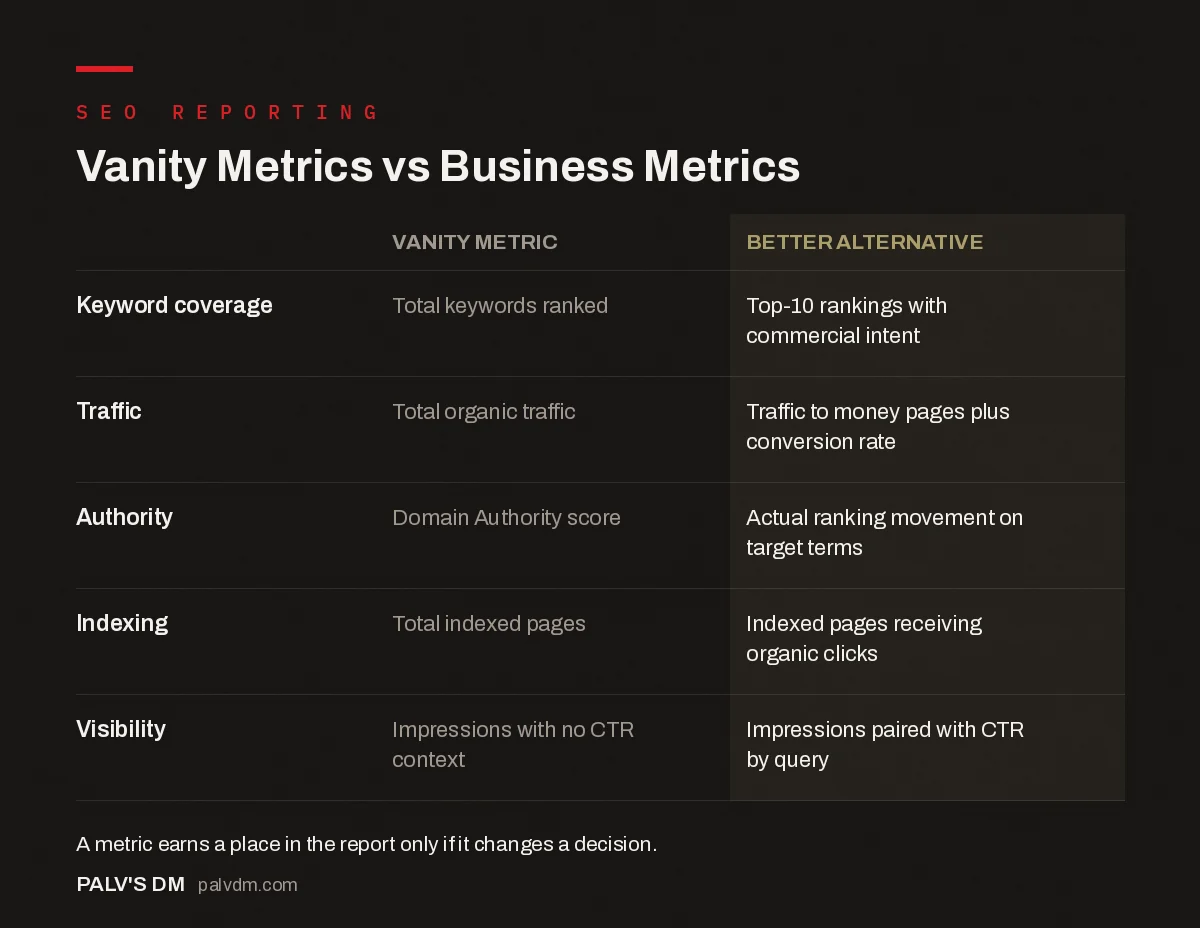
Vanity Metrics vs Business Metrics
| Vanity Metric | Better Alternative | |
|---|---|---|
| Keyword coverage | Total keywords ranked | Top-10 rankings with commercial intent |
| Traffic | Total organic traffic | Traffic to money pages plus conversion rate |
| Authority | Domain Authority score | Actual ranking movement on target terms |
| Indexing | Total indexed pages | Indexed pages receiving organic clicks |
| Visibility | Impressions with no CTR context | Impressions paired with CTR by query |
Why Do Vanity Metrics Persist in SEO Reporting?
- They’re easy to pull. Total keywords ranked and Domain Authority are one-click exports from most SEO tools. Metrics tied to actual revenue require GA4 conversion tracking to be configured correctly first, which takes more setup work.
- They almost always trend upward. A growing content library naturally accumulates more ranked keywords and indexed pages over time, regardless of whether the SEO strategy is working. That makes them safe, feel-good numbers to report even when deeper performance is flat.
- They’re easier to explain to a non-technical stakeholder in isolation. “We rank for 200 more keywords” sounds like unambiguous progress. “Organic conversion rate held steady while traffic mix shifted toward higher-intent pages” is a more accurate story but takes longer to explain.
- Some agencies use them to pad results when real outcomes are weak. This is the least charitable reason, but a genuine one — when a client relationship’s actual outcome metrics are underwhelming, vanity metrics are a way to show “activity” without confronting a strategy problem.
What Should Replace Vanity Metrics in Client Reporting?
- Organic traffic to revenue-relevant pages, not the whole site. Traffic to a careers page or an unrelated old blog post doesn’t move the business the way traffic to a service or product page does.
- Conversions and conversion rate from organic search. This requires GA4 goals or key events configured correctly — without that foundation, this metric isn’t available, which is itself a sign the tracking setup needs attention before reporting can be credible.
- Rankings for a defined set of priority keywords, not “all keywords.” Pick 20-50 terms tied directly to services or products and track those specifically, rather than an undifferentiated list that includes long-tail, informational, and branded terms together.
- Share of voice on priority terms against known competitors, where competitive data is available, gives a more honest picture of position than an absolute ranking number in isolation.
- Assisted conversions and multi-touch context, where marketing analytics tools support it, since organic search often plays a supporting role in a longer buying journey rather than the final click.
How Does This Play Out Differently for TOFU vs Bottom-Funnel Content?
Top-of-funnel content — guides, definitional posts, general educational articles — often ranks and drives traffic without converting directly on that same visit, which is normal and doesn’t make the traffic worthless. The mistake is reporting TOFU traffic the same way as traffic to a service or pricing page, where conversion is the expected and measurable outcome.
A more honest framing separates the two: bottom-funnel pages get judged primarily on conversions and conversion rate, while TOFU content gets judged on assisted conversions, return visits, and whether it’s building the audience that eventually reaches a service page. Collapsing both into one “organic traffic” number obscures which type of content is actually doing its job.
Are There Cases Where a “Vanity” Metric Is Actually Useful?
Yes, as a diagnostic, not a headline. Total indexed pages is a genuinely useful check for catching indexing problems — a sudden drop signals something broke, worth investigating even though the raw count itself isn’t a success metric. Domain Authority-type scores can be a rough proxy when comparing your own site over a long time horizon, even though they shouldn’t be presented to a client as proof of ranking improvement, since Google doesn’t use them as a ranking factor.
The distinction is context and framing: use these numbers internally to catch problems early, and don’t present them to a client as the main measure of success without the business outcome data alongside them.
What Does a Before-and-After Report Section Look Like?
A report that leans on vanity metrics might say: “We now rank for 1,240 keywords, up from 980 last quarter, with a Domain Authority of 42.” A revised version covering the same underlying work might say: “Organic sessions to service pages grew 18% quarter-over-quarter, with 34 qualified leads attributed to organic search, up from 27 the prior quarter. The keyword set driving this growth expanded from 40 to 58 commercial-intent terms ranking in the top 10.” The second version takes more tracking discipline to produce, but it answers the question a business owner is actually asking.
FAQ
Is organic traffic always a vanity metric?
Not inherently — traffic is a real, useful signal when segmented by page type and paired with conversion data. It becomes a vanity metric when reported as a single undifferentiated number with no context on whether that traffic is reaching pages that matter to the business or converting once it arrives.
Why do SEO tools still surface these metrics prominently?
SEO platforms like SEMrush and Ahrefs are built for a broad range of use cases, including competitive research where total keyword counts and authority scores are genuinely useful comparison tools. The issue isn’t the metric existing in the tool — it’s copying that metric directly into a client report without translating it into a business-relevant number first.
How do I push back if a client specifically asks for Domain Authority in the report?
Explain plainly that it’s a third-party estimate, not something Google uses to rank sites, and that it can be included as a secondary reference point if they find it reassuring, but shouldn’t replace outcome metrics like traffic to money pages and conversions. Most clients accept this once it’s explained clearly rather than assumed.
What’s the fastest way to audit a current report for vanity metrics?
Go through each metric currently in the report and ask whether it changed a decision in the last quarter. If a metric has been reported every month for a year and never once prompted a strategy adjustment or explained a result, it’s a strong candidate to cut or demote to an appendix.
Reporting What Actually Matters
Cutting vanity metrics isn’t about reporting less — it’s about reporting the numbers that connect directly to whether the client’s business is growing. That requires more setup work upfront, particularly around conversion tracking, but it produces a report that survives scrutiny from a CFO or business owner asking “so what did this actually get us.”
Getting the tracking foundation right so outcome-based reporting is even possible is core to our SEO Growth service, which treats conversion tracking as a prerequisite for reporting, not an afterthought.
For the full structure of what a credible monthly report should include instead, see the SEO report clients should get every month. For the dashboard that visualizes these outcome metrics, read building an SEO dashboard in Looker Studio. And for building the discipline of checking the right numbers regularly, see building a weekly SEO metrics review habit.
For the raw Search Console data these outcome metrics are built from, see Google Search Console: the reports that actually matter.