SEO vs CRO: Resolving the Fights Between Rankings and Conversions
SEO vs CRO conflicts show up in headlines, internal links and page speed. Here is where the two genuinely disagree and how to resolve each fight.
SEO and CRO genuinely conflict on three specific decisions: how much text sits above the fold, how internal links get distributed, and how much a headline gets simplified for persuasion at the cost of keyword context. Everywhere else, the two goals point the same direction, and treating every disagreement as a fundamental war wastes energy that should go into the three fights that are real.
The “SEO vs CRO” framing gets overused because it’s a convenient way to explain why two specialists disagree on a brief. Most of what looks like conflict is actually just two people optimising for different metrics on the same page without a shared decision rule. Fix the rule and most of the arguments disappear on their own.
Where do SEO and CRO actually disagree?
Three places, consistently. First, above-the-fold content: CRO wants a short, benefit-led headline and a visible call to action with minimal scrolling; SEO wants enough text early on the page to establish topical relevance for the target keyword. Second, internal linking: SEO wants generous contextual links to spread authority and crawl paths; CRO wants a page with one dominant action and as few exit points as possible. Third, headline and copy simplification: CRO pushes toward plain, persuasive language; SEO wants the primary keyword phrase represented close to how people actually search for it, which isn’t always the most natural sentence.
Notice what’s not on that list: page speed, mobile usability, clear navigation, trustworthy content, and a logical page structure. Those help both goals equally. The conflicts are real but narrow, and most “SEO vs CRO” arguments online are actually happening in that narrow zone without anyone naming it.
SEO wants, CRO wants: resolving each specific fight
| Decision point | SEO wants | CRO wants | Working resolution |
|---|---|---|---|
| Above-the-fold text | Enough context to establish topic relevance | Minimal text, immediate CTA | Short, keyword-carrying headline; supporting detail just below the fold |
| Internal links | Multiple contextual links for crawl paths | Few exit points, one dominant action | Link only where genuinely relevant; route most links to a sidebar or footer, not mid-copy on a conversion page |
| Headline wording | Includes the target keyword phrase | Plain, benefit-led language | Keyword in the headline where it reads naturally; move exact-match phrasing to a subheading or meta title if it doesn’t |
| Page length | Enough depth to rank for informational intent | Short enough to not lose attention | Long page, short first screen: depth further down for those who scroll, brevity for those who don’t |
How do you decide who wins when there’s no clean compromise?
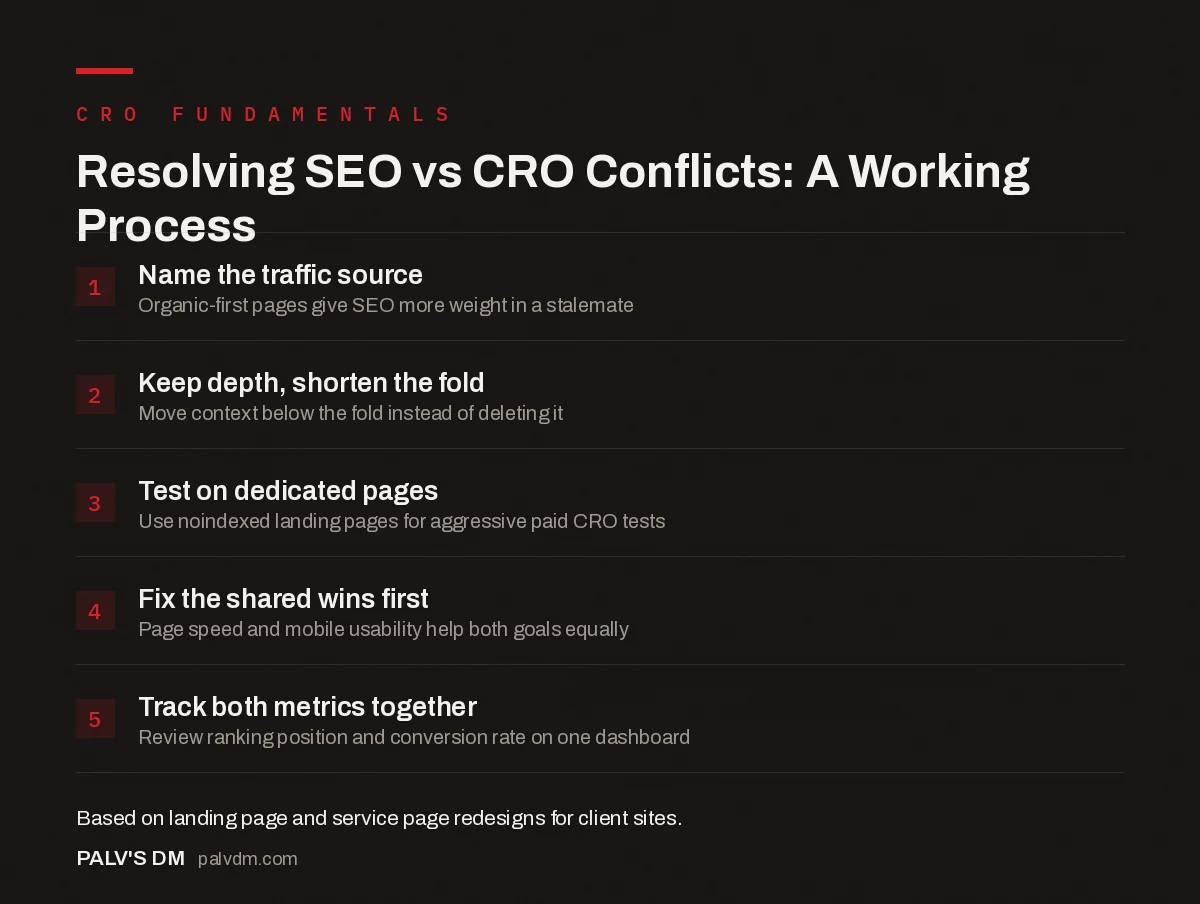
Resolving SEO vs CRO Conflicts: A Working Process
- Name the traffic source. Organic-first pages give SEO more weight in a stalemate.
- Keep depth, shorten the fold. Move context below the fold instead of deleting it.
- Test on dedicated pages. Use noindexed landing pages for aggressive paid CRO tests.
- Fix the shared wins first. Page speed and mobile usability help both goals equally.
- Track both metrics together. Review ranking position and conversion rate on one dashboard.
Traffic source is the deciding variable more often than either camp wants to admit. A page that earns most of its traffic from organic search should lean SEO when the two genuinely conflict, because losing the ranking removes the visitors CRO is trying to convert in the first place. A page that lives mostly on paid traffic or email links can lean CRO harder, because it isn’t carrying ranking weight to begin with.
The other deciding factor is whether the conflict is testable. If you can A/B test a shorter above-the-fold section against the current version and measure the conversion lift without touching anything that affects crawlability or keyword placement, run the test. If the proposed change would strip out the content actually earning the ranking, that’s not a CRO test anymore, it’s a bet against your organic traffic, and it needs sign-off from whoever owns that number, not a unilateral call from whoever’s turn it is to edit the page.
What does this look like on an actual client page?
The most common real fight we see is a service page redesign where the CRO recommendation is to cut the page down to a hero, three benefit bullets, and a form. That reads great in a Figma mock-up and converts fine in a quick test. It also often strips out the exact content that was ranking the page for its target keyword in the first place, the paragraphs explaining the process, the FAQ answering objections, the specifics that signal to Google this page actually covers the topic in depth.
Our resolution on pages like that: keep the short, punchy version as the first screen, and keep the depth, still genuinely useful, further down the page rather than deleting it. Nobody scrolling past the fold is annoyed that more information exists below. Somebody who needed that information and found it gone is a lost conversion and, eventually, a lost ranking too.
Does technical SEO work ever directly help conversion rate?
Page speed is the cleanest example, and it’s not a coincidence that it shows up as common ground rather than conflict. Core Web Vitals (Largest Contentful Paint, Interaction to Next Paint, Cumulative Layout Shift) are confirmed Google ranking signals, and independently, slow-loading pages consistently show worse conversion and higher bounce across the studies both SEO and CRO practitioners cite. Structured data is a similar case: schema markup that earns a rich result in search doesn’t just improve visibility, a more informative search snippet also tends to pull in more qualified clicks, which is a CRO outcome achieved through an SEO mechanism.
Mobile usability sits in the same bucket. A page that’s hard to tap through on a phone loses both rankings, since Google evaluates mobile experience directly, and conversions, since most traffic on most sites is mobile now. Fixing that isn’t a compromise between two goals, it’s just fixing a genuine defect that happens to matter to both.
What’s the practical process for avoiding these fights before launch?
- Name the page’s primary traffic source before designing it. Organic-first pages get SEO veto rights on anything that touches ranking-relevant content. Paid or email-first pages get more CRO latitude.
- Put the keyword-carrying content below the fold, not out. Almost every “SEO vs CRO” fight resolves once both sides accept that “shorter first screen” and “shorter page” are different requests.
- Use dedicated landing pages for aggressive paid tests. A noindexed page built for one campaign can run tests the organic page never should.
- Route the shared wins first. Fix page speed, mobile usability and clear structure before arguing about headline wording. Those changes help both metrics and cost nothing in trade-off negotiation.
Who should actually own the final call on a contested page?
Whoever’s number gets hurt worse if they’re wrong. That sounds glib, but it’s a better rule than seniority or job title, which is how most of these disputes actually get settled in practice and it usually produces a worse outcome than the traffic-source rule above. If a page is the top organic entry point for a service line and generates most of its leads from search, the SEO case should carry more weight in a stalemate, because a ranking drop costs more than a marginal conversion-rate improvement recovers. If the same page barely ranks and most of its traffic comes from a paid campaign or a newsletter link, flip the weighting.
Write this down before the disagreement happens, not during it. A one-line rule agreed on in a planning meeting removes the need to relitigate the same argument every time a new CRO idea or a new content brief lands on the same page. Teams that skip this step end up re-fighting the same three conflicts on every redesign, because nobody ever settled who breaks the tie.
How do you measure whether a change actually helped or hurt?
Track both metrics on the same page, on the same timeline, every time either team makes a change. That sounds obvious and almost nobody does it consistently. CRO teams watch conversion rate and drop the ranking tracking; SEO teams watch position and traffic and don’t loop back to check whether conversion held steady. A change that improves conversion 8% while quietly costing the page three ranking positions over the following month isn’t a clean win, it’s a trade that needs to be visible to make on purpose rather than discover by accident three months later in a traffic report nobody connects back to the redesign.
A simple shared dashboard, organic sessions, average position for the target keyword, and conversion rate, reviewed monthly by whoever owns each metric, catches this before it compounds. It doesn’t need to be sophisticated. It needs to exist and get checked on a schedule both teams actually keep.
Frequently asked questions
Do SEO and CRO actually conflict with each other?
On some specific decisions, yes: headline wording, how much text sits above the fold, and how aggressively you link internally. Most of the time they pull in the same direction, since both want a fast, clear, relevant page. The genuine conflicts are narrow but recurring, which is why they need a decision rule rather than a case-by-case argument.
Does removing text to improve conversion hurt SEO rankings?
It can, if the page loses the depth and keyword context Google uses to understand what it’s about. A short, punchy landing page can still rank if the missing context lives elsewhere on the page, lower down, or in supporting content it links to. Cutting text without a plan for where that context goes is the actual risk, not conciseness itself.
Do exit-intent popups hurt SEO?
Not directly, since Google doesn’t crawl or index popup content as separate from the page. The indirect risk is Google’s intrusive interstitial guidance for mobile, which can penalise popups that block the main content immediately on page load. A popup triggered by exit intent or a scroll threshold, rather than on load, avoids that issue.
Should CRO testing use separate landing pages instead of the ranking page?
For paid traffic, yes, this is often the cleanest fix. A dedicated, noindexed landing page built purely for conversion can run aggressive tests without touching the organic page’s content or rankings. For organic traffic, you’re testing on the actual ranking page, so changes need to stay within limits that don’t strip out what’s earning the ranking.
Does page speed optimisation help both SEO and CRO at the same time?
Yes, this is the clearest case where the two goals fully align. Core Web Vitals are a confirmed Google ranking factor, and faster pages consistently show lower bounce rates and higher conversion in independent studies. There’s no real trade-off to manage here, just a shared priority both teams should push for together.
Sources
- Google Search Central: Understanding page experience
- web.dev: Core Web Vitals overview
- Core Web Vitals: LCP, INP and CLS Explained Properly
- Page Speed and Conversion Rate: The Documented Link
- Writing CTAs People Actually Click
- Trust Signals That Work in the Indian Market
Want this done on your site?
Every PalV’s DM engagement starts with a free audit of your actual website — a 12-point
crawl covering what is blocking indexation, on-page gaps against your primary keywords, speed
findings, and the three to five fixes worth making first. Delivered in two working days. No
payment details, and the findings are yours whether you hire us or not.
Get your free SEO audit
See web development plans and prices