Share of Citation: Defining the Metric
Share of citation is the AI-era share of voice: the percentage of relevant AI answers that cite your brand. How to define, measure and segment the headline AI-visibility metric.
Share of citation is the AI-era equivalent of share of voice: the percentage of relevant AI answers in your category that cite or recommend your brand. If you track fifty prompts your buyers ask AI engines and your brand appears in fifteen of the answers, your share of citation is 30%. It’s the single most useful headline metric for AI visibility, because it measures the thing that actually matters — how often you’re the answer — rather than proxy signals like rankings or traffic.
Key takeaway
- Share of citation is the percentage of relevant AI answers in your category that cite or recommend your brand.
- It’s the AI-era share of voice — a direct measure of how often you’re the answer, not a proxy like rankings.
- Measure it against a fixed prompt set so the number is comparable month to month and reflects real change.
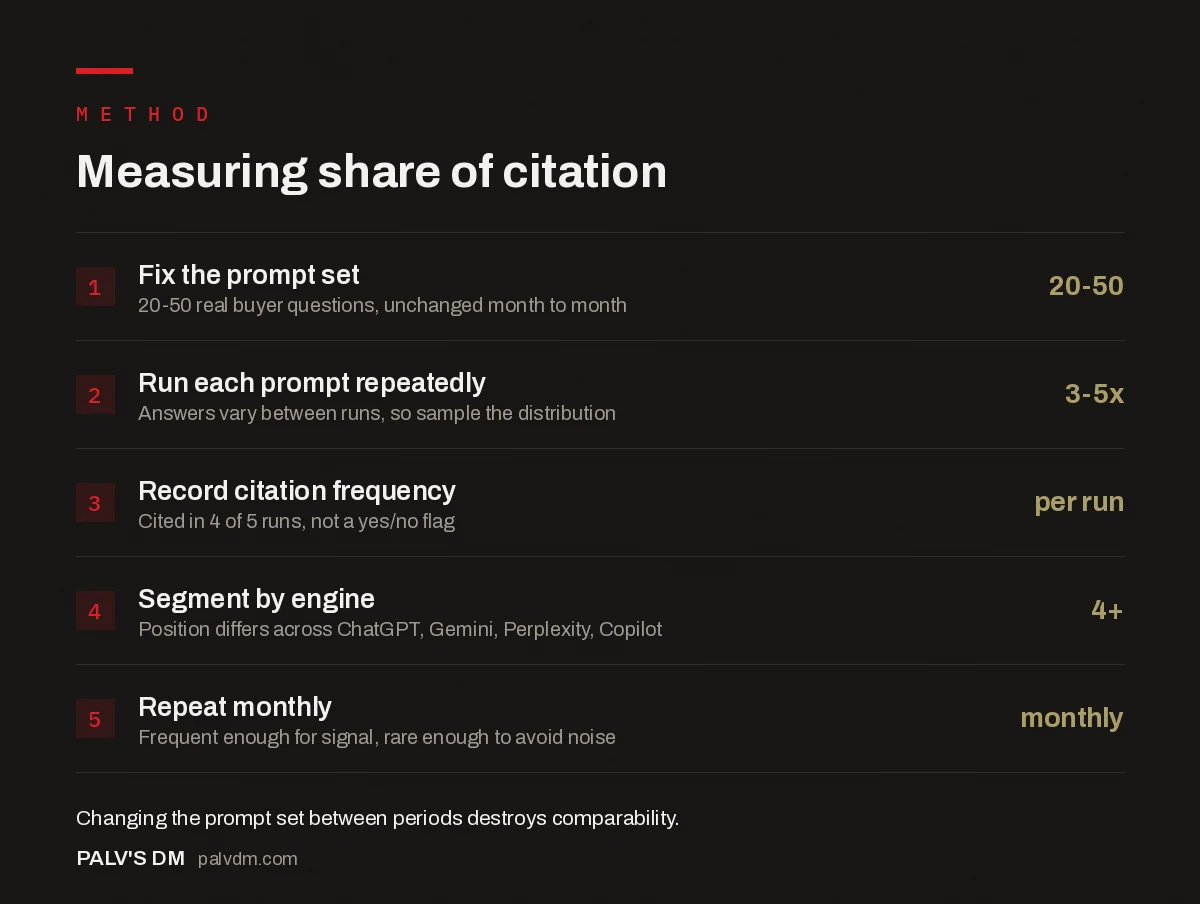
Measuring share of citation
- Fix the prompt set — 20-50 prompts. Real buyer questions, unchanged month to month.
- Run each prompt repeatedly — 3-5x. Answers vary between runs, so sample the distribution.
- Record citation frequency — per run. Cited in 4 of 5 runs, not a yes/no flag.
- Segment by engine — 4+. Position differs across ChatGPT, Gemini, Perplexity, Copilot.
- Repeat monthly — every 30 days. Frequent enough for signal, rare enough to avoid noise.
Defining the metric
Share of citation is calculated simply: take a defined set of prompts relevant to your business, run them across the AI engines you care about, and count the proportion in which your brand is cited or recommended. Cited in fifteen of fifty prompts is a 30% share of citation. You can measure it overall, per engine, or per prompt cluster, and track it over time to see whether your AI visibility is growing.
The concept deliberately mirrors share of voice from traditional media and share of search from SEO — a competitive presence metric. But where those measure exposure or ranking, share of citation measures the outcome that AI search has made decisive: being named in the answer itself.
Why it’s the right headline metric
In an AI answer, there’s no page two — there’s the answer, and the handful of sources it cites. Either you’re in it or you’re invisible. Share of citation captures exactly that binary at scale, across your important prompts, in one comparable number. It’s more honest than rankings (which have decoupled from citation) and more direct than traffic (which AI answers increasingly intercept). For reporting AI visibility to a client or a founder, it’s the number that answers “are we the answer or not,” which is the question that matters.
15 / 50 = 30%
Share of citation in one line: cited in fifteen of a fifty-prompt tracked set equals a 30% share. Run the same fixed set each period and the trend tells you whether your AI visibility is genuinely improving.
Source — AI visibility measurement practice
How to measure it properly
The discipline that makes the number meaningful is a fixed prompt set. Choose a representative set of prompts — real questions your buyers ask, spanning your key topics and buying stages — and keep it identical month to month. Run it consistently (same prompts, same engines, ideally a consistent method), record whether your brand is cited in each answer, and compute the share. Because AI answers vary between runs, run each prompt a few times and treat consistent citation as the signal.
Changing the prompt set between periods breaks comparability — a jump could just mean you swapped in easier prompts. Lock the set, and movement in your share reflects real change in visibility, which is the entire point of tracking it.
Going beyond the headline number
Once you have overall share of citation, segment it for insight. Share per engine shows where you’re strong and weak (cited by Perplexity but not Gemini). Share per prompt cluster shows which topics you own and which you’re losing. And pairing share with competitors’ share turns it into a genuine competitive metric — your share of citation versus theirs across the same prompts. The headline number tells you where you stand; the segments tell you where to work.
Frequently asked questions
What is share of citation?
Share of citation is the percentage of relevant AI answers in your category that cite or recommend your brand. Run a defined prompt set across AI engines, count how many answers include you, and that proportion is your share. It’s the AI-era equivalent of share of voice — a direct measure of how often you’re the answer, and the most useful headline metric for AI visibility.
How do I calculate share of citation?
Take a fixed set of prompts relevant to your business, run them across the AI engines you care about, and count the proportion in which your brand is cited or recommended. Cited in fifteen of fifty prompts is a 30% share. Because AI answers vary between runs, run each prompt a few times and treat consistent citation as the signal. Keep the prompt set identical each period for comparability.
Why is share of citation better than rankings for AI?
Because rankings have decoupled from AI citation — only a small share of AI citations now come from top-ranked pages, so ranking no longer predicts being cited. Share of citation measures the outcome directly: how often you’re actually named in AI answers. In an AI answer there’s no page two, just the answer and its sources, so a metric that captures whether you’re in it is more honest than ranking position.
How often should I measure share of citation?
Monthly is a sensible cadence for most businesses — frequent enough to catch changes and see the effect of your work, without over-reacting to normal answer variability. Use the same fixed prompt set each time so the trend is comparable. AI engines and their answers change continuously, so a steady monthly measurement against a locked set gives you a reliable picture of whether your visibility is genuinely improving.
The bottom line
Share of citation answers the only question that matters in AI search: how often are you the answer? Define it as the percentage of your tracked prompts whose AI answers cite you, measure it against a fixed set for comparability, and segment it by engine and topic to find where to work. It’s the honest headline metric for AI visibility — and the number to put at the top of any AI-visibility report.
We measure and grow your share of citation against a fixed prompt set — part of our AI Visibility service.