Blocking AI Crawlers: The Trade-Off Nobody Explains
Blocking training crawlers is defensible; blocking search crawlers removes you from AI answers for no real gain. The trade-off nobody explains — and the accidental-block trap.
Whether you should block AI crawlers comes down to a trade-off nobody spells out clearly: blocking training crawlers protects your content from feeding models but costs you nothing in visibility, while blocking search crawlers protects nothing meaningful and costs you your place in AI answers entirely. The two decisions are completely different, and conflating them is the mistake most people make. This is the trade-off laid out honestly, so you can decide each one deliberately instead of blocking blindly or leaving everything open by default.
Key takeaway
- Blocking training crawlers is a defensible choice — it protects your content from model training at no visibility cost.
- Blocking search crawlers is almost always a mistake — it removes you from AI answers while protecting nothing meaningful.
- Decide the two separately: the common sensible stance is allow search crawlers, choose your training-crawler policy on principle.
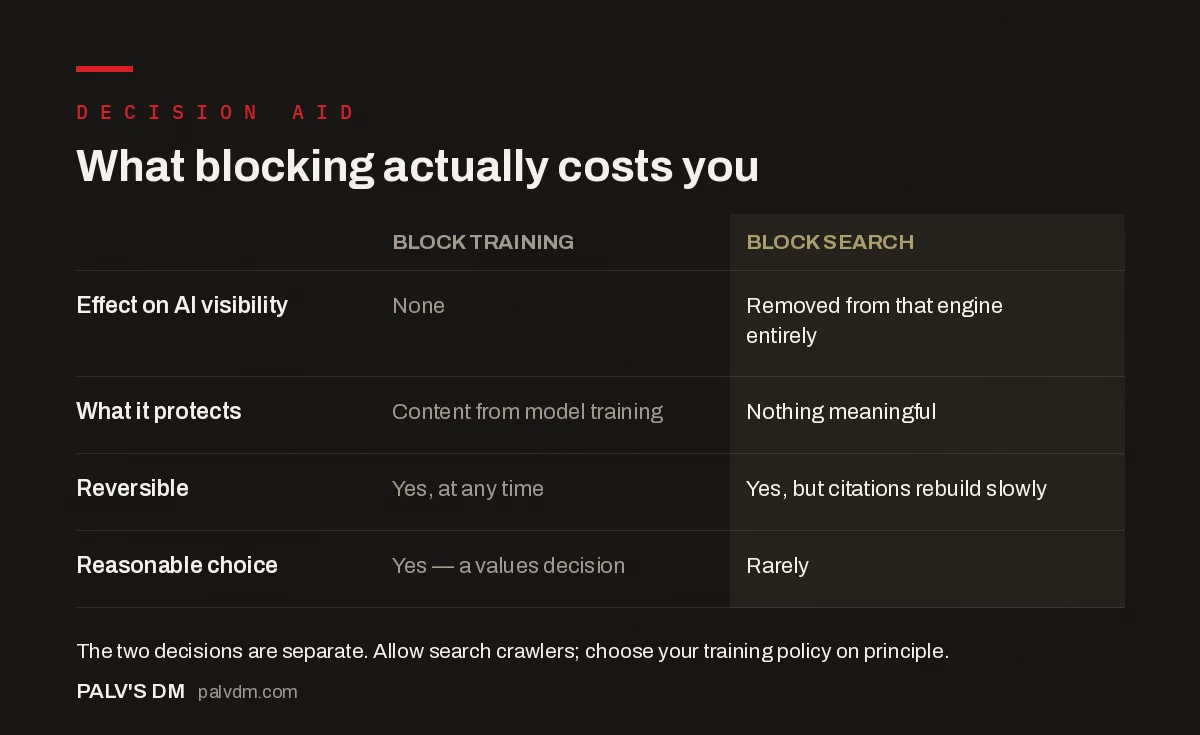
What blocking actually costs you
| Block training | Block search | |
|---|---|---|
| Effect on AI visibility | None | Removed from that engine entirely |
| What it protects | Content from model training | Nothing meaningful |
| Reversible | Yes, at any time | Yes, but citations rebuild slowly |
| Reasonable choice | Yes — a values decision | Rarely |
Two decisions, not one
The phrase “block AI crawlers” hides two entirely different decisions. One is whether to let training crawlers use your content to train models. The other is whether to let search crawlers fetch your pages to answer live queries and cite you. These have opposite implications, so treating them as a single yes/no is the root of most bad crawler policies. Untangle them and each becomes straightforward.
Blocking training crawlers: a real choice
Blocking training crawlers (GPTBot, ClaudeBot, Google-Extended, CCBot) stops your content being used to train AI models, and it does not reduce your AI-search visibility, because search crawlers are separate. So this is a legitimate, cost-free-to-visibility decision made on principle: some businesses object to their content training models they don’t control, and blocking training crawlers is how they opt out. Others are happy to contribute. There’s no visibility penalty either way — it’s a values-and-strategy call, not a visibility one.
Block search = vanish
Blocking a search crawler removes you from that engine’s answers entirely — block OAI-SearchBot and you disappear from ChatGPT Search. Unlike blocking training crawlers, it protects nothing meaningful while costing you real visibility.
Source — AI crawler access practice, 2026
Blocking search crawlers: almost always a mistake
Blocking search crawlers (OAI-SearchBot, PerplexityBot, Claude-SearchBot, plus Bingbot and Googlebot) removes you from those engines’ answers — you simply can’t be cited by an engine that can’t fetch your pages. And it protects nothing meaningful: these crawlers aren’t training on your content, they’re retrieving it to answer a user’s live question, which is exactly the visibility you want. So blocking them is the worst of both worlds — no protection benefit, real visibility cost. Unless you have a specific reason to be absent from AI answers, never block search crawlers.
The accidental-block problem
The most damaging version of this isn’t a deliberate choice at all — it’s blocking search crawlers by accident. A CDN or security service (a common cause is a single toggle in a security provider’s dashboard) can block AI crawlers site-wide even when your robots.txt allows them, and a meaningful share of sites do this without realising. The result is invisible: you’re quietly cut out of AI answers with no error to alert you. Check both your robots.txt and your CDN or security settings to confirm you’re not accidentally blocking the search crawlers you want.
The sensible default stance
For most businesses that want AI visibility, the sensible policy is: allow the search crawlers unconditionally, and decide the training-crawler question on principle. If you’re comfortable contributing to training, allow those too; if not, block them — knowing it won’t hurt your visibility. What you should almost never do is block search crawlers, and what you must actively check is that you’re not blocking them by accident at the CDN. Make each decision deliberately, and your crawler policy matches your actual goals rather than a vague instinct to “block the AI bots.”
Frequently asked questions
Should I block AI crawlers?
It depends which. Blocking training crawlers (GPTBot, ClaudeBot, CCBot) is a defensible choice that protects your content from model training at no visibility cost. Blocking search crawlers (OAI-SearchBot, PerplexityBot, Claude-SearchBot, Bingbot, Googlebot) removes you from AI answers while protecting nothing meaningful — almost always a mistake. Decide the two separately; the common sensible stance is to allow search crawlers and choose your training policy on principle.
Does blocking training crawlers hurt my AI visibility?
No — because search and training crawlers are separate user agents. Blocking training crawlers (GPTBot, ClaudeBot, Google-Extended, CCBot) stops your content being used to train models but doesn’t affect whether search crawlers can retrieve and cite you in live answers. So it’s a cost-free-to-visibility decision made on principle: opt out of training if you object to it, without any penalty to your presence in AI search results.
What happens if I block search crawlers?
You disappear from that engine’s AI answers. A search crawler that can’t fetch your pages can’t cite you — block OAI-SearchBot and you’re removed from ChatGPT Search, for example. And it protects nothing meaningful, since these crawlers retrieve your content to answer users’ live questions rather than train models. Blocking them is the worst of both worlds: no benefit, real visibility loss. Don’t, unless you specifically want to be absent.
Could I be blocking AI crawlers without knowing?
Yes, and it’s common. A CDN or security service can block AI crawlers site-wide even when your robots.txt allows them — often via a single toggle in a security dashboard — cutting you out of AI answers with no error to alert you. Check both your robots.txt and your CDN or security settings to confirm the search crawlers you want are actually reaching your pages, not being silently blocked upstream.
The bottom line
“Should I block AI crawlers” is really two questions. Blocking training crawlers is a fair choice with no visibility cost — decide it on principle. Blocking search crawlers is almost always wrong — it erases you from AI answers for no real gain. And the quiet danger is blocking search crawlers by accident at the CDN. Decide each deliberately, check both robots.txt and your CDN, and never lock the search crawlers out.
We audit your crawler policy so you’re visible where you want to be and protected where you choose. Part of our AI Visibility service.