Deciding Which URL Survives a Merge
When two pages target the same topic and get merged into one, the URL that survives should be the one with more backlinks, more organic traffic, and the stronger ranking history. Here is the decision process.
When two pages compete for the same keyword and get merged into one, the URL that survives should be the one with the stronger backlink profile, higher organic traffic, and longer ranking history — in that priority order — and the losing URL gets a 301 redirect to it, not a canonical tag. Content quality is fixable after the decision; a backlink profile built over years is not, which is why link authority outweighs almost every other factor when two URLs are otherwise close.
This decision comes up constantly on sites that have published for years: two blog posts targeting near-identical keywords, a product page and a landing page saying the same thing, or a “guide” and “checklist” post that should have been one article from the start. Merging them fixes keyword cannibalisation and consolidates ranking signals onto a single page — but only if the right URL is chosen to survive.
What should you check before deciding which URL to keep?
Pull data on both URLs before making a call. Guessing from memory or “the one that feels more official” is how the wrong URL ends up surviving.
| Signal | Where to check | Weight |
|---|---|---|
| Referring domains (backlinks) | Ahrefs, Semrush, or Search Console links report | Highest — hardest to rebuild |
| Organic traffic (last 12 months) | Google Analytics or Search Console performance report | High |
| Current ranking position for the target keyword | Search Console or a rank tracker | High |
| Ranking history / age of the URL | Wayback Machine, Search Console date range | Medium |
| Internal links pointing to the URL | A site crawl (Screaming Frog) | Medium |
| Content quality and structure | Manual review | Low — this is editable after the decision |
| URL slug quality | Manual review | Low — also editable without losing the domain history |
Why do backlinks outweigh everything else?
A backlink is an external, third-party vote of confidence that accumulated over time, often years, and can’t be quickly rebuilt by rewriting content or restructuring headings. Traffic and rankings fluctuate and can recover; a link profile built from genuine outreach, mentions, and citations represents real editorial trust from other sites that Google’s ranking systems weight heavily. If URL A has 40 referring domains and URL B has 3, URL A should survive even if URL B currently has a slightly better ranking position — the ranking gap is far easier to close than the link gap.
How do you decide when the signals point in different directions?
The clean case — one URL wins on every signal — is rare. More often, one URL has the links and the other has the traffic. Work through the signals in priority order and let the first clear, meaningful gap decide it:
Step 1: Compare referring domains
If one URL has a meaningfully larger number of unique referring domains (not just total backlinks, which can be inflated by a single site linking many times), that URL is the default winner unless something below overrides it decisively.
Step 2: Compare 12-month organic traffic and current rankings
If the backlink gap is small or roughly even, traffic and ranking position become the tiebreaker. A URL pulling meaningfully more organic sessions or ranking several positions higher for the shared target keyword has more to lose from a redirect done wrong.
Step 3: Check ranking history and URL age
Older URLs with a longer continuous ranking history tend to carry more accumulated trust than a newer page, even at similar current traffic — this is a lighter-weight signal but useful as a final tiebreaker.
Step 4: Confirm internal link volume won’t fight the decision
Check how many internal links point to each URL. If the losing URL has significantly more internal links, plan to update those links to point at the surviving URL directly rather than relying on the redirect alone.
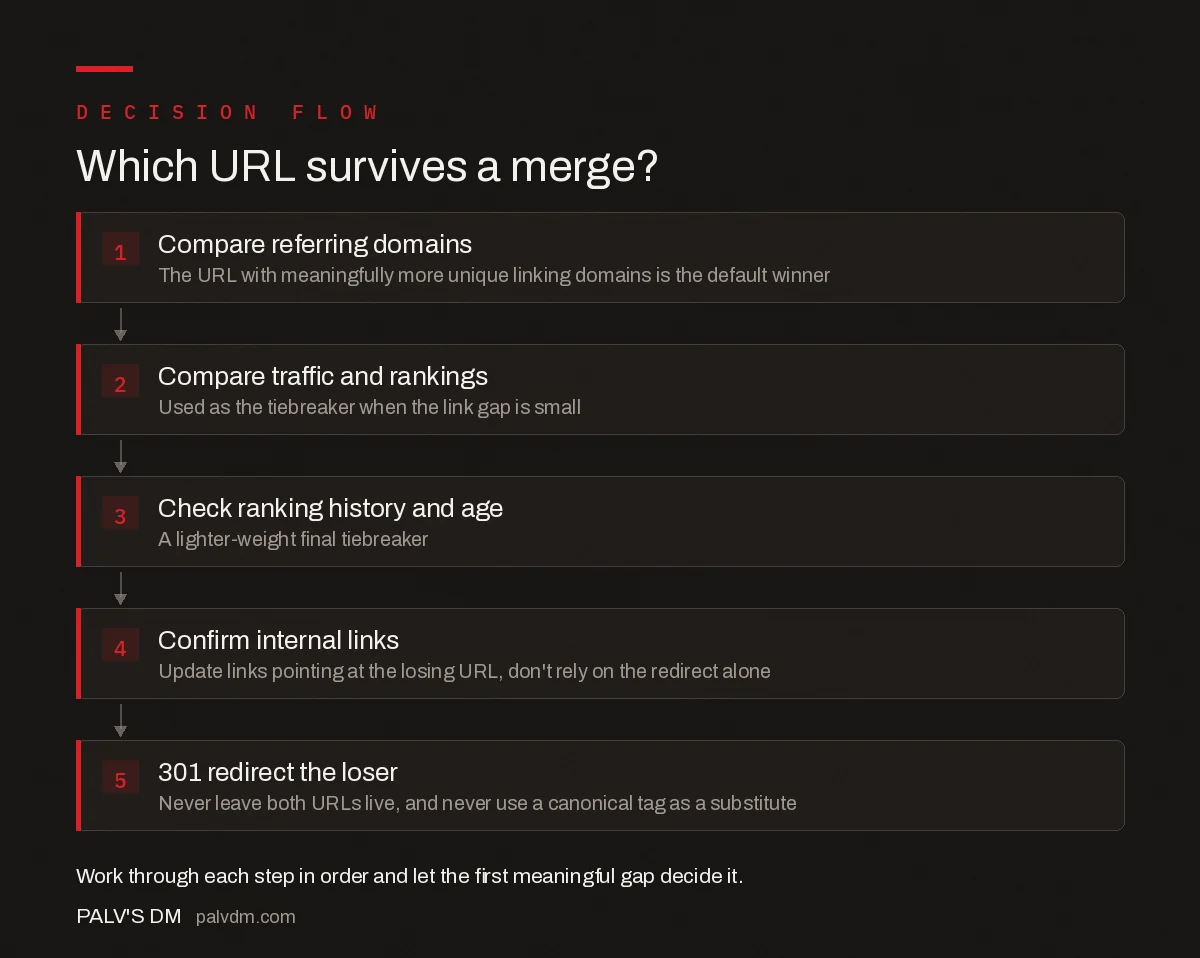
Decision flow: which URL survives a merge
- Compare referring domains — the URL with meaningfully more unique linking domains is the default winner
- Compare traffic and rankings — used as the tiebreaker when the link gap is small
- Check ranking history and age — a lighter-weight final tiebreaker
- Confirm internal links — update links pointing at the losing URL, don’t rely on the redirect alone
- 301 redirect the loser — never leave both URLs live, and never use a canonical tag as a substitute
What do you do with the content after the URL is chosen?
Once the surviving URL is decided, merge the strongest content from both pages into it: sections, data points, or examples from the losing page that were genuinely better get folded into the survivor, and the title, headings, and on-page structure get rewritten to reflect the combined, more complete version. The URL and its accumulated authority are what you’re preserving — the actual words on the page are fully editable and should reflect the best of both originals, not just whichever page happened to win the URL decision.
What happens to the losing URL?
It gets a 301 redirect to the surviving URL, not left live, not canonicalised, not simply deleted. A 301 is Google’s own recommended method for consolidating two URLs into one — it passes accumulated ranking signals to the target and removes the duplicate from the user’s path entirely. A canonical tag doesn’t achieve the same thing here because it doesn’t stop the old URL from still being requested and served; it only hints at indexing preference. For a genuine merge where one URL should stop existing, a redirect is the correct tool, not a canonical.
Frequently asked questions
What’s the single biggest factor in choosing which URL to keep?
Backlinks, specifically the number and quality of unique referring domains pointing at each URL. Link equity is the hardest signal to rebuild from zero, so the URL with the stronger external link profile should almost always survive, even if the other URL currently ranks slightly better.
Should I always redirect the losing URL to the surviving one?
Yes, with a 301 redirect, not a canonical tag. A redirect is a strong signal that consolidates the losing URL’s link equity onto the surviving URL and removes the duplicate from users’ path; a canonical tag alone doesn’t stop users or bots from still loading the old page.
What if the lower-traffic URL has a much better title and structure?
Keep the higher-authority URL and rewrite its title, headings, and content structure to match the better version before merging. The URL itself carries the accumulated signals; the on-page content is fully editable after the decision is made.
How soon after merging will rankings stabilise?
Most sites see the redirect fully processed and rankings settle within a few weeks, though Google has said consolidation can take longer on lower-authority or infrequently crawled sites. Expect some short-term fluctuation in the first days as Google re-evaluates the combined page.
Sources
- How to Specify a Canonical with rel=”canonical” — Google Search Central
- The Complete On-Page SEO Checklist
- How to Update an Old Blog Post for Rankings
- How to Merge Two Competing Posts Into One
- Redirecting a Merged Post Without Losing Rankings
Want this done on your site?
Every PalV’s DM engagement starts with a free audit of your actual website — a 12-point
crawl covering what is blocking indexation, on-page gaps against your primary keywords, speed
findings, and the three to five fixes worth making first. Delivered in two working days. No
payment details, and the findings are yours whether you hire us or not.