Case Studies That Convert: Structure, Numbers, Proof
How to write a case study that converts: the challenge-solution-result structure, how to use real numbers, and a pre-publish checklist.

A case study that converts follows a challenge-solution-result structure, leads with the measurable outcome rather than the customer’s logo, and includes enough specific detail that a prospect can map the story onto their own situation. The version that doesn’t convert is the one built around vague praise: “great to work with,” “significant improvement,” “highly recommended.” Specificity is what turns a testimonial into proof. A number, a timeframe, and an honest account of what the process actually involved do more persuasive work than any amount of enthusiastic adjectives.
Published August 2026.
What structure do converting case studies actually use?
The core structure is challenge, solution, result: what problem the customer had before working with you, what was actually done about it, and what measurably changed afterward. This isn’t a rigid template so much as a sequence that matches how a prospect reads: they need to recognise their own situation in the challenge section before they’ll invest attention in the rest. Skipping straight to the result without establishing the challenge in enough detail loses that recognition moment, and skipping the solution section to jump from problem to result leaves the reader unable to judge whether the same approach would work for them.
| Section | What it needs to include |
|---|---|
| Challenge | The specific problem, with enough context that a similar prospect recognises their own situation |
| Solution | What was actually done, in enough detail to be credible, not just “we optimised their strategy” |
| Result | Measurable outcomes with real numbers and a timeframe, not vague claims of improvement |
| Proof | A direct quote from the customer, where available, adding a first-person account beyond the narrator’s own claims |
Should a case study lead with the result or the customer’s story?
Lead with the result. A headline structured as “how [customer] achieved [specific result]” gives the reader an immediate reason to keep going, because it answers the question “is this relevant to me” before asking for any further attention. A headline built around the customer’s name and industry alone, with the outcome buried in the body copy, asks readers to invest time before they know whether the story is worth their time at all. The same logic applies to the opening paragraph: state the headline result again in the first two or three sentences, then use the rest of the case study to substantiate it.
What makes a case study’s numbers credible instead of hollow?
A number without context reads as marketing copy; a number with context reads as evidence. “Traffic increased” is a claim. “Organic traffic grew from roughly 2,000 to 5,400 monthly sessions over four months” is evidence, because it states the starting point, the endpoint, and the timeframe, all of which a skeptical reader can sanity-check against their own situation. Whenever real figures are available, include the baseline as well as the outcome; a result without a starting point is much easier to dismiss as inflated or cherry-picked.
- State the baseline, not just the endpoint. “From X to Y” is more credible than “increased by Y.”
- Include a timeframe. A result achieved over four months reads differently than the same result over eighteen.
- Name the metric precisely. “Traffic” is vague; “organic sessions from Search Console” is specific.
- Acknowledge what didn’t work initially, if relevant. A case study that admits an early approach needed adjusting reads as more honest than one presenting a flawless straight line to success.
What mistakes make a case study read as marketing instead of proof?
A handful of recurring patterns are what separate a case study a skeptical prospect trusts from one they mentally file as an ad.
- Rounding numbers to sound more impressive. “Nearly doubled traffic” instead of “grew from 2,100 to 3,900 monthly sessions” trades precision for a punchier phrase, but precision is exactly what makes a number checkable, and checkable is what makes it believable.
- Omitting the timeframe. A result with no stated duration lets a reader assume whatever timeframe makes it least impressive. Stating “over six months” costs nothing and adds real credibility.
- Using a title or department instead of a specific role. A quote attributed to “Marketing Team” rather than a named person with a job title reads as unverifiable, since there’s no one a skeptical reader could plausibly confirm it with.
- Describing the solution in vague strategic language. “We optimised their content strategy” tells a reader nothing they can evaluate. “We restructured their 40 highest-traffic blog posts around search intent and added comparison tables to their 12 commercial-intent pages” describes something specific enough to be either replicated or judged as credible.
- Publishing every case study with the exact same result shape. If every case study shows a smooth, uninterrupted climb to success, a reader who has run their own projects will notice the pattern and discount all of them, because real work rarely looks that clean.
A worked example: turning a vague result into a credible one
Here’s the same underlying case study written two ways, showing what the difference in specificity actually looks like in practice.
Weak version: “We helped a growing e-commerce brand significantly improve their organic visibility. After partnering with us, they saw a substantial increase in traffic and conversions, and the client was thrilled with the results.”
Stronger version: “A D2C skincare brand came to us with organic traffic stuck around 4,200 monthly sessions for over a year, despite publishing regularly. Over a four-month engagement, we ran a content audit that found 60% of their blog posts were competing against their own product pages for the same keywords. We consolidated 22 overlapping posts into 8 stronger ones, added comparison tables to their 6 highest-intent buying guides, and fixed a category structure that had grown to 34 categories for a 90-post blog. By month four, organic sessions had grown to 7,100, and organic-attributed revenue, tracked through their existing analytics setup, was up 38% over the same period the previous year. The most time-consuming part wasn’t the writing, it was getting stakeholder agreement on which posts to merge, which took the first three weeks.”
The second version includes a real starting number, a specific diagnosis, concrete actions with counts attached, a measurable and dated result, and an honest note about where the effort went. None of that requires exaggeration, just the specificity vague marketing language tends to strip out.
How do you handle a case study when you don’t have hard numbers?
Not every engagement produces a clean before-and-after metric, particularly for qualitative work like brand positioning or a longer sales cycle where attribution is genuinely difficult. In that situation, resist the temptation to invent a number or round a vague impression into something that sounds precise. Instead, lean on process detail and a genuine customer quote: what specifically changed about how the customer operates, what they said in their own words about the outcome, and what became possible afterward that wasn’t before. A well-told story about a real, specific change is more credible than a fabricated statistic, and fabricated numbers carry real reputational risk if a prospect ever asks for the underlying data.
A practical checklist before publishing a case study
- Confirm every number with the customer or with your own verifiable records. Never publish a figure you can’t stand behind if asked.
- Get explicit permission to use the customer’s name, logo, and any quotes. Anonymised case studies are an option when permission isn’t available, and are still useful if the specifics are compelling enough.
- Lead the headline and opening with the outcome, not the customer’s industry or company size alone.
- Structure the body as challenge, solution, result, with enough detail in the solution section for a reader to judge whether the approach would apply to them.
- Include a direct quote where possible; a first-person account adds credibility a narrator’s claims alone can’t provide.
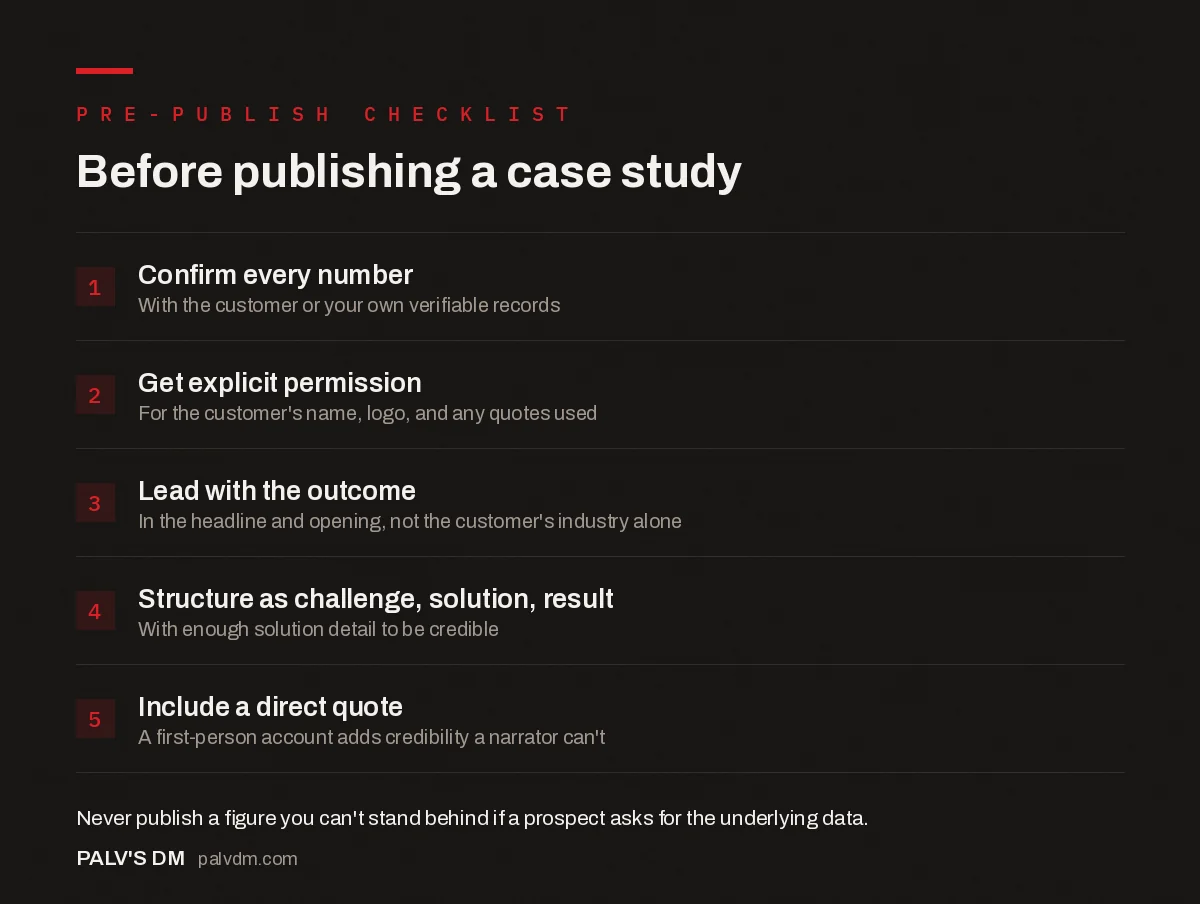
Before publishing a case study
- Confirm every number. With the customer or your own verifiable records.
- Get explicit permission. For the customer’s name, logo, and any quotes used.
- Lead with the outcome. In the headline and opening, not the customer’s industry alone.
- Structure as challenge, solution, result. With enough solution detail to be credible.
- Include a direct quote. A first-person account adds credibility a narrator can’t.
Where should case studies live, and does format matter?
A case study that only exists as a static PDF in a downloads folder gets far less exposure than one published as an indexable page, since the PDF version can’t be found through organic search and is harder to share as a link. Publishing the same story as a web page, with the option to also offer a PDF version for sales teams to send directly, covers both the SEO benefit and the sales-enablement use case. For B2B audiences increasingly starting research with AI tools, plain, well-structured language with clear headings also makes it easier for those tools to summarise the outcome accurately when someone asks about your company.
Frequently asked questions
How long should a case study be?
Most effective case studies run 800 to 1,500 words, long enough to cover challenge, solution, and result with real specificity, short enough that a busy prospect can read the whole thing in one sitting. Highly technical case studies for a specialist audience can run longer if the reader genuinely needs that depth to evaluate the approach.
Should a case study include negative details, like setbacks?
Including a brief, honest account of an initial approach that needed adjusting, or a genuine early challenge, tends to make the eventual result more credible rather than less. A case study that reads as an unbroken success story from day one can trigger skepticism in a reader who has run their own projects and knows things rarely go that smoothly.
Is it acceptable to anonymise a case study if a client won’t allow their name to be used?
Yes, and it’s common practice, particularly in industries with confidentiality concerns. An anonymised case study (“a mid-sized D2C brand in the fashion category”) still works if the specifics of the challenge, solution, and result are detailed enough to be credible, even without a named company attached.
How often should case studies be updated or refreshed?
If the results are still current and the client relationship is ongoing, a case study can stay live for years without changes. If the client has since changed direction, the product referenced has evolved significantly, or the numbers are old enough to feel dated, either update it with current figures (confirmed with the client) or retire it rather than leaving a stale result implying it’s still representative.
Writing proof that actually persuades
A converting case study isn’t about polish, it’s about specificity: a real number with a baseline and a timeframe, a solution section detailed enough to be credible, and a quote in the customer’s own words wherever one exists. Vague praise convinces nobody who’s already skeptical, which describes most B2B buyers doing real research. If you need help turning client results into case studies that hold up under scrutiny, our content writing service handles the interview, structure, and verification process end to end.
This post is part of our writing craft series. For the broader question of how different post types should be structured, see blog post structures that work, by intent type. If you’re building proof content more broadly, our content strategy guide covers where case studies fit into a wider content plan, and our post on writing a comparison post without being dishonest covers a related discipline: making a persuasive case without overstating it.