
When Two Pages Ranking for One Term Is Actually Fine
Cannibalization tools flag any two URLs sharing a query, but a shared query isn't automatically a problem. The myths that cause needless page merges, and the actual test for whether it's hurting you.

Two pages ranking for the same term is only a problem when they’re competing for the same intent and neither one can win outright — if they answer different sub-questions behind a shared keyword, both can rank at once without hurting each other. Most cannibalization tools can’t tell the difference. They flag any query with more than one ranking URL, which turns a huge number of harmless overlaps into a to-do list of unnecessary merges.
The myth-busting here matters because merging or pruning the wrong pages destroys real traffic. A page that answers “how does X work” and a page that answers “X vs Y” can both legitimately rank for a shared head term. Collapsing them into one document to satisfy a cannibalization report often loses the audience that wanted the narrower answer.
Myth: any keyword with two ranking URLs is cannibalization
The claim: a cannibalization audit tool reports every query where more than one page from your site appears in the results, and treats each one as an issue needing a fix.
The reality: Google’s own explanation of how it filters similar content says that when multiple documents contain the same information, only the most relevant is generally shown — implying Google already handles true duplication on its own. A tool flagging two URLs for one query is reporting overlap, not damage. Damage requires the two pages to be fighting for the identical intent and dragging each other down; overlap without competition is just two pages that happen to share a word.
Why the confusion happens: cannibalization tools work off Search Console query data, matching queries to multiple ranking pages mechanically. They have no way to evaluate whether the two pages serve different sub-intents, so every shared query gets the same red flag regardless of whether it’s a real conflict or two pages doing their jobs.
Myth: cannibalization always caps both pages at a lower position
The claim: when two pages compete for one keyword, both get stuck lower than either would rank alone, because Google is confused about which one to favour.
The reality: this is true in the specific case where both pages target the exact same intent with near-identical content. It’s false as a general rule. A pillar guide and a narrow how-to post can both rank reasonably for an overlapping term because Google is matching each page to a different variant of the underlying query, not splitting one ranking in half. Check the Performance report filtered by query with the Pages breakdown before assuming a cap exists — if both pages hold stable, reasonable positions and combined clicks aren’t declining, there’s no cap to fix.
Myth: the fix is always to merge the pages into one
The claim: whenever cannibalization shows up, the correct move is combining both pages into a single, more comprehensive URL and redirecting the loser.
The reality: merging is the right fix only when both pages target the same intent and audience and neither serves a purpose the other doesn’t. When the two pages serve different funnel stages — a comparison page for someone still evaluating options, a how-to page for someone who already decided — merging strips out the version at least one of those audiences actually wanted. The better fix in that case is differentiating the pages further: sharpening each title, intro, and H1 so the intent match is unambiguous to both users and Google.
| Situation | Likely fix | Why |
|---|---|---|
| Two pages, identical intent, both rank low, swap weekly | Merge into one page, 301 the weaker URL | Signals split across near-duplicate content; consolidating usually lifts the combined page above either original |
| Two pages, different sub-intents, both hold stable positions | Leave separate, sharpen differentiation | Each page serves a real, distinct query variant — merging would remove a version some searchers need |
| Old and new version of the same article, both indexed | Redirect old to new, or canonicalise | True duplication with no intent difference; one URL should represent the content going forward |
| Category page and a blog post both ranking for a broad term | Usually leave separate | Commercial and informational intent commonly coexist for the same broad keyword without conflict |
Myth: falling rankings on a shared keyword always means cannibalization
The claim: if a page’s ranking for a term drops right after a second page targeting something similar gets published, the new page must be cannibalizing the old one.
The reality: the timing is suggestive, not proof. Algorithm updates, seasonal query volume shifts, a competitor’s new page, or a technical issue on the original page can all produce the same symptom at the same time a second page happens to launch. Before treating it as cannibalization, isolate the variable: check whether the new page is actually ranking for the exact same query the old page lost, using the query-and-page breakdown in Search Console, rather than assuming correlation from publish dates alone.
How do you actually test whether cannibalization is hurting a query?
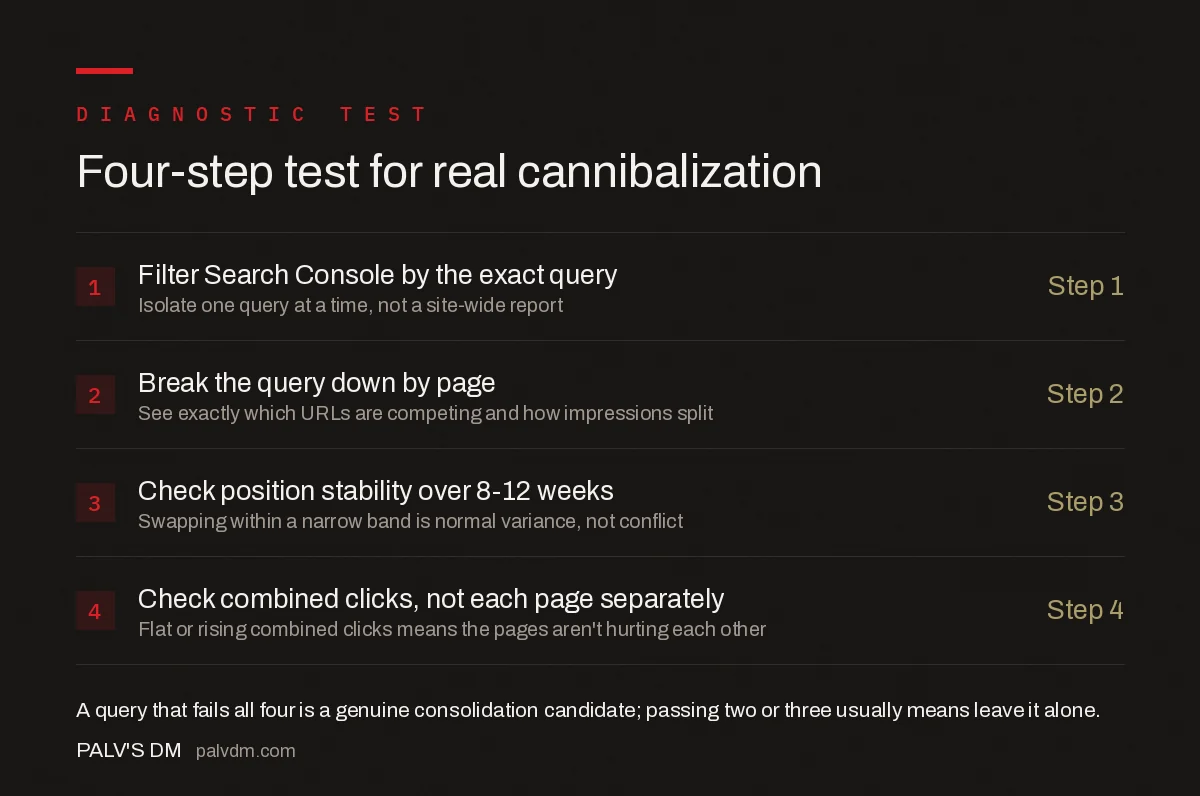
Four-step test for real cannibalization
- Filter Search Console by the exact query — Isolate one query at a time; site-wide cannibalization reports blur the distinction between real conflicts and harmless overlap.
- Break the query down by page — See exactly which URLs are competing and how their impressions split.
- Check position stability over 8-12 weeks — Positions swapping within a narrow, reasonable band is normal variance, not conflict.
- Check combined clicks, not each page separately — If total clicks to the query are flat or rising, the pages aren’t dragging each other down even if individually neither dominates.
A query that fails all four checks — impressions split, positions both weak, no stability, combined clicks declining — is a genuine candidate for consolidation. A query that passes even two or three of them usually isn’t worth touching, and the time is better spent on fixing duplicate title tags and metas across the site, which causes more measurable harm than borderline keyword overlap.
When does cannibalization genuinely need fixing?
Real cannibalization shows up as two pages targeting an identical query with an identical intent, where the content is similar enough that Google itself seems unsure which to favour — visible as positions swapping unpredictably and neither page settling into a stable rank. In that case, deciding which URL survives a merge comes down to which page has more backlinks, more historical traffic, and the stronger existing title and structure, then redirecting the other into it rather than leaving both live to keep splitting the same signals.
Frequently asked questions
Is keyword cannibalization always bad for SEO?
No. Two pages sharing a query only hurts you if they’re competing for the exact same intent and splitting authority that would otherwise concentrate on one page. If they answer different sub-intents behind the same query, both can rank without either one holding the other back.
How do I tell if cannibalization is actually hurting a query?
Check Search Console’s Performance report filtered to that query with Pages as the breakdown. If impressions are split but total clicks and average position are stable or improving over time, it’s not hurting you. A real problem shows both pages ranking low and swapping positions week to week.
Does Google penalize sites for keyword cannibalization?
There’s no cannibalization penalty. What happens instead is dilution: ranking signals like links and relevance split across pages instead of consolidating on one, which can leave both pages weaker than a single well-built page would be. That’s a competitive disadvantage, not a punitive action.
Should I merge every pair of pages that rank for the same keyword?
No. Merge pages that genuinely target the same intent and audience. Keep pages separate when they serve different funnel stages, different sub-questions, or different formats — a comparison page and a how-to page can legitimately share a head term without needing to become one document.
Can position swapping between two pages be a good sign?
It can be neutral rather than harmful if both pages sit in a similar, reasonable position band and total traffic to the query holds steady. It becomes a signal worth acting on only when the swap coincides with declining impressions or clicks for the query overall.
Sources
- How to Specify a Canonical with rel=”canonical” and Other Methods — Google Search Central
- On-Page SEO Checklist: The Complete Guide
- Duplicate Title Tags and Metas Across a Large Site
- Detecting Cannibalisation in Search Console Data
- Deciding Which URL Survives a Merge
Want this done on your site?
Every PalV’s DM engagement starts with a free audit of your actual website — a 12-point
crawl covering what is blocking indexation, on-page gaps against your primary keywords, speed
findings, and the three to five fixes worth making first. Delivered in two working days. No
payment details, and the findings are yours whether you hire us or not.